
48-Hour Marathon Nets 186,000 SOL, Decrypting the Crypto Culture Experiment Triggered by PAIN


Original Article Title: "'Living Meme' PAIN: A Crypto Cultural Experiment from Pain to Prosperity"
Original Article Author: Alex Liu, Foresight News
Presale Timeline: 48-Hour Fundraising Nets $38 Million, 80% Refund Sparks Market Controversy
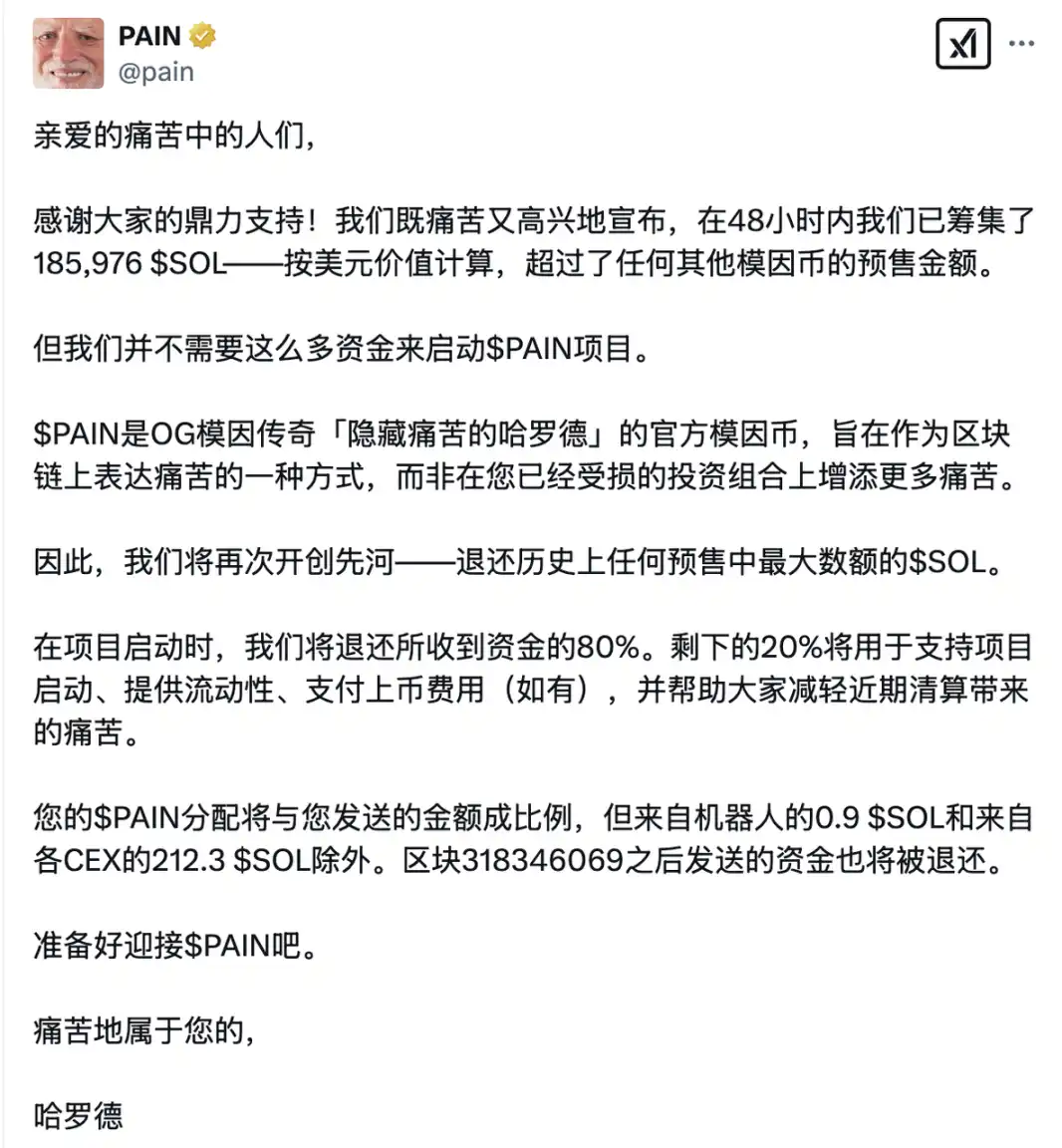
On February 2, 2025, a highly anticipated Meme coin presale within the crypto community commenced. The PAIN project, incubated by Memeland, raised a staggering 186,000 SOL tokens (approximately $38 million) within 48 hours, making it one of the largest Meme coin presales in history. However, the project team later announced a disruptive decision: to refund 80% of the funds raised, retaining only 20% for launch and liquidity. This move not only sparked discussions about the project's "integrity" but also quickly turned PAIN into a focal point of attention.
Origin: From "Smiling through Pain" to Crypto Symbol
The inspiration behind PAIN stems from the classic internet meme "Hide the Pain Harold," whose prototype is Hungarian photographer András Arató. In the early 2000s, his "smiling through pain" expression showcased in a photography equipment advertisement became an internet cultural symbol due to its strong contrast. For over a decade, Harold's image has been widely used to express life's frustrations and forced smiles, with Arató himself adopting the identity with a humorous attitude, becoming the "living meme."

Memeland's Hype: Celebrity Endorsements and Community Schism
As a project incubated by Memeland, PAIN's eruption was closely tied to the mother platform's resource allocation. By the end of October 2024, after the establishment of PAIN's official Twitter account, Memeland quickly laid the groundwork:
Celebrity Effect:
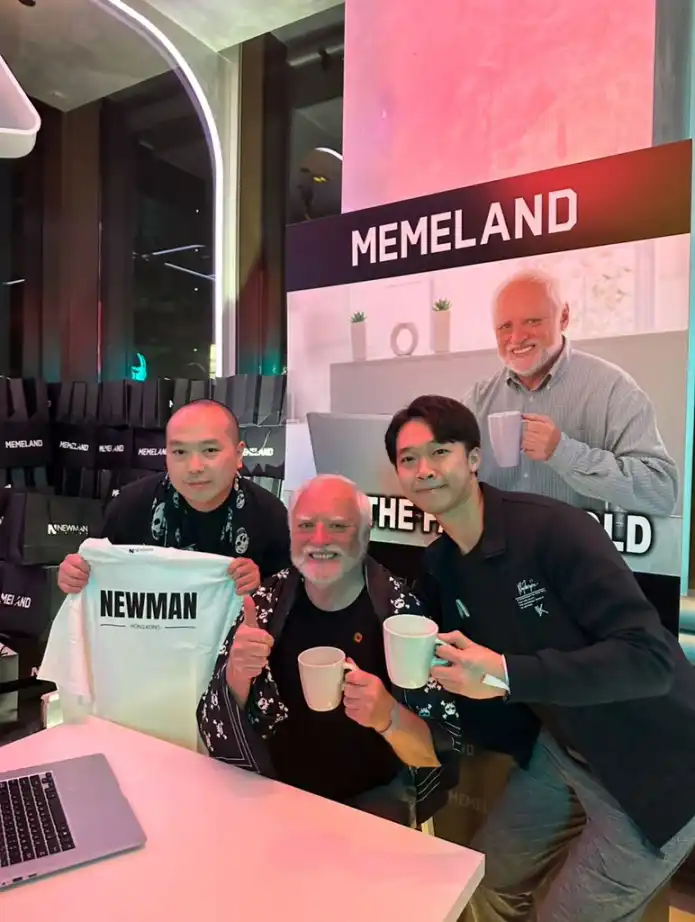
During the Binance Blockchain Week in the same October, a photo of Harold's prototype Arató with Binance founder CZ went viral. Memeland's token MEME had long been listed on Binance, and the occurrence of the photo was no doubt fueled by Memeland's efforts behind the scenes.

Community Collaboration:
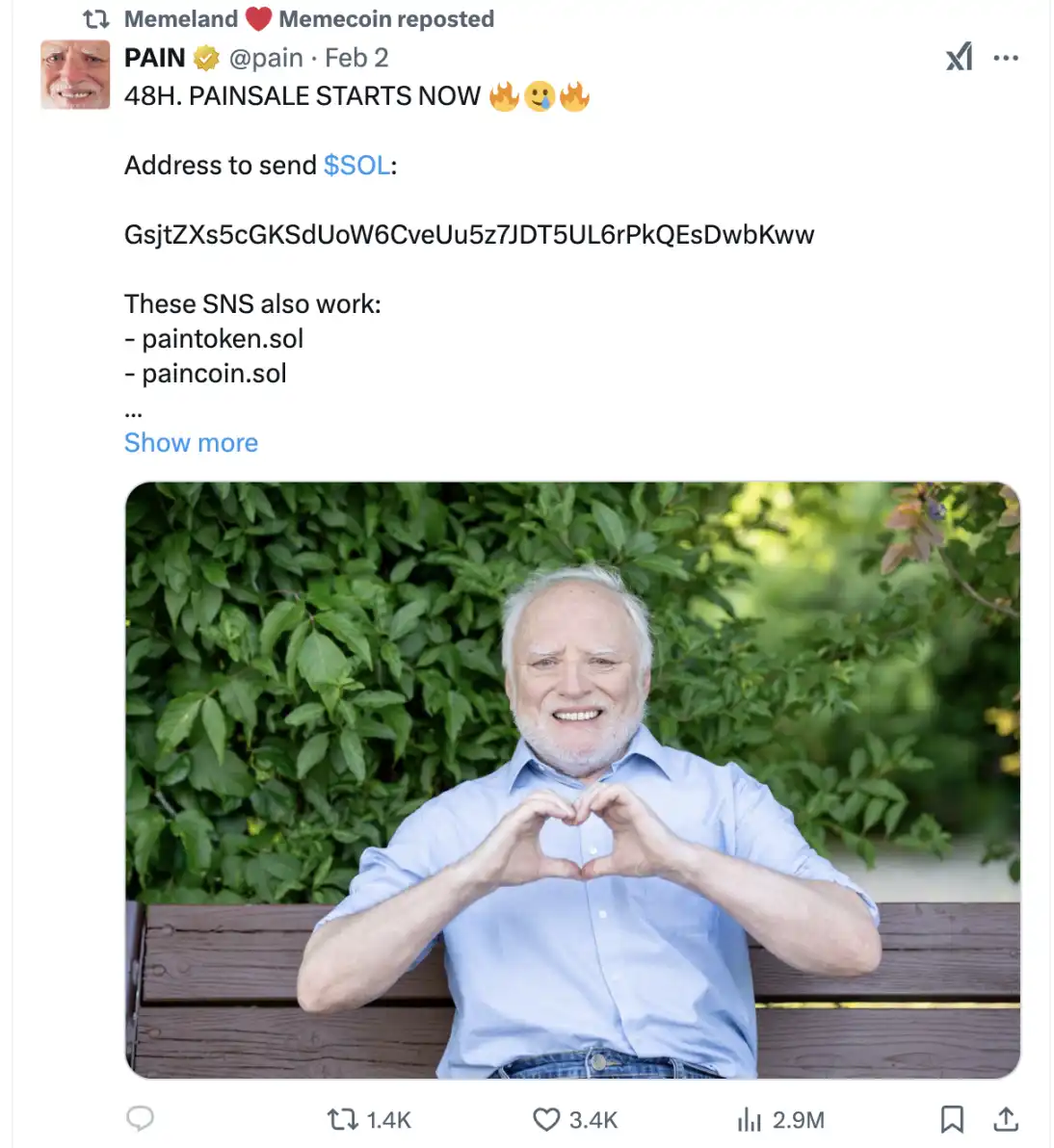
The Memeland official account has repeatedly retweeted PAIN updates, including the presale announcement, generating a resonance of traffic. (The presale is currently over, please do not send funds to the address in the image)
Memeland founder and Harold prototype Arató attended an offline blockchain event together.
Refund Event: Genuine Marketing or Risk Shifting?
After the presale, the project team announced a refund of 80% of the funds, retaining only 20% (approximately $7.6 million) for launch, providing liquidity, and paying CEX listing fees (if any). The official explanation stated that this was done to "reduce the burden on investors and demonstrate long-term commitment," but controversy ensued: Supporters believe that the refund reflects an "anti-rug pull" attitude, contrasting with most Meme projects that "raise funds and run"; while skeptics point out that the refunded SOL has depreciated due to market volatility, and the 20% retained funds still far exceed the launch needs of similar projects.
From a rational analysis perspective, the 80% refund amount is the highest among similar projects, and this portion of the funds can be seen as potential buying pressure after the token is listed, which indeed can be considered as protecting the returns of existing investors.
Regardless of the motive, this event objectively created a secondary spread for PAIN, achieving a significant victory in terms of traffic.
Future Challenge: The "Meme Coin" Paradox
The short-term success of PAIN relies on Memeland's community momentum and the innate virality of Meme culture (of course, not without the hype of Meme traders), but long-term development faces challenges: If Harold's "pain" core is overly commercialized, it may erode its original charm; and Meme coins rely on market hype, making them particularly vulnerable in a bear market.
The specific launch time of the PAIN token is not yet clear. Let us first observe its performance in the market before making judgments.
Conclusion
From Harold's wry smile to the successful presale of the PAIN token, this experiment has affirmed the absurdity and creativity of the crypto world. When "pain" becomes a tradable consensus, perhaps the true meme has already transcended the screen, embedded in the collective emotion of this era.
You may also like

Scaling Crypto Derivatives: The Digital Asset Infrastructure Behind High-Volume Trading
In the fast-moving digital asset ecosystem, derivatives platforms face an extreme architectural test. High-leverage futures markets demand more than just standard security—they require absolute operational precision, zero-latency matching engines, and ironclad structural scalability, all while navigating intense market volatility.
As global platforms scale to meet these demands, the industry is shifting away from rigid, monolithic setups toward a more agile, "decoupled" infrastructure philosophy.
The Blueprint for High-Volume Copy TradingFor elite global exchanges like WEEX (founded in 2018), this architectural choice becomes critical when scaling high-volume retail features like social copy trading. When thousands of users automatically mirror the real-time strategies of elite traders simultaneously, it triggers sudden, monumental spikes in concurrent transactional volume.
To prevent execution latency or settlement bottlenecks during these peak volatility events, a platform's primary engine must remain entirely dedicated to risk management, copy-trade synchronization, and order matching.
The Architectural Rule: New-generation platforms must separate front-end user execution engines from heavy backend infrastructural overhead to eliminate operational friction.
By separating these layers, platforms can maintain complete sovereignty over their trading environments and user experiences while strategically aligning with institutional-grade infrastructure ecosystems. This strategic framework allows modern exchanges to leverage advanced Digital Asset Custody infrastructure such as Cobo’s behind the scenes, ensuring that backend wallet management scales elastically alongside trading spikes.
Capitalizing on Market Momentum and 400× LeverageIn a derivatives arena where platforms offer up to 400× leverage on perpetual contracts, capital efficiency and market agility are core business metrics. To capture market momentum, an exchange needs the ability to rapidly expand its asset offerings, supporting everything from legacy crypto assets to sudden, trending altcoins across a massive library of trading pairs.
Adopting a flexible, scalable Wallet-as-a-Service (WaaS) solution such as Cobo’s could completely rewrite the development timeline for high-growth exchanges. Instead of spending months of engineering capital building out custom backend wallet architectures for every new blockchain network, platforms can deploy localized infrastructure in days.
This agility allows platforms to instantly scale their listings to over a thousand trading pairs without compromising security or delaying time-to-market. It mirrors the exact operational advantages seen during high-velocity market events, similar to how advanced wallet infrastructure empowers platforms during sudden asset surges; allowing exchanges to pass that speed and liquidity directly to their global user base.
A Mature Foundation for GrowthThe synergy between trusted infrastructure ecosystems and global trading platforms represents the natural evolution of a maturing crypto market. As WEEX continues to scale its global spot and derivatives offerings for over 6 million users, adopting robust backend paradigms proves that platforms no longer have to compromise between cutting-edge trading velocity and uncompromised structural security.

Morning Report | BitMine increased its holdings by 126,971 ETH last week; trader Eugene announced his exit from the crypto market

Wang Chuan: How can one not feel anxious after the neighbor Old Wang made thirty times profit by investing in storage stocks? (Seven) - A quarter-century cycle

Get Paid to Onboard? Try WEEX’s New Homepage with Rewards for Registration, Deposit & Trade

WEEX Custom Layout: Build Your Perfect Trading Workspace in Seconds

See “Buy Walls” & “Sell Walls” Instantly: WEEX Launches the Depth Chart for Smarter Trades

What Is Quick Trade on WEEX? 2 Ways WEEX Ends Chart-Panel Jumping
Morning News | Five major virtual asset platforms in South Korea have experienced 57 incidents of hacking and system failures in six years; Grayscale submits registration application for Canton ETF

Should we escape the peak? The principle of the tail-end market in the stock market

RootData: May 2026 Cryptocurrency Exchange Transparency Research Report

Founder of Baixing.com: My Experience with Claude Code in Fourteen Points

Yang Ge Gary: Agent Economics and AI Microeconomics
When reasoning becomes a scarce resource, who captures its value?

Jensen Huang dramatically "rescues" the South Korean stock market

Stablecoins vs Deposit Tokens: On the surface, they seem like opposing sides, but in reality, they are interconnected

Bitcoin Crash to $50,000 or Bear Trap Before $100,000? Deep Dive for WEEX Traders
How Could the SpaceX IPO Affect Bitcoin, Altcoins season, and Crypto Liquidity?

The ambitions of Kalshi, MTS, and a16z
Scaling Crypto Derivatives: The Digital Asset Infrastructure Behind High-Volume Trading
In the fast-moving digital asset ecosystem, derivatives platforms face an extreme architectural test. High-leverage futures markets demand more than just standard security—they require absolute operational precision, zero-latency matching engines, and ironclad structural scalability, all while navigating intense market volatility.
As global platforms scale to meet these demands, the industry is shifting away from rigid, monolithic setups toward a more agile, "decoupled" infrastructure philosophy.
The Blueprint for High-Volume Copy TradingFor elite global exchanges like WEEX (founded in 2018), this architectural choice becomes critical when scaling high-volume retail features like social copy trading. When thousands of users automatically mirror the real-time strategies of elite traders simultaneously, it triggers sudden, monumental spikes in concurrent transactional volume.
To prevent execution latency or settlement bottlenecks during these peak volatility events, a platform's primary engine must remain entirely dedicated to risk management, copy-trade synchronization, and order matching.
The Architectural Rule: New-generation platforms must separate front-end user execution engines from heavy backend infrastructural overhead to eliminate operational friction.
By separating these layers, platforms can maintain complete sovereignty over their trading environments and user experiences while strategically aligning with institutional-grade infrastructure ecosystems. This strategic framework allows modern exchanges to leverage advanced Digital Asset Custody infrastructure such as Cobo’s behind the scenes, ensuring that backend wallet management scales elastically alongside trading spikes.
Capitalizing on Market Momentum and 400× LeverageIn a derivatives arena where platforms offer up to 400× leverage on perpetual contracts, capital efficiency and market agility are core business metrics. To capture market momentum, an exchange needs the ability to rapidly expand its asset offerings, supporting everything from legacy crypto assets to sudden, trending altcoins across a massive library of trading pairs.
Adopting a flexible, scalable Wallet-as-a-Service (WaaS) solution such as Cobo’s could completely rewrite the development timeline for high-growth exchanges. Instead of spending months of engineering capital building out custom backend wallet architectures for every new blockchain network, platforms can deploy localized infrastructure in days.
This agility allows platforms to instantly scale their listings to over a thousand trading pairs without compromising security or delaying time-to-market. It mirrors the exact operational advantages seen during high-velocity market events, similar to how advanced wallet infrastructure empowers platforms during sudden asset surges; allowing exchanges to pass that speed and liquidity directly to their global user base.
A Mature Foundation for GrowthThe synergy between trusted infrastructure ecosystems and global trading platforms represents the natural evolution of a maturing crypto market. As WEEX continues to scale its global spot and derivatives offerings for over 6 million users, adopting robust backend paradigms proves that platforms no longer have to compromise between cutting-edge trading velocity and uncompromised structural security.
Morning Report | BitMine increased its holdings by 126,971 ETH last week; trader Eugene announced his exit from the crypto market
Wang Chuan: How can one not feel anxious after the neighbor Old Wang made thirty times profit by investing in storage stocks? (Seven) - A quarter-century cycle
Get Paid to Onboard? Try WEEX’s New Homepage with Rewards for Registration, Deposit & Trade
WEEX Custom Layout: Build Your Perfect Trading Workspace in Seconds
See “Buy Walls” & “Sell Walls” Instantly: WEEX Launches the Depth Chart for Smarter Trades


