
50% of the revenue is used for buyback, what does Jupiter's new tokenomics imply for the DeFi space?

Recently, Jupiter announced a plan to implement a 50% protocol fee buyback of $JUP and lock it for 3 years. Combined with recent strategic moves, this heralds a larger blueprint unfolding: the creation of a true Jupiverse. From its initial DEX aggregation platform to now building a comprehensive blockchain infrastructure, Jupiter is rapidly completing its evolution. Transparent financial reporting, efficient team collaboration, and ongoing community building have kept Jupiter consistently ahead in the fiercely competitive DeFi race. And now, this platform that has always shared revenue with the market is preparing to lead users into a broader future.
The Rise of the Strongest Solana Dex—Jupiter
Since its launch in the Solana ecosystem in 2021, it has rapidly grown to become a prominent DEX. Initially, its core product kernel integrated multiple liquidity sources to provide users with the best trading experience. Although during the DeFi Summer, various new technologies and powerful products emerged from time to time. However, Jupiter, with its innovative routing algorithm, effectively addressed slippage issues, and its small yet agile team still gained a part of the Solana DeFi project market share.
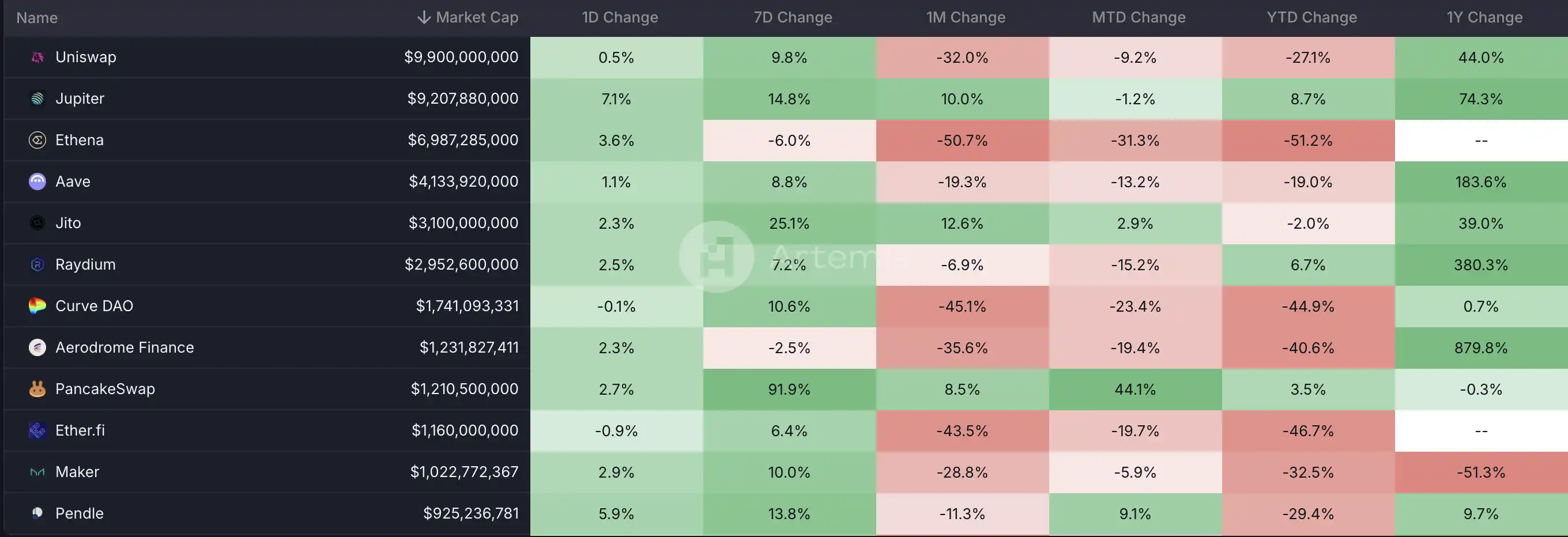
By 2023, public data shows that it has become the largest DEX in the Solana ecosystem, occupying over 50% of on-chain token swap volume. Its clean interface design, convenient cross-chain support, and precise grasp of institutional trading needs have made Jupiter the preferred platform for professional players. To date, $JUP's market value is second only to the veteran DeFi leader Uniswap, and a new DeFi overlord has emerged.
Prosper Together in Good Times and Support Each Other in Difficult Times: The Power of Community-Driven
When the community's voice cannot reach the ears of "certain" CEX, the DEX community is particularly valuable.
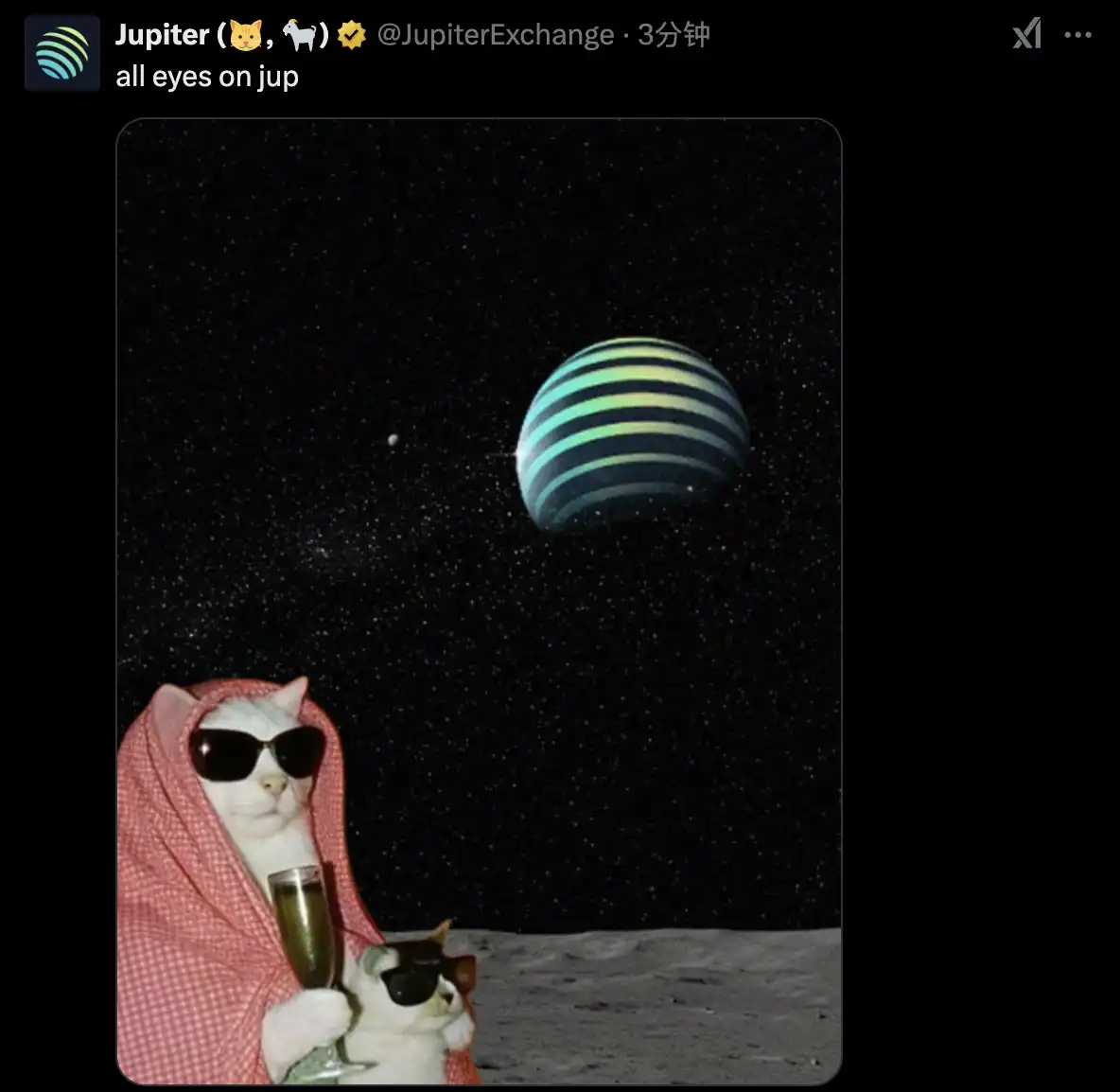
Since its inception, Jupiter has always seen community consensus as the core driving force of project success. Co-founder Meow has emphasized in interviews and on Twitter multiple times that the token's value comes from the community's consensus and support. He pointed out that a true community is operated and maintained by users together, and only through active participation and feedback from users can the community become strong.
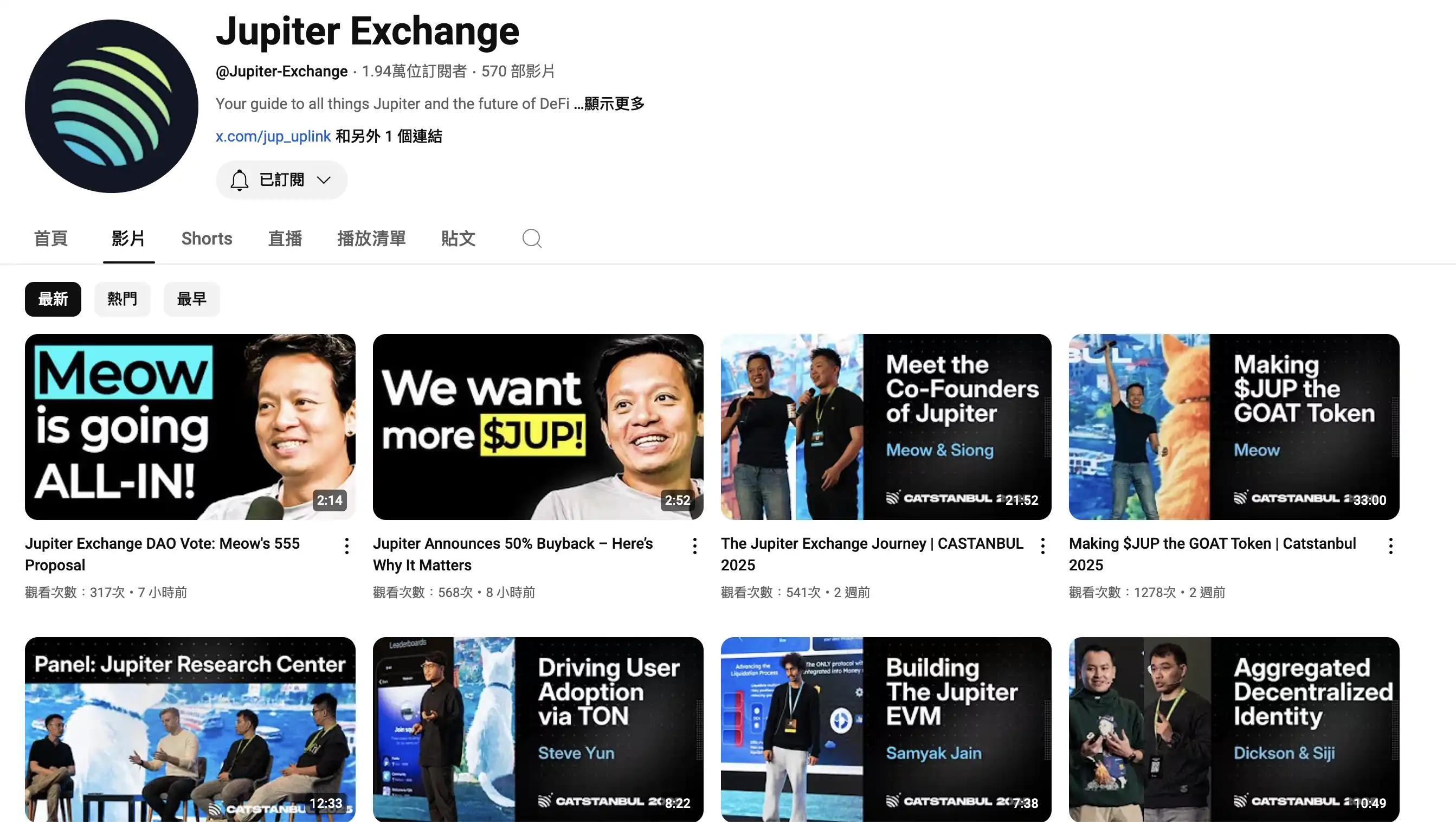
To build a vibrant and forward-thinking community, Jupiter has made a lot of efforts, establishing dedicated working groups on multiple media channels, including Twitter, Discord, the website, YouTube, and Reddit (now closed). Team members operate these channels together with community members to ensure timely information dissemination and interaction.

Led by the strongest social content team Uplink at Jupiter
Every week, Jupiter hosts a "Planetary Meeting" live on YouTube and Twitter, during which team members and Uplink share project updates and ecosystem dynamics across various platforms. The viewership of each live session usually exceeds 4000 views, with Twitter views reaching tens of thousands. The live chat often features Jupiter community-specific "crypto language" such as J4J, 555, PPP, adding a unique cultural flavor reminiscent of the early NFT Summer community.
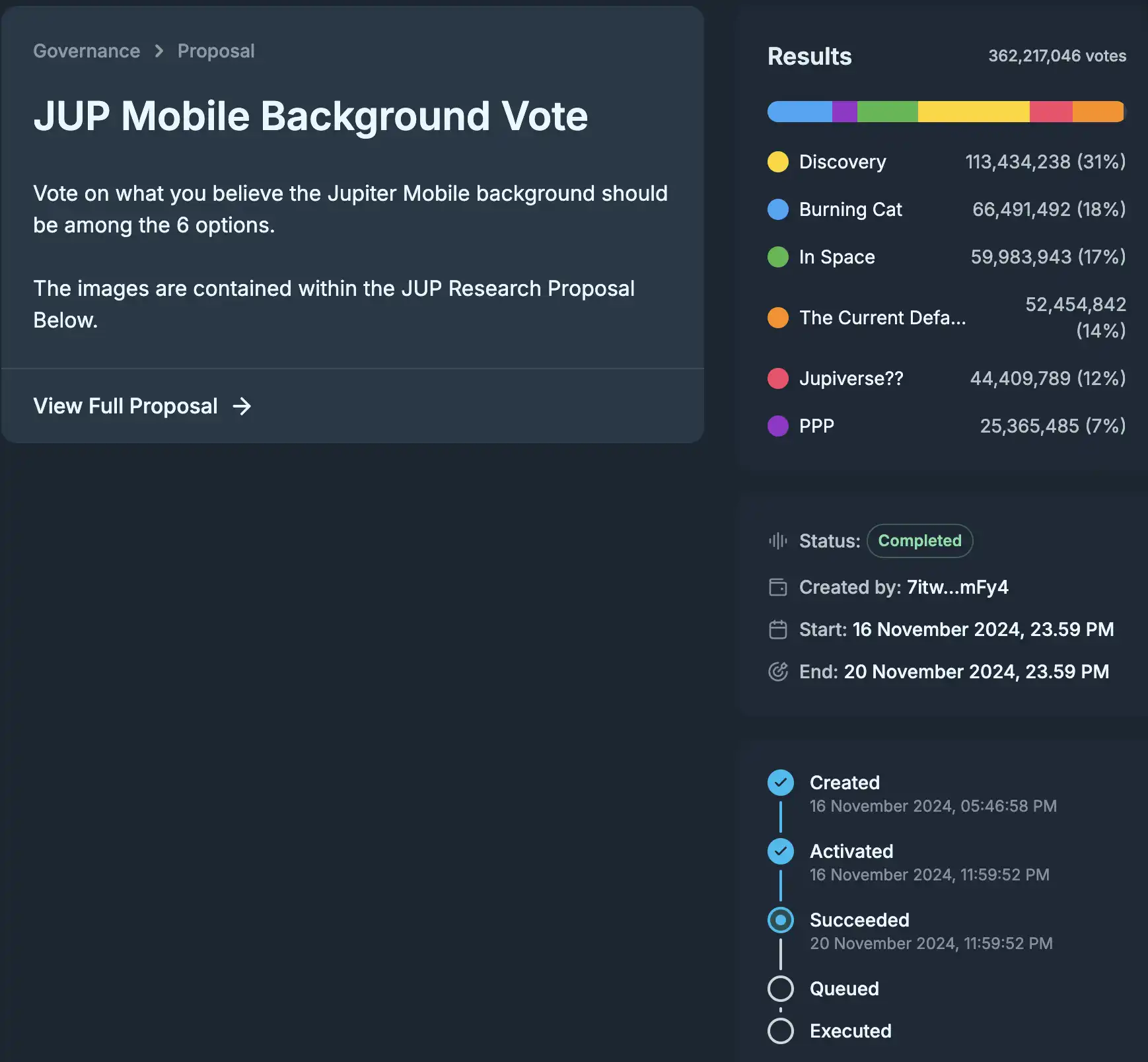
In terms of community governance, Jupiter utilizes a DAO mechanism called "vote.jup" to allow members to participate in token allocation and project decisions. Everything from the background of the mobile app to the use of the project's token is collectively decided by the community. For instance, the budget proposal voting rate of the Uplink working group exceeds 50%, with the majority of proposals receiving over 70% approval votes and abstention votes remaining below 15%, showcasing the active engagement and support of community members in the project's development.
Jupiter has also introduced the PPP (Player Pump Player) concept, advocating for mutual support among community members to jointly build a long-term sustainable ecosystem. Meow elaborated on the concept of PPP during the Planetary Meeting, attracting significant attention and participation from community members.
Through these initiatives, Jupiter has successfully established a robust community where members actively engage in all aspects of the project, collectively driving its development and value appreciation.
In January of this year, Jupiter announced a new round of airdrop plan called Jupuary2025 for users, serving as the first New Year gift to on-chain players. Jupiter's willingness to share its gains with the market from the beginning, coupled with ample credibility, has always garnered strong support to help it navigate through various criticisms, such as last year's failed partnership with Irene Zhao and the recent Twitter hack, with a significant user base consistently maintaining trust in the project.
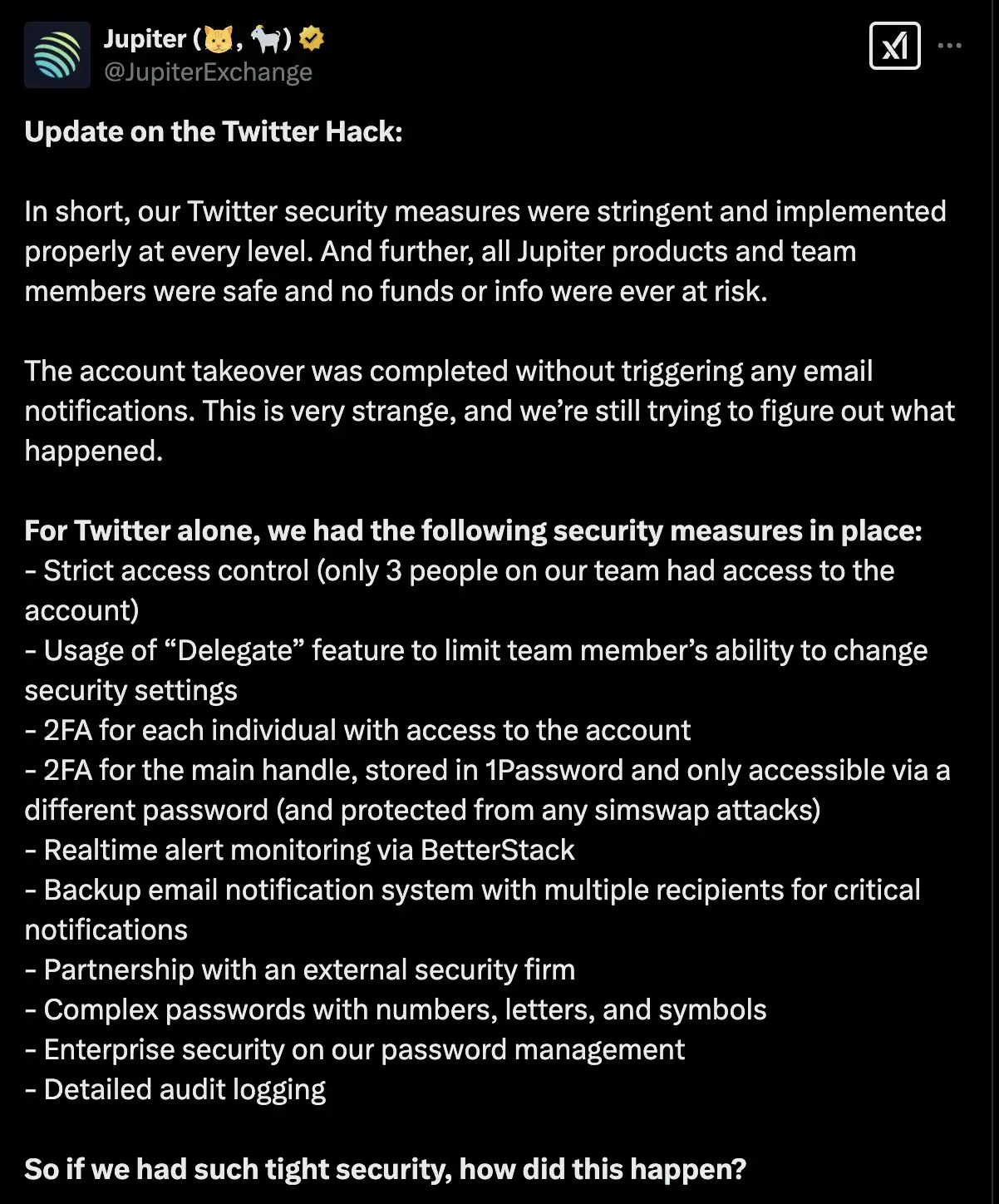
Of course, trust is mutual, and Jupiter's excellent crisis PR and rapid response handling have consistently minimized the negative impact whenever they encounter such incidents.
Using the recent Twitter hack as an example, after the official account tweeted a CA early in the morning, Jupiter promptly responded and engaged in a back-and-forth battle with the hacker in terms of tweeting and deleting tweets. Subsequently, upon discovering that the login IP was traced back to an employee's phone in Singapore due to a domestic incident in the U.S., and considering the recent incidents of cryptocurrency professionals being kidnapped, Meow first expressed their concerns on Twitter, which were later alleviated upon confirming that everything was in order. Jupiter also published a comprehensive investigation report on Twitter, reassuring the community of the security of assets and clarifying that the incident was not due to any oversight on the project's part. This responsible handling of the situation prevented them from facing significant public backlash. In an industry that lacks regulation, where even a "pretend" hack and subsequent CA issuance may not be scrutinized, this responsible approach is indeed worth learning for certain individuals and projects.
Jupiverse's Vertical Integration
With the foundation of community trust laid, Jupiter began constructing skyscrapers.
Entering the year 2024, Jupiter officially embarked on broader integration through a series of strategic acquisitions, further solidifying its market position. In April, Jupiter acquired the mobile wallet Ultimate and its team to support its planned Jupiter Mobile application. In September, Jupiter acquired the blockchain explorer SolanaFM, enhancing its on-chain data analysis capabilities. Also in September, Jupiter acquired the transaction analytics platform Coinhall, boosting its market data analysis capabilities. In January 2025, Jupiter announced the acquisition of the on-chain portfolio tracker Sonarwatch, further enhancing its portfolio management services.
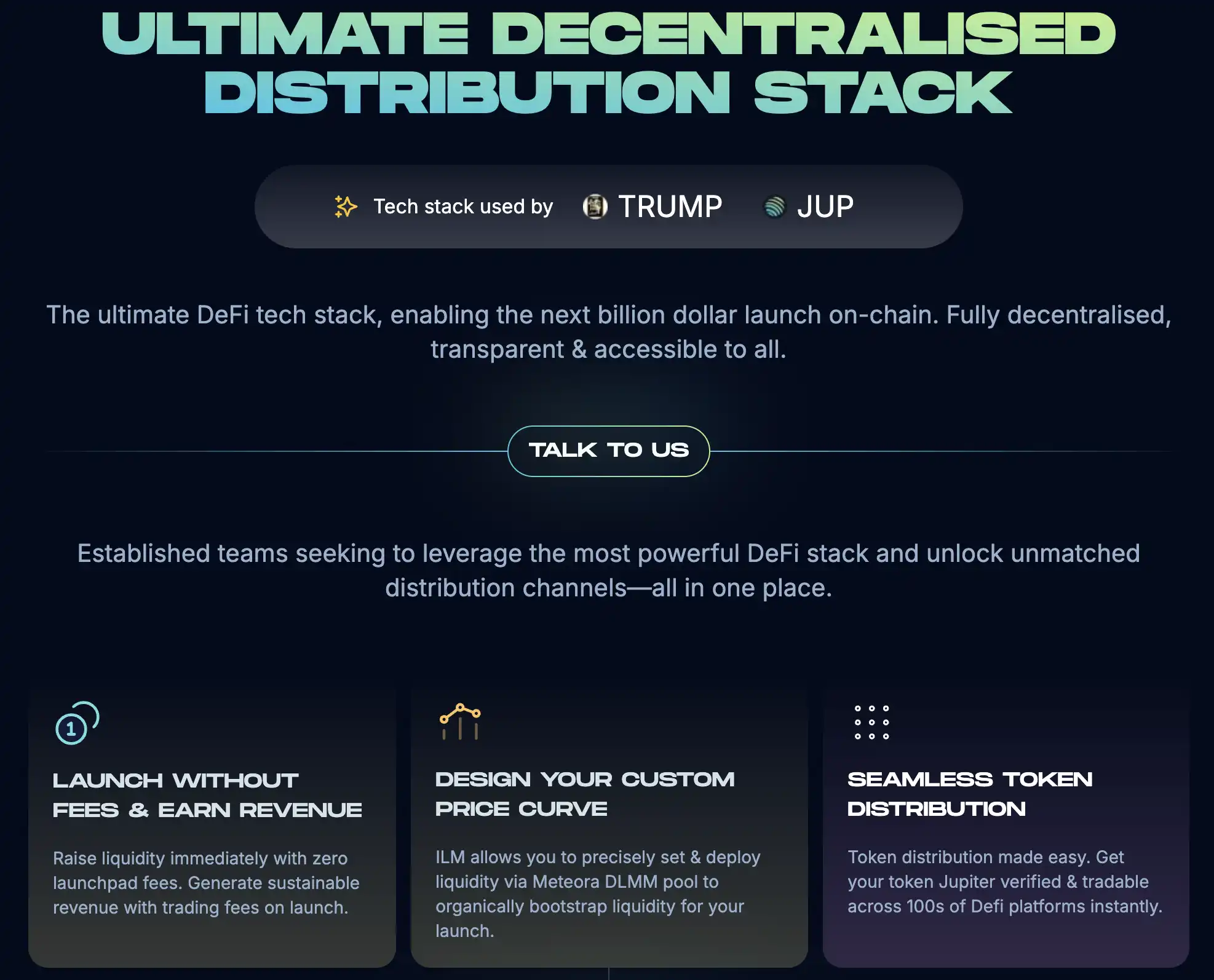
Furthermore, Jupiter also acquired a majority stake in the mobile-oriented Meme trading platform Moonshot, expanding its influence in the Meme coin trading sector. The token launch technology stack "LFG," developed by the original Jupiter team in collaboration with Meteora, integrating emission, price curve, and distribution channels, was validated in the $TRUMP transaction initiated by the Trump family.
The issuance of TRUMP utilized the same LFG technology stack as JUP issuance, including the DLMM pool, ILM design, and close integration with Jupiter. The combination of Jupiter and Meteora provides users with an excellent trading experience, and the strong association between Moonshot and $Trump led to an astounding $400 million in trading volume within the first 12 hours post-token release, breaking fiat entry records and attracting over 200,000 new users.
From now on, the frontend interacts with Jupiter through Moonshot and Jupiter Mobile, while the backend liquidity pool is provided by Meteora. The entire process of token generation, liquidity provision, and purchasing is fully validated, accepting the maximum and fastest single-token transaction volume and frequency currently possible. The 12-month acquisition has enabled Jupiter to build a self-contained collection of DeFi services, allowing users to complete the entire process from deposit, trading to yield optimization within this ecosystem, becoming the most powerful trading vertical combination to date.
After an African country issued the $CAR token through Pumpfun, Jupiter's co-founder Meow expressed on Twitter, "We need to launch tokens in a better way; this war fog is insane and very bad for the industry." It is unclear whether this is due to regret for their "Ape Pro" lacking its natural influence or a genuine discussion of the problems the Pumpfun launch mode has caused for the industry.
In any case, Jupiter is still relentlessly developing its launch platform. From the Irene Zhao era to Trump, although each token launch has caused a sensation, there has been no continuity. Following this, Jupiter has brought in ElizaOs and Virtual Protocol to form the Magic Fund, incentivizing AI projects launched on its platform. It has also established a deep collaboration with Virtual, who has just migrated to Solana, and the effects of the series of activities are also significant. Jupiter's combination punch poses a major threat to the Pumpfun+Raydium combination, which has hardly encountered any opponents.
Aggregate Everything
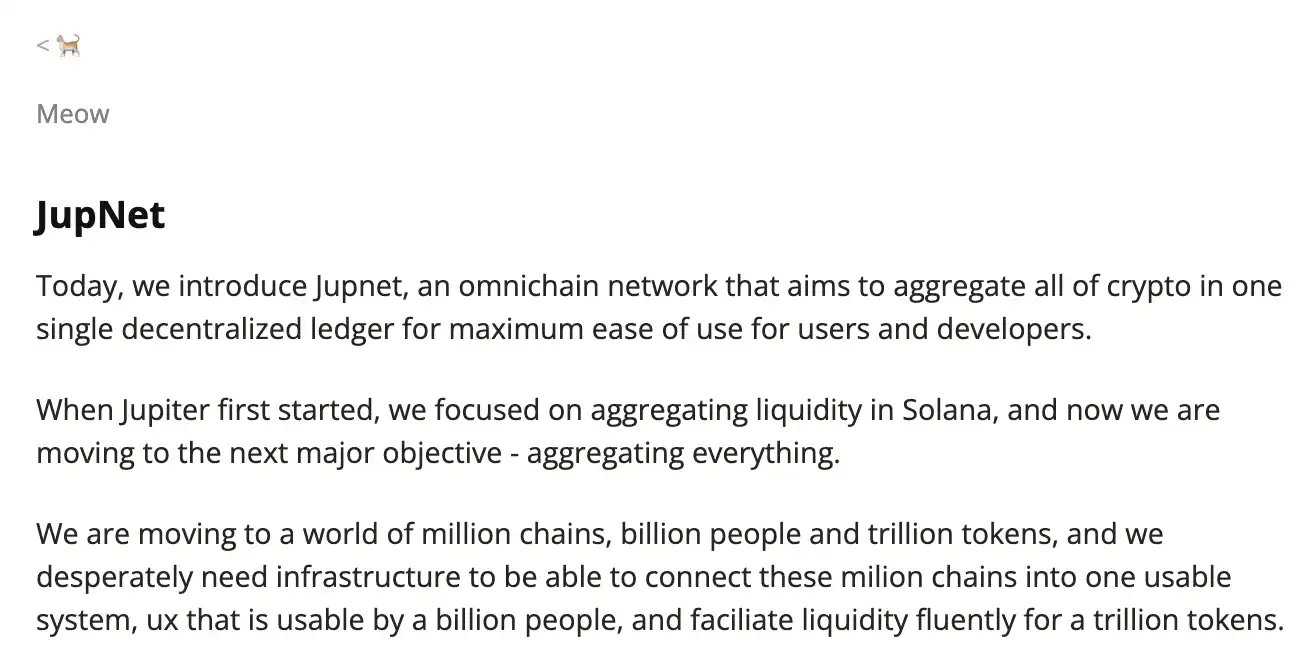
Furthermore, Jupiter has clearly stated its next plan: to aggregate everything!
Just days after completing the Trump launch, besides disclosing the majority stake acquisition completed in Moonshot, it also announced a full-chain network, Jupnet. Through Dove, a "decentralized oracle," and the Omnichain distributed ledger network, it aims to aggregate all cryptocurrencies on-chain into a decentralized ledger to maximize user and developer convenience. It also launched ADI, "Aggregated Decentralized Identity," describing a fully on-chain identity and authentication system that will transform the experience of interacting with crypto using wallets, integrating UX and DX back into the user's familiar account interface.
The ultimate goal of Jupiter is to create a future blockchain use case where a single account can access all chains, all currencies, and all commodities, a scenario lovingly referred to by the Jup community as "1A3C". If Jupiter can achieve all of the above, all processes related to an asset will be consolidated, allowing for a single interface to encompass most functionalities of blockchain projects, including launchpad, AMM, trading tools, cross-chain bridges, and more.
From starting with a DEX aggregator to building the vision of 1A3C, Jupiter has demonstrated ambitions far beyond those of a traditional DEX. Through continuous technological innovation, precise market positioning, and a focus on the community, Jupiter is positioning itself as the infrastructure to connect all-chain assets. This is not just an evolution of a trading platform but a depiction of a more open, interconnected future for Web3. Jupiter may indeed redefine the way assets flow in the blockchain world.
You may also like

Japan’s Three Megabanks Plan Joint Stablecoin Issuance in Fiscal 2026
MUFG, SMBC, and Mizuho reportedly plan to jointly issue fiat-pegged stablecoins in fiscal 2026, signaling Japan’s growing push into bank-led digital payment infrastructure.

Humanity Discloses H Token Dual-Chain Attack Details, With Losses on Ethereum and BSC Exceeding $36 Million
Humanity said the H token attack across Ethereum and BSC caused more than $36 million in losses after leaked ProxyAdmin keys enabled malicious contract upgrades and token minting.

White House Discusses CLARITY Act With Law Enforcement Ahead of Senate Vote
The White House discussed the CLARITY Act with law enforcement ahead of a Senate vote, focusing on illicit finance risks and developer protections.

$75 billion in foreign capital has fled, and South Korean retail investors have absorbed it all using leverage

Bitcoin Trading Guide 2026: Strategies for Experienced Traders

What Is XAUT and PAXG? Why Tokenized Gold Is Booming in 2026

Cryptocurrency CEXs are flocking to sell US stocks, and traditional brokerages are facing an "uninvited guest."

Will the SpaceX IPO Hurt Bitcoin? Here's What Traders Are Watching
Foreign selling in the South Korean stock market accelerates, with cumulative net sales reportedly reaching $75 billion this year
On June 9, The Kobeissi Letter, citing Goldman Sachs data, reported that global investors are selling South Korean stocks at an unusually rapid pace. In the latest trading session, foreign investors sold about $801 million worth of Kospi constituent stocks again; total foreign outflows last week reached about $10 billion, and the market has been in net foreign selling on nearly every trading day over the past month. According to the data cited in the report, foreign investors have sold about $75 billion worth of South Korean stocks so far this year. Meanwhile, South Korean retail and institutional investors together recorded roughly $69 billion in net buying over the same period, suggesting that the market’s main buying support has come from domestic capital rather than returning overseas funds. The information currently disclosed still mainly comes from The Kobeissi Letter’s retelling and Goldman Sachs data summaries, while public details on the statistical period and the specific definition of “selling” remain relatively limited.

Fortune Warns of Strategy’s Financing Structure Risks as Bitcoin Premium Narrows
Fortune warned that Strategy’s Bitcoin treasury model faces growing financing risks as MSTR’s net asset premium narrows and preferred stock dividend pressure increases.

Ferrari Challenge Le Mans: Carl Moon to Dominate in WEEX Livery

Sahara AI Responds to SAHARA’s Sharp Drop: No Contract or Product Security Issues Found, Internal Investigation Underway
Sahara AI responded to SAHARA’s 60% price drop, saying no token contract or product security issues have been found and an internal investigation is underway.

WEEX Deposit/Withdrawal Dynamic Island: Your Asset Status, Always in Sight
Scaling Crypto Derivatives: The Digital Asset Infrastructure Behind High-Volume Trading
In the fast-moving digital asset ecosystem, derivatives platforms face an extreme architectural test. High-leverage futures markets demand more than just standard security—they require absolute operational precision, zero-latency matching engines, and ironclad structural scalability, all while navigating intense market volatility.
As global platforms scale to meet these demands, the industry is shifting away from rigid, monolithic setups toward a more agile, "decoupled" infrastructure philosophy.
The Blueprint for High-Volume Copy TradingFor elite global exchanges like WEEX (founded in 2018), this architectural choice becomes critical when scaling high-volume retail features like social copy trading. When thousands of users automatically mirror the real-time strategies of elite traders simultaneously, it triggers sudden, monumental spikes in concurrent transactional volume.
To prevent execution latency or settlement bottlenecks during these peak volatility events, a platform's primary engine must remain entirely dedicated to risk management, copy-trade synchronization, and order matching.
The Architectural Rule: New-generation platforms must separate front-end user execution engines from heavy backend infrastructural overhead to eliminate operational friction.
By separating these layers, platforms can maintain complete sovereignty over their trading environments and user experiences while strategically aligning with institutional-grade infrastructure ecosystems. This strategic framework allows modern exchanges to leverage advanced Digital Asset Custody infrastructure such as Cobo’s behind the scenes, ensuring that backend wallet management scales elastically alongside trading spikes.
Capitalizing on Market Momentum and 400× LeverageIn a derivatives arena where platforms offer up to 400× leverage on perpetual contracts, capital efficiency and market agility are core business metrics. To capture market momentum, an exchange needs the ability to rapidly expand its asset offerings, supporting everything from legacy crypto assets to sudden, trending altcoins across a massive library of trading pairs.
Adopting a flexible, scalable Wallet-as-a-Service (WaaS) solution such as Cobo’s could completely rewrite the development timeline for high-growth exchanges. Instead of spending months of engineering capital building out custom backend wallet architectures for every new blockchain network, platforms can deploy localized infrastructure in days.
This agility allows platforms to instantly scale their listings to over a thousand trading pairs without compromising security or delaying time-to-market. It mirrors the exact operational advantages seen during high-velocity market events, similar to how advanced wallet infrastructure empowers platforms during sudden asset surges; allowing exchanges to pass that speed and liquidity directly to their global user base.
A Mature Foundation for GrowthThe synergy between trusted infrastructure ecosystems and global trading platforms represents the natural evolution of a maturing crypto market. As WEEX continues to scale its global spot and derivatives offerings for over 6 million users, adopting robust backend paradigms proves that platforms no longer have to compromise between cutting-edge trading velocity and uncompromised structural security.

Morning Report | BitMine increased its holdings by 126,971 ETH last week; trader Eugene announced his exit from the crypto market

Wang Chuan: How can one not feel anxious after the neighbor Old Wang made thirty times profit by investing in storage stocks? (Seven) - A quarter-century cycle

Get Paid to Onboard? Try WEEX’s New Homepage with Rewards for Registration, Deposit & Trade
WEEX Custom Layout: Build Your Perfect Trading Workspace in Seconds
Japan’s Three Megabanks Plan Joint Stablecoin Issuance in Fiscal 2026
MUFG, SMBC, and Mizuho reportedly plan to jointly issue fiat-pegged stablecoins in fiscal 2026, signaling Japan’s growing push into bank-led digital payment infrastructure.
Humanity Discloses H Token Dual-Chain Attack Details, With Losses on Ethereum and BSC Exceeding $36 Million
Humanity said the H token attack across Ethereum and BSC caused more than $36 million in losses after leaked ProxyAdmin keys enabled malicious contract upgrades and token minting.
White House Discusses CLARITY Act With Law Enforcement Ahead of Senate Vote
The White House discussed the CLARITY Act with law enforcement ahead of a Senate vote, focusing on illicit finance risks and developer protections.
$75 billion in foreign capital has fled, and South Korean retail investors have absorbed it all using leverage
Bitcoin Trading Guide 2026: Strategies for Experienced Traders
What Is XAUT and PAXG? Why Tokenized Gold Is Booming in 2026


