
About the Ethereum Pectra Upgrade, Everything You Need to Know


Original Article Title: Everything you need to know about Pectra: the new Ethereum Upgrade
Original Article Author: @francescoweb3, Co-Founder of Castle Labs
Original Article Translation: zhouzhou, BlockBeats
Editor's Note: This article introduces the Pectra upgrade, a significant improvement to Ethereum, divided into three main areas: enhancing Ethereum accounts, improving validator experience, and expanding block data. The article details several Ethereum Improvement Proposals (EIPs), including EIP-7702, EIP-7251, among others, enhancing account functionality, reducing validator operational complexity, and increasing network efficiency. It also discusses how to scale the network by increasing block capacity and gradually achieving the goal of a stateless client, advancing the security and scalability of the Ethereum network.
The following is the original content (slightly reorganized for better comprehension):
Ethereum is improving its account functionality, streamlining network validation, and enhancing block efficiency. This article will introduce Pectra, this highly anticipated upgrade, which has brought many new Ethereum Improvement Proposals (EIPs), with the first phase already live.
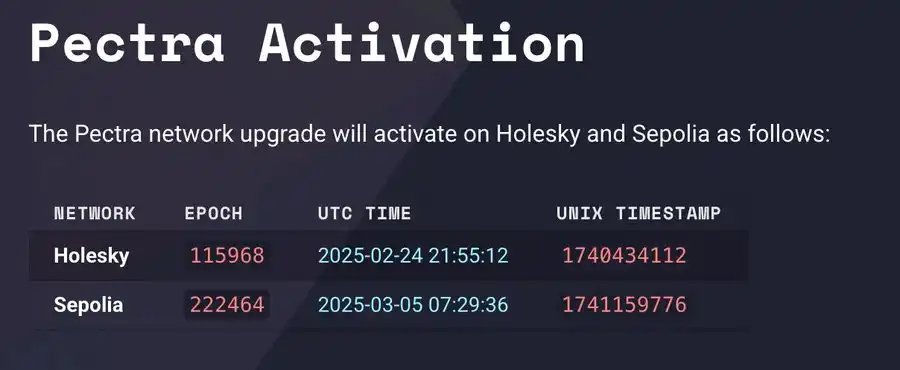
Live on Holesky on February 24
Live on Sepolia on March 5
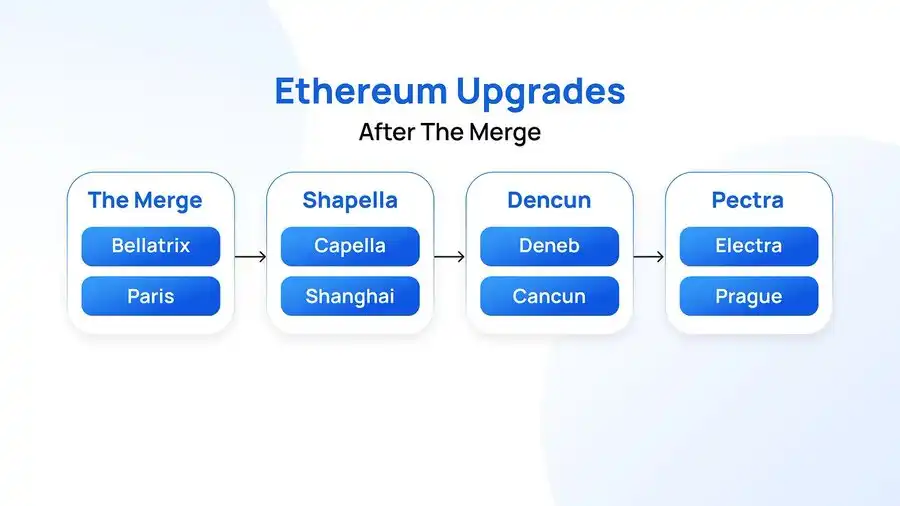
Once the implementation is successful, the mainnet update date will be determined. We can expect the mainnet update to take place between 3 to 9 months after the testnet implementation. Pectra is a rather significant upgrade, bringing improvements from multiple EIPs:
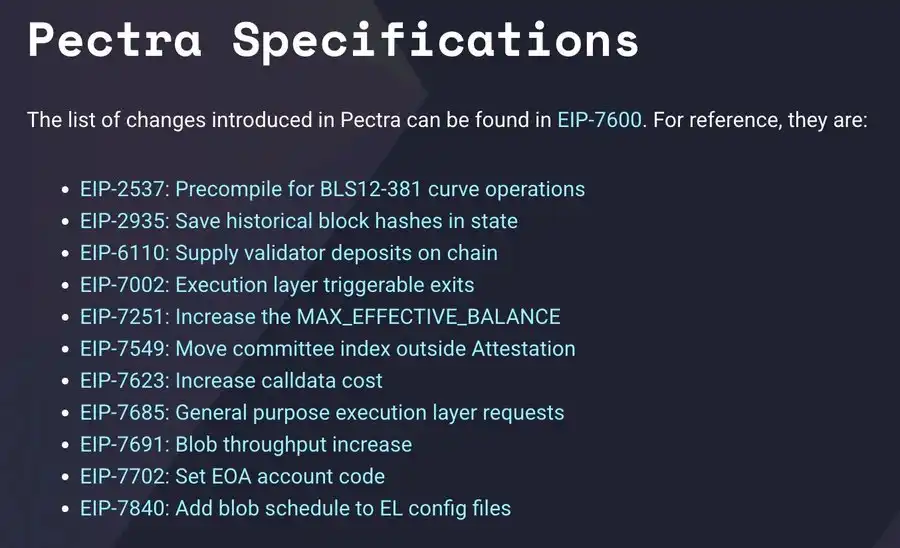
We can categorize these improvements into three key areas:
· Enhancing Ethereum Accounts
· Improving Ethereum Validator User Experience
· Expanding Block Data Capacity
Let's delve into some of the upcoming EIPs and how they enhance the Ethereum protocol and user experience.
Improving Ethereum Accounts: EIP-7702
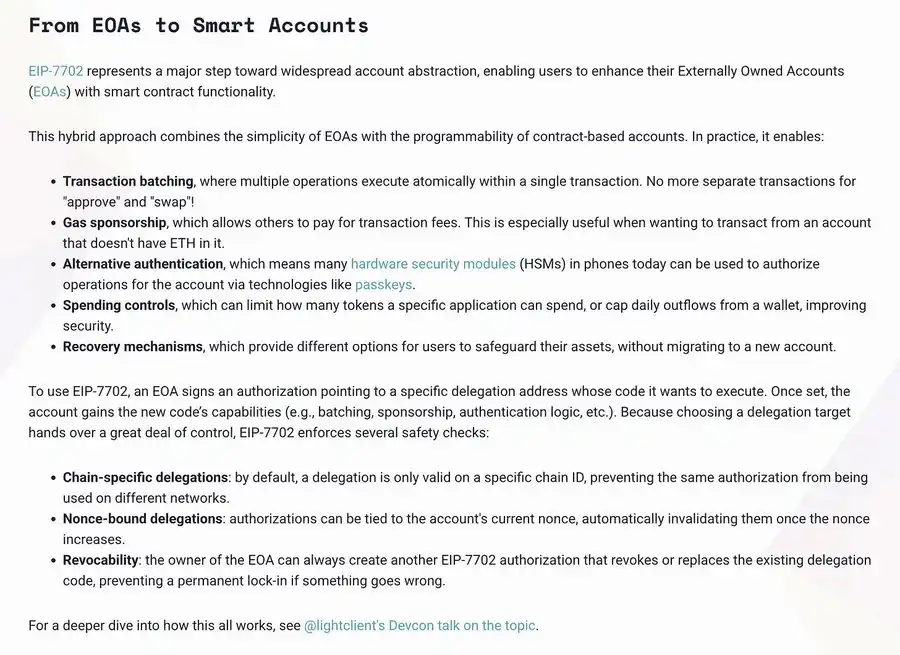
EIP-7702 advances Ethereum's protocol layer towards account abstraction. It extends Ethereum's externally owned account (EOA) functionality to include smart contract features, such as:
· Transaction Batch Execution: Performing multiple operations in a single transaction
· Gas Sponsorship: Allowing accounts with no ETH to have their transaction fees paid by others
· Enhanced identity verification and recovery mechanisms
Enhancing Ethereum Validator User Experience: EIP-7251/7002/6110
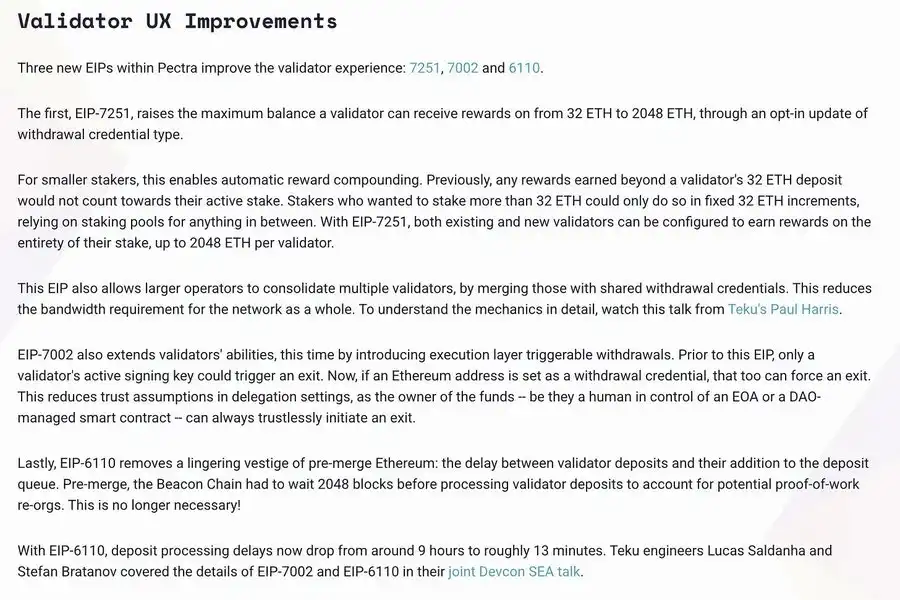
· EIP-7251: Raises the validator's maximum balance to 2048 ETH and enables them to automatically compound rewards on larger active stakes. Previously, rewards were only considered for a 32 ETH balance. Furthermore, larger validators can now merge multiple 32 ETH validators into one.
·️ EIP-7002: Reduces trust assumptions by allowing execution layer addresses to trigger withdrawals (as long as they are set as "withdrawal credentials"). Previously, only validators could trigger exits.
· EIP-6110: Eliminates the 2048-block delay for validator deposits to be queued. This time is expected to reduce from 9 hours to 13 minutes.
Extending Data Blocks: EIP-7691
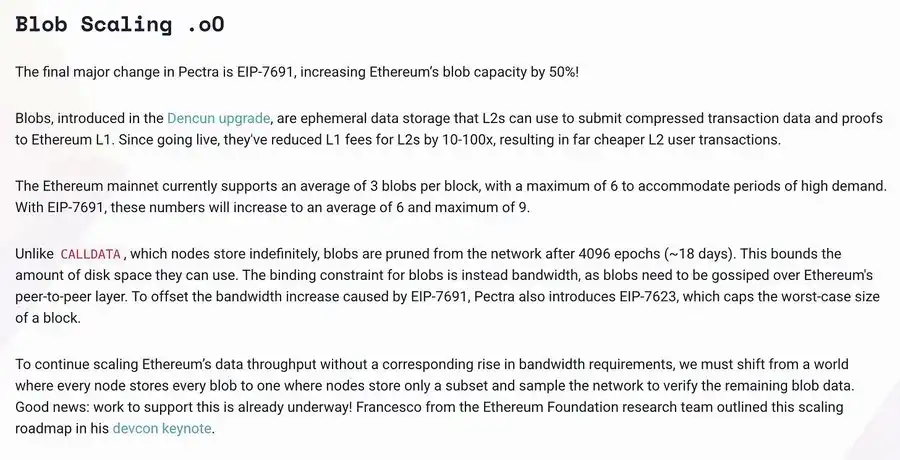
With the rising cost of data blocks, the need for extending data blocks has emerged.
Through EIP-7691, the capacity of data blocks will increase by 50%: currently, each Ethereum block can accommodate approximately 3 data blocks (up to 6 at peak demand). After implementing EIP-7691, on average, support for 6 data blocks will be available, reaching up to 9 during high demand.
The next step in further extending data blocks is to reduce the requirement to store all data blocks and move towards shards, which can still be used to validate block data.
Other EIPs in Pectra include:
· EIP-2537: Increases the security bit length of operations to over 120 bits, currently above 80 bits.
·EIP-2935: Designed for stateless clients, this EIP proposes storing historical block hashes in state as part of the block processing logic. Through contract storage implementation, the EIP allows for a smooth transition without impacting block hash logic. Rollups will be able to benefit from a longer history and directly query the storage contract.
·EIP-7549: This EIP focuses on enhancing the efficiency of the Casper client. By reducing the number of pairings required for consensus validation, particularly by removing one of the three elements from Casper client attestation messages: the committee index. By moving it out of the attestation message, achieving consensus votes can now be more efficiently aggregated into blocks, increasing the number of votes per block from 2 slots to 8.
·EIP-7623: EIP-7623 proposes an increase in the calldata cost, being one of the significant developments affecting Layer 2. This proposal aims to adjust the call data cost to address the difference between the average (100 KB) and maximum block size (7.15 MB). This will not affect regular users but only transactions mainly used for data publishing.
This increase will be introduced through a base fee that depends on the gas ratio consumed in call data operations: reduce block size to accommodate more data blocks or increase gas limits.
·EIP-7685: Introduces a framework to store requests triggered by smart contracts. This allows validators controlled by smart contracts to delegate management operations to the latter, reducing the need for intermediaries.
·EIP-2935: Designed for stateless clients, this EIP proposes storing historical block hashes in state as part of the block processing logic. Through contract storage implementation, the EIP allows for a smooth transition without impacting block hash logic. Rollups will be able to benefit from a longer history and directly query the storage contract.
The focus of this upgrade is a significant signal for Ethereum; we know these improvements have been in the works for a long time and are not in response to recent criticisms. However, focusing on simplifying network security, improving Ethereum account capabilities, and enhancing the ability to expand block data are key development directions needed to achieve Ethereum's goals.
You may also like

Mastercard Launches Agent Pay for AI, Plans to Record AI Agent Payment Authorizations on Polygon
Mastercard launched Agent Pay for AI, a new payment protocol designed to help AI agents make small payments such as pay-per-use access to data and APIs. The system plans to record human-granted AI agent permissions on Polygon, focusing on verifiable authorization, identity, and payment controls.

Curve Deploys Llamalend v2 on Optimism With 250,000 OP Incentives
Curve launched Llamalend v2 on Optimism with 250,000 OP incentives from the Optimism Foundation. The upgrade expands Llamalend beyond its earlier crvUSD-focused model, adding broader collateral support, LlamaRisk market reviews, and the ability to use Curve LP tokens as collateral.

Raydium Old Liquidity Pool Reportedly Exploited, With $1.34 Million Moved to Ethereum and Tornado Cash
An old Raydium liquidity pool was reportedly exploited for around $1.34 million in USDC, RAY, and wSOL, with the stolen funds bridged to Ethereum and deposited into Tornado Cash. The incident highlights the tail risks of legacy DeFi pools, old contracts, and cross-chain fund laundering paths.

Kalshi Executive Challenges “SBF Backed AI Unicorns” Narrative, Says Leopold Aschenbrenner Was Key Figure
Kalshi executive John Wang questioned the “SBF backed AI unicorns” narrative, saying Leopold Aschenbrenner was the key figure behind major AI investment decisions.

Pantera Capital Partner: How Tokenization is Restructuring the Private Equity and Early Investment Ecosystem?

New York Proposes Stricter Stablecoin Issuer Rules Aligned With Federal GENIUS Act
NYDFS proposed stricter stablecoin issuer rules aligned with the GENIUS Act, covering reserves, custody, redemption timelines, audits, and capital buffers.
Every exchange is a "Universal Exchange."

The counterattack of traditional finance: Alliance chains are quietly reviving

CryptoQuant Says Bitcoin Profitable Supply Is Near 45% Pressure Zone as On-Chain Data Points to Market Repricing
CryptoQuant said Bitcoin’s profitable supply is nearing the 45% pressure zone, signaling rising market stress, unrealized losses, and a possible on-chain repricing phase.

Bitcoin Falls Below 200-Week Moving Average as On-Chain Data Shows Over Half of Supply in Loss
Bitcoin dropped below its 200-week moving average as on-chain data showed over 50% of circulating supply is now in loss, signaling rising market stress.

CFTC Reportedly Plans New Prediction Market Rules Focused on Manipulation Risk and Public Interest Review
The CFTC is reportedly preparing new prediction market rules focused on manipulation risk, public interest review, and retail trader protections.

Meet the new WEEX trial fund—your gateway to greater profits

WEEX Labs Lands at Dutch Blockchain Week: A Disruptive Crypto × AI Conversation Sets Sail in Amsterdam
SK Hynix Reportedly Plans U.S. ADR Listing as Early as August, With SEC Approval Possible in Late June
SK Hynix may pursue a U.S. ADR listing as early as August, with SEC approval reportedly possible in late June amid strong AI chip supply chain demand.

SpaceX vs Tesla vs xAI: Which Elon Musk Trade Has the Biggest Upside in 2026?
OpenAI Reveals It Has Confidentially Submitted an S-1 to the SEC, Keeping the Door Open for a Future IPO
On June 9, according to an OpenAI announcement, the company recently confidentially submitted a draft S-1 registration statement to the U.S. Securities and Exchange Commission (SEC), beginning the preliminary compliance process for a potential initial public offering. OpenAI said it chose to disclose this proactively because it expected the news might leak; however, the company has not yet set a specific listing timeline, and related arrangements may still take some time.
Latest research from 13 top universities including Cornell University: The current state, challenges, and misconceptions of the fusion of Crypto and AI
Deconstructing Anthropic: The Best AI Company, Possibly Also a Type of Organizational Invention
Mastercard Launches Agent Pay for AI, Plans to Record AI Agent Payment Authorizations on Polygon
Mastercard launched Agent Pay for AI, a new payment protocol designed to help AI agents make small payments such as pay-per-use access to data and APIs. The system plans to record human-granted AI agent permissions on Polygon, focusing on verifiable authorization, identity, and payment controls.
Curve Deploys Llamalend v2 on Optimism With 250,000 OP Incentives
Curve launched Llamalend v2 on Optimism with 250,000 OP incentives from the Optimism Foundation. The upgrade expands Llamalend beyond its earlier crvUSD-focused model, adding broader collateral support, LlamaRisk market reviews, and the ability to use Curve LP tokens as collateral.
Raydium Old Liquidity Pool Reportedly Exploited, With $1.34 Million Moved to Ethereum and Tornado Cash
An old Raydium liquidity pool was reportedly exploited for around $1.34 million in USDC, RAY, and wSOL, with the stolen funds bridged to Ethereum and deposited into Tornado Cash. The incident highlights the tail risks of legacy DeFi pools, old contracts, and cross-chain fund laundering paths.
Kalshi Executive Challenges “SBF Backed AI Unicorns” Narrative, Says Leopold Aschenbrenner Was Key Figure
Kalshi executive John Wang questioned the “SBF backed AI unicorns” narrative, saying Leopold Aschenbrenner was the key figure behind major AI investment decisions.
Pantera Capital Partner: How Tokenization is Restructuring the Private Equity and Early Investment Ecosystem?
New York Proposes Stricter Stablecoin Issuer Rules Aligned With Federal GENIUS Act
NYDFS proposed stricter stablecoin issuer rules aligned with the GENIUS Act, covering reserves, custody, redemption timelines, audits, and capital buffers.


