
After being hunted by whales and CEX, Hyperliquid "pulls the plug" to save $200 million


Tonight, a liquidity crisis sparked by the JellyJelly-associated Memecoin $JELLY, created by former Facebook Vice President of Product lessin, has thrust derivative DEX Hyperliquid into the eye of the storm. From whale price manipulation, CEX sniper attacks, to protocol emergency "pulling the plug" self-rescue, this crisis has not only exposed the governance weakness of decentralized protocols but has also evolved into a face-off between CEX and Perp DEX.
Hyperliquidity Pulling the Plug
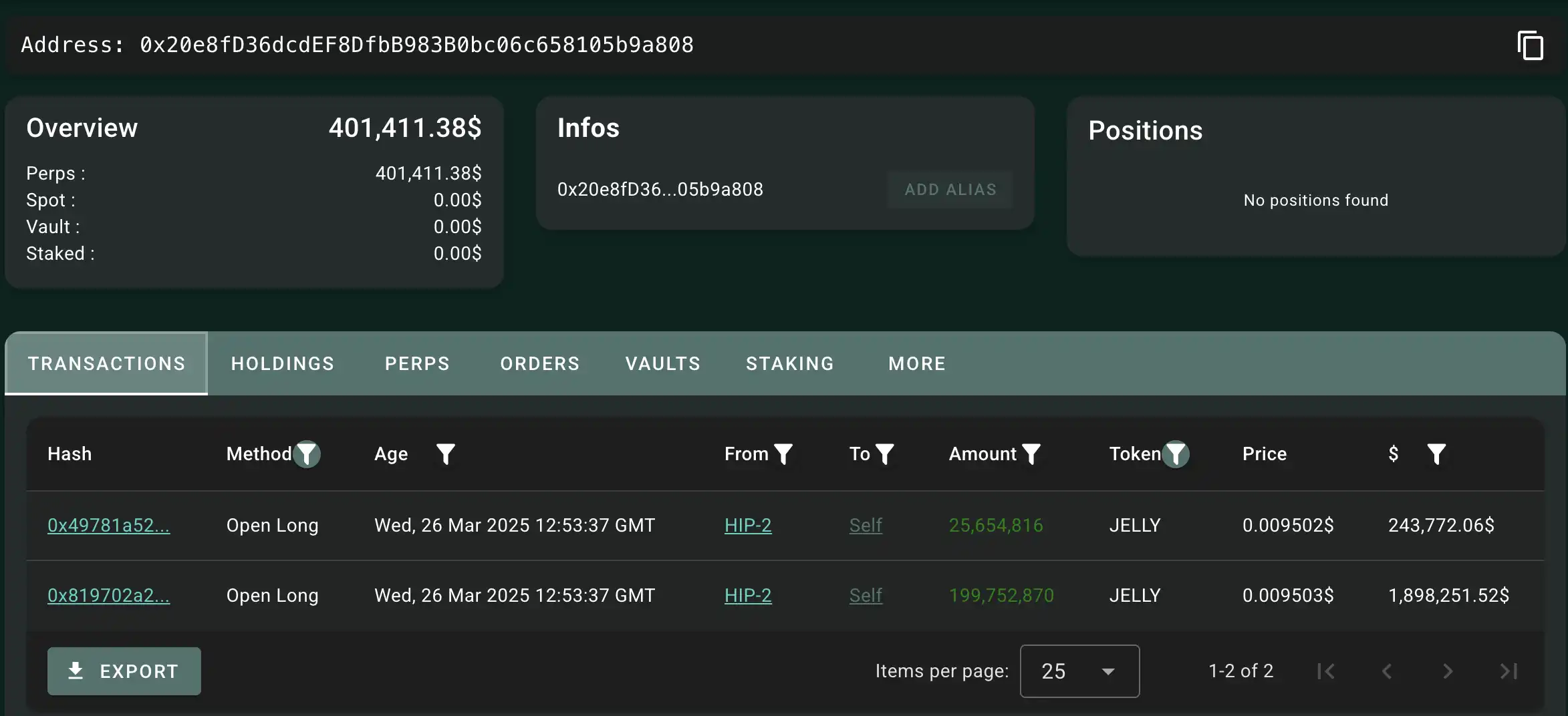
Tonight, another exciting whale battle unfolded on-chain, with address "0x20e8" opening a 2.5 billion $JELLY long position in the 0.0095 price range at 8:53 on the 26th, amounting to approximately $2.1 million at the time (link).
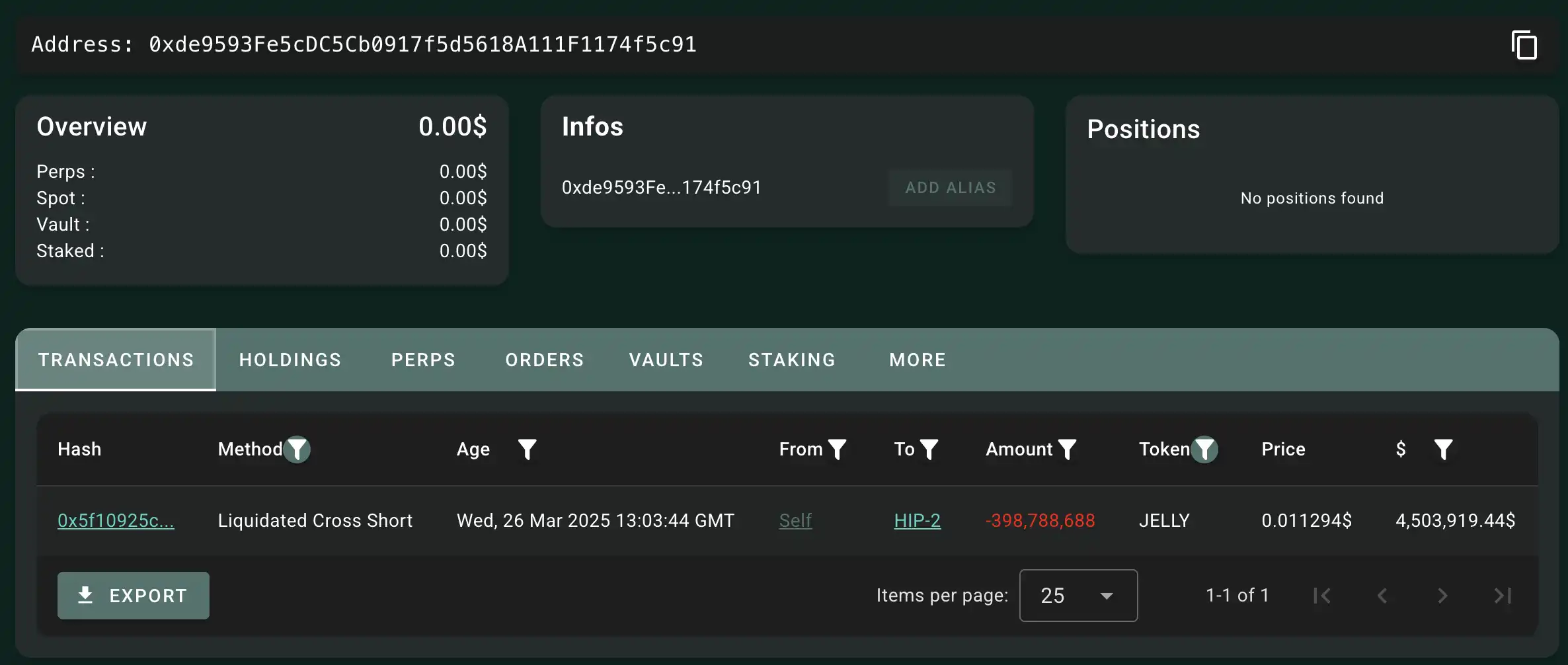
Then, 10 minutes later, around 9:00 on the 26th, address "0xde95" first opened a 3.98 billion $JELLY short position on Hyperliquid perpetual futures, amounting to approximately $4.5 million at the time (link), while also buying $JELLY spot on-chain to artificially raise the spot price and subsequently removing collateral from the short position.
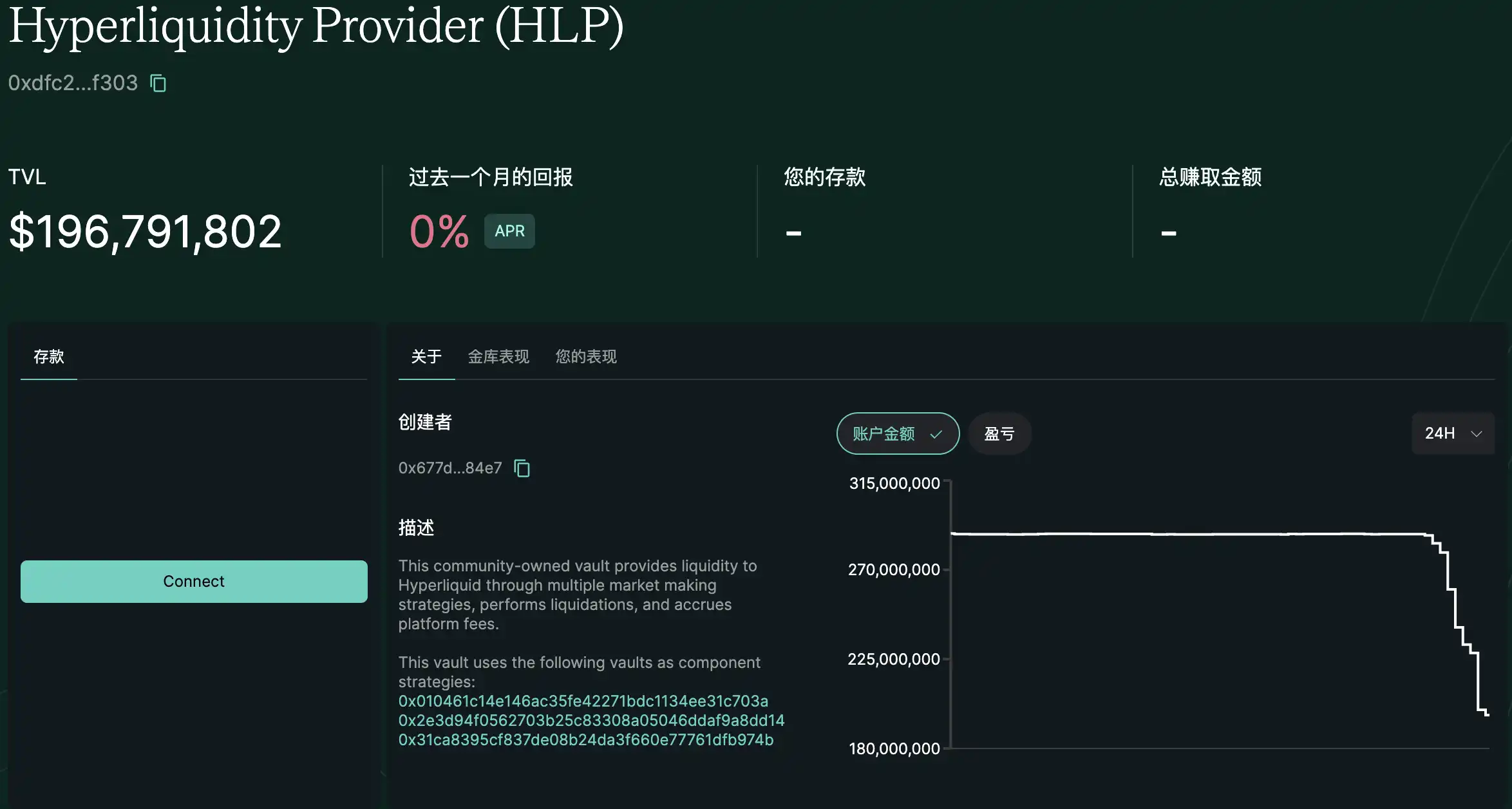
This triggered the mechanism of HLP, as HLP's market-making strategy calculates a fair price by integrating tick data from Hyperliquid and mainstream CEX, and executes strategies to continuously provide 24/7 liquidity. Therefore, when the $JELLY price drops, HLP acts as a counterparty during the liquidation period, inheriting the short positions amounting to approximately $5 million.
Subsequently, the address continued to buy back $JELLY, causing a significant price surge due to low liquidity. At this point, HLP held a passive short position of 3.98 billion $JELLY (valued at approximately $15.3 million at the time) due to the token price rise, resulting in nearly a $12 million loss for HLP. According to on-chain data analyst @ai_9684xtpa, if the counterpart raises the coin price to around $0.17, the Hyperliquid Vault will face liquidation and lose the $240 million it currently holds. At this time, the price fluctuates between $0.035-$0.045, only requiring roughly a threefold increase for one of Hyperliquid's treasuries holding $240 million to vanish into thin air.
Renowned crypto influencer CryptoSkanda "@thecryptoskanda" ignited a spark on Twitter, suggesting that Binance should list JELLY for spot trading or merely hinting at considering JELLY listing. Through his own influence, he further boosted the JELLY price to outcompete Hyperliquid. In response, Binance's co-founder He Yi replied, "Noted."
Around 11 PM on the 26th, several community members noticed that the $JELLY token's K-line on HyperLiquid had stopped updating, indicating a potential delisting of $JELLY. As retail and large-scale holders collectively "attacked" HyperLiquid, the project's treasury funds were reduced to $50 million to minimize risks, and the liquidation price dropped to $0.14.
10 minutes later, both OKX and Binance announced the listing of JELLY perpetual contracts. Subsequently, Hyperliquid responded on Discord, stating that upon detecting suspicious market activity, the Validator Council voted to delist the JELLY perpetual contract. Except for tagged addresses, all user losses will be fully compensated by the Hyper Foundation. This meant that after the so-called "vote," they directly settled on-chain activities at a price of $0.0095, enraging community members. "DEX" turned into "CEX" overnight, and Hyperliquid even profited $700,000 from this liquidation.
CZ referenced a previous tweet about "DEX vs. CEX" on social media and wrote, "I know I'm not that smart. I admit when I don’t know. I often feel those smart people must have a trick I don't, to do things that I can't. But occasionally, I find: the most fundamental rules still apply."
Arthur Hayes even claimed that Hyperliquid mishandled the JELLY incident, indicating that it is not truly decentralized. He expressed that traders do not care about decentralization and believed that the HYPE would quickly plummet back to zero.
The impact of this event is still unfolding, whether it be the previous DEX insider trading or the recent large holders on PolyMarket coercing a "prediction outcome." CEX customer data breaches or market maker manipulation of CEX prices events, nearly every day reminds cryptocurrency practitioners of the many issues they still need to address. BlockBeats will continue to monitor the event's developments.
You may also like

Citibank releases "2030 Asset Tokenization Market Outlook": 6 major trends may create a $8.2 trillion market

The trillion-dollar valuation test: Are the three major super IPOs a celebration for tech stocks or a nightmare for the crypto market?

Morning Report | Digital Asset completes $355 million financing led by a16z Crypto; Meta completes operational separation from Manus

a16z Crypto Partner: Cash flow is the moat

Cryptocurrency market makers collectively seek change as it becomes increasingly difficult to make money

How TradeXYZ, xStocks, and Alpaca break down the SpaceX IPO into three different strategies

$75 billion in risk asset redistribution: How will SpaceX's IPO affect U.S. stocks and Bitcoin?

Why Is BlackRock Investing $5 Billion in the SpaceX IPO?
Morning News | CME Group launches Nasdaq Cryptocurrency Index futures; Asset management giant Janus Henderson strategically invests in Ethena

Bitcoin Layer 2 Network Botanix: Why Did We Choose to Dissolve?

Why did Oracle deliver the strongest financial report in history, yet its stock price fell?
When the P2P illicit funds from ten years ago turned into 60,000 bitcoins
Dialogue with OmenX Founder: Why does the prediction market need an evolution from "spot" to "derivatives"?
Galaxy in-depth report: Is Solana still worth paying attention to?
Young people in South Korea make a "final effort" in the epic bull market
The pricing controversy of Trade.xyz exposes the fatal weakness of Pre-IPO perpetual contracts

How much longer can Ethereum's last big buyer hold on?

World Cup 2026 Coming – WEEX Celebrates with $1M Prize Pool & Michael Owen Live
Citibank releases "2030 Asset Tokenization Market Outlook": 6 major trends may create a $8.2 trillion market
The trillion-dollar valuation test: Are the three major super IPOs a celebration for tech stocks or a nightmare for the crypto market?
Morning Report | Digital Asset completes $355 million financing led by a16z Crypto; Meta completes operational separation from Manus
a16z Crypto Partner: Cash flow is the moat
Cryptocurrency market makers collectively seek change as it becomes increasingly difficult to make money
How TradeXYZ, xStocks, and Alpaca break down the SpaceX IPO into three different strategies


