
Bloomberg: $1.3 Billion Accounting Loss, Is Tom Lee's Ethereum Bet Facing Collapse?


Original Title: Tom Lee's Big Crypto Bet Buckles Under Mounting Market Strain
Original Author: Sidhartha Shukla, Bloomberg
Original Translation: Chopper, Foresight News
The Ethereum corporate treasury experiment is currently on the verge of collapse.
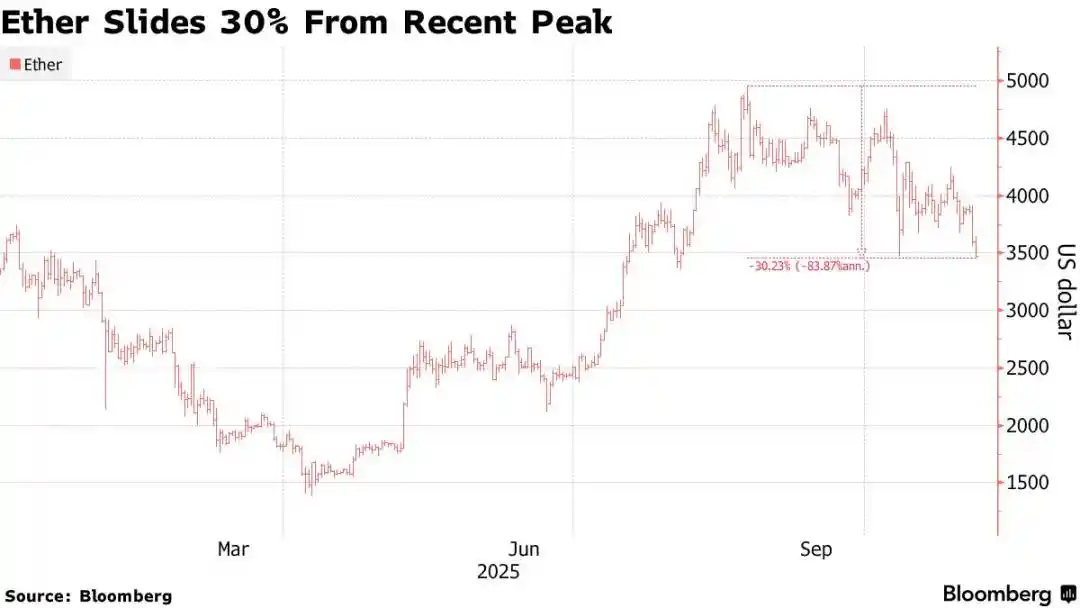
The world's second-largest cryptocurrency dropped below $3,300 on Tuesday, in sync with the market's benchmarks such as Bitcoin and tech stocks. This decline has pushed Ethereum's price down by 30% from its August peak, falling to levels before the large-scale corporate buy-in, further solidifying its bearish trend.
According to research firm 10x Research, this reversal has put Ethereum's most fervent corporate supporter, Bitmine Immersion Technologies Inc., at a staggering $1.3 billion paper loss. This publicly traded company, backed by billionaire Peter Thiel and led by Wall Street analyst Tom Lee, whose strategy mimicked Michael Saylor's Bitcoin treasury model, purchased 3.4 million Ethereum at an average price of $3,909. Today, Bitmine's treasury is fully deployed and facing increasing pressure.
10x stated in its report, "For months, Bitmine has been driving the market narrative and fund flows. Now with its treasury fully deployed, facing a paper loss of over $1.3 billion, and no available additional funds."
The report notes that retail investors who bought Bitmine stock at a premium to net asset value (NAV) have suffered even greater losses, and the market's willingness to catch falling knives is limited.
Lee did not immediately respond to a request for comment, and representatives from Bitmine did not respond immediately either.
Bitmine's bet is far from a simple asset-liability trade. Behind the company's accumulation is a grander vision: the transition of digital assets from speculative tools to corporate financial infrastructure, thereby cementing Ethereum's position in the mainstream financial realm. Supporters believe that by integrating Ethereum into a publicly traded company's asset treasury, enterprises will help build an entirely new decentralized economy. In this economic system, code replaces contracts, and tokens serve as assets.
This logic drove the summer bull run. Ethereum's price once approached $5000, and only in July and August, Ethereum ETFs attracted over $90 billion in inflows. However, after the crypto market crash on October 10, the situation reversed: according to Coinglass and Bloomberg compiled data, Ethereum ETFs saw outflows of $8.5 billion, and Ethereum futures' open interest decreased by $16 billion.
Lee had previously predicted that Ethereum would reach $16,000 by the end of this year.
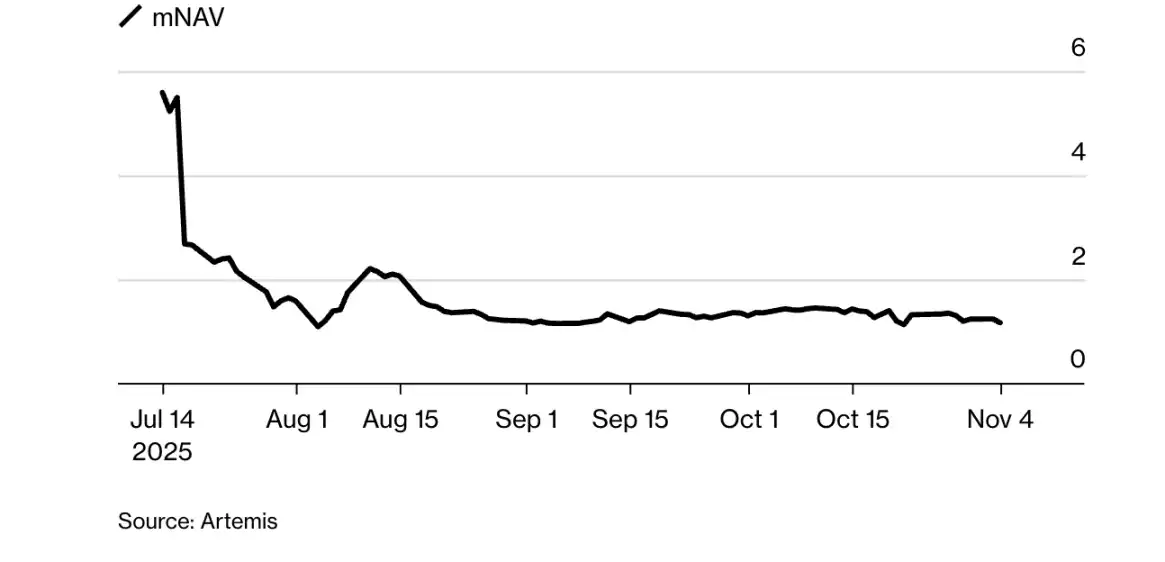
Bitmine's Net Asset Value (mNAV) Premium Decline
According to Artemis data, Bitmine's market cap to net asset value multiple has plummeted from 5.6 in July to 1.2, with its stock price falling 70% from its peak. Similar to other Bitcoin-related companies before it, Bitmine's stock price is now closer to its underlying asset value, as the market reevaluates the once high valuation of its crypto asset balance sheet.
Last week, another publicly traded Ethereum treasury company, ETHZilla, sold $40 million worth of Ethereum holdings to buy back shares, aiming to bring its modified Net Asset Value (mNAV) ratio back to a normal level. The company stated in a press release at that time: "ETHZilla plans to use the proceeds from the remaining Ethereum sales for further share buybacks and intends to continue selling Ethereum to repurchase shares until the discount to Net Asset Value normalizes."
Despite the price decline, Ethereum's long-term fundamentals appear to remain strong: its on-chain value processed still exceeds that of all competing smart contract networks, and the staking mechanism gives the token both yield attributes and deflationary properties. However, as competitors like Solana gain momentum, ETF flows reverse, and retail interest wanes, the narrative of "institutional stability in cryptocurrency prices" is gradually losing relevance.
You may also like

Argentina vs Cape Verde: When a Record-Breaking Legend Meets an Unbreakable Underdog
WEEX exclusive pre-match analysis of Argentina vs Cape Verde, exploring Messi-led Argentina’s dominance and Cape Verde’s historic defensive breakout, with a breakdown of volatility, structure, and match dynamics.
How does Gate redo "buying and selling stocks" from the cryptocurrency world to the stock market?
Former ByteDance employee's account: How I started with two Pinduoduo hard drives and made six times the profit with Seagate to achieve financial freedom?
Visa and Mastercard join 140 giants to launch a new stablecoin, but the impact on the market landscape may still be limited
WEEX Launches Depth Chart for Spot Trading
MiCA reshuffle begins, Binance temporarily bids farewell to the EU
Raising interest rates to protect STRC and selling coins to maintain credit, this time the strategy has chosen the two most expensive paths
Morning Report | Samsung announces a 265.5 trillion won investment plan, focusing on semiconductor and AI computing power data centers; Vitalik publishes an article detailing the entire technology tree behind the confusion protocol (iO) mainline
In the era of AI, what is left of Bitcoin?
NeoSoul announced plans to integrate with the OKX Agentic Wallet, promoting AI agents' participation in the on-chain economy
Why Is Bitcoin Lagging Stocks in 2026? AI Stocks, ETF Outflows, and the Nasdaq Rally Explained
What you bought on CEX is really not US stocks: Analyzing the 94% liquidation monopoly and the evaporation of equity under a five-layer pipeline
In such a crowded cross-border payment arena, where is the next stop for the future?
Why Is Bitcoin Down in 2026? What We Can Learn From 2022
The large models in the United States are moving towards closure in the name of security
From the white-haired stock god to the billionaire fund mogul, the smart people shorting Nvidia are all getting rich using the same framework
Morning Report | CoinEx becomes a key hub for Iran to evade sanctions, involving over $3.8 billion in funds; Kalshi seeks a new round of financing, with a valuation potentially rising to $40 billion
Global Launch: As predictions become the most scarce asset in the AI era, Manadia is defining the next generation of the value internet
Argentina vs Cape Verde: When a Record-Breaking Legend Meets an Unbreakable Underdog
WEEX exclusive pre-match analysis of Argentina vs Cape Verde, exploring Messi-led Argentina’s dominance and Cape Verde’s historic defensive breakout, with a breakdown of volatility, structure, and match dynamics.
How does Gate redo "buying and selling stocks" from the cryptocurrency world to the stock market?
Former ByteDance employee's account: How I started with two Pinduoduo hard drives and made six times the profit with Seagate to achieve financial freedom?
Visa and Mastercard join 140 giants to launch a new stablecoin, but the impact on the market landscape may still be limited
WEEX Launches Depth Chart for Spot Trading
MiCA reshuffle begins, Binance temporarily bids farewell to the EU


