
Brevis Pico: A High-Performance Modular General-Purpose ZK Virtual Machine






Source: Brevis

The Brevis team is excited to introduce Pico — a modular and efficient zero-knowledge virtual machine (zkVM). Pico allows developers to flexibly build a zkVM tailored to their application's computational needs, similar to assembling LEGO bricks, in order to optimize performance and user experience. Developers can freely choose from a rich set of built-in options, and even fully customize the proof backends and VM instances to create a bespoke computational flow that meets their specific requirements.
Pico redefines the "Glue-and-Coprocessor" architecture, supporting not only underlying coprocessors (such as using precompiled modules to accelerate specific VM instruction operations) but also natively integrating Brevis' on-chain data zkCoprocessor, boosting application performance utilizing blockchain historical data by up to 32 times.
While a complete GPU-accelerated cluster solution for Pico has yet to be introduced, it has already achieved world-class performance on the CPU side. Compared to other industry zkVMs like RISC0, SP1, and OpenVM, Pico boasts a CPU speed improvement of 70% to 155%, setting a new performance benchmark.
With the release of Pico v1.0, we have introduced the world's first zkVM supporting a customizable compute architecture, allowing developers to adjust the following key parameters flexibly:
Selectable Proof Backend: Supporting STARK on KoalaBear and BabyBear, as well as CircleSTARK on Mersenne31.
Flexible Proofing Process: Optimizing security, scalability, proof generation efficiency to adapt to various application requirements.
On-chain Historical Data Access: Through the built-in on-chain data zkCoprocessor, developers can freely query, compute historical blockchain data to build dApps, achieving optimal computational performance and programming flexibility.
Pico is compatible with the RISC-V instruction set and supports the Rust development toolchain. Due to its modular architecture, Pico is future-proof and can easily adapt to the latest ZK theoretical research innovations. Whether it's the next generation of ZK applications or cutting-edge explorations in the ZK field, Pico provides developers with a stable and powerful computing foundation.
Feel free to visit the Pico Developer Guide, explore the GitHub code repository, and join the Telegram or Discord discussion groups to stay updated and contribute, together shaping the future of ZK computing.
Why Pico?
Brevis's first product—the on-chain data zkCoprocessor—has been widely used in DeFi and other fields. Many partners have deployed innovative features based on Brevis on the mainnet, including Kwenta, Usual, Algebra Labs, JoJo Exchange, Trusta, and more. In addition, PancakeSwap, Celer, Gamma, Quickswap, Frax, Mask Network, Kernel, BeraBorrow, Thena, Kim Protocol, 0G, Bedrock, Mellow Finance, ZettaBlock, Hemera
and Mendi Finance and other top protocols and applications are also developing next-generation products and features based on Brevis.
However, in the process of collaborating with these cutting-edge teams, we found that the practical application needs of zk computation are becoming more diverse and face the following core challenges:
1. Adapting to Different Application Needs
The business logic of different projects varies, and their performance requirements differ greatly. The traditional "one-size-fits-all" zkVM or fixed ZK circuit solutions struggle to meet the changing needs. If there is a lack of flexible customization of the proof process or an inability to integrate custom circuits (whether at the opcode level or application level), the scalability of zkVM will be limited.
2. Embracing Cutting-Edge ZK Technology
The ZK field is rapidly evolving, with new proof backends, frameworks, and cryptographic breakthroughs emerging constantly. Many existing zk solutions, due to their closed architecture, find it challenging to quickly integrate these innovative technologies, resulting in outdated proofs, poor performance, high computational costs, and limited optimization space.
Pico's Modular Approach: Truly Flexible and Scalable
To address these challenges, Pico adopts a modular architecture, providing:
· Support for Multiple Proof Backends: Easily switch or upgrade to the latest proof backend to ensure computational performance and compatibility.
· Customizable Proof Processes: Developers can freely customize the proof generation pipeline to meet specific application requirements.
· Scalable Coprocessor Integration: Supporting the building or integration of dedicated coprocessors, without being limited to a fixed zkVM framework.
Innovative Glue-and-Coprocessor Architecture: Breaking Through the Bottleneck of Traditional zkVM
Pico adopts the "Glue-and-Coprocessor" architecture, combining efficient dedicated circuits (Coprocessors) with a universal zkVM (Glue) to balance performance, generality, and scalability.
Coprocessors: Optimize intensive tasks such as arithmetic operations, cryptographic computations, machine learning, etc., to enhance ZK proof efficiency.
Universal zkVM (Glue): Manages the overall proof and verification process to ensure all logical computations can proceed securely.
What are the advantages of this architecture?
Compared to traditional zkVMs, Pico achieves faster proof generation and higher programmability by combining the generality and computational power of dedicated circuits.
Precompiles are a common type of coprocessor that extends the RISC-V instruction set to accelerate fundamental operations like hashing and signature verification. Pico supports developers in customizing precompiled modules based on their requirements and offers out-of-the-box optimization solutions.
However, relying solely on precompiles is insufficient to meet all application performance needs. For example, if a developer wants to prove that a trader executed 10,000 Uniswap trades totaling $50 million in the past 30 days, performing the computation using only zkVM would require writing Merkle tree inclusion proofs and RLP decoding programs, incurring high costs.
How to overcome this limitation?
Pico natively integrates Brevis's on-chain data zkCoprocessor as an application-level coprocessor, enabling developers to efficiently access and compute on-chain historical data, achieving a 32x performance improvement while reducing costs by 67%.

Table 1: Performance Comparison between Coprocessor-Enhanced Pico and Native Pico (4096 transactions, log size: 40)
Pico further extends this architecture to support verifiable AI inference, Reth, and other application-level coprocessors to further enhance zk computation efficiency.
By combining Coprocessors and the universal zkVM (Glue), Pico provides developers with a powerful and flexible tool to balance performance, programmability, and adaptability in ZK-driven applications.
Flexible Proof Backend with Customizable Computing Flow
1. Flexible Support for Multiple Proof Backends
Pico is compatible with multiple zero-knowledge proof systems, including:
STARK (KoalaBear, BabyBear)
CircleSTARK (Mersenne 31)
For example, the Poseidon2 hash function is widely used in zkVM recursive proofs. Under the same STARK system, KoalaBear proof efficiency far exceeds BabyBear, and a significant performance improvement can be achieved by simply switching the proof backend without modifying the computing logic.
2. Customizable Proof Workflow
Pico allows developers to freely adjust the proof generation process to optimize scalability, cost, and latency.
· Instance-Level Optimization: Developers can customize the computing flow of each VM instance (including proof backend, computing chip, memory management, etc.).
· ProverChain Proof Chain: Through modular processes such as RISCV → CONVERT → COMBINE → COMPRESS → EMBED → ONCHAIN, computing efficiency is optimized.
· Optional Decentralized Verification: Developers can choose whether to conduct on-chain verification on the EVM based on their needs to balance performance and decentralization.
Setting New Industry Performance Records: Establishing the New Benchmark for zkVM
In the latest performance benchmark tests, Pico has comprehensively surpassed existing zkVM solutions and demonstrated remarkable performance improvements in a CPU computing environment. We compared RISC0, SP1, and OpenVM, covering the following core computing tasks:
· Fibonacci Calculation
· Tendermint Block Consensus
· Ethereum Reth Block #17106222 Proof
All tests were conducted on an AWS r7a.48xlarge instance (192-core CPU, 1.5TB RAM) to ensure the consistency of the computing environment. The results show:
· Pico's runtime in all tasks is faster than the second fastest solution by up to 155%, setting a new performance record for zkVM computation!
· Pico's CPU computational power is significantly ahead, especially suitable for applications requiring efficient computation.
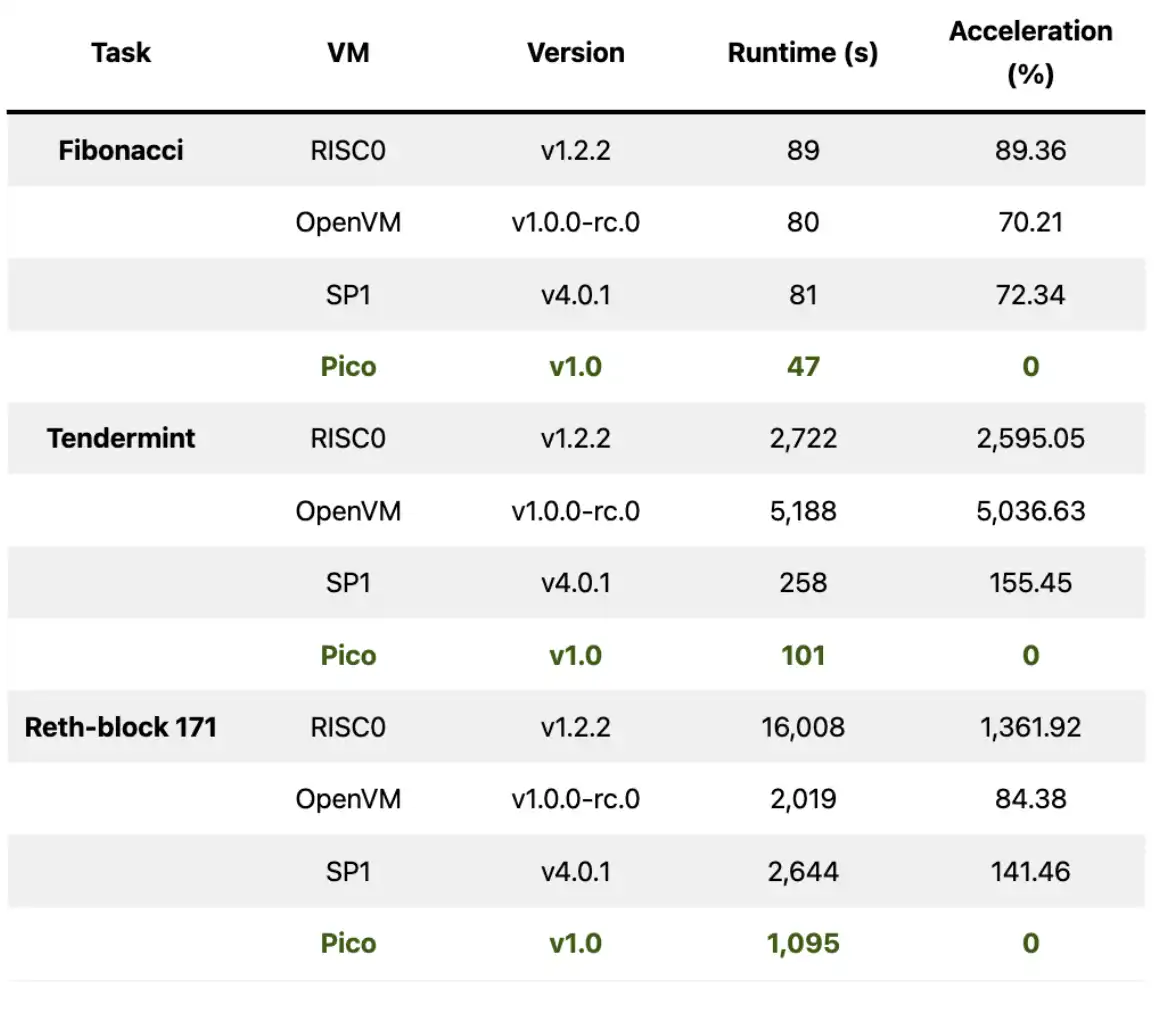
Table 2: Performance Benchmark Test Results of RISC0, OpenVM, SP1, and Pico on Fibonacci, Tendermint, and Reth-block 171 tasks on AWS r7a.48xlarge (192-core, 1.5TB memory)
GPU Accelerated Version Coming Soon
While the current data is based on CPU testing, Pico is developing a GPU-accelerated version expected to be released in the coming months. The GPU-accelerated version of Pico will further enhance zk computation capabilities, providing increased throughput and computational efficiency. A comprehensive GPU performance test report will be released in the future.
Standing on the Shoulders of Giants
Pico draws inspiration from the following projects, each representing cutting-edge advancements in zero-knowledge proof systems.
By building on these innovative foundations, Pico offers a modular and high-performance zkVM:
Plonky3: Pico's proof backend is based on Plonky3, extending its modular features to the zkVM layer, allowing developers to flexibly choose the proof domain and proof system that best suit their applications.
SP1: Pico gains important insights from SP1's chip design and constraint system, including the design of the recursion compiler and precompiles.
Valida: Pico's implementation of cross-table lookups is inspired by Valida's pioneering work in this field.
RISC0: Pico's Rust toolchain is directly based on the toolchain originally developed for RISC0.
Join the Pico Developer Community
Brevis has always believed that the future of zero-knowledge technology lies in collaboration and innovation. Pico is not just a zkVM but also a development platform that empowers building the next generation of zk applications.
· Read the Pico Developer Documentation: Pico Docs
· Explore the GitHub Repository: GitHub Repo
· Join the Community Discussions: Telegram or Discord
Let's work together to expand the boundaries of zero-knowledge computing and to build an intelligent, trustless, decentralized world!
This article is contributed content and does not represent the views of BlockBeats.
You may also like

OpenAI Reveals It Has Confidentially Submitted an S-1 to the SEC, Keeping the Door Open for a Future IPO
On June 9, according to an OpenAI announcement, the company recently confidentially submitted a draft S-1 registration statement to the U.S. Securities and Exchange Commission (SEC), beginning the preliminary compliance process for a potential initial public offering. OpenAI said it chose to disclose this proactively because it expected the news might leak; however, the company has not yet set a specific listing timeline, and related arrangements may still take some time.

Latest research from 13 top universities including Cornell University: The current state, challenges, and misconceptions of the fusion of Crypto and AI
Deconstructing Anthropic: The Best AI Company, Possibly Also a Type of Organizational Invention
Apollo and Blackstone Reportedly Back $35 Billion Anthropic Chip Financing as Deal Details Remain Unclear
On June 9, according to currently available news alerts, Apollo and Blackstone Group participated in a $35 billion financing for an Anthropic “chip project.” Based on the original wording of the report, the funding has already been raised, but public information remains limited. The financing structure, use of proceeds, project entity, and whether Apollo and Blackstone participated through equity, debt, or project financing have not yet been disclosed.

Humanity Protocol Security Incident Escalates: More Than $31 Million Stolen From Related Addresses as Attacker Continues Selling H for ETH
On June 9, according to monitoring by Onchain Lens, more than $31 million has been stolen from addresses linked to Humanity Protocol, and the attack is still ongoing, with the hacker continuously swapping H tokens for ETH. Project founder Terence Kwok later confirmed the security incident on X, saying the issue involved a private key leak.

Bloomberg: As Bitcoin Weakens, Stablecoins and RWA Continue to Drive Expansion in Crypto Businesses
In June, Bloomberg reported that despite Bitcoin falling below $60,000 last week, wiping out about $235 billion in market value within seven days, and dropping close to 50% from last year’s peak, some core businesses in the crypto industry are still expanding, mainly in stablecoins, real-world asset tokenization (RWA), payments, and infrastructure. The report also noted that overall altcoin activity has contracted significantly: altcoin market capitalization has fallen from a peak of about $431 billion in November 2021 to around $170 billion, and among the tens of millions of tokens issued in recent years, fewer than 1,700 still maintain meaningful trading activity.

Galaxy Deep Research Report: How Hyperliquid's HIP-4 Upgrade Changes the Landscape of Prediction Markets?
Binance Research: RWA Market Expected to Expand Nearly 6x from Early 2025, with Public Equities and Onchain Payments Heating Up Together
In June, Binance Research said in its monthly market report that the real-world asset (RWA) market is expected to grow by about 589% from the beginning of 2025. Bond- and money market fund-related RWA expanded by about $6.5 billion, up 83% year over year, while publicly traded equity RWAs grew by about 422%. The report also noted that monthly crypto debit card transaction volume exceeded $747 million in May, up 48.6% year to date.

Japan to Assess a Framework for Yen Stablecoins and Crypto ETFs as Asia’s Compliant Payments Narrative Heats Up
Recently, according to the original report, Japan is considering the launch of yen stablecoins and cryptocurrency ETFs. Public information remains limited at this stage, and there is still no complete policy text, regulatory draft, or clear implementation timeline, so this is better characterized as a “policy discussion” rather than formal implementation. The original wording also noted that advancing stablecoin regulation in Asia is driving XRP usage and supporting growth in the XRPL ecosystem. However, based on currently available public information, there is not enough evidence to directly establish a clear causal relationship between this round of discussion in Japan and XRP or XRPL.

ZachXBT: Humanity private key leak and abnormal surge in H token should be viewed separately
On June 9, according to related disclosures, on-chain investigator ZachXBT posted an update on Humanity’s roughly $31 million security incident, saying that after further analyzing fund flows, he currently tends to believe the project team was not involved in an “inside job” or a self-staged attack. According to him, the official explanation about the private key leak was broadly accurate, but before the token unlock, the price of H had been artificially pushed higher, and the hacker later took advantage of that market environment; therefore, the private key leak and the earlier abnormal price pumping should be regarded as two separate and independent events. This reframing has shifted the market’s understanding of the nature of the incident. Earlier discussion around Humanity had focused on whether the team directly participated in the attack or used the security incident to cover up internal operations. ZachXBT’s latest remarks shift the focus from “whether it was self-theft” to “whether there were pre-unlock market structure issues.” He also questioned whether the team may have.

Morning Report | OpenAI has submitted an S-1 registration statement draft to the U.S. SEC; Morpho completes $175 million financing

Morning Report | BitMine increased its holdings by 126,971 ETH last week; trader Eugene announced his exit from the crypto market

Wang Chuan: How can one not feel anxious after the neighbor Old Wang made thirty times profit by investing in storage stocks? (Seven) - A quarter-century cycle
Cryptocurrency CEXs are flocking to sell US stocks, and traditional brokerages are facing an "uninvited guest."
$75 billion in foreign capital has fled, and South Korean retail investors have absorbed it all using leverage

Japan’s Three Megabanks Plan Joint Stablecoin Issuance in Fiscal 2026
MUFG, SMBC, and Mizuho reportedly plan to jointly issue fiat-pegged stablecoins in fiscal 2026, signaling Japan’s growing push into bank-led digital payment infrastructure.

Humanity Discloses H Token Dual-Chain Attack Details, With Losses on Ethereum and BSC Exceeding $36 Million
Humanity said the H token attack across Ethereum and BSC caused more than $36 million in losses after leaked ProxyAdmin keys enabled malicious contract upgrades and token minting.
White House Discusses CLARITY Act With Law Enforcement Ahead of Senate Vote
The White House discussed the CLARITY Act with law enforcement ahead of a Senate vote, focusing on illicit finance risks and developer protections.
OpenAI Reveals It Has Confidentially Submitted an S-1 to the SEC, Keeping the Door Open for a Future IPO
On June 9, according to an OpenAI announcement, the company recently confidentially submitted a draft S-1 registration statement to the U.S. Securities and Exchange Commission (SEC), beginning the preliminary compliance process for a potential initial public offering. OpenAI said it chose to disclose this proactively because it expected the news might leak; however, the company has not yet set a specific listing timeline, and related arrangements may still take some time.
Latest research from 13 top universities including Cornell University: The current state, challenges, and misconceptions of the fusion of Crypto and AI
Deconstructing Anthropic: The Best AI Company, Possibly Also a Type of Organizational Invention
Apollo and Blackstone Reportedly Back $35 Billion Anthropic Chip Financing as Deal Details Remain Unclear
On June 9, according to currently available news alerts, Apollo and Blackstone Group participated in a $35 billion financing for an Anthropic “chip project.” Based on the original wording of the report, the funding has already been raised, but public information remains limited. The financing structure, use of proceeds, project entity, and whether Apollo and Blackstone participated through equity, debt, or project financing have not yet been disclosed.
Humanity Protocol Security Incident Escalates: More Than $31 Million Stolen From Related Addresses as Attacker Continues Selling H for ETH
On June 9, according to monitoring by Onchain Lens, more than $31 million has been stolen from addresses linked to Humanity Protocol, and the attack is still ongoing, with the hacker continuously swapping H tokens for ETH. Project founder Terence Kwok later confirmed the security incident on X, saying the issue involved a private key leak.
Bloomberg: As Bitcoin Weakens, Stablecoins and RWA Continue to Drive Expansion in Crypto Businesses
In June, Bloomberg reported that despite Bitcoin falling below $60,000 last week, wiping out about $235 billion in market value within seven days, and dropping close to 50% from last year’s peak, some core businesses in the crypto industry are still expanding, mainly in stablecoins, real-world asset tokenization (RWA), payments, and infrastructure. The report also noted that overall altcoin activity has contracted significantly: altcoin market capitalization has fallen from a peak of about $431 billion in November 2021 to around $170 billion, and among the tens of millions of tokens issued in recent years, fewer than 1,700 still maintain meaningful trading activity.


