
CEX Exchange's New Coin Liquidation Exceeds $65 Million, Is the "Bear Market Bull" Coming to an End?


Summary: When retail investors' mindset is formed, the next step is harvesting
Today's best joke must be "Auntie transferred money to OKX, found that there was no such coin as PI, then saw IP at the top of the gainers list, angrily cursed the exchange for being too careless, got on board decisively."
As you can see, waking up this morning, the gainers list is full of new coins, as of the time of writing:
IP is up 47% in the last 24 hours, reaching a high of $8.9
KAITO is up 51% in the past 24 hours, reaching a high of $2.1
BERA is up 30% in the last 24 hours, reaching a high of $9.6
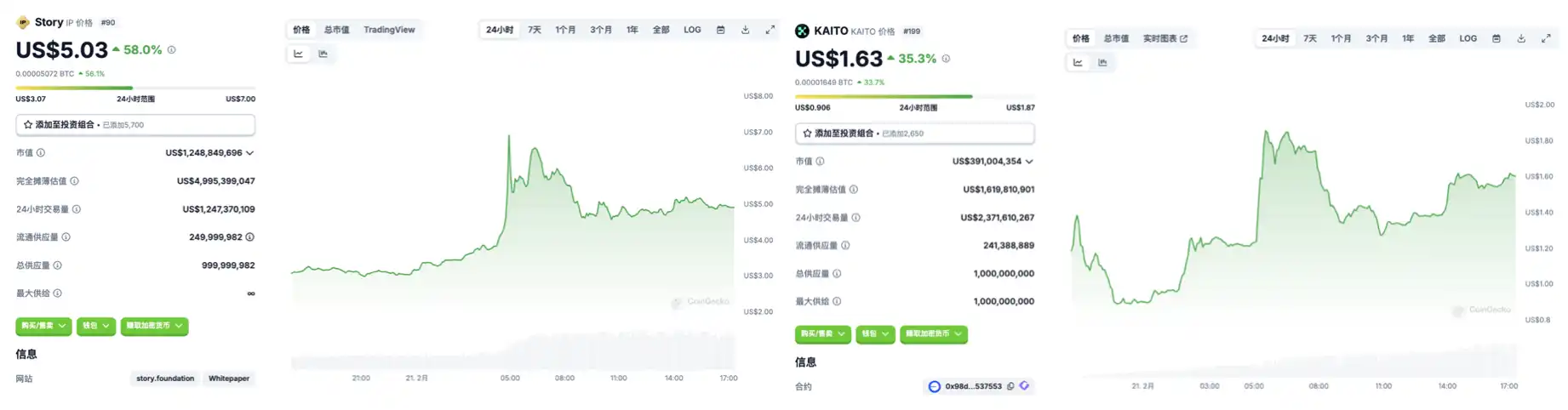
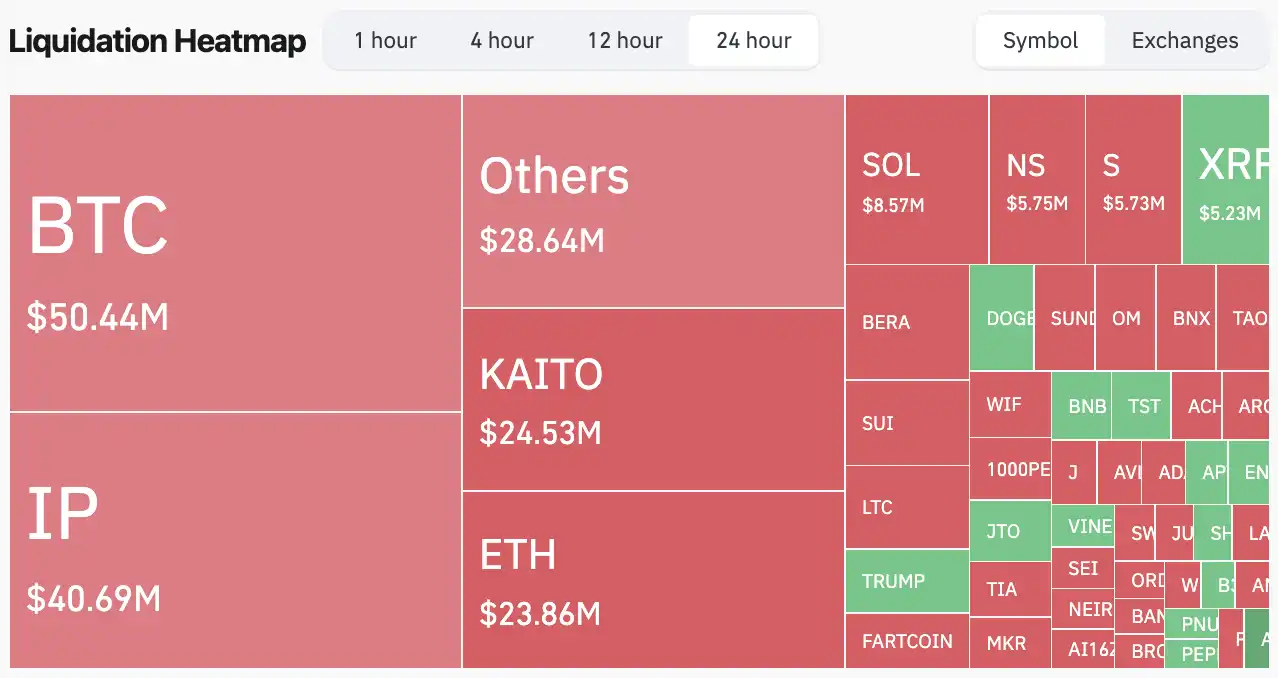
Market data shows that the IP contract price on the OKX platform reached $9 in the early hours of today, with a spot price of $8.96, up about 550% from the low on February 16. Coinglass data shows that the total liquidation in the IP contract trading on the network in the last 24 hours was $40.69 million, second only to BTC contract trading (liquidation of $50.44 million), with long liquidation of $10.38 million and short liquidation of $30.31 million.
Meanwhile, KAOTO's trading volume surpassed $2.5 billion, with a total network contract liquidation of $24.53 million, ranking third across the network in 24 hours, second only to BTC and IP, with long liquidation of $10.31 million and short liquidation of $14.22 million.
Why is there a liquidation frenzy?
Many investors exclaimed that this kind of market behavior is not common market behavior at all but more like the sophisticated manipulation of whales, market makers, or operators who believe that the cost of quickly driving up the price is far lower than consuming the positions of retail traders in liquidation.
In the past, when the price of a token rose, there would usually be a profound narrative, but the current situation is that fundamentals and price are barely related.
Some time ago, token burns by PENGU, or price buybacks by JUP did not cause a particularly significant reaction at the price level. Since "if you don't like it, you can short it" has become a consensus, the so-called "fundamentals" of new coins are hardly noticed by anyone. As long as the contract is launched, the whole network experiences a situation where negative rates are maxed out, and the bears rush in. "Profound narratives" are a thing of the past, and market trading behavior is now dominated by funds and contract leverage.
And when the mindset of retail investors is formed, the next step is harvesting. You can already see clues from the IP liquidation data: when everyone is on the "short" side, the whales only need to invest a relatively limited amount of money to drive up the coin price, allowing them to "consume" the liquidation positions of retail traders and profit from "contract liquidation."
Some in the community jokingly refer to it as "there are no retail investors who wake up at 4 a.m. and use $100 million to push the price to $9; this is the work of whales." For whales, rapidly pumping the price in the short term to benefit from the liquidation of short positions is often faster and more direct than slowly accumulating on the secondary market. Once those shorting retail investors are liquidated in a turn of events, whales can lock in profits at a high price. This back-and-forth movement of funds tilting towards whales makes the subsequent price manipulation easier.
The reason new coins can play this way is fundamentally because their liquidity and circulation are not as abundant as mainstream coins, allowing large funds to easily manipulate the market. If the hype is sufficient in the short term, whales are still willing to test the retail investors' loss tolerance.
Although many people love to summarize the market with "it won't rise if everyone is bullish," in the high-leverage, high-volatility ecosystem of new coin contracts, this rule is often amplified by the market's reflexivity. In short: as soon as the shorts become mainstream, whales often choose to liquidate them all. However, there is not a single way to liquidate the weak hands; market whales can both pump up the price and massively dump it when retail investors switch to "buying the dip" long positions. Therefore, simple "mindlessly chasing long" or "mindlessly longing" strategies may lead to being harvested.
With each round of the new coin myth, many people may harbor a sense of luck, thinking they are quick enough to avoid being harvested. However, most of the harvested weak hands initially thought they could take profits at the right time, but the outcome often leads to quicker liquidation triggers than imagined.
In this battle between retail investors and whales, in a market where everyone wants to short, whales, who nurture market groupthink, excel at harvesting during chaos, with reflexivity and capital leverage as their double-edged sword. To stay alert, the only thing one can rely on is perhaps a respect for risk and an understanding of market mechanisms. After all, the one who laughs last must have understood the logic and techniques behind the scenes, rather than blindly following the crowd. Whether the next price movement continues to skyrocket or plummet, rational and cautious behavior is always the best strategy.
You may also like

Galaxy Deep Research Report: How Hyperliquid's HIP-4 Upgrade Changes the Landscape of Prediction Markets?

Binance Research: RWA Market Expected to Expand Nearly 6x from Early 2025, with Public Equities and Onchain Payments Heating Up Together
In June, Binance Research said in its monthly market report that the real-world asset (RWA) market is expected to grow by about 589% from the beginning of 2025. Bond- and money market fund-related RWA expanded by about $6.5 billion, up 83% year over year, while publicly traded equity RWAs grew by about 422%. The report also noted that monthly crypto debit card transaction volume exceeded $747 million in May, up 48.6% year to date.

Japan to Assess a Framework for Yen Stablecoins and Crypto ETFs as Asia’s Compliant Payments Narrative Heats Up
Recently, according to the original report, Japan is considering the launch of yen stablecoins and cryptocurrency ETFs. Public information remains limited at this stage, and there is still no complete policy text, regulatory draft, or clear implementation timeline, so this is better characterized as a “policy discussion” rather than formal implementation. The original wording also noted that advancing stablecoin regulation in Asia is driving XRP usage and supporting growth in the XRPL ecosystem. However, based on currently available public information, there is not enough evidence to directly establish a clear causal relationship between this round of discussion in Japan and XRP or XRPL.

ZachXBT: Humanity private key leak and abnormal surge in H token should be viewed separately
On June 9, according to related disclosures, on-chain investigator ZachXBT posted an update on Humanity’s roughly $31 million security incident, saying that after further analyzing fund flows, he currently tends to believe the project team was not involved in an “inside job” or a self-staged attack. According to him, the official explanation about the private key leak was broadly accurate, but before the token unlock, the price of H had been artificially pushed higher, and the hacker later took advantage of that market environment; therefore, the private key leak and the earlier abnormal price pumping should be regarded as two separate and independent events. This reframing has shifted the market’s understanding of the nature of the incident. Earlier discussion around Humanity had focused on whether the team directly participated in the attack or used the security incident to cover up internal operations. ZachXBT’s latest remarks shift the focus from “whether it was self-theft” to “whether there were pre-unlock market structure issues.” He also questioned whether the team may have.

Morning Report | OpenAI has submitted an S-1 registration statement draft to the U.S. SEC; Morpho completes $175 million financing

Morning Report | BitMine increased its holdings by 126,971 ETH last week; trader Eugene announced his exit from the crypto market

Wang Chuan: How can one not feel anxious after the neighbor Old Wang made thirty times profit by investing in storage stocks? (Seven) - A quarter-century cycle

Cryptocurrency CEXs are flocking to sell US stocks, and traditional brokerages are facing an "uninvited guest."
$75 billion in foreign capital has fled, and South Korean retail investors have absorbed it all using leverage

Japan’s Three Megabanks Plan Joint Stablecoin Issuance in Fiscal 2026
MUFG, SMBC, and Mizuho reportedly plan to jointly issue fiat-pegged stablecoins in fiscal 2026, signaling Japan’s growing push into bank-led digital payment infrastructure.

Humanity Discloses H Token Dual-Chain Attack Details, With Losses on Ethereum and BSC Exceeding $36 Million
Humanity said the H token attack across Ethereum and BSC caused more than $36 million in losses after leaked ProxyAdmin keys enabled malicious contract upgrades and token minting.
White House Discusses CLARITY Act With Law Enforcement Ahead of Senate Vote
The White House discussed the CLARITY Act with law enforcement ahead of a Senate vote, focusing on illicit finance risks and developer protections.

Bitcoin Trading Guide 2026: Strategies for Experienced Traders

What Is XAUT and PAXG? Why Tokenized Gold Is Booming in 2026

Will the SpaceX IPO Hurt Bitcoin? Here's What Traders Are Watching

Foreign selling in the South Korean stock market accelerates, with cumulative net sales reportedly reaching $75 billion this year
On June 9, The Kobeissi Letter, citing Goldman Sachs data, reported that global investors are selling South Korean stocks at an unusually rapid pace. In the latest trading session, foreign investors sold about $801 million worth of Kospi constituent stocks again; total foreign outflows last week reached about $10 billion, and the market has been in net foreign selling on nearly every trading day over the past month. According to the data cited in the report, foreign investors have sold about $75 billion worth of South Korean stocks so far this year. Meanwhile, South Korean retail and institutional investors together recorded roughly $69 billion in net buying over the same period, suggesting that the market’s main buying support has come from domestic capital rather than returning overseas funds. The information currently disclosed still mainly comes from The Kobeissi Letter’s retelling and Goldman Sachs data summaries, while public details on the statistical period and the specific definition of “selling” remain relatively limited.

Fortune Warns of Strategy’s Financing Structure Risks as Bitcoin Premium Narrows
Fortune warned that Strategy’s Bitcoin treasury model faces growing financing risks as MSTR’s net asset premium narrows and preferred stock dividend pressure increases.

Ferrari Challenge Le Mans: Carl Moon to Dominate in WEEX Livery
Galaxy Deep Research Report: How Hyperliquid's HIP-4 Upgrade Changes the Landscape of Prediction Markets?
Binance Research: RWA Market Expected to Expand Nearly 6x from Early 2025, with Public Equities and Onchain Payments Heating Up Together
In June, Binance Research said in its monthly market report that the real-world asset (RWA) market is expected to grow by about 589% from the beginning of 2025. Bond- and money market fund-related RWA expanded by about $6.5 billion, up 83% year over year, while publicly traded equity RWAs grew by about 422%. The report also noted that monthly crypto debit card transaction volume exceeded $747 million in May, up 48.6% year to date.
Japan to Assess a Framework for Yen Stablecoins and Crypto ETFs as Asia’s Compliant Payments Narrative Heats Up
Recently, according to the original report, Japan is considering the launch of yen stablecoins and cryptocurrency ETFs. Public information remains limited at this stage, and there is still no complete policy text, regulatory draft, or clear implementation timeline, so this is better characterized as a “policy discussion” rather than formal implementation. The original wording also noted that advancing stablecoin regulation in Asia is driving XRP usage and supporting growth in the XRPL ecosystem. However, based on currently available public information, there is not enough evidence to directly establish a clear causal relationship between this round of discussion in Japan and XRP or XRPL.
ZachXBT: Humanity private key leak and abnormal surge in H token should be viewed separately
On June 9, according to related disclosures, on-chain investigator ZachXBT posted an update on Humanity’s roughly $31 million security incident, saying that after further analyzing fund flows, he currently tends to believe the project team was not involved in an “inside job” or a self-staged attack. According to him, the official explanation about the private key leak was broadly accurate, but before the token unlock, the price of H had been artificially pushed higher, and the hacker later took advantage of that market environment; therefore, the private key leak and the earlier abnormal price pumping should be regarded as two separate and independent events. This reframing has shifted the market’s understanding of the nature of the incident. Earlier discussion around Humanity had focused on whether the team directly participated in the attack or used the security incident to cover up internal operations. ZachXBT’s latest remarks shift the focus from “whether it was self-theft” to “whether there were pre-unlock market structure issues.” He also questioned whether the team may have.
Morning Report | OpenAI has submitted an S-1 registration statement draft to the U.S. SEC; Morpho completes $175 million financing
Morning Report | BitMine increased its holdings by 126,971 ETH last week; trader Eugene announced his exit from the crypto market


