
「Creator Tokenization」 Narrative Emerges, Will It Be the Next Billion-Dollar Market?

Original Article Title: Liquid Markets for Creators Coins - $100B Market Opportunity
Original Article Author: hitesh.eth, Founder of dyorcryptoapp
Original Article Translation: Ashley, BlockBeats
Editor's Note: This article explores how creator tokenization enables fans, investors, and brands to directly participate in a creator's growth, driving market-based trading and value discovery. With the creator economy surpassing $500 billion, a tokenization model can empower brands to secure early partnership opportunities and allow fans to co-create business decisions through DAO governance. The financialization of the creator economy is becoming an inevitable trend in the Web3 era, potentially reshaping the interaction between social media and financial markets.
The following is the original article content (slightly reorganized for clarity):
Creators are essentially like a startup, but a key difference is that in a startup, investors can invest at different stages and bet on its growth, whereas in the creator space, fans or investors previously couldn't directly participate in their growth. Whether it's a startup or a creator, the core of growth lies in whether consumers are willing to pay for their product or service. A startup's product or service usually revolves around a specific problem to be solved, while a creator's product is their content itself. This content, as a product, is tailored to different interest-driven niche markets, catering to various audience needs.
The Speculative Nature of Startups and Creators
Startups operate in a highly speculative environment, with investors betting on early-stage companies, hoping they will scale rapidly and become profitable. A startup's valuation typically depends on market attractiveness, user growth, and revenue potential. This speculative logic also applies to creators, but there is currently no formalized investment structure that allows fans or traders to participate in a creator's growth. The lack of liquidity in the creator economy signifies an untapped market opportunity—if creators can be tokenized, speculators can bet on their growth potential just like they would on a startup.
Speculating on creators could be a significant opportunity for traders and investors. Just as startups go through hype cycles where their valuation fluctuates with market recognition, creators also experience similar cycles—growing in influence due to viral spread, strategic partnerships, and media exposure. A creator's reputation, engagement rate, and ability to convert traffic into revenue are all quantifiable metrics that can serve as the speculative basis for their tokenized value.
The Creator's 0-1 and 1-10 Journey
The growth journey of a creator is similar to that of a startup, going through the 0-1 and 1-10 stages.
· 0-1 Stage: This means breaking barriers, entering a niche market, building an initial audience, and continuously optimizing content strategy. Many creators stop at this stage, just as many startups fail before finding product-market fit.
· 1-10 Stage: This means scaling up. Creators at this stage start securing brand partnerships, receiving commercial sponsorships, and achieving traffic monetization. At this stage, creators are no longer just content producers but are gradually growing into a full-fledged business entity. This transformation is similar to a startup evolving from a small team into a mature company.
Today, many consumer startups and creators have become part of the same ecosystem, with a similar goal: to sell two products to users— the content itself and brand integrations within the content.
The Scale and Future Potential of the Creator Economy
The creator economy has grown into a multi-billion-dollar industry, with the market size expected to surpass $500 billion in the next decade. Currently, millions of creators produce content daily, and brands are investing significant sums in influencer marketing. In 2023 alone, global spending on influencer marketing exceeded $20 billion, and as brand budgets shift towards digital-native advertising, this number continues to grow.
The tokenization of the creator economy is poised to create an entirely new asset class. Within the next three years, the valuation of the creator token market could easily reach $100 billion as more creators adopt token-based monetization models. Establishing a liquid creator token trading market will provide investors with a new speculative domain, allowing them to bet on emerging influencers and forming a price discovery mechanism based on social influence, audience growth, and brand partnership flow.
Creator Tokens and Brand Partnerships
From a brand perspective, early engagement with creator partnerships is crucial. Brands often seek to establish partnerships at discounted rates before a creator becomes hugely popular. With the tokenization of creators, brands can benefit from purchasing and holding their tokens during their influence growth. This not only provides brands with preferential partnership rights but also ensures that they have access to more valuable ad placement resources once the creator succeeds.
If the value of creator tokens rises with the growth of influence, brands holding these tokens can also benefit from discounted sponsorship costs and capital appreciation. This model makes brands more willing to invest in potentially successful creators for the long term rather than just paying one-time ad fees.
Fans as Brand Managers: Collaborating on DAO Governance
By introducing a DAO governance model, fans can deeply engage in creators' business decisions, fundamentally transforming the way brand collaborations are conducted.
· Fan Voting Decisions: Creator's brand collaborations will be collectively decided by DAO members (i.e., token holders) through voting, rather than unilaterally by the creator. This ensures that brand collaborations align with the creator's audience needs and values.
· Revenue Sharing: The revenue generated from brand collaborations can be distributed to governance token holders through a staking reward mechanism, making them direct beneficiaries of the creator's growth.
As long as the creator remains popular, their influence and traffic will continue to grow, further driving token trading volume and investor interest, thereby increasing the value of the creator's token. The DAO will act as a decentralized brand manager, ensuring transparency and fairness in partnerships, and providing a sustainable profit model for the creator and their community.
The Future of Creator Tokenization
Creator tokenization is not just a conceptual innovation but an inevitable trend in the digital economy. The emergence of Web3, DeFi, and tokenized assets has created the perfect environment for the thriving creator token market. The speculative market built around the creator economy could fundamentally alter the power dynamics of social media, enabling creators, brands, and fans to participate in a whole new financial system.
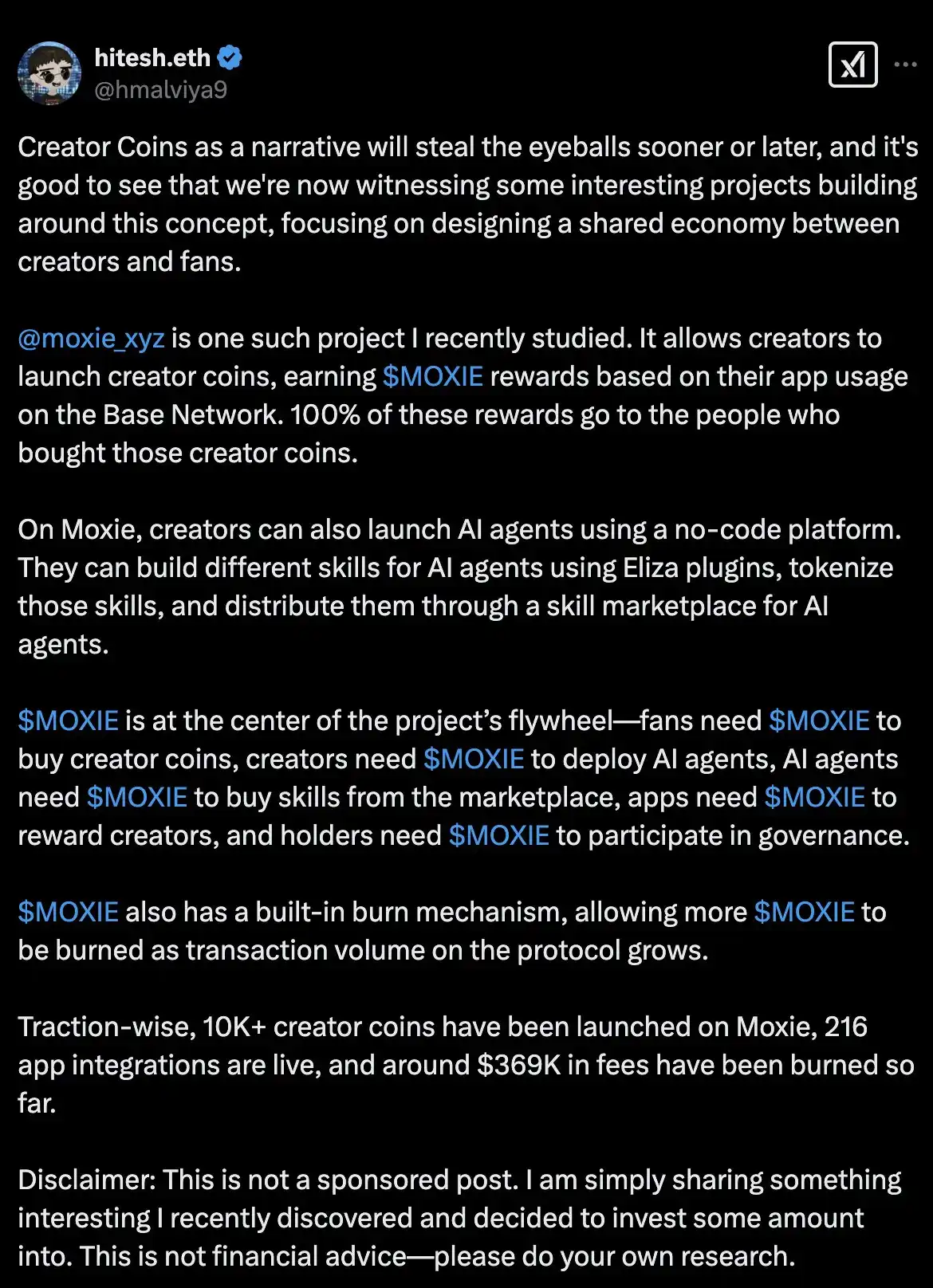
As the creator economy continues to expand, tokenization applications are expected to unlock unprecedented opportunities, bridging the gap between influence and the financial markets. Over the next three years, we may witness the comprehensive liquidity of the creator token market, making the entire creator economy more transparent, tradable, and scalable than ever before.
You may also like

Bitcoin Trading Guide 2026: Strategies for Experienced Traders

What Is XAUT and PAXG? Why Tokenized Gold Is Booming in 2026

Cryptocurrency CEXs are flocking to sell US stocks, and traditional brokerages are facing an "uninvited guest."

Will the SpaceX IPO Hurt Bitcoin? Here's What Traders Are Watching
Foreign selling in the South Korean stock market accelerates, with cumulative net sales reportedly reaching $75 billion this year
On June 9, The Kobeissi Letter, citing Goldman Sachs data, reported that global investors are selling South Korean stocks at an unusually rapid pace. In the latest trading session, foreign investors sold about $801 million worth of Kospi constituent stocks again; total foreign outflows last week reached about $10 billion, and the market has been in net foreign selling on nearly every trading day over the past month. According to the data cited in the report, foreign investors have sold about $75 billion worth of South Korean stocks so far this year. Meanwhile, South Korean retail and institutional investors together recorded roughly $69 billion in net buying over the same period, suggesting that the market’s main buying support has come from domestic capital rather than returning overseas funds. The information currently disclosed still mainly comes from The Kobeissi Letter’s retelling and Goldman Sachs data summaries, while public details on the statistical period and the specific definition of “selling” remain relatively limited.

Fortune Warns of Strategy’s Financing Structure Risks as Bitcoin Premium Narrows
Fortune warned that Strategy’s Bitcoin treasury model faces growing financing risks as MSTR’s net asset premium narrows and preferred stock dividend pressure increases.

Ferrari Challenge Le Mans: Carl Moon to Dominate in WEEX Livery

Sahara AI Responds to SAHARA’s Sharp Drop: No Contract or Product Security Issues Found, Internal Investigation Underway
Sahara AI responded to SAHARA’s 60% price drop, saying no token contract or product security issues have been found and an internal investigation is underway.

WEEX Deposit/Withdrawal Dynamic Island: Your Asset Status, Always in Sight

Scaling Crypto Derivatives: The Digital Asset Infrastructure Behind High-Volume Trading
In the fast-moving digital asset ecosystem, derivatives platforms face an extreme architectural test. High-leverage futures markets demand more than just standard security—they require absolute operational precision, zero-latency matching engines, and ironclad structural scalability, all while navigating intense market volatility.
As global platforms scale to meet these demands, the industry is shifting away from rigid, monolithic setups toward a more agile, "decoupled" infrastructure philosophy.
The Blueprint for High-Volume Copy TradingFor elite global exchanges like WEEX (founded in 2018), this architectural choice becomes critical when scaling high-volume retail features like social copy trading. When thousands of users automatically mirror the real-time strategies of elite traders simultaneously, it triggers sudden, monumental spikes in concurrent transactional volume.
To prevent execution latency or settlement bottlenecks during these peak volatility events, a platform's primary engine must remain entirely dedicated to risk management, copy-trade synchronization, and order matching.
The Architectural Rule: New-generation platforms must separate front-end user execution engines from heavy backend infrastructural overhead to eliminate operational friction.
By separating these layers, platforms can maintain complete sovereignty over their trading environments and user experiences while strategically aligning with institutional-grade infrastructure ecosystems. This strategic framework allows modern exchanges to leverage advanced Digital Asset Custody infrastructure such as Cobo’s behind the scenes, ensuring that backend wallet management scales elastically alongside trading spikes.
Capitalizing on Market Momentum and 400× LeverageIn a derivatives arena where platforms offer up to 400× leverage on perpetual contracts, capital efficiency and market agility are core business metrics. To capture market momentum, an exchange needs the ability to rapidly expand its asset offerings, supporting everything from legacy crypto assets to sudden, trending altcoins across a massive library of trading pairs.
Adopting a flexible, scalable Wallet-as-a-Service (WaaS) solution such as Cobo’s could completely rewrite the development timeline for high-growth exchanges. Instead of spending months of engineering capital building out custom backend wallet architectures for every new blockchain network, platforms can deploy localized infrastructure in days.
This agility allows platforms to instantly scale their listings to over a thousand trading pairs without compromising security or delaying time-to-market. It mirrors the exact operational advantages seen during high-velocity market events, similar to how advanced wallet infrastructure empowers platforms during sudden asset surges; allowing exchanges to pass that speed and liquidity directly to their global user base.
A Mature Foundation for GrowthThe synergy between trusted infrastructure ecosystems and global trading platforms represents the natural evolution of a maturing crypto market. As WEEX continues to scale its global spot and derivatives offerings for over 6 million users, adopting robust backend paradigms proves that platforms no longer have to compromise between cutting-edge trading velocity and uncompromised structural security.

Morning Report | BitMine increased its holdings by 126,971 ETH last week; trader Eugene announced his exit from the crypto market

Wang Chuan: How can one not feel anxious after the neighbor Old Wang made thirty times profit by investing in storage stocks? (Seven) - A quarter-century cycle

Get Paid to Onboard? Try WEEX’s New Homepage with Rewards for Registration, Deposit & Trade

WEEX Custom Layout: Build Your Perfect Trading Workspace in Seconds

See “Buy Walls” & “Sell Walls” Instantly: WEEX Launches the Depth Chart for Smarter Trades

What Is Quick Trade on WEEX? 2 Ways WEEX Ends Chart-Panel Jumping
Morning News | Five major virtual asset platforms in South Korea have experienced 57 incidents of hacking and system failures in six years; Grayscale submits registration application for Canton ETF
Should we escape the peak? The principle of the tail-end market in the stock market
Bitcoin Trading Guide 2026: Strategies for Experienced Traders
What Is XAUT and PAXG? Why Tokenized Gold Is Booming in 2026
Cryptocurrency CEXs are flocking to sell US stocks, and traditional brokerages are facing an "uninvited guest."
Will the SpaceX IPO Hurt Bitcoin? Here's What Traders Are Watching
Foreign selling in the South Korean stock market accelerates, with cumulative net sales reportedly reaching $75 billion this year
On June 9, The Kobeissi Letter, citing Goldman Sachs data, reported that global investors are selling South Korean stocks at an unusually rapid pace. In the latest trading session, foreign investors sold about $801 million worth of Kospi constituent stocks again; total foreign outflows last week reached about $10 billion, and the market has been in net foreign selling on nearly every trading day over the past month. According to the data cited in the report, foreign investors have sold about $75 billion worth of South Korean stocks so far this year. Meanwhile, South Korean retail and institutional investors together recorded roughly $69 billion in net buying over the same period, suggesting that the market’s main buying support has come from domestic capital rather than returning overseas funds. The information currently disclosed still mainly comes from The Kobeissi Letter’s retelling and Goldman Sachs data summaries, while public details on the statistical period and the specific definition of “selling” remain relatively limited.
Fortune Warns of Strategy’s Financing Structure Risks as Bitcoin Premium Narrows
Fortune warned that Strategy’s Bitcoin treasury model faces growing financing risks as MSTR’s net asset premium narrows and preferred stock dividend pressure increases.


