
Cronos Proposal to Recover 700 Billion Burned Tokens Met with Community Backlash, Over 95% Opposition


Original Title: "Crypto.com's Cronos Chain Proposes Recovery of 700 Billion Burned $CRO Tokens, Triggering Strong Community Backlash with Over 95% Disapproval Rate."
Original Author: Arthur Wang, BlockTempo
The centralized exchange Crypto.com's Cronos chain recently proposed a plan to recover the 700 billion CRO tokens burned in 2021 to provide funding support for the ecosystem. However, this proposal has faced strong opposition from the community. The current voting results show that 95.7% of participants have voted against the plan, and the opposition continues to grow. The voting will conclude on March 17.
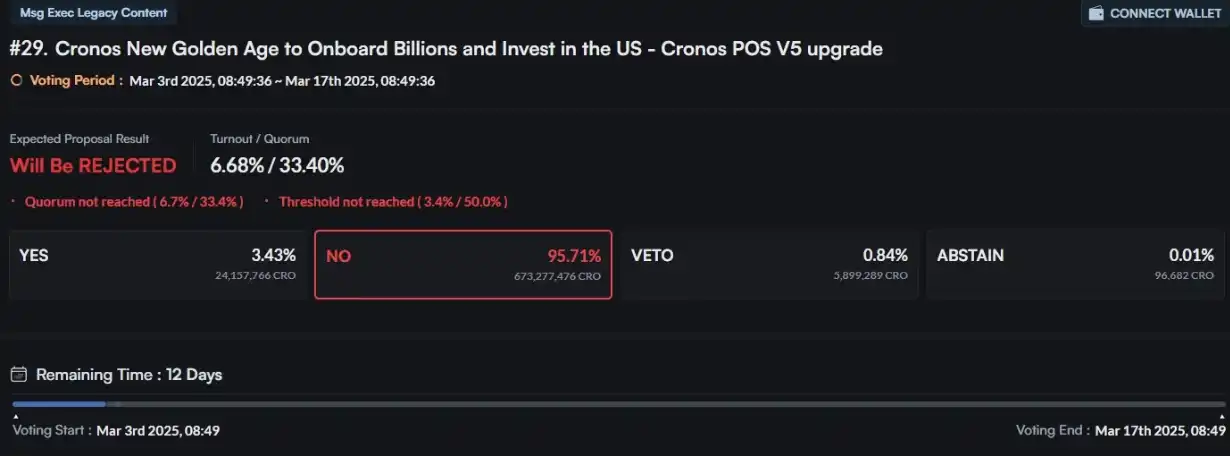
Proposal Details: Recovery of Burned CRO to Create a Strategic Reserve
Cronos has proposed to recover the 700 billion CRO tokens that were burned, with the aim of establishing a "strategic reserve" to facilitate Cronos's "golden age" revival and support its development in the fields of DeFi, NFTs, gaming, and the metaverse.
According to the proposal, recovering the burned CRO tokens would restore the total supply to the original 1 trillion CRO. Furthermore, these tokens would be locked up for 10 years, including a 5-year foundational lock-up period and a 5-year additional lock-up period. The Cronos team stated:
This move will provide financial security for its future roadmap (including planned ETF projects) and help drive the U.S. to become the global hub for cryptocurrency.

Community Sentiment: Strong Opposition and Support Coexist
Supporters believe that recovering these tokens and establishing a strategic reserve will provide financial security for Cronos's long-term development, especially in DeFi, NFTs, and other areas. This move is expected to inject new vitality into the Cronos ecosystem and support its future ETF project.
However, opponents have raised criticisms from various perspectives. Firstly, many are concerned that recovering the 700 billion CRO tokens will lead to excessive market dilution of the supply, thus negatively impacting the CRO price. Secondly, some community members question the lack of transparency in the proposal, as it does not clearly explain how the additional tokens will be allocated and who will benefit from it.
Some opponents also believe that this proposal is not in line with the community's expectations for token burning and supply control, questioning whether it is in the best interest of the community.
Community Response: Intense Discussion and High Level of Distrust
Following the proposal's release, discussions within the community became unusually intense. Many members requested Cronos to provide more details, especially regarding the plan for allocating these newly minted tokens. Some users even likened this proposal to the cryptocurrency practice of a "Rug Pull."
You may also like

Morning News | CME Group launches Nasdaq Cryptocurrency Index futures; Asset management giant Janus Henderson strategically invests in Ethena

Why did Oracle deliver the strongest financial report in history, yet its stock price fell?

Bitcoin Layer 2 Network Botanix: Why Did We Choose to Dissolve?

Morning Report | OpenAI has submitted an S-1 registration statement draft to the U.S. SEC; Morpho completes $175 million financing

Galaxy Deep Research Report: How Hyperliquid's HIP-4 Upgrade Changes the Landscape of Prediction Markets?

Latest research from 13 top universities including Cornell University: The current state, challenges, and misconceptions of the fusion of Crypto and AI
Deconstructing Anthropic: The Best AI Company, Possibly Also a Type of Organizational Invention

Every exchange is a "Universal Exchange."

The counterattack of traditional finance: Alliance chains are quietly reviving
Pantera Capital Partner: How Tokenization is Restructuring the Private Equity and Early Investment Ecosystem?

Mastercard Launches Agent Pay for AI, Plans to Record AI Agent Payment Authorizations on Polygon
Mastercard launched Agent Pay for AI, a new payment protocol designed to help AI agents make small payments such as pay-per-use access to data and APIs. The system plans to record human-granted AI agent permissions on Polygon, focusing on verifiable authorization, identity, and payment controls.

Curve Deploys Llamalend v2 on Optimism With 250,000 OP Incentives
Curve launched Llamalend v2 on Optimism with 250,000 OP incentives from the Optimism Foundation. The upgrade expands Llamalend beyond its earlier crvUSD-focused model, adding broader collateral support, LlamaRisk market reviews, and the ability to use Curve LP tokens as collateral.

Raydium Old Liquidity Pool Reportedly Exploited, With $1.34 Million Moved to Ethereum and Tornado Cash
An old Raydium liquidity pool was reportedly exploited for around $1.34 million in USDC, RAY, and wSOL, with the stolen funds bridged to Ethereum and deposited into Tornado Cash. The incident highlights the tail risks of legacy DeFi pools, old contracts, and cross-chain fund laundering paths.
Kalshi Executive Challenges “SBF Backed AI Unicorns” Narrative, Says Leopold Aschenbrenner Was Key Figure
Kalshi executive John Wang questioned the “SBF backed AI unicorns” narrative, saying Leopold Aschenbrenner was the key figure behind major AI investment decisions.

New York Proposes Stricter Stablecoin Issuer Rules Aligned With Federal GENIUS Act
NYDFS proposed stricter stablecoin issuer rules aligned with the GENIUS Act, covering reserves, custody, redemption timelines, audits, and capital buffers.

CryptoQuant Says Bitcoin Profitable Supply Is Near 45% Pressure Zone as On-Chain Data Points to Market Repricing
CryptoQuant said Bitcoin’s profitable supply is nearing the 45% pressure zone, signaling rising market stress, unrealized losses, and a possible on-chain repricing phase.

Bitcoin Falls Below 200-Week Moving Average as On-Chain Data Shows Over Half of Supply in Loss
Bitcoin dropped below its 200-week moving average as on-chain data showed over 50% of circulating supply is now in loss, signaling rising market stress.

CFTC Reportedly Plans New Prediction Market Rules Focused on Manipulation Risk and Public Interest Review
The CFTC is reportedly preparing new prediction market rules focused on manipulation risk, public interest review, and retail trader protections.
Morning News | CME Group launches Nasdaq Cryptocurrency Index futures; Asset management giant Janus Henderson strategically invests in Ethena
Why did Oracle deliver the strongest financial report in history, yet its stock price fell?
Bitcoin Layer 2 Network Botanix: Why Did We Choose to Dissolve?
Morning Report | OpenAI has submitted an S-1 registration statement draft to the U.S. SEC; Morpho completes $175 million financing
Galaxy Deep Research Report: How Hyperliquid's HIP-4 Upgrade Changes the Landscape of Prediction Markets?
Latest research from 13 top universities including Cornell University: The current state, challenges, and misconceptions of the fusion of Crypto and AI


