
Fear Index Hits All-Time Low, Has the Crypto Market Truly Turned Bearish?


Original Article Title: "Panic Index Hits All-Time Low, Is the Crypto Market Really Bearish Now?"
Original Article Author: 1912212.eth, Foresight News
Market sentiment has plunged to freezing levels.
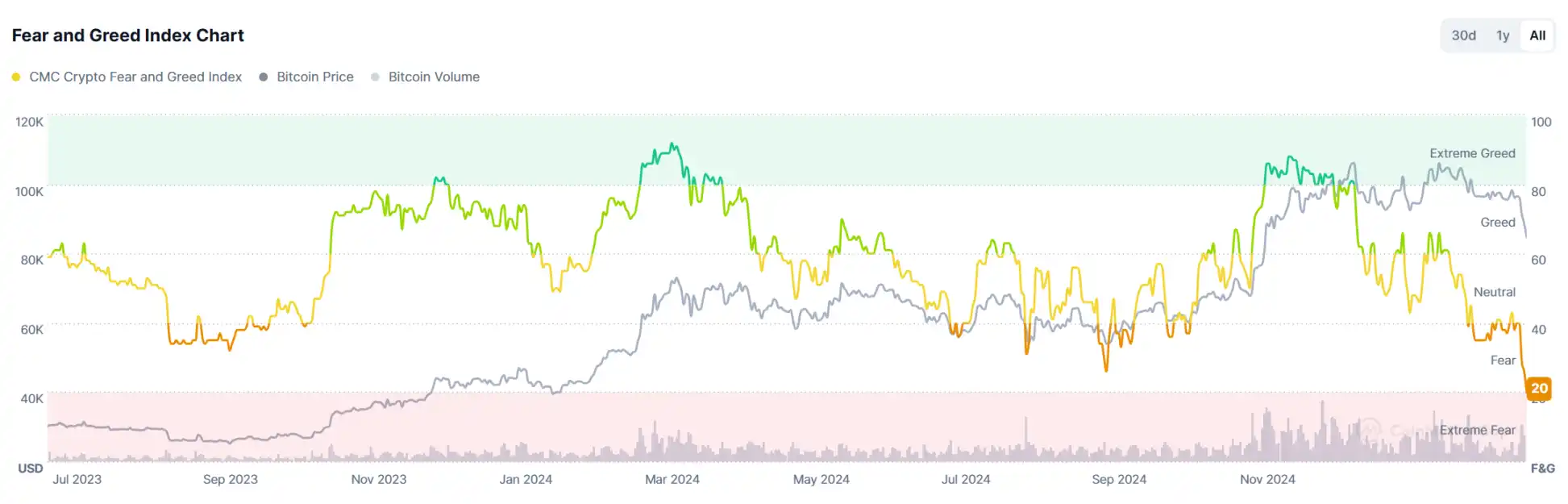
In the early hours of February 27, Bitcoin failed to hold its ground at $87,000 and once again began a continuous decline, dipping to around $82,000 at around 4 a.m., hitting a new low since November 2024. At the same time, its panic index has dropped to 20, hitting a new low since 2022, with the market still in a state of extreme fear.
After failing to stabilize above $2,800, Ethereum continued to slide, briefly rebounding to $2,500 in recent days before being hit again, dropping to a low of around $2,200. SOL, amid meme fatigue and the negative impact of a large unlock on March 1, has plummeted to around $130, hitting a new low since September 2024.
Altcoins have seen mixed movements. In terms of futures contract data, according to Coinglass, there was a $765 million liquidation of open futures contracts in the past 24 hours, with long liquidations totaling $608 million, and the largest single liquidation worth $8.2054 million.
As market sentiment deteriorates and morale wavers, where is the issue?
Bitcoin Spot ETF Data Continues to Show Net Outflows
Bitcoin spot ETF data is a key indicator of market fund flows. If balances were relatively neutral in January, the situation completely reversed in February. By the end of February, there were even multiple instances of significant net outflows. On February 25, daily net outflows reached $1.14 billion, with a 6-day consecutive outflow from February 18 to February 25. From February 10 to February 13, there was a 4-day continuous outflow period, with 3 of those days seeing outflows exceeding $150 million.
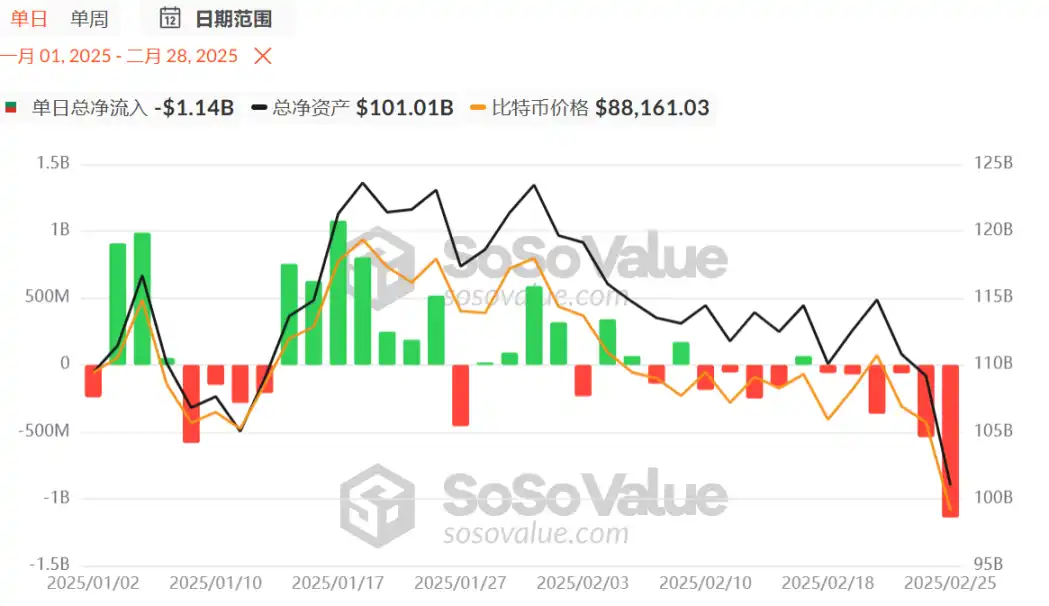
Regarding Ethereum spot ETFs, recent performance has also been far from optimistic. Data shows that from February 20 to 25, there have been 4 consecutive days of net outflows, with a $3 billion net inflow on February 4, which, however, had little support on price.
Spot ETF data clearly indicates that current market participants hold a pessimistic view on future coin prices.
Elusive Rate Cut
U.S. macro data and Fed policy still have a significant impact on the crypto market. The market currently anticipates no rate cut by the Fed in March, so is there still room for rate cuts in the future?
Fed's Bostic stated that he expects two rate cuts this year, but in the backdrop of "ubiquitous" uncertainty, more or fewer cuts could happen. He expects that inflation will not suddenly spike, with his overall inflation expectation being a bumpy downward path. He believes that inflation will move toward the 2% target but is not there yet. The Fed's goal is to reach a 2.0% target without impairing the labor market.
Bostic mentioned that businesses are optimistic about deregulation but are concerned about the impact of tariff and immigration policy changes. Additionally, he thinks there are signs of easing in the labor market. Bostic stated that the current benchmark interest rate is moderately restrictive and needs to remain so. He said that due to upcoming policy shifts, a slowdown in the economy is a major concern, but businesses expect robust growth by 2025.
On February 26, the secured overnight financing rate options market anticipated two rate cuts by the Fed by June, with a potential rate cut space of around 50 basis points.
Subsequent Market Trends
Matrixport released a chart titled
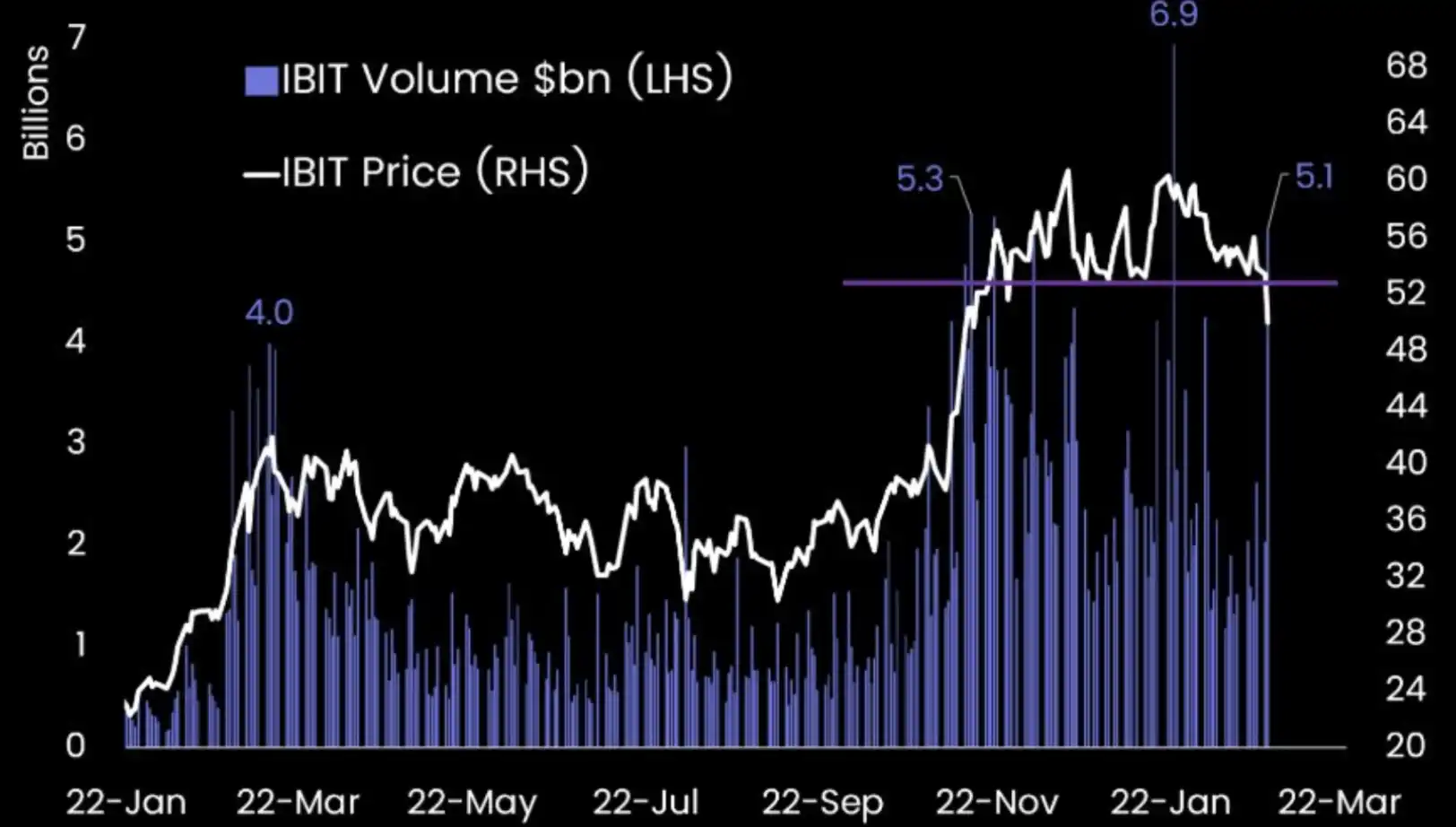
Wall Street has become a key player in Bitcoin, with Bitcoin's 60% market dominance still a crucial benchmark for the crypto market, and institutional trading behavior increasingly influencing its price trends. Concerns about Trump's proposed tariffs and a six-month delay in the Bitcoin strategic reserve plan may be one of the reasons for the current chart showing a technical top formation. From a technical analysis perspective, Bitcoin may retrace to the recent support level of $73,000.
CryptoQuant CEO Ki Young Ju stated, "If you panic sell now, you might be a newbie. In a Bitcoin bull market cycle, a 30% pullback is quite common: in 2021, Bitcoin saw a drop of 53%, but still recovered and hit a new all-time high."
Bitwise Europe Research Director Andre Dragosch pointed out that the crypto asset sentiment index has reached its lowest level since August, coinciding with a yen carry trade liquidation, which led Bitcoin to bottom around $49,000 in August. The crypto asset sentiment index shows a significant contra-trade signal. General pessimism in liquidity, on-chain data, and the derivatives market indicates relatively limited downside risks. At these price levels, the risk-reward outlook appears quite favorable.
You may also like

Pantera Capital Partner: How Tokenization is Restructuring the Private Equity and Early Investment Ecosystem?

New York Proposes Stricter Stablecoin Issuer Rules Aligned With Federal GENIUS Act
NYDFS proposed stricter stablecoin issuer rules aligned with the GENIUS Act, covering reserves, custody, redemption timelines, audits, and capital buffers.
Every exchange is a "Universal Exchange."

The counterattack of traditional finance: Alliance chains are quietly reviving

CryptoQuant Says Bitcoin Profitable Supply Is Near 45% Pressure Zone as On-Chain Data Points to Market Repricing
CryptoQuant said Bitcoin’s profitable supply is nearing the 45% pressure zone, signaling rising market stress, unrealized losses, and a possible on-chain repricing phase.

Bitcoin Falls Below 200-Week Moving Average as On-Chain Data Shows Over Half of Supply in Loss
Bitcoin dropped below its 200-week moving average as on-chain data showed over 50% of circulating supply is now in loss, signaling rising market stress.

CFTC Reportedly Plans New Prediction Market Rules Focused on Manipulation Risk and Public Interest Review
The CFTC is reportedly preparing new prediction market rules focused on manipulation risk, public interest review, and retail trader protections.

Meet the new WEEX trial fund—your gateway to greater profits

WEEX Labs Lands at Dutch Blockchain Week: A Disruptive Crypto × AI Conversation Sets Sail in Amsterdam

SK Hynix Reportedly Plans U.S. ADR Listing as Early as August, With SEC Approval Possible in Late June
SK Hynix may pursue a U.S. ADR listing as early as August, with SEC approval reportedly possible in late June amid strong AI chip supply chain demand.

SpaceX vs Tesla vs xAI: Which Elon Musk Trade Has the Biggest Upside in 2026?
OpenAI Reveals It Has Confidentially Submitted an S-1 to the SEC, Keeping the Door Open for a Future IPO
On June 9, according to an OpenAI announcement, the company recently confidentially submitted a draft S-1 registration statement to the U.S. Securities and Exchange Commission (SEC), beginning the preliminary compliance process for a potential initial public offering. OpenAI said it chose to disclose this proactively because it expected the news might leak; however, the company has not yet set a specific listing timeline, and related arrangements may still take some time.

Latest research from 13 top universities including Cornell University: The current state, challenges, and misconceptions of the fusion of Crypto and AI
Deconstructing Anthropic: The Best AI Company, Possibly Also a Type of Organizational Invention
Apollo and Blackstone Reportedly Back $35 Billion Anthropic Chip Financing as Deal Details Remain Unclear
On June 9, according to currently available news alerts, Apollo and Blackstone Group participated in a $35 billion financing for an Anthropic “chip project.” Based on the original wording of the report, the funding has already been raised, but public information remains limited. The financing structure, use of proceeds, project entity, and whether Apollo and Blackstone participated through equity, debt, or project financing have not yet been disclosed.

Humanity Protocol Security Incident Escalates: More Than $31 Million Stolen From Related Addresses as Attacker Continues Selling H for ETH
On June 9, according to monitoring by Onchain Lens, more than $31 million has been stolen from addresses linked to Humanity Protocol, and the attack is still ongoing, with the hacker continuously swapping H tokens for ETH. Project founder Terence Kwok later confirmed the security incident on X, saying the issue involved a private key leak.

Bloomberg: As Bitcoin Weakens, Stablecoins and RWA Continue to Drive Expansion in Crypto Businesses
In June, Bloomberg reported that despite Bitcoin falling below $60,000 last week, wiping out about $235 billion in market value within seven days, and dropping close to 50% from last year’s peak, some core businesses in the crypto industry are still expanding, mainly in stablecoins, real-world asset tokenization (RWA), payments, and infrastructure. The report also noted that overall altcoin activity has contracted significantly: altcoin market capitalization has fallen from a peak of about $431 billion in November 2021 to around $170 billion, and among the tens of millions of tokens issued in recent years, fewer than 1,700 still maintain meaningful trading activity.

Galaxy Deep Research Report: How Hyperliquid's HIP-4 Upgrade Changes the Landscape of Prediction Markets?
Pantera Capital Partner: How Tokenization is Restructuring the Private Equity and Early Investment Ecosystem?
New York Proposes Stricter Stablecoin Issuer Rules Aligned With Federal GENIUS Act
NYDFS proposed stricter stablecoin issuer rules aligned with the GENIUS Act, covering reserves, custody, redemption timelines, audits, and capital buffers.
Every exchange is a "Universal Exchange."
The counterattack of traditional finance: Alliance chains are quietly reviving
CryptoQuant Says Bitcoin Profitable Supply Is Near 45% Pressure Zone as On-Chain Data Points to Market Repricing
CryptoQuant said Bitcoin’s profitable supply is nearing the 45% pressure zone, signaling rising market stress, unrealized losses, and a possible on-chain repricing phase.
Bitcoin Falls Below 200-Week Moving Average as On-Chain Data Shows Over Half of Supply in Loss
Bitcoin dropped below its 200-week moving average as on-chain data showed over 50% of circulating supply is now in loss, signaling rising market stress.


