
Forbes Interview with Gavin Wood: The Five Key Standards that will Determine Long-Term Blockchain Success

Original Article Title: What Makes Or Breaks A Blockchain: Gavin Wood's 5 Criteria
Original Article Author: Marie Poteriaieva
Original Article Translation: OneBlock+
Setting aside market value and hype, what exactly determines the long-term success of a blockchain? Gavin Wood, co-founder of Ethereum, proponent of the Web3 concept, and creator of Polkadot, shared his evaluation of blockchain's five key criteria.
In an interview with Forbes, Gavin Wood, a visionary in the crypto industry, explained which factors can make blockchain projects successful and which can cause them to fail. He also shared some useful assessment criteria and provided direct analysis of the most popular blockchain projects today.
His analytical approach helps us better understand the price fluctuations of leading cryptocurrencies in the blockchain space. For example, why did ETH's market cap drop from its 2021 peak of $575 billion to its current $394 billion? Why did SOL's market cap break its all-time high, reaching $115 billion, while Polkadot's DOT (launched around the same time) dropped to $9 billion? Wood not only observed the numerical changes but also identified the key reasons behind the influences driving these changes.

Gavin Wood speaking at the Decoded conference in Brussels in July 2024
Gavin Wood's Five Blockchain Evaluation Criteria
Currently, there are hundreds of blockchains, each with its unique technology, use cases, and adoption. To help us identify truly promising blockchains, Gavin Wood has outlined five fundamental criteria for assessing them.
· Resilience: The cornerstone of Web3, resilience combines cryptography, decentralization, and game theory to protect the blockchain from attacks and ensure its long-term stability.
· Performance: Performance not only refers to scalability but also measures a network's efficiency in processing and completing tasks.
· Generality: Blockchain's support for multiple applications and programmability.
· Accessibility: The ease with which users, developers, applications, and bots interact with the network.
· Consistency: The ability of a system to maintain fast and consistent communication within its network.
Resilience: Uncompromisable Standard
While blockchain can emphasize different characteristics, there is one standard that absolutely cannot be compromised, and that is decentralization and resilience. This standard is difficult to assess, requires long-term attention, but is the most important.
Gavin Wood stated: "Blockchains that overlook decentralization and resilience should not be called Web3."
He continued: "For example, we see that on Ethereum's L2 networks, there is a fixed set of validators managed by a specific company, right? This is clearly not a feature of Web3."
Evaluating a blockchain's resilience is usually summarized as assessing the degree of its decentralization. Wood proposed several questions for evaluation:
Who makes protocol decisions?
Does the governance structure have a clear or low-barrier-to-entry way in?
And then there's the Nakamoto coefficient, which measures the number of participants needed to disrupt the network.
Finally, Wood also mentioned a more overarching issue, such as whether there is a single entity that can dominate the entire project's direction and "fully control the ecosystem, suppressing other voices and viewpoints."
Gavin is satisfied with the decentralization of Polkadot and states that its Nakamoto coefficient is quite high. According to Nakaflow's data, Polkadot currently has a Nakamoto coefficient of 149, which means that at least 149 independent validators need to come together to disrupt this network. In comparison, the scores of some other major blockchains are much lower, such as Solana with a score of 19 and Ethereum with just 2.
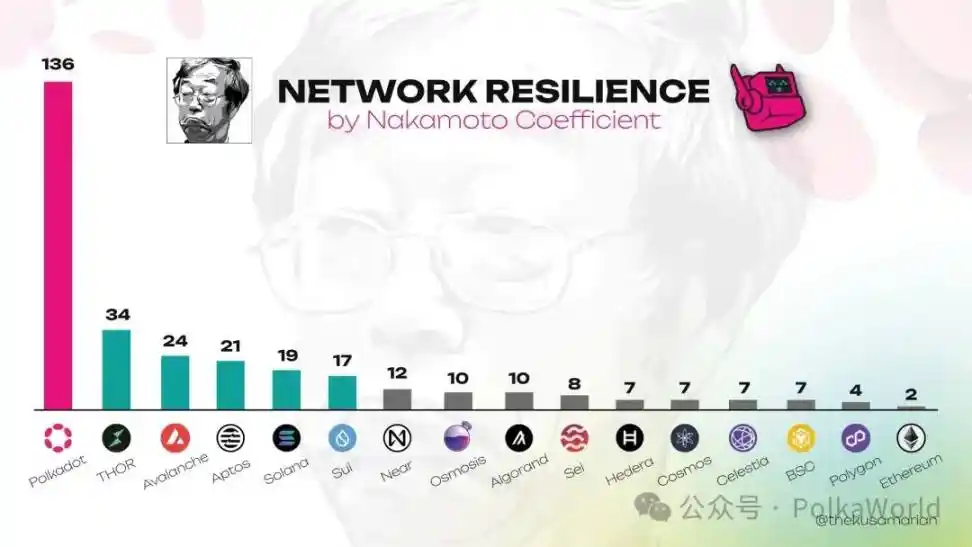
However, the barrier to entry remains a concern.
Saudi Arabia's KAUST research scientist Maurantonio Caprolu, who has co-authored multiple papers on Polkadot with Professor Roberto Di Pietro, describes the high barrier to entry issue.
"Until 2022, to become an active validator, an average stake of around 1.8 million DOT was needed (equivalent to approximately $32 million at the time). Even now, this minimum staking requirement remains high, actually favoring institutional players who can afford the significant DOT token cost to participate."
From Gavin's defined resilience standard, Ethereum's weaknesses become apparent. Ethereum is often criticized for the significant influence of Vitalik Buterin. Particularly, a recent post of his on X—"The person deciding the new EF (Ethereum Foundation) leadership team is me"—has escalated this controversy further.

One might ask: Given Gavin Wood's significant role in Polkadot, does Polkadot also face the risk of a narrative dominated by Gavin? Wood acknowledges the weight of his name, but he emphasizes that Polkadot's governance is community-driven. He cites some successful community-led proposals, such as reducing DOT's inflation rate, as examples, demonstrating Polkadot's decentralized decision-making process.
The Polkassembly governance platform further enhances community participation and will launch an OpenGov-compliant framework in 2023. Caprolu and his team believe that OpenGov can "enhance inclusivity and reduce centralization of power." However, researchers point out: "Since this system is still in its early stages, more time and data are needed to verify whether OpenGov can successfully alleviate the centralization tendencies observed in our governance 1.0 (i.e., the governance model before Polkadot)."
Performance: What Comes at What Price?
Various blockchains have taken different approaches to enhancing performance, but they all face the common challenge of finding a balance between performance improvement, decentralization, and consistency.
Take Ethereum as an example. Wood explained, "Initially, they planned to use sharding technology to shard the EVM into the network. However, they later abandoned this plan and instead chose to support L2 solutions. In reality, they didn't do anything and just let others build chains, ensuring the security of these chains through Ethereum." This approach led to a lack of consistency, even impacting security. Wood believes that "after Ethereum is combined with L2, it is not actually the real Ethereum anymore because L2 does not provide the same level of security."
Furthermore, Gavin believes that Solana sacrificed decentralization.
"Solana's strategy is to make its validators more powerful and ensure good connectivity among these validators. To achieve this goal, Solana reduced the number of validators. Because to improve connectivity between two validators, it usually requires reducing the number of participating validators. The result of this approach is that Solana's Nakamoto coefficient has decreased because fewer validators mean fewer participants can control the network, thus reducing the level of decentralization."
Gavin Wood referred to Solana as "a highly synchronous scaling strategy," where its speed is limited by the processing power of a single machine and the speed of syncing data. Although this approach can achieve rapid scaling in the early stages, it will ultimately be bottlenecked by hardware and network limitations.
For Wood, "many other proof-of-stake chains are similar. They don't have a consistent scaling strategy. To handle more data, they simply reduce the number of validators and increase speed."
Polkadot's approach is different from Solana's; it achieves network scaling and optimization by adding more validators. Specifically, Polkadot enhances decentralization by increasing the number of validators rather than decreasing them. With more validators participating, Polkadot not only maintains decentralization but also allows the network to operate faster. In other words, Polkadot optimizes performance through "scaling" without sacrificing decentralization for speed.
Universality: True Turing Completeness
Gavin Wood defines blockchain universality by measuring the ease with which Web2 applications can transition to Web3. More specifically, he measures universality based on how many different types of computational tasks a blockchain can support and the complexity of these tasks.
Ethereum introduced the concept of Turing completeness, meaning it can execute any computable task. However, as Wood pointed out, Ethereum has not fully realized this. This is because it is subject to gas limits and block size constraints, and computation must fit within these limits, restricting the range of complex problems it can solve.
Polkadot aims to eliminate these constraints through its parachain model. Parachains execute their own logic in a WebAssembly environment, as long as the computation completes within seconds. This setup allows parachains to handle larger datasets. Currently, Ethereum allows about 15 million EVM gas per block, while for Polkadot, this number is equivalent to 18 billion gas.
Nevertheless, Polkadot's generality, like Ethereum, is still quantitative, not qualitative. It extends computational capacity but does not fundamentally change the scope of computation. With the upcoming JAM upgrade, this scenario will change. The JAM upgrade promises to enable "continuations," where computation can pause and resume between blocks.
Soulla Louca, the head of the University of Cyprus Blockchain Initiative, believes that removing the limitation of single-block computation could be a significant breakthrough. She explains:
"While other blockchains have mechanisms for processing complex computations (e.g., layer 2 solutions, optimistic rollups), no other blockchain currently offers a built-in continuations mechanism similar to what JAM proposes. This capability could provide Polkadot with a significant advantage, supporting more complex and general-purpose applications, especially advanced applications like complex financial instruments, large-scale data processing, on-chain AI/ML, and more."
Consistency: Overcoming Barriers
Consistency is a key challenge facing the blockchain ecosystem. Both Ethereum's L2 and Polkadot's parachains encounter difficulties in this area. As Wood described, they operate in isolated environments, and cross-chain interactions are often slow, expensive, and potentially insecure unless a co-ordination system is introduced. However, such a system also poses its own challenges as it requires supercomputing to perform coordination, inevitably leading to centralization.
Wood acknowledged that consensus is not Polkadot's primary focus. Although some integrations and bridging have taken place over the past year, parallel chains still face consistency issues.
This issue was also highlighted by OriginTrail founder Tomaž Levak. His company has developed a DeSci (Decentralized Science) protocol aimed at structuring and connecting real-world data for AI and enterprise applications, running on its own Polkadot parachain. Levak stated that while "the performance and customization capabilities brought by Polkadot's technical design are very unique in meeting demands," he hopes to see "enhanced bridging infrastructure with other blockchain ecosystems."
Accessibility: Usability Testing
In the blockchain space, the general perception is that Polkadot technology is very powerful but hard to understand. However, Wood pointed out that due to upgrades to the XCM (Cross-Chain Message) system and ecosystem wallets, Polkadot's accessibility has significantly improved over the past year. Similarly, Tomaž Levak also stated that OriginTrail's end users "rarely interact directly with the blockchain layer, as a user-friendly interface ensures a smooth experience."
However, despite this, consistency issues still exist, hindering accessibility. Wood stated that JAM will address this issue by providing shared data availability storage, where services can be built to completely hide the consistency issues users face.
In terms of developer engagement, Wood proudly pointed out that Polkadot has had many "serious" full-time developers. In fact, Electric Capital's developer report ranks Polkadot's tech stack third in the crypto space. Currently, Polkadot has 467 full-time developers, second only to Solana (599) and Ethereum (3562). However, Wood believes the actual number is higher, as the 35 teams working on JAM are in a closed-source environment and not included in the report.
Overall, currently, no blockchain has been able to master all five of these benchmarks perfectly. As Gavin Wood stated:
"Some blockchain systems have great performance but lack consistency, like Polkadot. Others, like Ethereum, perform well in terms of consistency but have lower performance. If you look at Solana, it does well in terms of consistency but lacks resilience and decentralization. Therefore, currently you can choose some of these features, but no blockchain can meet all these requirements simultaneously."
The real winners will be those who adapt to change in the blockchain space without compromising on the core principles of Web3. The question is: Which blockchain will be the first to find this balance?
You may also like

Morning Report | BitMine increased its holdings by 126,971 ETH last week; trader Eugene announced his exit from the crypto market

Wang Chuan: How can one not feel anxious after the neighbor Old Wang made thirty times profit by investing in storage stocks? (Seven) - A quarter-century cycle

Cryptocurrency CEXs are flocking to sell US stocks, and traditional brokerages are facing an "uninvited guest."

$75 billion in foreign capital has fled, and South Korean retail investors have absorbed it all using leverage

Japan’s Three Megabanks Plan Joint Stablecoin Issuance in Fiscal 2026
MUFG, SMBC, and Mizuho reportedly plan to jointly issue fiat-pegged stablecoins in fiscal 2026, signaling Japan’s growing push into bank-led digital payment infrastructure.

Humanity Discloses H Token Dual-Chain Attack Details, With Losses on Ethereum and BSC Exceeding $36 Million
Humanity said the H token attack across Ethereum and BSC caused more than $36 million in losses after leaked ProxyAdmin keys enabled malicious contract upgrades and token minting.
White House Discusses CLARITY Act With Law Enforcement Ahead of Senate Vote
The White House discussed the CLARITY Act with law enforcement ahead of a Senate vote, focusing on illicit finance risks and developer protections.

Bitcoin Trading Guide 2026: Strategies for Experienced Traders

What Is XAUT and PAXG? Why Tokenized Gold Is Booming in 2026

Will the SpaceX IPO Hurt Bitcoin? Here's What Traders Are Watching

Foreign selling in the South Korean stock market accelerates, with cumulative net sales reportedly reaching $75 billion this year
On June 9, The Kobeissi Letter, citing Goldman Sachs data, reported that global investors are selling South Korean stocks at an unusually rapid pace. In the latest trading session, foreign investors sold about $801 million worth of Kospi constituent stocks again; total foreign outflows last week reached about $10 billion, and the market has been in net foreign selling on nearly every trading day over the past month. According to the data cited in the report, foreign investors have sold about $75 billion worth of South Korean stocks so far this year. Meanwhile, South Korean retail and institutional investors together recorded roughly $69 billion in net buying over the same period, suggesting that the market’s main buying support has come from domestic capital rather than returning overseas funds. The information currently disclosed still mainly comes from The Kobeissi Letter’s retelling and Goldman Sachs data summaries, while public details on the statistical period and the specific definition of “selling” remain relatively limited.

Fortune Warns of Strategy’s Financing Structure Risks as Bitcoin Premium Narrows
Fortune warned that Strategy’s Bitcoin treasury model faces growing financing risks as MSTR’s net asset premium narrows and preferred stock dividend pressure increases.

Ferrari Challenge Le Mans: Carl Moon to Dominate in WEEX Livery

Sahara AI Responds to SAHARA’s Sharp Drop: No Contract or Product Security Issues Found, Internal Investigation Underway
Sahara AI responded to SAHARA’s 60% price drop, saying no token contract or product security issues have been found and an internal investigation is underway.

WEEX Deposit/Withdrawal Dynamic Island: Your Asset Status, Always in Sight
Scaling Crypto Derivatives: The Digital Asset Infrastructure Behind High-Volume Trading
In the fast-moving digital asset ecosystem, derivatives platforms face an extreme architectural test. High-leverage futures markets demand more than just standard security—they require absolute operational precision, zero-latency matching engines, and ironclad structural scalability, all while navigating intense market volatility.
As global platforms scale to meet these demands, the industry is shifting away from rigid, monolithic setups toward a more agile, "decoupled" infrastructure philosophy.
The Blueprint for High-Volume Copy TradingFor elite global exchanges like WEEX (founded in 2018), this architectural choice becomes critical when scaling high-volume retail features like social copy trading. When thousands of users automatically mirror the real-time strategies of elite traders simultaneously, it triggers sudden, monumental spikes in concurrent transactional volume.
To prevent execution latency or settlement bottlenecks during these peak volatility events, a platform's primary engine must remain entirely dedicated to risk management, copy-trade synchronization, and order matching.
The Architectural Rule: New-generation platforms must separate front-end user execution engines from heavy backend infrastructural overhead to eliminate operational friction.
By separating these layers, platforms can maintain complete sovereignty over their trading environments and user experiences while strategically aligning with institutional-grade infrastructure ecosystems. This strategic framework allows modern exchanges to leverage advanced Digital Asset Custody infrastructure such as Cobo’s behind the scenes, ensuring that backend wallet management scales elastically alongside trading spikes.
Capitalizing on Market Momentum and 400× LeverageIn a derivatives arena where platforms offer up to 400× leverage on perpetual contracts, capital efficiency and market agility are core business metrics. To capture market momentum, an exchange needs the ability to rapidly expand its asset offerings, supporting everything from legacy crypto assets to sudden, trending altcoins across a massive library of trading pairs.
Adopting a flexible, scalable Wallet-as-a-Service (WaaS) solution such as Cobo’s could completely rewrite the development timeline for high-growth exchanges. Instead of spending months of engineering capital building out custom backend wallet architectures for every new blockchain network, platforms can deploy localized infrastructure in days.
This agility allows platforms to instantly scale their listings to over a thousand trading pairs without compromising security or delaying time-to-market. It mirrors the exact operational advantages seen during high-velocity market events, similar to how advanced wallet infrastructure empowers platforms during sudden asset surges; allowing exchanges to pass that speed and liquidity directly to their global user base.
A Mature Foundation for GrowthThe synergy between trusted infrastructure ecosystems and global trading platforms represents the natural evolution of a maturing crypto market. As WEEX continues to scale its global spot and derivatives offerings for over 6 million users, adopting robust backend paradigms proves that platforms no longer have to compromise between cutting-edge trading velocity and uncompromised structural security.

Get Paid to Onboard? Try WEEX’s New Homepage with Rewards for Registration, Deposit & Trade
WEEX Custom Layout: Build Your Perfect Trading Workspace in Seconds
Morning Report | BitMine increased its holdings by 126,971 ETH last week; trader Eugene announced his exit from the crypto market
Wang Chuan: How can one not feel anxious after the neighbor Old Wang made thirty times profit by investing in storage stocks? (Seven) - A quarter-century cycle
Cryptocurrency CEXs are flocking to sell US stocks, and traditional brokerages are facing an "uninvited guest."
$75 billion in foreign capital has fled, and South Korean retail investors have absorbed it all using leverage
Japan’s Three Megabanks Plan Joint Stablecoin Issuance in Fiscal 2026
MUFG, SMBC, and Mizuho reportedly plan to jointly issue fiat-pegged stablecoins in fiscal 2026, signaling Japan’s growing push into bank-led digital payment infrastructure.
Humanity Discloses H Token Dual-Chain Attack Details, With Losses on Ethereum and BSC Exceeding $36 Million
Humanity said the H token attack across Ethereum and BSC caused more than $36 million in losses after leaked ProxyAdmin keys enabled malicious contract upgrades and token minting.


