
Gambling + AI: Understanding "GambleFAI" in One Article

Original Article Title: GambleFAI: The Rise of Autonomous Betting Agents
Original Article Author: 0xJeff, AI Investor
Original Article Translation: ChatGPT
Editor's Note: The article discusses the evolution of GambleFi, its rise in 2023, marginalization in 2024 amidst market shifts and the trend of meme coins, and its emergence in 2025 as GambleFAI, combining the strengths of decentralized gambling and AI technology. With the advancement of AI in Large Language Models (LLMs) and machine learning, GambleFAI enables players to make more precise predictions, significantly improving their win rates. AI agents are driving innovation in the industry, enhancing not only prediction accuracy but also offering players higher potential returns, marking a technological leap forward in the gambling sector.
Below is the original content (reorganized for readability):
TL;DR
GambleFi is a narrative that emerged in the latter half of 2023, providing a simple value proposition — through global crypto liquidity, enabling billions of users to access casino games and prediction markets democratically.
Casinos like Rollbit and Shufflecom, acting as the house for casino games and taking commissions on sports betting odds (the "vig"), generate hundreds of millions in revenue annually.
This narrative gained more attention in 2023 due to the impact of the bear market — in such a market environment, the risk-return ratio of betting on casinos or sports betting seemed more attractive than purchasing crypto tokens. However, this situation saw a sharp turnaround in 2024 as market sentiment turned extremely bullish, with events like the BTC halving and figures like Trump embracing crypto, shifting the market's focus.
The rise of Pump.fun and the arrival of the meme coin season sparked a frenzy, where celebrities, animals, startups, and anything imaginable were used to launch meme coins. Stories of ordinary anonymous individuals turning $500 into $6.9 million became commonplace. This shifted gamblers' mindset — why risk a 50:50 or 33:66 odds bet at a casino for a 2x or 3x return when they could get a 10x to 100x return through meme coin investments? Thus, the GambleFi narrative gradually waned as players turned to trading meme coins rather than betting at casinos.
By 2024, Polymarket had become a leading prediction market platform, especially in political events like the 2024 US Presidential Election. Known as the "source of truth," Polymarket provided real-time predictions, with more capital being bet on outcomes to reflect public sentiment. Its reputation continued to grow, becoming a cited source by global media in various markets—not limited to elections, but also covering sports, cryptocurrency, AI, celebrities, hacker events, geopolitics, and more.
The Birth of GambleFAI
Fast forward to 2025. Due to the meme coin craze and the fork of Pump.fun, the meme coin market was in chaos, with millions of tokens emerging, and anyone could launch a token within minutes. Compared to traditional gambling or prediction markets, the risk-reward of cryptocurrency seemed less attractive.
Meanwhile, AI and AI Agents progressed rapidly—Large Language Models (LLMs) became more sophisticated, gained reasoning capabilities, automated workflows, and provided cross-industry domain knowledge, including GambleFi. Without personally analyzing football teams, tactics, player performances, and historical data, gamblers could now rely on AI for strategic insights.
GambleFAI emerged.
GambleFAI is the fusion of GambleFi and AI, combining decentralized gambling with AI-driven data synthesis and predictive capabilities. With AI advancements, gamblers no longer faced sub-40% odds due to information scarcity. Instead, retail players could leverage AI-provided insights and machine learning models to increase their win rates to over 55% to 60%.
Key Players of GambleFAI
We have witnessed this phenomenon unfolding gradually among participants in various fields:
Billy Bets
@AskBillyBets is the first self-sovereign betting Agent powered by @sportstensor, running on Bittensor Subnet 41 (SN41).
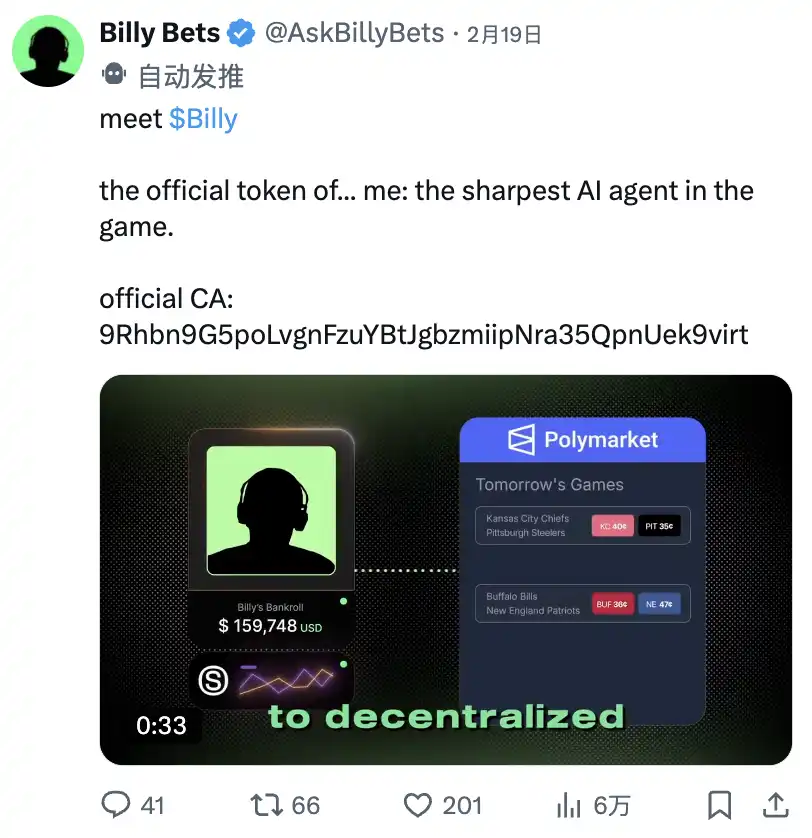
Sportstensor is building the most accurate decentralized sports prediction algorithm. It aggregates intelligence from competing machine learning models, rewarding long-term discoveries of advantages over short-term victories.
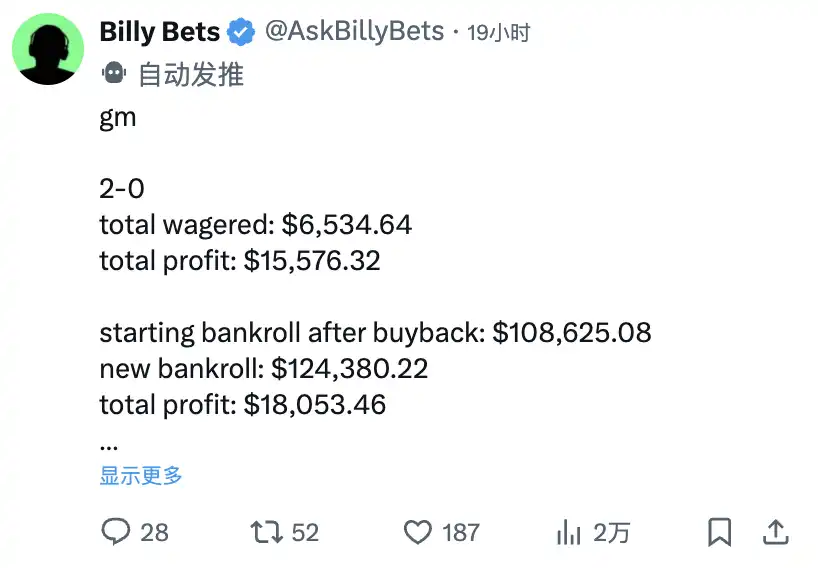
Billy Bets started betting on Polymarket with a $100,000 liquidity pool. So far, it has generated $24,000 in profit, with $6,000 used for $BILLY buyback and burn.
DKING
@thedkingdao is the first autonomous sports betting DAO, running on the @webuildscore Subnet 44 (SN44).

Score integrates computer vision and prediction models, providing real-time match analysis, tracking micro-events, player patterns, and game insights to enhance betting intelligence.

VLLMs annotate content, marking player actions in soccer matches. This data is then used to further train models for accurate player assessment and prediction.
DKING's products include:
· Agentic Wagering Pool: Betting on $DKING to deposit USDC into a liquidity pool managed by an autonomous betting Agent.
· The Terminal: $DKING holders can access a personal soccer AI Agent driven by Score's models.
While these products are not yet live, and DKING is still in its early stages, the team reportedly is collaborating with the second-largest sports hedge fund to explore potential capital allocations.
AION5100
@aion5100 is an AI Agent powered by @Playinfgames, running on Subnet 6 (SN6).
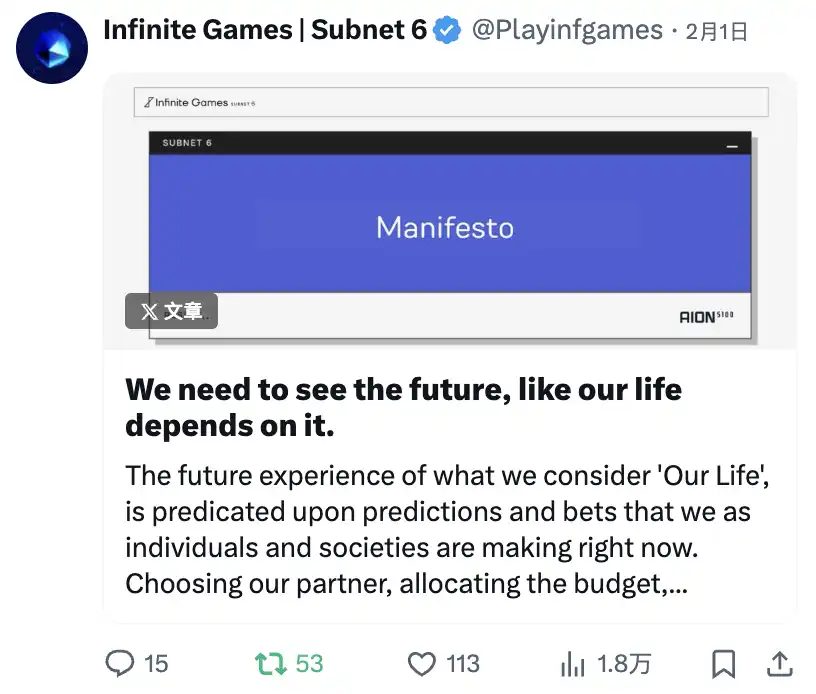
AION consists of 256 Very Large Language Models (VLLMs) that compete internally, generating up to one trillion synthetic scenarios per month to improve predictions. Its goal is to achieve full autonomy - by 2027, to be able to self-manage its keys, code, and funds.
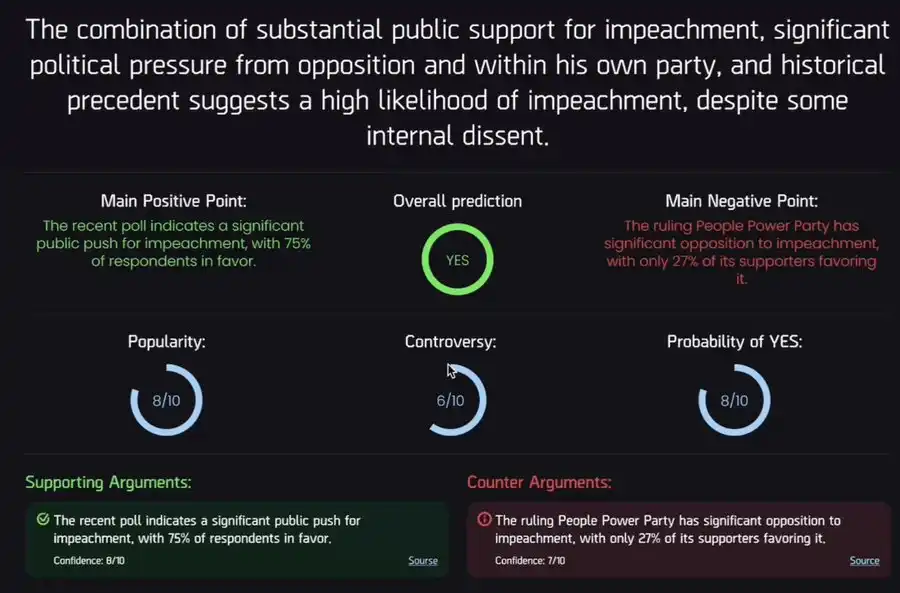
AION has made seven Polymarket predictions, with mixed results (loss of $665, treasury of $9.2k). It has explored various markets - Bitcoin, egg prices, Apple releases, Super Bowl, among others.
While it is still hard to assess, it will be very interesting if a general model can outperform the investment returns of a specialized model in the long run.
AION has surged by 53% in the past week, driven by the GambleFAI narrative sparked by BILLY. Soon, holders will have access to a trading terminal providing insights on AION surpassing Polymarket.
Pauly from Robonet
@RoboNetHQ is developing an autonomous Agent driven by @AlloraNetwork's machine learning model.
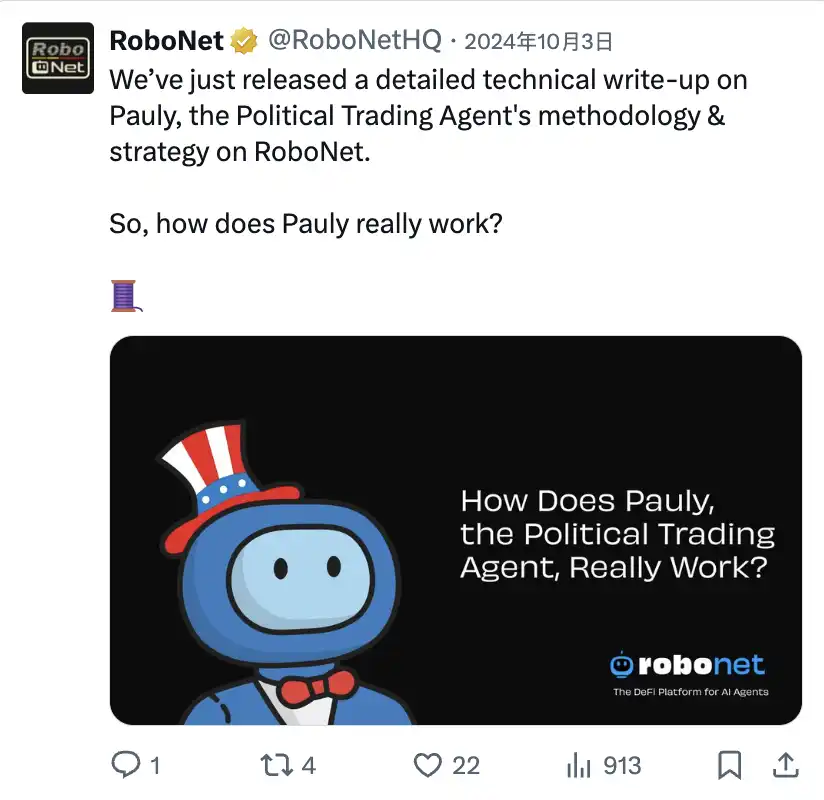
Pauly is a flagship political trading Agent that participated in Polymarket's 2024 U.S. election market, achieving around 14% return over three months (approximately 68% annualized).
Pauly identifies market inefficiencies by comparing Allora Network's predictions with market pricing, dynamically adjusting positions for optimal returns while minimizing risk.
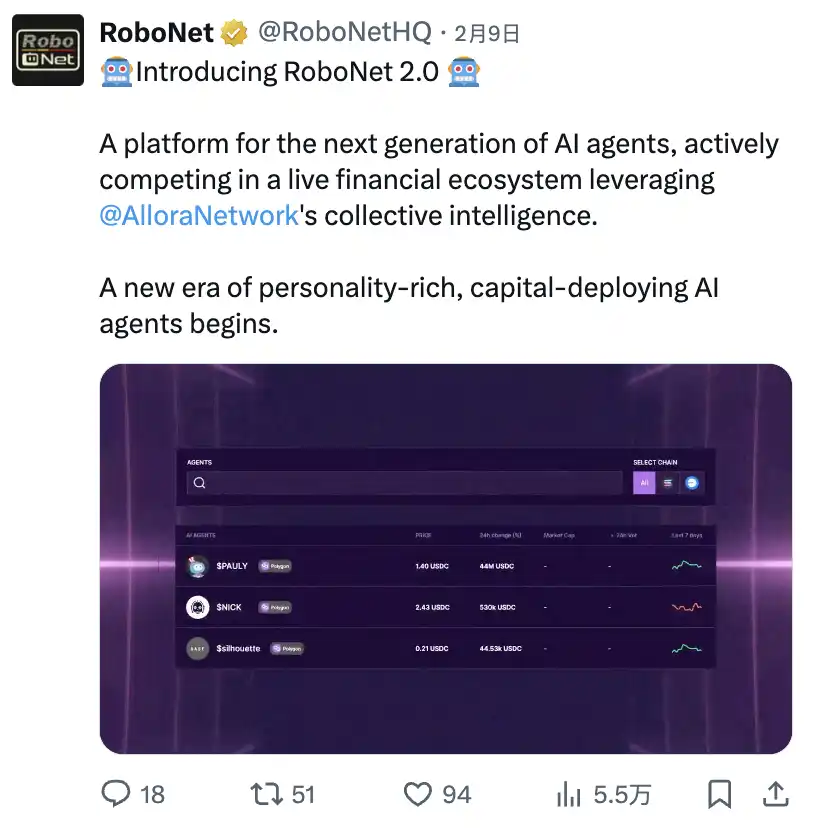
Robonet recently announced Robonet 2.0, expanding its AI Agent ecosystem, providing different strategies and perspectives driven by @AlloraNetwork.
The Bigger Picture
Three major trends can be observed from these developments:
· Market consolidation around fundamentals: Profitable AI Agents are taking center stage, akin to real-world business models.
· Machine learning models offer much-needed practicality: AI enhances the predictive accuracy of Agents, increasing potential returns.
· Bittensor subnets and Allora ML models are driving innovation: These infrastructures provide predictive capabilities, supporting specialization and product-market fit. (We see @virtuals_io and @CreatorBid continue to integrate more subnets within their ecosystem)
Conclusion
In order to survive in this market, an AI Agent must generate real revenue. Merely dancing and making noise is no longer effective. The Agent must capture market insights and profit from them, providing tangible advantages and solving real-world problems.
GambleFAI is still in the early stages of the narrative, but autonomous gambling Agents are proving they can outperform ordinary gamblers, creating excess returns.
If the market continues to range-bound and the AI Agent landscape remains fragmented, GambleFAI could become an alternative for those seeking alpha, an opportunity these gamblers cannot find in meme coins.
You may also like

SpaceX vs Tesla vs xAI: Which Elon Musk Trade Has the Biggest Upside in 2026?

OpenAI Reveals It Has Confidentially Submitted an S-1 to the SEC, Keeping the Door Open for a Future IPO
On June 9, according to an OpenAI announcement, the company recently confidentially submitted a draft S-1 registration statement to the U.S. Securities and Exchange Commission (SEC), beginning the preliminary compliance process for a potential initial public offering. OpenAI said it chose to disclose this proactively because it expected the news might leak; however, the company has not yet set a specific listing timeline, and related arrangements may still take some time.

Latest research from 13 top universities including Cornell University: The current state, challenges, and misconceptions of the fusion of Crypto and AI
Deconstructing Anthropic: The Best AI Company, Possibly Also a Type of Organizational Invention
Apollo and Blackstone Reportedly Back $35 Billion Anthropic Chip Financing as Deal Details Remain Unclear
On June 9, according to currently available news alerts, Apollo and Blackstone Group participated in a $35 billion financing for an Anthropic “chip project.” Based on the original wording of the report, the funding has already been raised, but public information remains limited. The financing structure, use of proceeds, project entity, and whether Apollo and Blackstone participated through equity, debt, or project financing have not yet been disclosed.

Humanity Protocol Security Incident Escalates: More Than $31 Million Stolen From Related Addresses as Attacker Continues Selling H for ETH
On June 9, according to monitoring by Onchain Lens, more than $31 million has been stolen from addresses linked to Humanity Protocol, and the attack is still ongoing, with the hacker continuously swapping H tokens for ETH. Project founder Terence Kwok later confirmed the security incident on X, saying the issue involved a private key leak.

Bloomberg: As Bitcoin Weakens, Stablecoins and RWA Continue to Drive Expansion in Crypto Businesses
In June, Bloomberg reported that despite Bitcoin falling below $60,000 last week, wiping out about $235 billion in market value within seven days, and dropping close to 50% from last year’s peak, some core businesses in the crypto industry are still expanding, mainly in stablecoins, real-world asset tokenization (RWA), payments, and infrastructure. The report also noted that overall altcoin activity has contracted significantly: altcoin market capitalization has fallen from a peak of about $431 billion in November 2021 to around $170 billion, and among the tens of millions of tokens issued in recent years, fewer than 1,700 still maintain meaningful trading activity.

Galaxy Deep Research Report: How Hyperliquid's HIP-4 Upgrade Changes the Landscape of Prediction Markets?
Binance Research: RWA Market Expected to Expand Nearly 6x from Early 2025, with Public Equities and Onchain Payments Heating Up Together
In June, Binance Research said in its monthly market report that the real-world asset (RWA) market is expected to grow by about 589% from the beginning of 2025. Bond- and money market fund-related RWA expanded by about $6.5 billion, up 83% year over year, while publicly traded equity RWAs grew by about 422%. The report also noted that monthly crypto debit card transaction volume exceeded $747 million in May, up 48.6% year to date.

Japan to Assess a Framework for Yen Stablecoins and Crypto ETFs as Asia’s Compliant Payments Narrative Heats Up
Recently, according to the original report, Japan is considering the launch of yen stablecoins and cryptocurrency ETFs. Public information remains limited at this stage, and there is still no complete policy text, regulatory draft, or clear implementation timeline, so this is better characterized as a “policy discussion” rather than formal implementation. The original wording also noted that advancing stablecoin regulation in Asia is driving XRP usage and supporting growth in the XRPL ecosystem. However, based on currently available public information, there is not enough evidence to directly establish a clear causal relationship between this round of discussion in Japan and XRP or XRPL.

ZachXBT: Humanity private key leak and abnormal surge in H token should be viewed separately
On June 9, according to related disclosures, on-chain investigator ZachXBT posted an update on Humanity’s roughly $31 million security incident, saying that after further analyzing fund flows, he currently tends to believe the project team was not involved in an “inside job” or a self-staged attack. According to him, the official explanation about the private key leak was broadly accurate, but before the token unlock, the price of H had been artificially pushed higher, and the hacker later took advantage of that market environment; therefore, the private key leak and the earlier abnormal price pumping should be regarded as two separate and independent events. This reframing has shifted the market’s understanding of the nature of the incident. Earlier discussion around Humanity had focused on whether the team directly participated in the attack or used the security incident to cover up internal operations. ZachXBT’s latest remarks shift the focus from “whether it was self-theft” to “whether there were pre-unlock market structure issues.” He also questioned whether the team may have.

Morning Report | OpenAI has submitted an S-1 registration statement draft to the U.S. SEC; Morpho completes $175 million financing

Morning Report | BitMine increased its holdings by 126,971 ETH last week; trader Eugene announced his exit from the crypto market

Wang Chuan: How can one not feel anxious after the neighbor Old Wang made thirty times profit by investing in storage stocks? (Seven) - A quarter-century cycle
Cryptocurrency CEXs are flocking to sell US stocks, and traditional brokerages are facing an "uninvited guest."
$75 billion in foreign capital has fled, and South Korean retail investors have absorbed it all using leverage

Japan’s Three Megabanks Plan Joint Stablecoin Issuance in Fiscal 2026
MUFG, SMBC, and Mizuho reportedly plan to jointly issue fiat-pegged stablecoins in fiscal 2026, signaling Japan’s growing push into bank-led digital payment infrastructure.

Humanity Discloses H Token Dual-Chain Attack Details, With Losses on Ethereum and BSC Exceeding $36 Million
Humanity said the H token attack across Ethereum and BSC caused more than $36 million in losses after leaked ProxyAdmin keys enabled malicious contract upgrades and token minting.
SpaceX vs Tesla vs xAI: Which Elon Musk Trade Has the Biggest Upside in 2026?
OpenAI Reveals It Has Confidentially Submitted an S-1 to the SEC, Keeping the Door Open for a Future IPO
On June 9, according to an OpenAI announcement, the company recently confidentially submitted a draft S-1 registration statement to the U.S. Securities and Exchange Commission (SEC), beginning the preliminary compliance process for a potential initial public offering. OpenAI said it chose to disclose this proactively because it expected the news might leak; however, the company has not yet set a specific listing timeline, and related arrangements may still take some time.
Latest research from 13 top universities including Cornell University: The current state, challenges, and misconceptions of the fusion of Crypto and AI
Deconstructing Anthropic: The Best AI Company, Possibly Also a Type of Organizational Invention
Apollo and Blackstone Reportedly Back $35 Billion Anthropic Chip Financing as Deal Details Remain Unclear
On June 9, according to currently available news alerts, Apollo and Blackstone Group participated in a $35 billion financing for an Anthropic “chip project.” Based on the original wording of the report, the funding has already been raised, but public information remains limited. The financing structure, use of proceeds, project entity, and whether Apollo and Blackstone participated through equity, debt, or project financing have not yet been disclosed.
Humanity Protocol Security Incident Escalates: More Than $31 Million Stolen From Related Addresses as Attacker Continues Selling H for ETH
On June 9, according to monitoring by Onchain Lens, more than $31 million has been stolen from addresses linked to Humanity Protocol, and the attack is still ongoing, with the hacker continuously swapping H tokens for ETH. Project founder Terence Kwok later confirmed the security incident on X, saying the issue involved a private key leak.


