
Gen Z's Crypto New Darling, How Much Further Can Robinhood Grow?



Original Title: "Gen Z's New Favorite Crypto, How Much Further Can Robinhood Rise?"
Original Source: RockFlow
Key Takeaways
1. Robinhood's rise in the crypto business stems from three key advantages the company has accumulated over the years: a large young user base established through its zero-commission model, the infrastructure and technological prowess behind product innovation, and user investment habits cultivated during the meme stock craze.
2. Recent quarterly reports have shown that Robinhood's stock price surge by 2024 was largely driven by the unexpectedly strong recovery of its crypto business. Particularly, in the third quarter of 2024, crypto revenue skyrocketed by 165% year-over-year to $61 million, becoming a dual engine of revenue growth alongside options trading.
3. Looking ahead, Robinhood's expansion into the EU and UK markets, coupled with its core user base (Millennials and Gen Z) being among the most active participants in cryptocurrencies, as well as the regulatory relaxation trend under the new administration and the potential benefits of crypto, will all provide significant growth opportunities for its crypto business.
In the 24/7 trading frenzy of the crypto market, one name is increasingly being mentioned by investors—Robinhood. This fintech platform founded by two Stanford students has not only disrupted traditional Wall Street with its zero-commission model but has also pioneered a new frontier in the crypto space.
When Baiju Bhatt and Vlad Tenev persisted in their dream after facing 75 failed funding attempts, they may not have imagined that Robinhood would eventually become a crucial bridge connecting traditional finance with digital assets.
Previous articles by RockFlow have provided detailed insights into Robinhood's history, the GME event, and Payment for Order Flow (PFOF)—"Robinhood: There Is No Free Lunch, Only Everlasting Bagholders."
In this article, RockFlow’s research team will delve into its core crypto business, exploring the reasons behind its 383% stock price surge in the past year, meticulously analyzing its current investment value, and bullish catalysts for the future.
1. Three Waves of Growth Setting the Stage for Crypto's Rise
Robinhood's outperformance in the crypto business is no coincidence. Three waves of revolutionary trends gradually built a strong user base and product innovation capability, laying a solid foundation for its subsequent soaring in the crypto business.
Robinhood initially entered the market with a zero-commission model, breaking the traditional brokerage's $8-10 commission barrier. By eliminating minimum deposit requirements and supporting fractional share trading, it successfully attracted a large number of young users, establishing initial trust in the platform. This laid a valuable user base for future expansion into innovative services like cryptocurrency.
In the second wave of growth, Robinhood demonstrated outstanding product innovation capabilities. By integrating gamification elements into the trading experience, creating a clean and intuitive interface design, and implementing an attractive stock reward mechanism, the platform achieved remarkable growth. During this period, the trading volume reached 9 times that of E-Trade, and the options contract trading volume even surpassed Charles Schwab by 88 times, showcasing its strong technological prowess and product operational capabilities. These capabilities were later successfully applied to the development of cryptocurrency trading products.
In the third wave of growth, Robinhood played a central role in the Meme Stock and cryptocurrency frenzy. The platform became the main battleground for popular stocks like GameStop, AMC, and cryptocurrencies like Dogecoin, setting a record in January 2021 with a monthly new account opening surpassing the total of all other brokerages. This period not only brought a large number of active users but, more importantly, nurtured users' investment habits in emerging asset classes.
Robinhood's revolutionary waves of user growth three times not only changed the brokerage industry landscape but also reshaped the entire investment culture. Under its influence, retail investors rose in power, accounting for 20% of total trading volume. The younger generation began to view investment as part of their lifestyle, a mindset shift that led to the popularization of innovative financial products like cryptocurrency.
The accumulated advantages—massive user base, strong technological capabilities, mature operational experience, and profound influence on investment culture—have together formed the cornerstone of Robinhood's success in the cryptocurrency field.
2. Crypto Revenue Surges, Driving Robinhood's Stock Price to Double
With the gradual recovery of the cryptocurrency market since 2023, Robinhood has also benefited. In its recent quarterly earnings reports, the share of cryptocurrency revenue has been increasing. The following chart shows Robinhood's revenue over the past 9 quarters, with the growth in options revenue and crypto revenue being particularly notable:
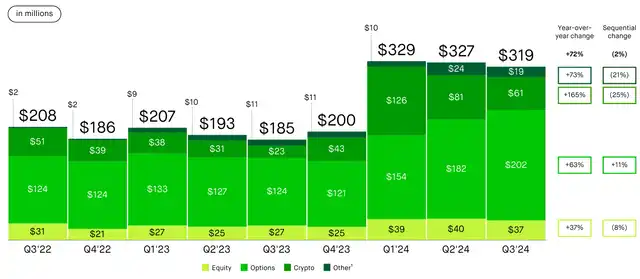
Taking the most recent 2024 Q3 earnings report as an example, crypto revenue surged by 165% year-over-year to $61 million, demonstrating remarkable growth momentum. This achievement not only confirms the company's strategic vision in the cryptocurrency field but also highlights its outstanding execution during the business expansion process.
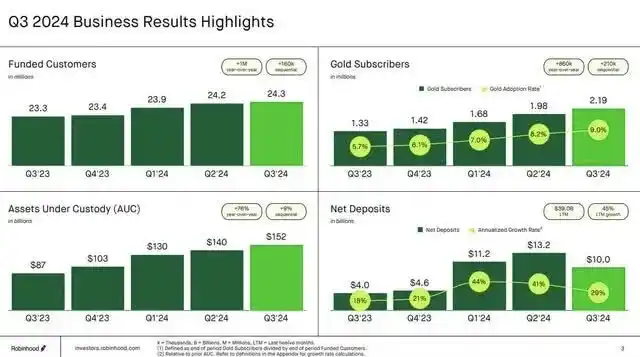
Robinhood's revenue mainly comes from three key areas: Transaction Revenue, Net Interest Income, and Other Revenue. Among them, Transaction Revenue saw a significant year-over-year increase of 72% to reach $319 million, with the cryptocurrency business growing at a stunning rate of 165% year-over-year, becoming one of the most prominent segments. This achievement, along with Options Transaction Revenue ($202 million), formed the dual engines driving the company's revenue growth.
Despite its rapid growth, Robinhood has not overlooked the stability of its business. Net Interest Income increased by 9% year-over-year to $274 million, providing the company with a stable cash flow. Innovative services such as Gold subscriptions drove Other Revenue up by 42% to $44 million, and the 2.2 million strong cohort of premium users demonstrated user recognition of the platform's services.
Furthermore, the platform achieved over $100 billion in net deposits for the third consecutive quarter, highlighting users' high level of trust in Robinhood. This trust not only supports the development of traditional business but also provides a solid foundation for the expansion of innovative businesses such as cryptocurrency.
It is noteworthy that while pursuing high-speed growth, Robinhood has maintained cautious cost control, keeping the full-year 2024 operating expense outlook in the range of $1850-1950 million. This balanced growth and efficiency strategy provide assurance for the continued development of innovative businesses such as cryptocurrency.
From this financial report, it is clear that Robinhood is gradually transitioning from a traditional zero-commission trading platform to a comprehensive financial technology platform with cryptocurrency as a key growth driver. The outstanding performance of its cryptocurrency business not only brings substantial revenue growth to the company but also heralds a broad future in the new era of cryptocurrency.
3. Why Robinhood is Still Worth Looking Forward to in 2025?
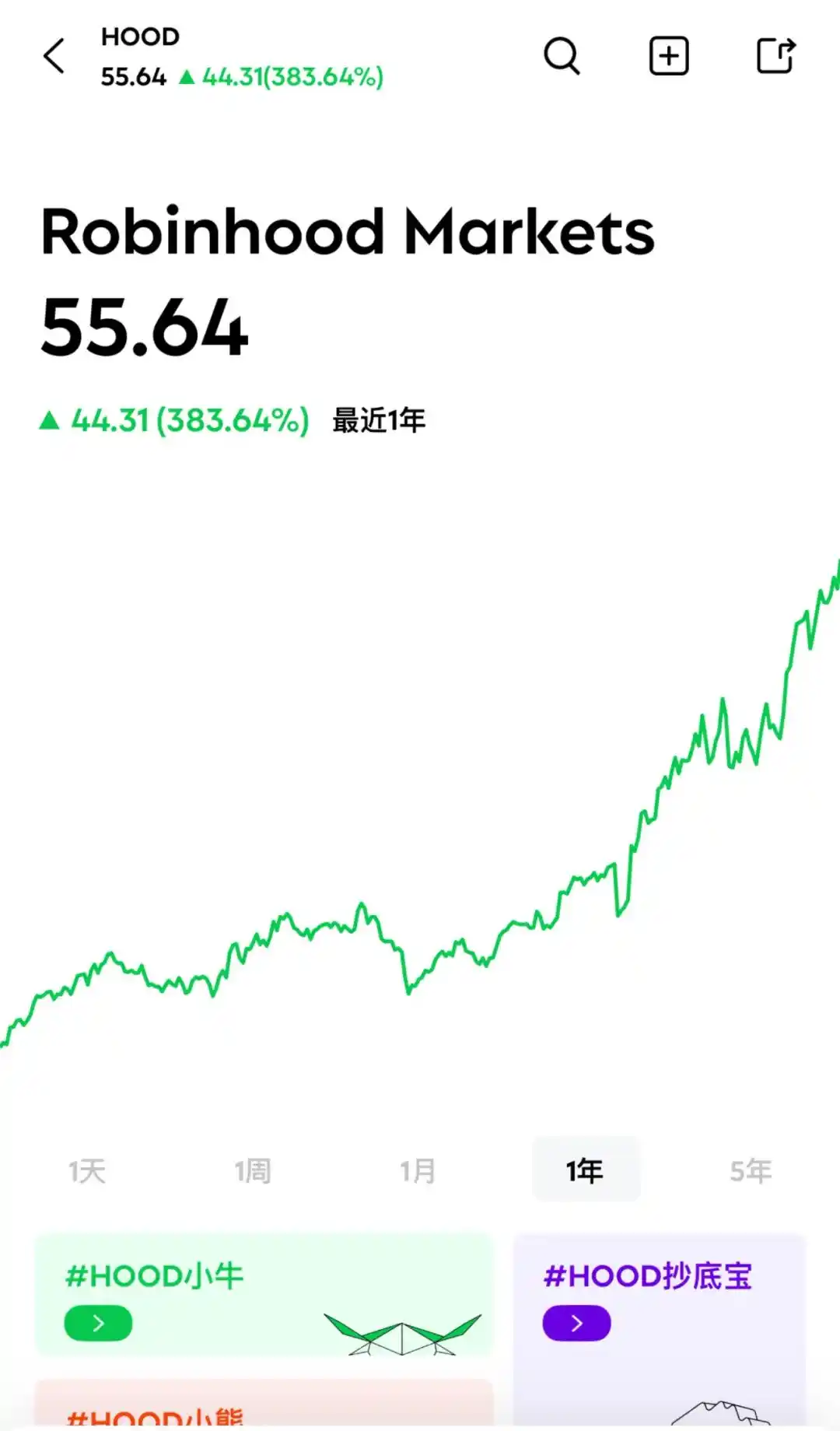
Despite a 383% increase in Robinhood's stock price over the past year, based on its unique market opportunity, the RockFlow Research Team remains optimistic about its performance in 2025. This confidence is largely driven by its proactive approach in the cryptocurrency field.
Robinhood's core user base is mainly concentrated in the millennial and Gen Z demographics, precisely the most active participants in cryptocurrency. As wealth transfers from the older generation to the younger generation, these assets are likely to flow to platforms that better meet the investment needs of the new generation. As a bridge connecting traditional finance and crypto innovation, Robinhood will reap significant benefits from this wealth transfer wave.
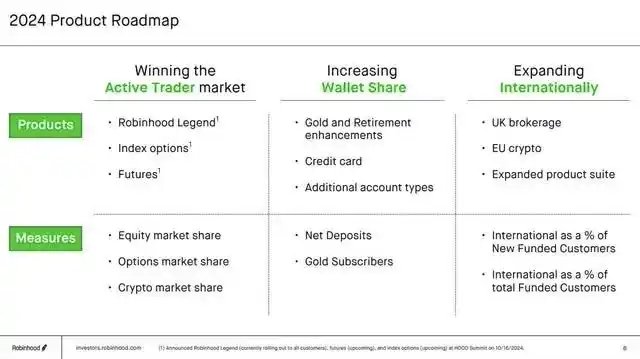
In addition, Robinhood's international expansion strategy has placed particular emphasis on the importance of its crypto business: EU Market: Actively expanding its crypto business in the EU, positioning it as a key pillar of its internationalization; UK Market: Pioneering its business in the London financial district, laying the foundation for future crypto service expansion.
Furthermore, Robinhood has strengthened its crypto business competitiveness through various initiatives: for example, its developed futures trading infrastructure can provide technical support for future crypto derivative trading; the Gold membership service is expected to offer users more crypto-related privileges; continuous optimization of the trading interface and services can also enhance user engagement in crypto trading.
Overall, Robinhood's crypto business development reflects a clear global mindset and innovation orientation. By integrating traditional finance with crypto services, the company is building a more inclusive financial ecosystem. Its presence in the European market, especially the expansion of its crypto business, demonstrates the company's long-term commitment to the digital asset field. As the global crypto market continues to mature, Robinhood is poised to occupy a more significant position in this rapidly evolving space.
On the policy front, following Trump's official inauguration, the impact he will have on the stock market and the crypto industry will also be a key driver in boosting Robinhood's stock price.
It is well known that the Trump administration has always advocated for reduced financial regulation, potentially lowering compliance costs and simplifying compliance processes further. Fintech companies like Robinhood that rely on flexible operations may benefit from a more relaxed regulatory environment. If the crypto sector continues to receive clear policy support (such as a clear regulatory framework or relaxed restrictions), Robinhood's crypto business will continue to grow beyond expectations.
Moreover, although the new president has been in office for less than a month, the volatility he has brought to the market is significantly increasing. The market has already seen tariff policies implemented (and the subsequent delays) causing major fluctuations in the stock market, intensifying the volatile stock market, which significantly impacts retail trading activity. Robinhood's trading volume and commission revenue (especially from options) may noticeably increase as a result.
Conclusion
The RockFlow Research Team believes that Robinhood is demonstrating remarkable growth potential: its core user base (Millennials and Gen Z) are precisely the most active participants in cryptocurrency, benefiting from the upcoming generational wealth transfer; coupled with the improvement of the trading infrastructure, innovation in the Gold membership service, the Trump administration's regulatory relaxation tendencies, and the potential crypto benefits, these measures will collectively propel Robinhood to a more prominent position in the global crypto market.
While facing regulatory pressure and market volatility in the short term, Robinhood is expected to become an important bridge connecting traditional finance with the future of crypto in the long run. Its investment value is worth long-term attention.
You may also like

Bitcoin Trading Guide 2026: Strategies for Experienced Traders

What Is XAUT and PAXG? Why Tokenized Gold Is Booming in 2026

Cryptocurrency CEXs are flocking to sell US stocks, and traditional brokerages are facing an "uninvited guest."

Will the SpaceX IPO Hurt Bitcoin? Here's What Traders Are Watching
Foreign selling in the South Korean stock market accelerates, with cumulative net sales reportedly reaching $75 billion this year
On June 9, The Kobeissi Letter, citing Goldman Sachs data, reported that global investors are selling South Korean stocks at an unusually rapid pace. In the latest trading session, foreign investors sold about $801 million worth of Kospi constituent stocks again; total foreign outflows last week reached about $10 billion, and the market has been in net foreign selling on nearly every trading day over the past month. According to the data cited in the report, foreign investors have sold about $75 billion worth of South Korean stocks so far this year. Meanwhile, South Korean retail and institutional investors together recorded roughly $69 billion in net buying over the same period, suggesting that the market’s main buying support has come from domestic capital rather than returning overseas funds. The information currently disclosed still mainly comes from The Kobeissi Letter’s retelling and Goldman Sachs data summaries, while public details on the statistical period and the specific definition of “selling” remain relatively limited.

Fortune Warns of Strategy’s Financing Structure Risks as Bitcoin Premium Narrows
Fortune warned that Strategy’s Bitcoin treasury model faces growing financing risks as MSTR’s net asset premium narrows and preferred stock dividend pressure increases.

Ferrari Challenge Le Mans: Carl Moon to Dominate in WEEX Livery

Sahara AI Responds to SAHARA’s Sharp Drop: No Contract or Product Security Issues Found, Internal Investigation Underway
Sahara AI responded to SAHARA’s 60% price drop, saying no token contract or product security issues have been found and an internal investigation is underway.

WEEX Deposit/Withdrawal Dynamic Island: Your Asset Status, Always in Sight

Scaling Crypto Derivatives: The Digital Asset Infrastructure Behind High-Volume Trading
In the fast-moving digital asset ecosystem, derivatives platforms face an extreme architectural test. High-leverage futures markets demand more than just standard security—they require absolute operational precision, zero-latency matching engines, and ironclad structural scalability, all while navigating intense market volatility.
As global platforms scale to meet these demands, the industry is shifting away from rigid, monolithic setups toward a more agile, "decoupled" infrastructure philosophy.
The Blueprint for High-Volume Copy TradingFor elite global exchanges like WEEX (founded in 2018), this architectural choice becomes critical when scaling high-volume retail features like social copy trading. When thousands of users automatically mirror the real-time strategies of elite traders simultaneously, it triggers sudden, monumental spikes in concurrent transactional volume.
To prevent execution latency or settlement bottlenecks during these peak volatility events, a platform's primary engine must remain entirely dedicated to risk management, copy-trade synchronization, and order matching.
The Architectural Rule: New-generation platforms must separate front-end user execution engines from heavy backend infrastructural overhead to eliminate operational friction.
By separating these layers, platforms can maintain complete sovereignty over their trading environments and user experiences while strategically aligning with institutional-grade infrastructure ecosystems. This strategic framework allows modern exchanges to leverage advanced Digital Asset Custody infrastructure such as Cobo’s behind the scenes, ensuring that backend wallet management scales elastically alongside trading spikes.
Capitalizing on Market Momentum and 400× LeverageIn a derivatives arena where platforms offer up to 400× leverage on perpetual contracts, capital efficiency and market agility are core business metrics. To capture market momentum, an exchange needs the ability to rapidly expand its asset offerings, supporting everything from legacy crypto assets to sudden, trending altcoins across a massive library of trading pairs.
Adopting a flexible, scalable Wallet-as-a-Service (WaaS) solution such as Cobo’s could completely rewrite the development timeline for high-growth exchanges. Instead of spending months of engineering capital building out custom backend wallet architectures for every new blockchain network, platforms can deploy localized infrastructure in days.
This agility allows platforms to instantly scale their listings to over a thousand trading pairs without compromising security or delaying time-to-market. It mirrors the exact operational advantages seen during high-velocity market events, similar to how advanced wallet infrastructure empowers platforms during sudden asset surges; allowing exchanges to pass that speed and liquidity directly to their global user base.
A Mature Foundation for GrowthThe synergy between trusted infrastructure ecosystems and global trading platforms represents the natural evolution of a maturing crypto market. As WEEX continues to scale its global spot and derivatives offerings for over 6 million users, adopting robust backend paradigms proves that platforms no longer have to compromise between cutting-edge trading velocity and uncompromised structural security.

Morning Report | BitMine increased its holdings by 126,971 ETH last week; trader Eugene announced his exit from the crypto market

Wang Chuan: How can one not feel anxious after the neighbor Old Wang made thirty times profit by investing in storage stocks? (Seven) - A quarter-century cycle

Get Paid to Onboard? Try WEEX’s New Homepage with Rewards for Registration, Deposit & Trade

WEEX Custom Layout: Build Your Perfect Trading Workspace in Seconds

See “Buy Walls” & “Sell Walls” Instantly: WEEX Launches the Depth Chart for Smarter Trades

What Is Quick Trade on WEEX? 2 Ways WEEX Ends Chart-Panel Jumping
Morning News | Five major virtual asset platforms in South Korea have experienced 57 incidents of hacking and system failures in six years; Grayscale submits registration application for Canton ETF
Should we escape the peak? The principle of the tail-end market in the stock market
Bitcoin Trading Guide 2026: Strategies for Experienced Traders
What Is XAUT and PAXG? Why Tokenized Gold Is Booming in 2026
Cryptocurrency CEXs are flocking to sell US stocks, and traditional brokerages are facing an "uninvited guest."
Will the SpaceX IPO Hurt Bitcoin? Here's What Traders Are Watching
Foreign selling in the South Korean stock market accelerates, with cumulative net sales reportedly reaching $75 billion this year
On June 9, The Kobeissi Letter, citing Goldman Sachs data, reported that global investors are selling South Korean stocks at an unusually rapid pace. In the latest trading session, foreign investors sold about $801 million worth of Kospi constituent stocks again; total foreign outflows last week reached about $10 billion, and the market has been in net foreign selling on nearly every trading day over the past month. According to the data cited in the report, foreign investors have sold about $75 billion worth of South Korean stocks so far this year. Meanwhile, South Korean retail and institutional investors together recorded roughly $69 billion in net buying over the same period, suggesting that the market’s main buying support has come from domestic capital rather than returning overseas funds. The information currently disclosed still mainly comes from The Kobeissi Letter’s retelling and Goldman Sachs data summaries, while public details on the statistical period and the specific definition of “selling” remain relatively limited.
Fortune Warns of Strategy’s Financing Structure Risks as Bitcoin Premium Narrows
Fortune warned that Strategy’s Bitcoin treasury model faces growing financing risks as MSTR’s net asset premium narrows and preferred stock dividend pressure increases.


