
Glassnode: How Severe is This Sell-off? Is it a Normal Retracement?


Original Article Title: Profiling the Sell-Off
Original Source: Glassnode
Original Translation: Tao Zhu, Golden Finance
Abstract
· Bitcoin investors suffered substantial losses during the economic downturn, with the BTC price dropping to $93,000 at one point.
· However, when we standardize these losses into BTC terms, the severity of the loss seems consistent with other local adjustments.
· The majority of locked losses come from the short-term holder group, as the profitability of local top buyers rapidly declined.
· The altcoin industry experienced the most significant relative losses during the economic downturn, with global altcoin market cap going through one of the largest depreciations in history.
Significant Depreciation
Last week, Bitcoin investors experienced a sharp price fluctuation. The BTC price initially dropped to a low of $93,000, then briefly rebounded to $102,000, and is currently trading close to $98,000. This indecisive price action was primarily in response to President Trump's threats to impose tariffs on Canada, Mexico, and China, providing investors with an uncertain macro backdrop. Additionally, the continued strength of the US dollar has led to a slightly tense liquidity environment.
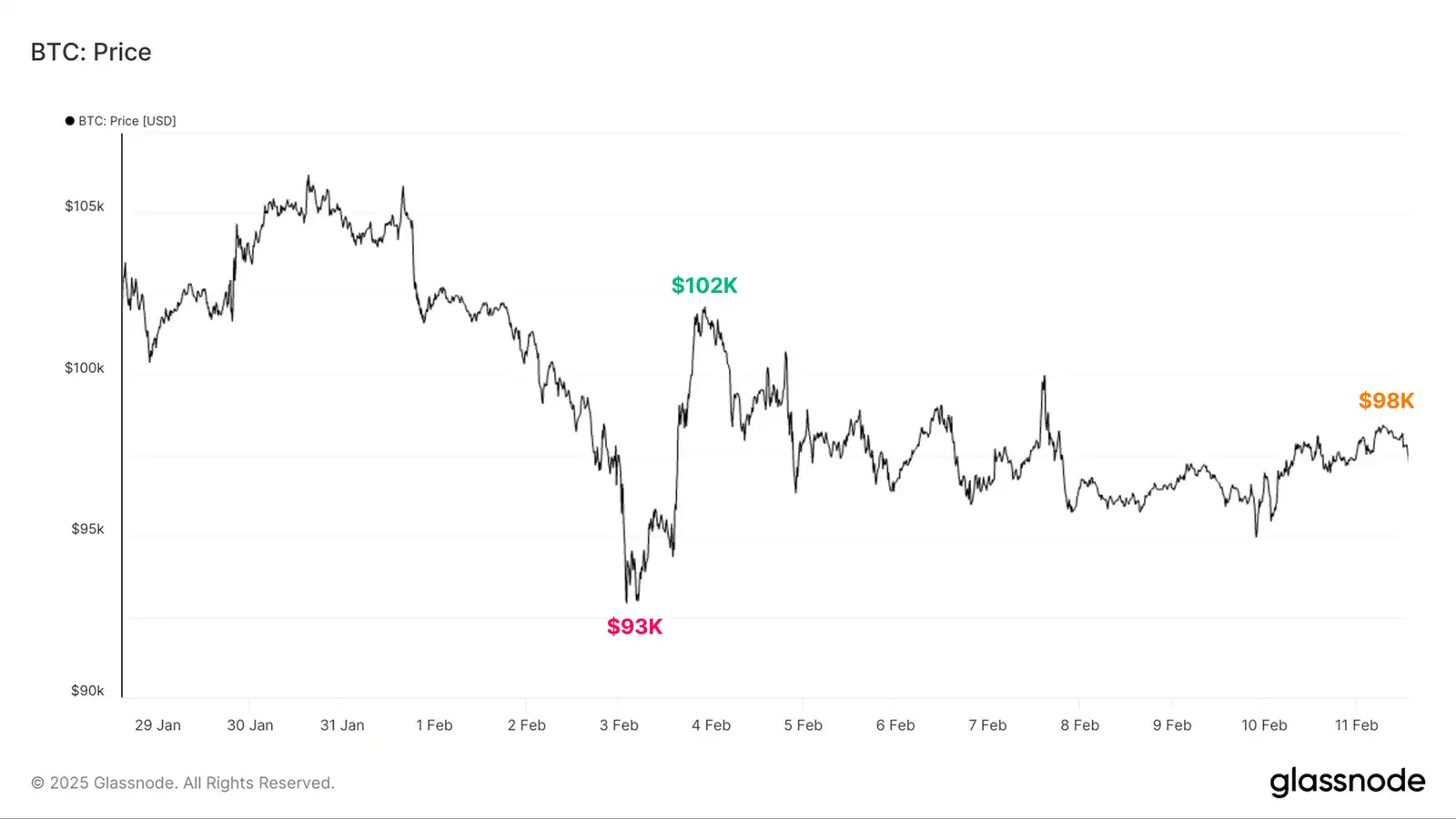
While Bitcoin's price has been highly volatile in recent weeks, it has not strayed too far from its starting point during this period, as daily fluctuations and sideways movement continue.
How has the composition of Bitcoin investors evolved during this cycle? Bitcoin's liquidity has significantly increased, with larger capital flows balancing the inertia of increasingly large assets. Furthermore, even in a relatively unstable macro backdrop, an increasing number of steadfast, patient holders are contributing to the stability of Bitcoin's price.
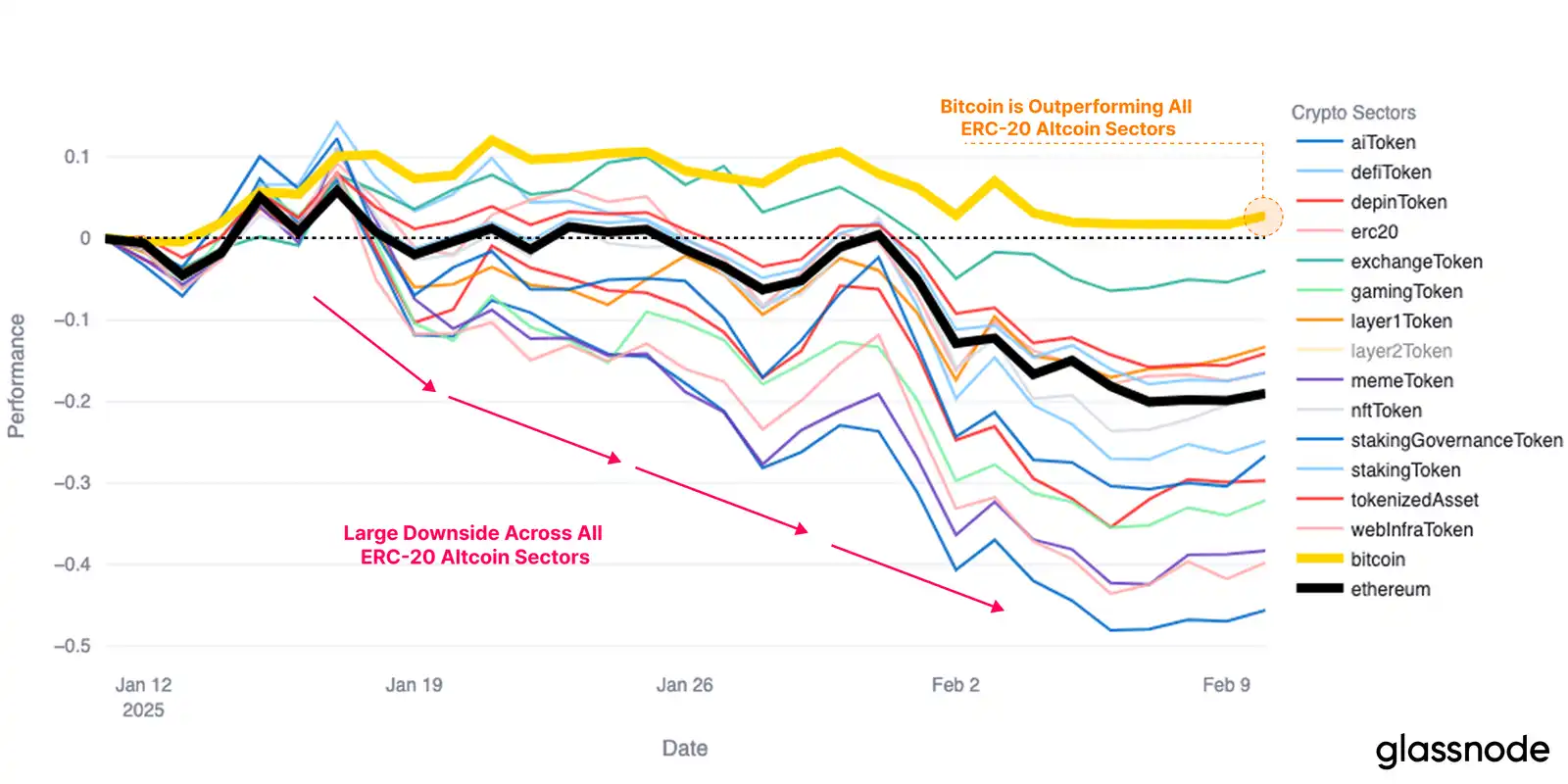
On the other hand, the altcoin industry has faced significant selling pressure, with many assets struggling to achieve widespread adoption or align their product with the market, making the market environment more challenging. This has ultimately led to a sharp decline in token prices, with the performance of all altcoin subsectors in recent weeks lagging behind Bitcoin.
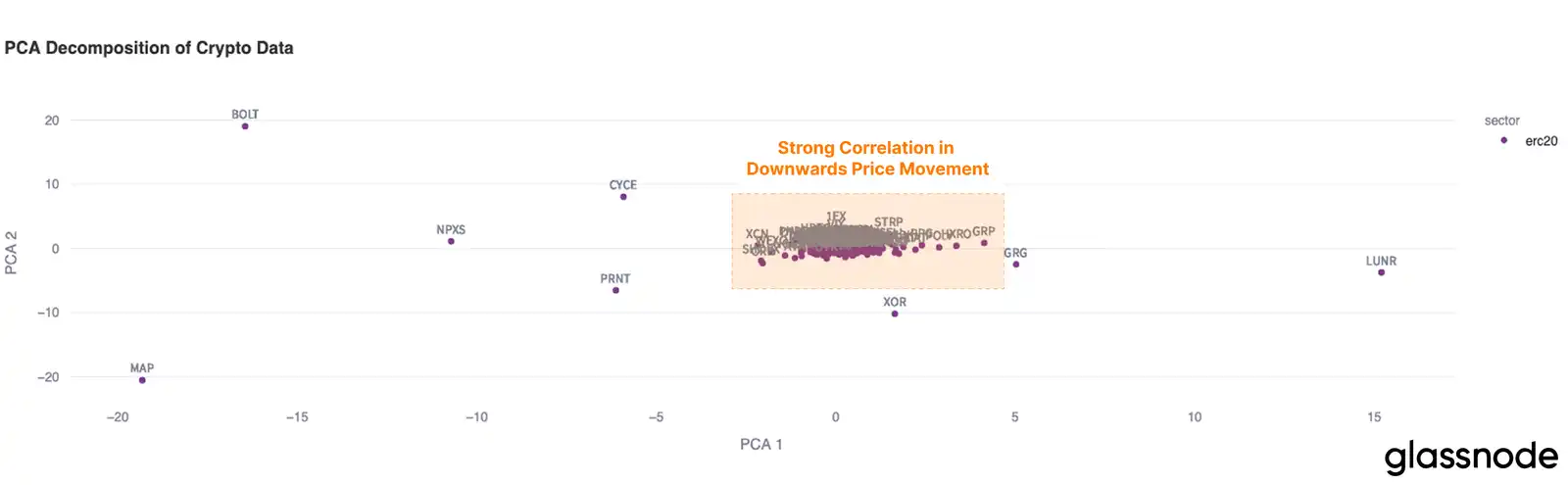
To explore the downtrend in the altcoin space, we can utilize Principal Component Analysis (PCA) to project token returns' correlations into a two-dimensional space. This visualization helps identify tokens that exhibit similar performance (clustered together) or different performance (far apart) based on their return behavior.
We can observe that most ERC-20 tokens are densely clustered together, highlighting a widespread sell-off where many altcoins experienced similar behavior, lacking distinctiveness across different sectors.
In other words, few tokens have been able to escape this week's downward trend, they have essentially all moved lower in unison.
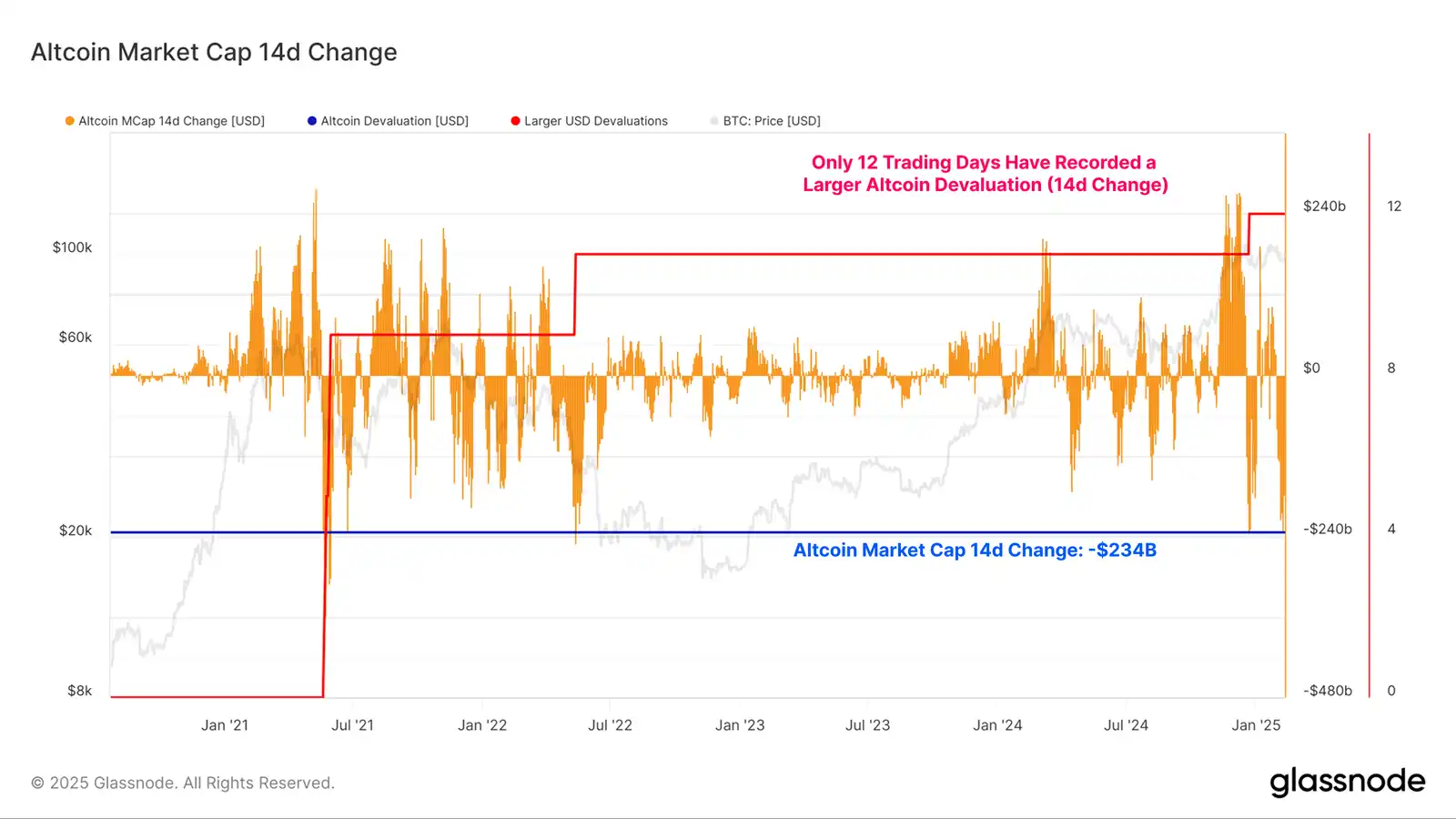
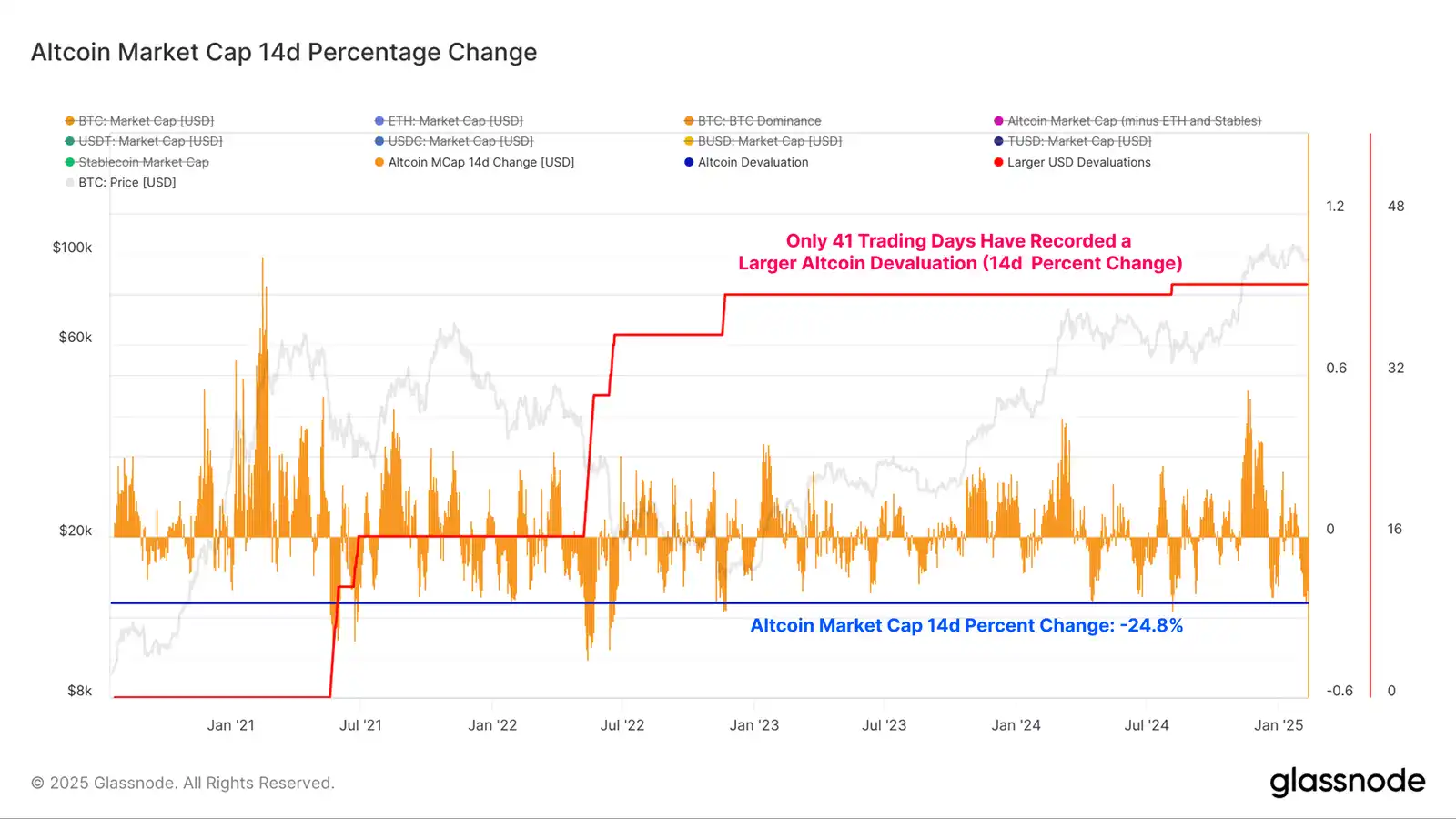
We can assess the magnitude of the decline by evaluating the global altcoin market cap's 14-day change. Over the past two weeks, the altcoin market cap has fallen by $234 billion, with the absolute decline greater on a few days.
The severity of this decline highlights the scale of the sell-off event, reasonably considered an event within the altcoin bear market.
It is quite interesting because Bitcoin does not seem to exhibit the same relative weakness, indicating a growing divergence between BTC and the rest of the digital asset space.
Viewed in percentage terms, the altcoin decline is still significant, with only 41 out of 1662 trading days having a greater decline. However, on this relative scale, it does indeed align more closely with the previous downturn event experienced throughout the entirety of 2024.
Compared to the sell-offs in May 2021 (Great Miner Migration) and the collapse of LUNA/UST and 3AC at the end of 2022, the current decline is much smaller.
Check Bitcoin Losses
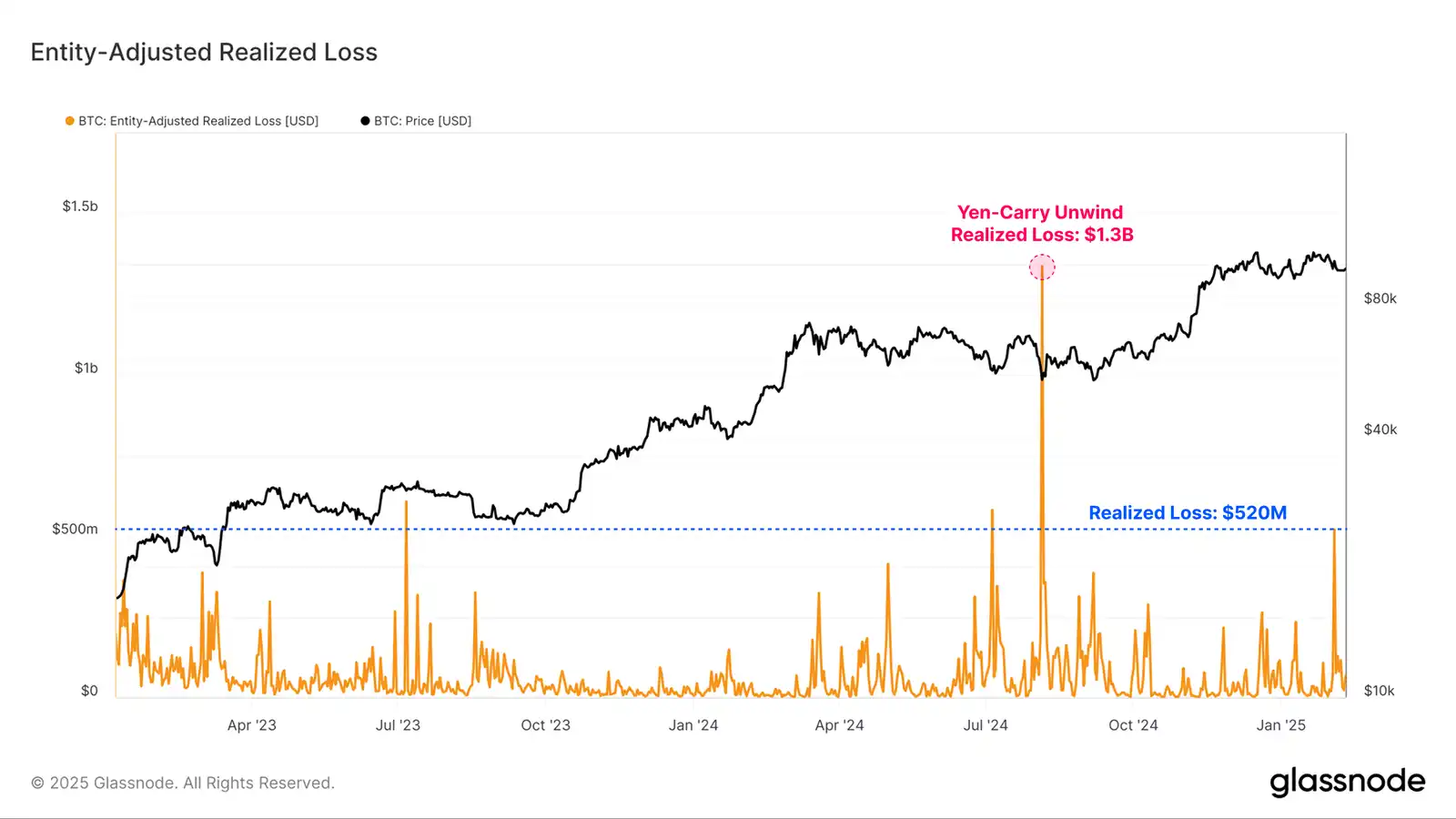
Despite Bitcoin's price remaining relatively stable over the week, the actual losses locked in by Bitcoin investors during the price fluctuations represent one of the largest losses in the current bull market cycle. As the market dropped to $93,000, investors locked in approximately $520 million in losses, marking one of the largest sell-off events to date.
Therefore, we can see this as a significant sell-off event amidst the macro bull market uptrend. Only the losses locked in during the yen carry trade liquidation on August 5, 2023, were greater on a single day (actual loss being -$1.3 billion).
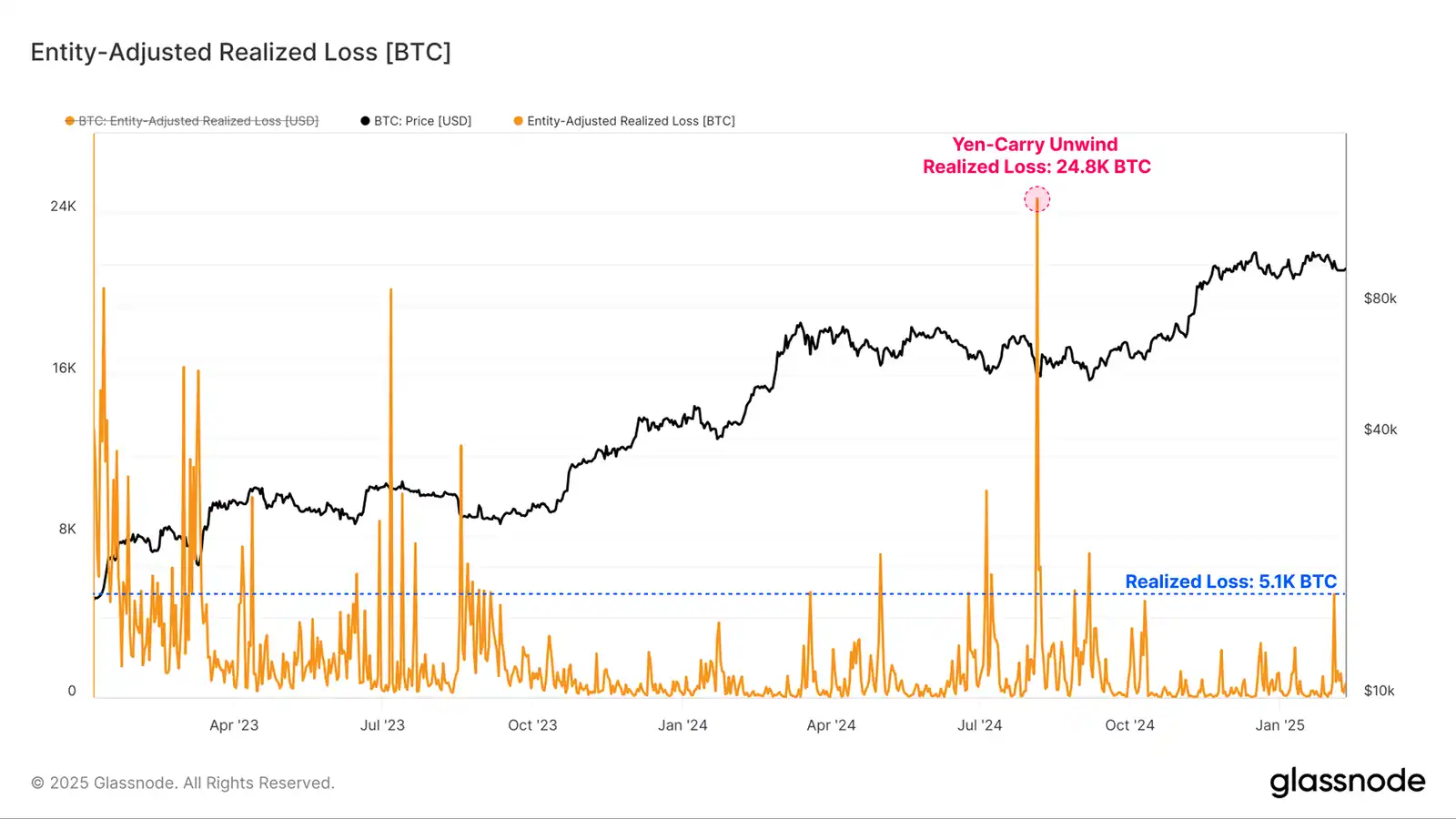
As Bitcoin's scale grows, we must also consider that, compared to previous price ranges, the absolute measure of actual losses may be misleading. When evaluating these losses in terms of BTC denomination, this actually normalizes market size, making the severity of losses appear more "typical."
The magnitude of this recent loss surge is similar to the partial sell-off event before the full-year 2024, indicating that this may still be considered a normal event during a bull market correction/consolidation phase.
Loss Analysis
During a bull market, long-term investors usually reap significant profits. Therefore, the main source of realized losses is the group of short-term holders, which represents a recent cohort of investors with the highest average cost basis.
Typically, there are no losses for long-term holders during a bull market. Losses for the LTH group usually begin as the cycle transitions from a bull to a bear market and accelerate as the market downturn intensifies, culminating in a final capitulation event usually near the macro cycle lows.
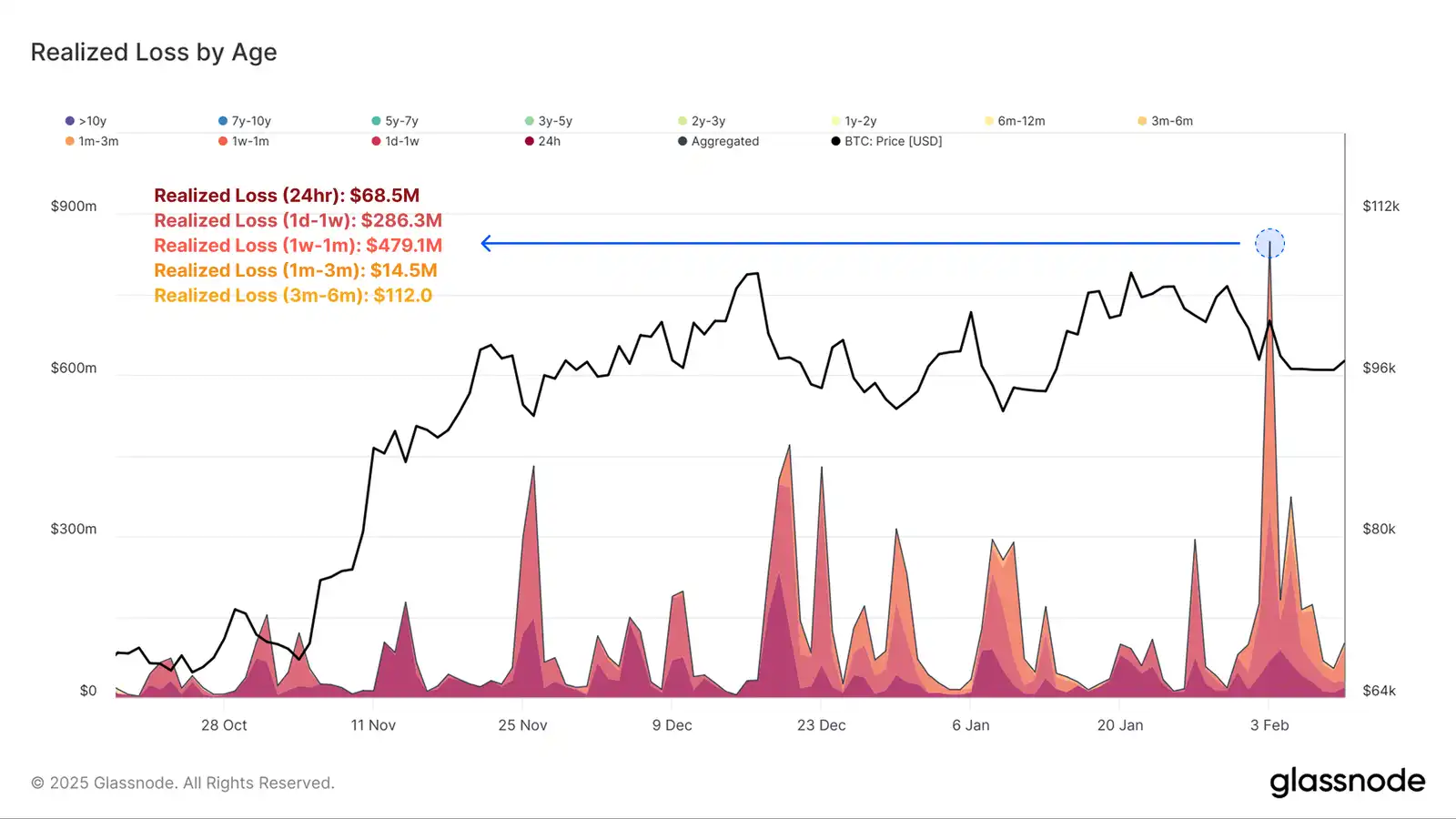
Conversely, relatively price-sensitive short-term holders often incur significant losses during both bull and bear market downturns. The total realized losses from this week's adjustment by short-term holders amount to $520 million, similar in magnitude to the retracement seen throughout the entire 2024-25 cycle so far.
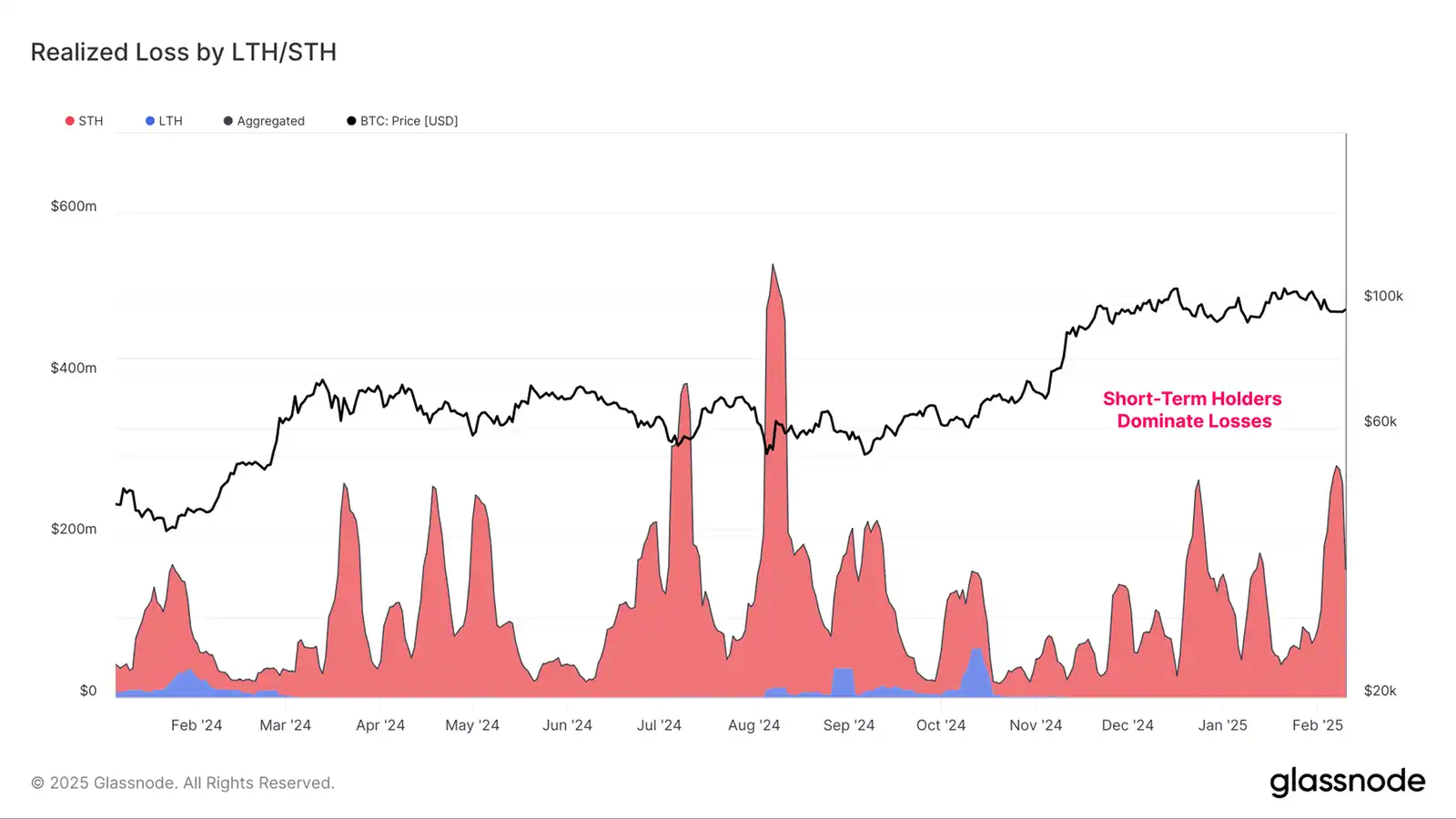
Further analysis of short-term holder losses reveals that the majority of losses are attributed to investors who purchased the token within the past month. The breakdown by coin age is as follows:
· 24-hour realized loss: $68.5 million
· 1 day to 1 week realized loss: $286.3 million
· 1 week to 1 month realized loss: $479.1 million
· 1 month to 3 months realized loss: $14.5 million
· 3 months to 6 months realized loss: $112 million
This reinforces the notion that a significant portion of on-chain transaction volume and realized losses are often related to investors who have recently entered the market, making them most sensitive to volatility and price fluctuations.
Future Outlook
With the price volatility, we can employ a set of on-chain derived pricing levels to explore some potential paths and thresholds for future prices.
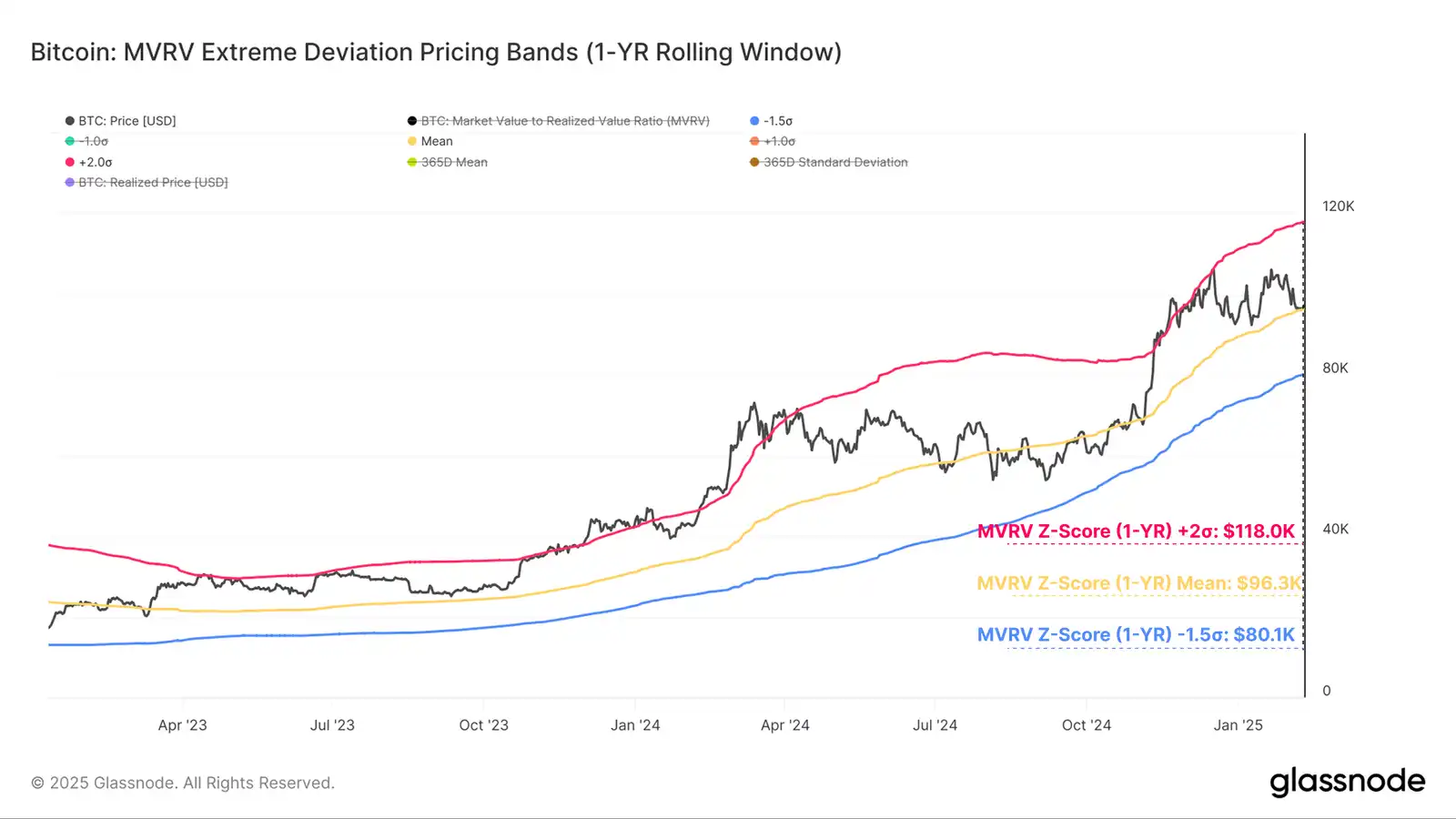
To assess key support areas, we can use the MVRV Z-score on a 1-year rolling window. This particular transformation can provide a clearer picture of recent market dynamics, with the model capturing only recent market behavior.
· +1σ: $118,000 (red)
· Mean: $96,300 (yellow)
· -1σ: $8.01K (Blue)
Currently, the price is finding strong support near the mean. If the price drops below the -1σ level, it could potentially become a key threshold for the next major defense support for the bulls. Conversely, the +1σ level could act as a resistance as investors have amassed significant unrealized gains and may look to realize them into market strength.
As we have identified that the majority of the losses are coming from the short-term hodler cohort, emphasizing their investment positioning while the market trades around the mid MVRV support range is a prudent move.
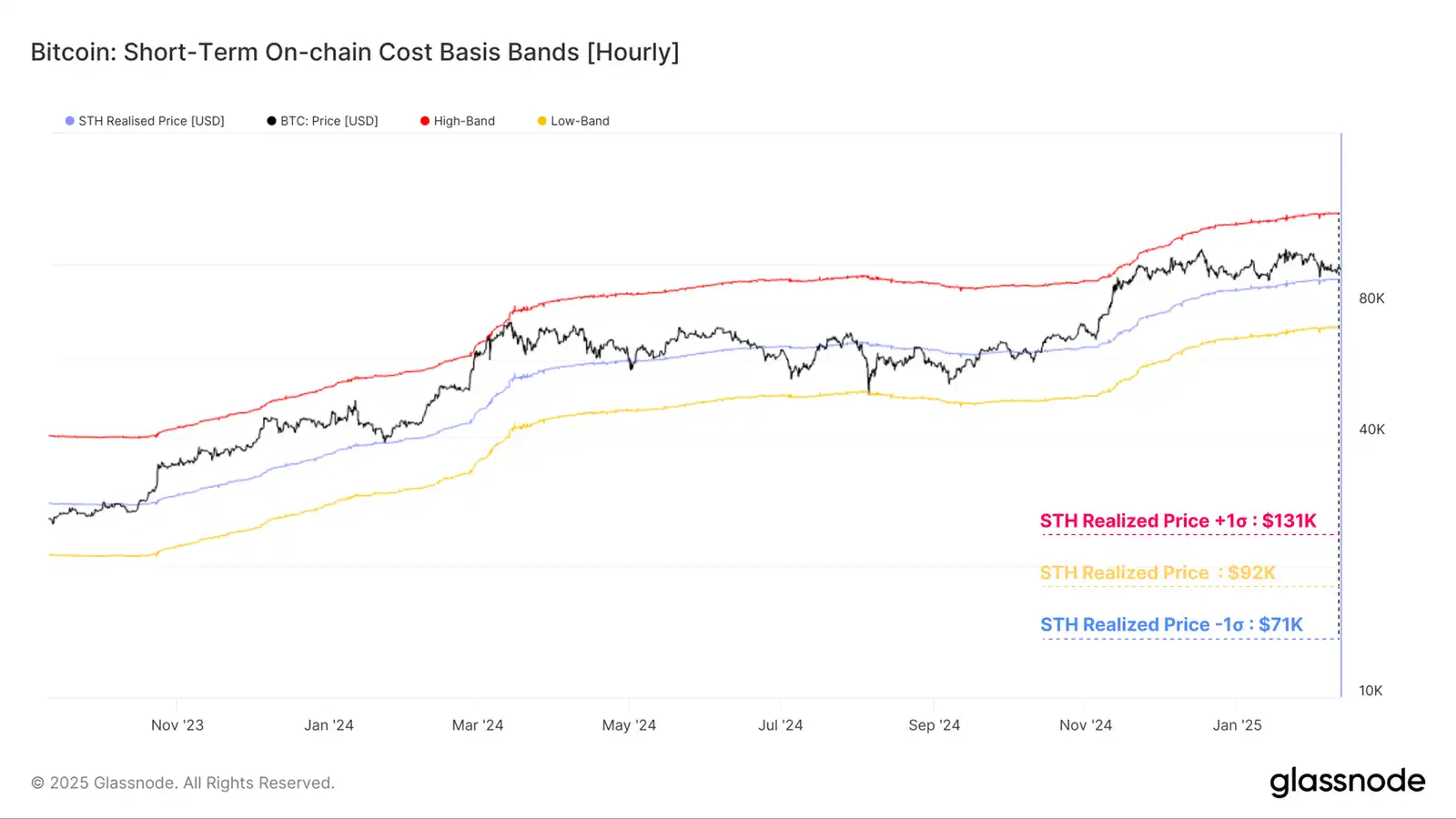
Historically, the short-term hodler's average cost basis has also acted as a strong support level during the uptrend of a bull market. The current trading price from this pricing model is around $92.2K, a critical zone for the market to avoid further downside.
We can similarly adopt a ±1σ range based on a full retrospective Z-score transformation to evaluate the typical upper and lower limits of price behavior.
· Short-Term Hodler Cost Basis +1σ: $13.1K
· Short-Term Hodler Cost Basis -1σ: $7.1K
Currently, the spot price is trading within the upper and lower limits and hovering above the STH cost basis. This indicates that the bulls are still in control, but the price is approaching their first line of defense and almost tested the STH cost basis in a recent sell-off event.
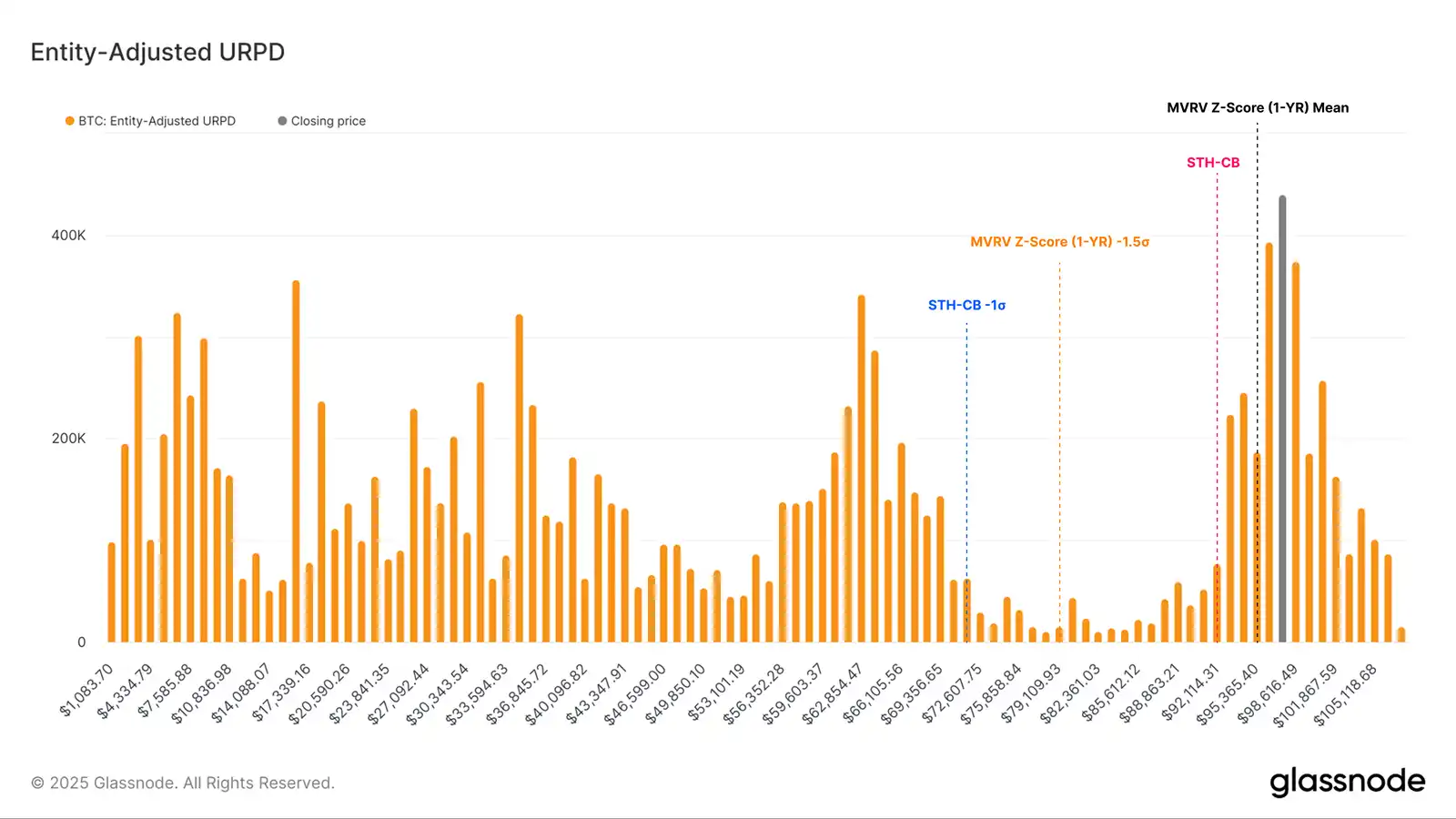
When overlaying the price trajectory on the URPD volume distribution chart, the significance of defending the STH cost basis and the MVRV 1Yr Z-Score pricing region becomes increasingly apparent. Significant volume voids can be seen below these levels, indicating little token turnover in this price range.
Furthermore, the -1σ band of the STH cost basis sits at the upper limit of this volume void, suggesting that if the price were to drop to this level, it could be a relatively sensitive area.
Summary
Over the past few weeks, the price of Bitcoin has experienced both sharp fluctuations and a tendency to stabilize. It has surged to a high of $10.5K at one point and dropped to a low of $9.3K at another, but by the end of this week, the price remains around $9.8K.
This volatile price action has resulted in significant losses, totaling $520M, one of the largest losses in this cycle when measured in USD. However, when assessing the severity of the downturn through standardized metrics, the sell-off still aligns roughly with other local corrections.
In contrast, the altcoin industry experienced a widespread sell-off and failed to find its footing. Most tokens went through a highly correlated downtrend, with hardly any industry spared.
This led to one of the largest altcoin sell-offs in history, highlighting a significant disconnect between Bitcoin and the typical rotation of capital into altcoins seen in previous market cycles.
You may also like

Japan’s Three Megabanks Plan Joint Stablecoin Issuance in Fiscal 2026
MUFG, SMBC, and Mizuho reportedly plan to jointly issue fiat-pegged stablecoins in fiscal 2026, signaling Japan’s growing push into bank-led digital payment infrastructure.

Humanity Discloses H Token Dual-Chain Attack Details, With Losses on Ethereum and BSC Exceeding $36 Million
Humanity said the H token attack across Ethereum and BSC caused more than $36 million in losses after leaked ProxyAdmin keys enabled malicious contract upgrades and token minting.

White House Discusses CLARITY Act With Law Enforcement Ahead of Senate Vote
The White House discussed the CLARITY Act with law enforcement ahead of a Senate vote, focusing on illicit finance risks and developer protections.

$75 billion in foreign capital has fled, and South Korean retail investors have absorbed it all using leverage

Bitcoin Trading Guide 2026: Strategies for Experienced Traders

What Is XAUT and PAXG? Why Tokenized Gold Is Booming in 2026

Cryptocurrency CEXs are flocking to sell US stocks, and traditional brokerages are facing an "uninvited guest."

Will the SpaceX IPO Hurt Bitcoin? Here's What Traders Are Watching
Foreign selling in the South Korean stock market accelerates, with cumulative net sales reportedly reaching $75 billion this year
On June 9, The Kobeissi Letter, citing Goldman Sachs data, reported that global investors are selling South Korean stocks at an unusually rapid pace. In the latest trading session, foreign investors sold about $801 million worth of Kospi constituent stocks again; total foreign outflows last week reached about $10 billion, and the market has been in net foreign selling on nearly every trading day over the past month. According to the data cited in the report, foreign investors have sold about $75 billion worth of South Korean stocks so far this year. Meanwhile, South Korean retail and institutional investors together recorded roughly $69 billion in net buying over the same period, suggesting that the market’s main buying support has come from domestic capital rather than returning overseas funds. The information currently disclosed still mainly comes from The Kobeissi Letter’s retelling and Goldman Sachs data summaries, while public details on the statistical period and the specific definition of “selling” remain relatively limited.

Fortune Warns of Strategy’s Financing Structure Risks as Bitcoin Premium Narrows
Fortune warned that Strategy’s Bitcoin treasury model faces growing financing risks as MSTR’s net asset premium narrows and preferred stock dividend pressure increases.

Ferrari Challenge Le Mans: Carl Moon to Dominate in WEEX Livery

Sahara AI Responds to SAHARA’s Sharp Drop: No Contract or Product Security Issues Found, Internal Investigation Underway
Sahara AI responded to SAHARA’s 60% price drop, saying no token contract or product security issues have been found and an internal investigation is underway.

WEEX Deposit/Withdrawal Dynamic Island: Your Asset Status, Always in Sight
Scaling Crypto Derivatives: The Digital Asset Infrastructure Behind High-Volume Trading
In the fast-moving digital asset ecosystem, derivatives platforms face an extreme architectural test. High-leverage futures markets demand more than just standard security—they require absolute operational precision, zero-latency matching engines, and ironclad structural scalability, all while navigating intense market volatility.
As global platforms scale to meet these demands, the industry is shifting away from rigid, monolithic setups toward a more agile, "decoupled" infrastructure philosophy.
The Blueprint for High-Volume Copy TradingFor elite global exchanges like WEEX (founded in 2018), this architectural choice becomes critical when scaling high-volume retail features like social copy trading. When thousands of users automatically mirror the real-time strategies of elite traders simultaneously, it triggers sudden, monumental spikes in concurrent transactional volume.
To prevent execution latency or settlement bottlenecks during these peak volatility events, a platform's primary engine must remain entirely dedicated to risk management, copy-trade synchronization, and order matching.
The Architectural Rule: New-generation platforms must separate front-end user execution engines from heavy backend infrastructural overhead to eliminate operational friction.
By separating these layers, platforms can maintain complete sovereignty over their trading environments and user experiences while strategically aligning with institutional-grade infrastructure ecosystems. This strategic framework allows modern exchanges to leverage advanced Digital Asset Custody infrastructure such as Cobo’s behind the scenes, ensuring that backend wallet management scales elastically alongside trading spikes.
Capitalizing on Market Momentum and 400× LeverageIn a derivatives arena where platforms offer up to 400× leverage on perpetual contracts, capital efficiency and market agility are core business metrics. To capture market momentum, an exchange needs the ability to rapidly expand its asset offerings, supporting everything from legacy crypto assets to sudden, trending altcoins across a massive library of trading pairs.
Adopting a flexible, scalable Wallet-as-a-Service (WaaS) solution such as Cobo’s could completely rewrite the development timeline for high-growth exchanges. Instead of spending months of engineering capital building out custom backend wallet architectures for every new blockchain network, platforms can deploy localized infrastructure in days.
This agility allows platforms to instantly scale their listings to over a thousand trading pairs without compromising security or delaying time-to-market. It mirrors the exact operational advantages seen during high-velocity market events, similar to how advanced wallet infrastructure empowers platforms during sudden asset surges; allowing exchanges to pass that speed and liquidity directly to their global user base.
A Mature Foundation for GrowthThe synergy between trusted infrastructure ecosystems and global trading platforms represents the natural evolution of a maturing crypto market. As WEEX continues to scale its global spot and derivatives offerings for over 6 million users, adopting robust backend paradigms proves that platforms no longer have to compromise between cutting-edge trading velocity and uncompromised structural security.

Morning Report | BitMine increased its holdings by 126,971 ETH last week; trader Eugene announced his exit from the crypto market

Wang Chuan: How can one not feel anxious after the neighbor Old Wang made thirty times profit by investing in storage stocks? (Seven) - A quarter-century cycle

Get Paid to Onboard? Try WEEX’s New Homepage with Rewards for Registration, Deposit & Trade
WEEX Custom Layout: Build Your Perfect Trading Workspace in Seconds
Japan’s Three Megabanks Plan Joint Stablecoin Issuance in Fiscal 2026
MUFG, SMBC, and Mizuho reportedly plan to jointly issue fiat-pegged stablecoins in fiscal 2026, signaling Japan’s growing push into bank-led digital payment infrastructure.
Humanity Discloses H Token Dual-Chain Attack Details, With Losses on Ethereum and BSC Exceeding $36 Million
Humanity said the H token attack across Ethereum and BSC caused more than $36 million in losses after leaked ProxyAdmin keys enabled malicious contract upgrades and token minting.
White House Discusses CLARITY Act With Law Enforcement Ahead of Senate Vote
The White House discussed the CLARITY Act with law enforcement ahead of a Senate vote, focusing on illicit finance risks and developer protections.
$75 billion in foreign capital has fled, and South Korean retail investors have absorbed it all using leverage
Bitcoin Trading Guide 2026: Strategies for Experienced Traders
What Is XAUT and PAXG? Why Tokenized Gold Is Booming in 2026


