
Has the Crypto Market Topped Out? Nearly 20% Indicator Has Hit Its Peak and Retreated



Original Article Title: "Is the Crypto Market Due for a Top? Nearly 20% Indicator Has Topped and Retraced"
Original Article Author: Viee, Biteye
Each bull market not only creates wealth but also generates numerous wealth illusions. When the market is euphoric, few can elegantly "top out" while remaining sober. Faced with a volatile market, how to exit near the peak timing, avoid asset shrinkage due to deep retracements, requires us to comprehensively assess multiple market indicators.
In this article, Biteye analyzed 15 common top-out indicators and found that one-fifth of the indicators had reached the top-out range in the past 24 years. These include: Bitcoin Rhodl Ratio, USDT Current Account Investment, and Altcoin Seasonality Index. In light of this, how should we respond to the market's future development?
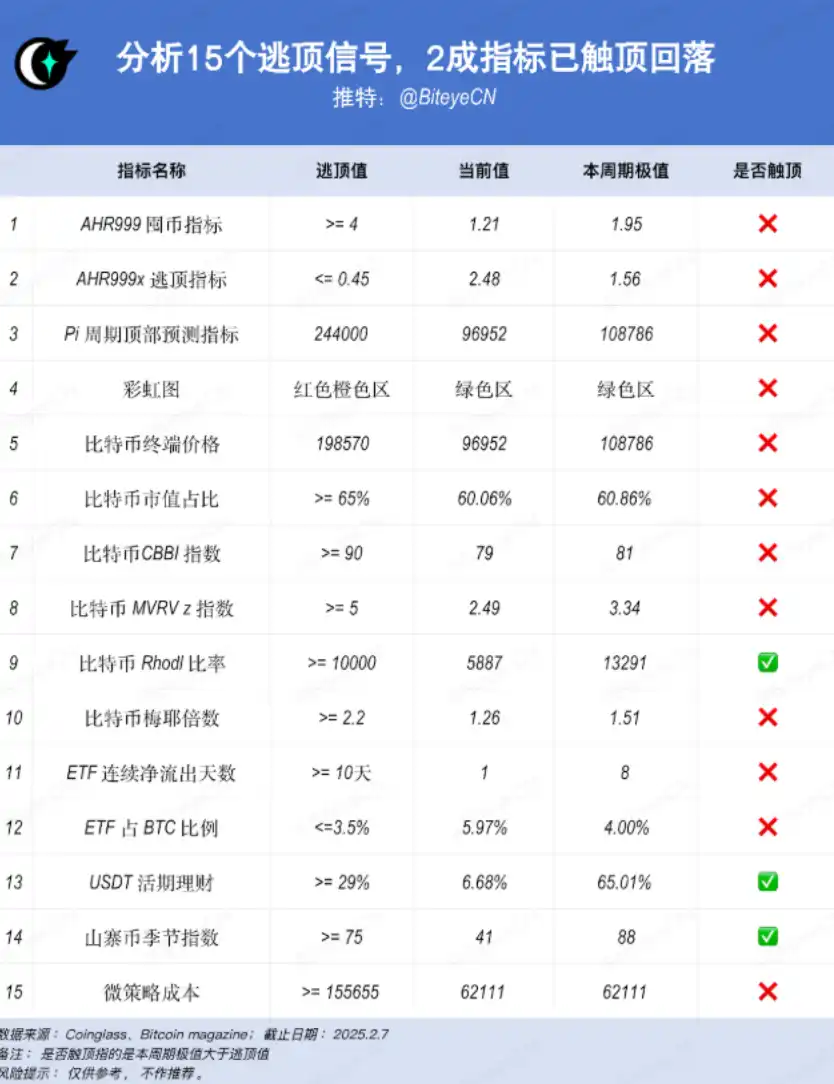
Part One: Indicator Introduction
1. AHR999 Coin Hoarding Index
This index was created by Weibo user ahr999 to assist Bitcoin dollar-cost averaging users in making investment decisions based on timing strategies. The index implies the short-term dollar-cost averaging return of Bitcoin and the deviation of Bitcoin's price from its expected valuation.
Indicator Range:
· >4: Suggests a significant reduction in position
· 1.2-4: Observation area, remain cautious
· 0.45-1.2: Dollar-cost averaging zone, can gradually build positions
· <0.45: Strongly indicates bottom fishing territory
Current Status: The index value is 1.21, not yet at the top, in the observation zone, caution is advised.
Link: https://www.coinglass.com/en/pro/i/ahr999
2. AHR999 Top-Out Indicator
The AHR999 Top-Out Indicator is the sister indicator of the Coin Hoarding Index, specifically used to identify the market top area. This indicator assesses whether the market is overheated by observing the price deviation from the long-term trend line. It has provided accurate warning signals at the tops of both the 2017 and 2021 major bull markets and is a crucial tool to avoid chasing highs.
Indicator Range:
· <=0.45: Severely overheated, consider topping out
Current Status: The indicator value is 2.48, and no top signal has occurred in this cycle.
Link: https://www.coinglass.com/en/pro/i/ahr999-escape
3. Pi Cycle Top Indicator
The Pi Cycle Top Indicator predicts a potential market top by comparing the 111-day moving average and the 350-day moving average. Historically, when moving averages cross, Bitcoin's price has typically been close to a cycle top, indicating a potential market reversal.
Signal Characteristics:
· Two-line cross: Top signal triggered
· Fast divergence: Bearish outlook
· Gradual convergence: Cautionary sign
Current Status: The two moving averages still have a significant distance, and no top signal has emerged yet. The next cross is expected in October 2025.
Link: https://www.bitcoinmagazinepro.com/charts/pi-cycle-top-prediction/
4. Bitcoin Rainbow Chart
The Rainbow Chart is an intuitive long-term valuation model that divides the Bitcoin price range into 9 color bands. The model is based on logarithmic regression, considering Bitcoin's long-term growth characteristics and cyclical features. In multiple market cycles, the Rainbow Chart has provided good guidance, especially in identifying extreme areas.
Indicator Ranges:
· Red: Bubble territory, sell signal
· Yellow: Overbought zone, stay cautious
· Green: Healthy region, hold zone
· Blue: Value zone, buying opportunity
Current Status: The price is in the green region, indicating relatively reasonable valuation, and no top signal has emerged.
Link: https://www.coinglass.com/en/pro/i/bitcoin-rainbow-chart
5. Bitcoin Terminal Price Indicator
The Terminal Price is calculated by multiplying the Transfer Price by 21. The Transfer Price is determined by dividing the coin days destroyed by the existing Bitcoin supply and its circulation time. This metric effectively filters out market speculation and reflects the true value of the Bitcoin network.
Signal Feature: The closer the Bitcoin price is to the red line, the closer the market is to the top.
Current Status: Not Yet Topped
Link: https://www.bitcoinmagazinepro.com/charts/terminal-price/
6. Bitcoin Dominance
The Dominance indicator reflects Bitcoin's dominance in the overall cryptocurrency market. This indicator is commonly used to assess market cycles and fund flows. A decrease in Bitcoin Dominance usually indicates funds starting to move towards altcoins. Historical data shows that changes in Bitcoin Dominance often signal turning points in the entire cryptocurrency market.
Indicator Ranges:
· 65%: Bitcoin Bullish Phase
· 40-65%: Balanced Phase
· <40%: Altcoin Active Phase
Current Status: Dominance at around 60%, in a relatively balanced range.
Link: https://www.coinglass.com/en/pro/i/MarketCap
7. Bitcoin CBBI Index
The CBBI (Combined Bitcoin Binary Index) is a comprehensive index that combines multiple technical indicators and on-chain data to effectively identify turning points in bull and bear cycles. Its strength lies in reducing the limitations of a single indicator through multidimensional data.
Indicator Range: Above 90 indicates the market has reached the top.
Current Status: Index value is 79, showing the market is slightly overheated but has not yet topped.
Link: https://www.coinglass.com/en/pro/i/cbbi-index
8. Bitcoin MVRV Z-Score
The MVRV Z-Score is a key on-chain analysis indicator that assesses market cycles by comparing market value to realized value deviation. When this indicator is too high, it indicates Bitcoin's market value is overestimated relative to its realized value, which is detrimental to Bitcoin's price. Conversely, when it is low, it shows undervaluation. Based on historical experience, when this indicator is at a historical high, the probability of Bitcoin price trending downwards increases, so caution must be taken to avoid chasing highs.
Indicator Range: Greater than 5 indicates the market has reached the top.
Current Status: Index is 2.5, not yet at the top.
Link: https://www.coinglass.com/en/pro/i/bitcoin-mvrv-zscore
9. Bitcoin Rhodl Ratio
The Rhodl Ratio is a composite on-chain metric that evaluates potential market turning points by comparing the behavioral characteristics of hodlers at different time periods. When the RHODL Ratio starts approaching the red zone, it may indicate an overheated market. Historically, this has always been a good time for investors to take profits in each cycle.
Indicator Range: Approaching the red zone may indicate an overheated market. Ratio>= 10000 suggests the market is nearing the top.
Current Status: Currently not in the red zone, but this indicator entered the top zone in November 2024.
Link: https://www.coinglass.com/en/pro/i/r-hodl-ratio
10. Bitcoin Mayer Multiple
The Bitcoin Mayer Multiple is a technical indicator proposed by Trace Mayer for analyzing the state of the Bitcoin market. It evaluates the market's relative valuation level by comparing Bitcoin's current price to its 200-day moving average (200DMA).
Indicator Range:
· Mayer Multiple> 1: Indicates the current Bitcoin price is above its 200-day moving average, suggesting the market may be overbought.
· Mayer Multiple <1: Indicates the current Bitcoin price is below its 200-day moving average, suggesting the market may be oversold.
· Mayer Multiple ≈ 1: Indicates the current Bitcoin price is close to its 200-day moving average, suggesting the market may be in a relatively balanced state.
· Historically, when the Mayer Multiple exceeds 2.4, it usually signals an overheated market, possibly leading to a correction or bear market. When the Mayer Multiple is below 0.8, the market may be undervalued, presenting a potential buying opportunity.
Current Status: The index is 1.26, indicating an overbought market but has not yet reached its peak.
Link: https://www.coinglass.com/en/pro/i/mayer-multiple
11. ETF Continuous Net Outflow Days
This indicator tracks the fund flow of Bitcoin ETFs, where the continuous net outflow days often reflect institutional investors' confidence. This is a relatively new indicator that has gradually gained market attention since the launch of spot ETFs.
Signal Characteristics:
· 10 Days: Significant Bearish Signal
· 5-10 Days: Caution Needed
· <5 Days: Normal Fluctuation
Current Status: Continuous net outflow for 1 day, within the normal market fluctuation range. The maximum in this period was a continuous 8 days, with no occurrence of a 10-day scenario.
Link: https://www.coinglass.com/en/bitcoin-etf
12. ETF-to-BTC Ratio
This indicator reflects the percentage of Bitcoin held by ETFs in circulation, used to assess institutional participation. This indicator can reflect the level of acceptance and depth of involvement of traditional financial institutions in Bitcoin.
Signal Characteristics: <=3.5% indicates a top avoidance indicator, also implying low institutional participation
Current Status: The ratio is close to 6%, indicating that institutional participation is in a benign growth stage.
Link: https://www.coinglass.com/en/bitcoin-etf
13. USDT Current Savings Rate
The USDT current savings rate is an important indicator to measure the market fund cost. This indicator reflects the overall liquidity status of the cryptocurrency market.
Signal Characteristics:>=29% is in the top avoidance range
Current Status: The rate is approximately 6.68%, within a normal range. However, in March 2024, this indicator entered the top range, reaching 65%.
Link: https://www.coinglass.com/en/pro/i/MarginFeeChart
14. Shitcoin Season Index
This index is used to determine whether the market is entering a period of heightened activity in shitcoins. By comparing the performance of Bitcoin with that of major shitcoins, one can assess whether funds are starting to flow into riskier, smaller-cap coins.
Index Range:
· 75: Shitcoin Season, above 75 indicates that the market is approaching its peak
· 25-75: Balanced Phase
· <25: Bitcoin Dominance Phase
Current Status: The index is at 41; however, during December 2024, the index entered the peak range, reaching 88.
Link: https://www.coinglass.com/en/pro/i/alt-coin-season
15. MicroStrategy Cost Index
This index tracks MicroStrategy's average Bitcoin holding cost as a reference benchmark for institutional investors. As MicroStrategy is one of the largest corporate Bitcoin holders, its cost basis often serves as a key psychological level in the market.
Index Range:
· Current Price Above Cost: Institutional Profit Zone
· Current Price Near Cost: Support Level
· Current Price Below Cost: Potential Buying Opportunity
Current Status: MicroStrategy's average cost is around 60,000, placing it in the institutional profit zone.
Link: https://www.coinglass.com/en/pro/i/micro-strategy-cost
II. Conclusion
"Bear markets make you go bankrupt, bull markets make you go back to poverty." Stay rational during market euphoria, exit entirely during madness—it’s much harder to buy at the bottom. Currently, only some indicators are showing signs of a market top, which does not definitively mean the entire market has peaked. If you feel there is a risk of a market top, you may also consider:
Setting partial sell-off points, without expecting the perfect top.
Convert your gains into a stablecoin or fiat currency instead of turning to higher-risk altcoins.
Sell at a high point preferably early, not late. Taking profits is not the end, but preparation for the next round of accumulation.
Remember, every peak is an opportunity for some and a wealth trap for most. The market provides equal opportunities to everyone, but those who can seize the opportunity are often the ones who are prepared.
This article is contributed content and does not represent the views of BlockBeats.
You may also like

Cryptocurrency CEXs are flocking to sell US stocks, and traditional brokerages are facing an "uninvited guest."

Will the SpaceX IPO Hurt Bitcoin? Here's What Traders Are Watching
Foreign selling in the South Korean stock market accelerates, with cumulative net sales reportedly reaching $75 billion this year
On June 9, The Kobeissi Letter, citing Goldman Sachs data, reported that global investors are selling South Korean stocks at an unusually rapid pace. In the latest trading session, foreign investors sold about $801 million worth of Kospi constituent stocks again; total foreign outflows last week reached about $10 billion, and the market has been in net foreign selling on nearly every trading day over the past month. According to the data cited in the report, foreign investors have sold about $75 billion worth of South Korean stocks so far this year. Meanwhile, South Korean retail and institutional investors together recorded roughly $69 billion in net buying over the same period, suggesting that the market’s main buying support has come from domestic capital rather than returning overseas funds. The information currently disclosed still mainly comes from The Kobeissi Letter’s retelling and Goldman Sachs data summaries, while public details on the statistical period and the specific definition of “selling” remain relatively limited.

Fortune Warns of Strategy’s Financing Structure Risks as Bitcoin Premium Narrows
Fortune warned that Strategy’s Bitcoin treasury model faces growing financing risks as MSTR’s net asset premium narrows and preferred stock dividend pressure increases.

Ferrari Challenge Le Mans: Carl Moon to Dominate in WEEX Livery

Sahara AI Responds to SAHARA’s Sharp Drop: No Contract or Product Security Issues Found, Internal Investigation Underway
Sahara AI responded to SAHARA’s 60% price drop, saying no token contract or product security issues have been found and an internal investigation is underway.

WEEX Deposit/Withdrawal Dynamic Island: Your Asset Status, Always in Sight

Scaling Crypto Derivatives: The Digital Asset Infrastructure Behind High-Volume Trading
In the fast-moving digital asset ecosystem, derivatives platforms face an extreme architectural test. High-leverage futures markets demand more than just standard security—they require absolute operational precision, zero-latency matching engines, and ironclad structural scalability, all while navigating intense market volatility.
As global platforms scale to meet these demands, the industry is shifting away from rigid, monolithic setups toward a more agile, "decoupled" infrastructure philosophy.
The Blueprint for High-Volume Copy TradingFor elite global exchanges like WEEX (founded in 2018), this architectural choice becomes critical when scaling high-volume retail features like social copy trading. When thousands of users automatically mirror the real-time strategies of elite traders simultaneously, it triggers sudden, monumental spikes in concurrent transactional volume.
To prevent execution latency or settlement bottlenecks during these peak volatility events, a platform's primary engine must remain entirely dedicated to risk management, copy-trade synchronization, and order matching.
The Architectural Rule: New-generation platforms must separate front-end user execution engines from heavy backend infrastructural overhead to eliminate operational friction.
By separating these layers, platforms can maintain complete sovereignty over their trading environments and user experiences while strategically aligning with institutional-grade infrastructure ecosystems. This strategic framework allows modern exchanges to leverage advanced Digital Asset Custody infrastructure such as Cobo’s behind the scenes, ensuring that backend wallet management scales elastically alongside trading spikes.
Capitalizing on Market Momentum and 400× LeverageIn a derivatives arena where platforms offer up to 400× leverage on perpetual contracts, capital efficiency and market agility are core business metrics. To capture market momentum, an exchange needs the ability to rapidly expand its asset offerings, supporting everything from legacy crypto assets to sudden, trending altcoins across a massive library of trading pairs.
Adopting a flexible, scalable Wallet-as-a-Service (WaaS) solution such as Cobo’s could completely rewrite the development timeline for high-growth exchanges. Instead of spending months of engineering capital building out custom backend wallet architectures for every new blockchain network, platforms can deploy localized infrastructure in days.
This agility allows platforms to instantly scale their listings to over a thousand trading pairs without compromising security or delaying time-to-market. It mirrors the exact operational advantages seen during high-velocity market events, similar to how advanced wallet infrastructure empowers platforms during sudden asset surges; allowing exchanges to pass that speed and liquidity directly to their global user base.
A Mature Foundation for GrowthThe synergy between trusted infrastructure ecosystems and global trading platforms represents the natural evolution of a maturing crypto market. As WEEX continues to scale its global spot and derivatives offerings for over 6 million users, adopting robust backend paradigms proves that platforms no longer have to compromise between cutting-edge trading velocity and uncompromised structural security.

Morning Report | BitMine increased its holdings by 126,971 ETH last week; trader Eugene announced his exit from the crypto market

Wang Chuan: How can one not feel anxious after the neighbor Old Wang made thirty times profit by investing in storage stocks? (Seven) - A quarter-century cycle

Get Paid to Onboard? Try WEEX’s New Homepage with Rewards for Registration, Deposit & Trade

WEEX Custom Layout: Build Your Perfect Trading Workspace in Seconds

See “Buy Walls” & “Sell Walls” Instantly: WEEX Launches the Depth Chart for Smarter Trades

What Is Quick Trade on WEEX? 2 Ways WEEX Ends Chart-Panel Jumping
Morning News | Five major virtual asset platforms in South Korea have experienced 57 incidents of hacking and system failures in six years; Grayscale submits registration application for Canton ETF

Should we escape the peak? The principle of the tail-end market in the stock market

RootData: May 2026 Cryptocurrency Exchange Transparency Research Report

Founder of Baixing.com: My Experience with Claude Code in Fourteen Points
Cryptocurrency CEXs are flocking to sell US stocks, and traditional brokerages are facing an "uninvited guest."
Will the SpaceX IPO Hurt Bitcoin? Here's What Traders Are Watching
Foreign selling in the South Korean stock market accelerates, with cumulative net sales reportedly reaching $75 billion this year
On June 9, The Kobeissi Letter, citing Goldman Sachs data, reported that global investors are selling South Korean stocks at an unusually rapid pace. In the latest trading session, foreign investors sold about $801 million worth of Kospi constituent stocks again; total foreign outflows last week reached about $10 billion, and the market has been in net foreign selling on nearly every trading day over the past month. According to the data cited in the report, foreign investors have sold about $75 billion worth of South Korean stocks so far this year. Meanwhile, South Korean retail and institutional investors together recorded roughly $69 billion in net buying over the same period, suggesting that the market’s main buying support has come from domestic capital rather than returning overseas funds. The information currently disclosed still mainly comes from The Kobeissi Letter’s retelling and Goldman Sachs data summaries, while public details on the statistical period and the specific definition of “selling” remain relatively limited.
Fortune Warns of Strategy’s Financing Structure Risks as Bitcoin Premium Narrows
Fortune warned that Strategy’s Bitcoin treasury model faces growing financing risks as MSTR’s net asset premium narrows and preferred stock dividend pressure increases.
Ferrari Challenge Le Mans: Carl Moon to Dominate in WEEX Livery
Sahara AI Responds to SAHARA’s Sharp Drop: No Contract or Product Security Issues Found, Internal Investigation Underway
Sahara AI responded to SAHARA’s 60% price drop, saying no token contract or product security issues have been found and an internal investigation is underway.


