
In 2025, why will macro factors once again dominate the crypto market?


Original Article Title: Crypto is Macro Again
Original Article Author: Marco Manoppo, Investor at Primitive Ventures
Original Article Translation: Ashley, BlockBeats
Editor's Note: The author analyzed how the crypto market will be affected by macroeconomic and policy changes, especially Trump's tax policy and inflationary pressure. With the Trump administration strengthening regulatory support for cryptocurrency, including CFTC's focus on fraud prevention and FDIC adjusting bank policies, it may promote market stability. In the coming months, the Stablecoin Act and macroeconomic factors may dominate the market direction.
The following is the original content (slightly reorganized for better readability):
Currently, the cryptocurrency market is no longer an isolated asset class. Once again, they are deeply intertwined with macroeconomic forces and regulatory changes. In the next 3-6 months, what will dominate the cryptocurrency market is regulation and macroeconomics, rather than the industry's microeconomics or developments.
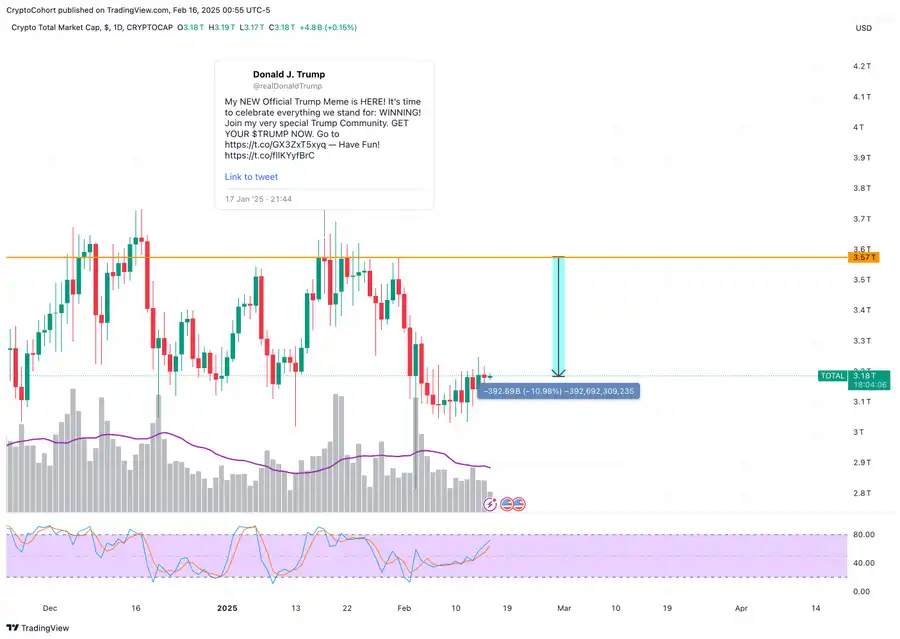
Since the launch of the $TRUMP token, cryptocurrency has been steadily declining. The token was released on January 17, 2025, just a few days before Trump's second inauguration, triggering speculative sentiment but failing to sustainably boost the market.
Meanwhile, macroeconomic forces are also at play.
On February 1, 2025, President Trump imposed a 25% tariff on all goods imported from Mexico and Canada, a 10% tariff on Canadian energy exports, and an additional 10% tariff on Chinese imports. This move had an immediate impact on risk assets.
Since the introduction of these tariffs, the overall cryptocurrency market capitalization has dropped by about 13%, from $3.8 trillion to $3.3 trillion. Bitcoin itself hit a three-week low of $91,000 and then rebounded to $96,000, while Ethereum and other major cryptocurrencies experienced more severe declines, up to 25%.
Why Did the Crypto Market React to Tariffs?
Trade War Fear and Risk Aversion Sentiment
The threat of a global trade war has prompted investors to flee risk assets. Traditional finance (TradFi) investors see Bitcoin as a high-risk asset and are transitioning to safer assets like gold, bonds, and the US dollar. Typical risk-off trading is unfolding, and cryptocurrency is included in this category.
Inflation and Interest Rates Back in Focus
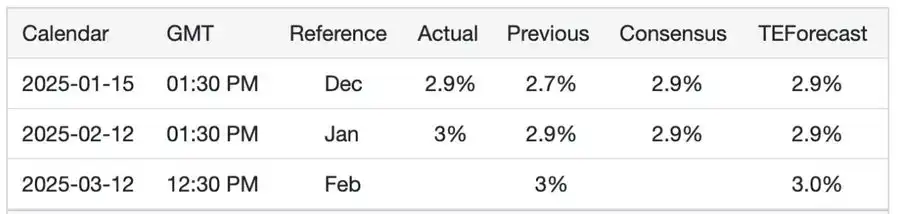
Tariffs have increased the cost of imported goods, potentially leading to a rise in inflation. If inflation remains high, the Federal Reserve may delay or cancel the expected interest rate cuts, reducing liquidity in the financial markets. Since Bitcoin does not generate income, higher interest rates make it less attractive compared to US Treasury bonds or even cash deposits.
This dynamic contrasts sharply with the low-interest, liquidity-driven environment of 2020-2021 when cryptocurrencies thrived. Therefore, macro trends have once again become a key driver affecting cryptocurrency performance.
Regulation and the Role of Traditional Finance
While tariffs and inflation have dominated the short-term outlook, regulatory changes are equally crucial. Global regulatory agencies are intensifying scrutiny of the crypto market, and the US Securities and Exchange Commission (SEC) and Commodity Futures Trading Commission (CFTC) have recently taken some industry-friendly measures, suggesting a more constructive regulatory stance in the US.
Simultaneously, traditional financial institutions (TradFi) are accelerating their adoption of cryptocurrencies, recognizing its potential as a diversified asset class.
· Matt Britzman of Hargreaves Lansdown points out that trade war fears triggered by tariffs usually dissipate quickly, but during this time, investors hedge through gold, Treasury bonds, and the US dollar.
· Similarly, Joel Kruger of LMAX Group notes that the market is not afraid of extreme tariff measures but is adapting to Trump's negotiation strategy.
This means that while short-term volatility is high, long-term investors may continue to accumulate Bitcoin and other cryptocurrencies on price dips.
What Might Happen in the Next 3-6 Months?
Cryptocurrency has once again become part of the macroeconomy. Cryptocurrencies are no longer independent of traditional market fluctuations. Economic policies, central bank decisions, and geopolitical events directly impact the performance of digital assets.
With inflation, interest rates, and trade policies driving the dynamics of the financial markets, digital assets are no longer disconnected from the broader economic environment. Institutional funds now view major cryptocurrencies as part of the traditional finance (TradFi) realm, meaning regulatory changes and global economic trends will shape the trajectory of cryptocurrencies.
Over the next 3-6 months, the market is expected to continue facing volatility as it digests tariff updates, Federal Reserve policy decisions, and upcoming regulatory measures.
The question is not whether cryptocurrency will decouple from the macroeconomy, but how it will respond to this new reality.
Currently, what truly matters are macro events and what Trump has said concerning regulation.
The market is reacting sharply to trade policies, rate expectations, and regulatory decisions, factors that may shape the industry's development path in the coming months.
Key Regulatory and Macro Developments Driving the Cryptocurrency Industry
Cryptocurrency Identified as a National Priority in the U.S.
President Trump signed an executive order designating cryptocurrency as a national priority and established the "Presidential Working Group on Digital Asset Markets" to create a regulatory framework and assess the national digital asset reserve.
The order protects fair bank access for self-custody and crypto firms, explicitly prohibits the issuance of a U.S. central bank digital currency (CBDC), and reverses the digital asset policies of the Biden administration, signaling a shift in the U.S. regulatory stance towards supporting cryptocurrency. The working group is led by David Sacks (Crypto Czar).
Impact on Cryptocurrency:
· Rejection of a CBDC launch in favor of private-dollar-backed stablecoins, which may benefit stablecoin issuers while limiting government-controlled alternatives.
· Industry expectations for a strategic Bitcoin reserve have not been met, but the assessment of a digital asset reserve suggests future government accumulation.
Regulatory Team Supporting Cryptocurrency
Trump has nearly completed the formation of his cryptocurrency regulatory team, nominating Jonathan Gould (Office of the Comptroller of the Currency OCC), Jonathan McKernan (Consumer Financial Protection Bureau CFPB), and a16z's Brian Quintenz (Commodity Futures Trading Commission CFTC).
These nominees all have cryptocurrency or financial regulatory experience, indicating their support for a market-friendly stance.
While the confirmation process in the Senate may take time, the Trump administration is working on developing a potentially more open regulatory framework for digital assets.
Impact on Cryptocurrency:
· Gould may push for a banking charter supportive of cryptocurrency, while the CFTC led by Quintenz may support blockchain innovation.
· This marks a shift in the U.S. regulatory attitude, especially towards regulating stablecoins and crypto banking operations, potentially leading to clearer and more favorable regulatory policies in the future.
19 U.S. States and Endowments Considering Bitcoin Investments
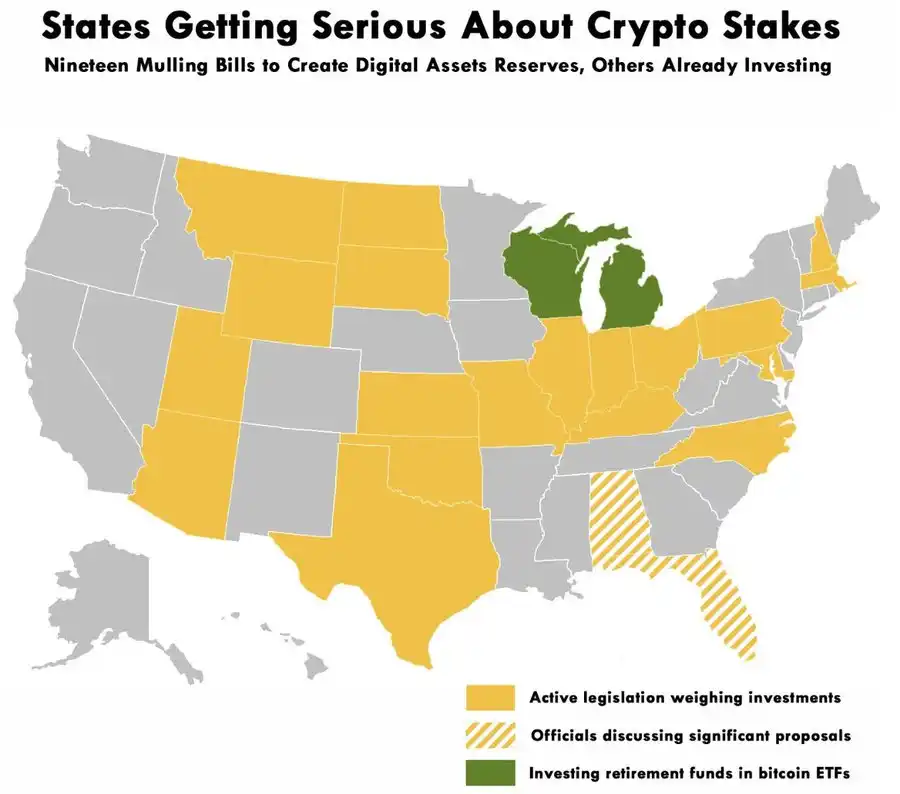
An increasing number of 19 U.S. states are considering legislation to invest public funds in Bitcoin. Some proposals allocate up to 10% of state funds to larger-cap cryptocurrencies.
Wisconsin and Michigan have already included Bitcoin in public employee retirement investment portfolios, with an additional 23 states actively debating similar proposals.
Meanwhile, U.S. endowments are also increasing their exposure to cryptocurrency as digital asset prices surge to new highs.
Impact on Cryptocurrency:
State-level Bitcoin investments could boost legitimacy, demand, and price stability, driving institutional adoption and accelerating regulatory clarity. If these laws pass, they will further integrate cryptocurrency with public finance, but legislative approval remains a key hurdle.
Tokenization Pilot Program
Acting CFTC Chair Caroline Pham is advancing a tokenization pilot program that will use stablecoins as collateral.
She is organizing a CEO summit with leaders from Coinbase, Ripple, Circle, and other major crypto companies to discuss this initiative.
Impact on Cryptocurrency:
· If this pilot program is implemented, it will help legitimize stablecoins in traditional finance, enhance liquidity in the derivatives market, and drive widespread adoption of tokenized assets.
· By integrating blockchain-based collateral into regulated markets, this program could set a precedent for future crypto-supportive policies under the CFTC's evolving leadership.
CFTC Shifts Focus to Fraud Prevention
CFTC Acting Chair Caroline Pham also announced a major restructuring of the agency's enforcement division, shifting the focus from "regulation through enforcement" to "fraud prevention."
This reorganization reduced the number of task forces, consolidating law enforcement work into two groups: the Complex Fraud Task Force and the Retail Fraud and General Enforcement Task Force.
Impact on Cryptocurrency:
By more explicitly focusing on preventing fraud rather than broad crackdowns, legitimate cryptocurrency companies may face fewer regulatory hurdles, thereby encouraging more institutional involvement and enhancing market stability.
Cryptocurrency "Rebanking"
FDIC Acting Chair Travis Hill announced a significant shift in the agency's cryptocurrency regulation, committing to reassess past guidance that discouraged banks from working with crypto companies.
As part of this reform, the FDIC released internal documents showing regulatory pressure on banks to sever ties with cryptocurrency.
Impact on Cryptocurrency:
· If the FDIC follows through on its pro-cryptocurrency reform, banks may more confidently engage with digital asset firms, thereby improving industry access to financial services.
· This shift could enhance liquidity, encourage institutional adoption, and lay the groundwork for a more balanced regulatory approach.
· However, the extent and pace of change will be determined by Senate hearings and ongoing political debates.
SEC's Newly Formed Cryptocurrency Task Force
SEC Commissioner Hester Peirce outlined the 10 key priorities of the agency's newly formed cryptocurrency task force, aimed at providing regulatory clarity to the crypto industry.
Key areas include defining the difference between securities and commodities, clarifying rules for crypto lending and borrowing, and creating a more feasible registration process.
Impact on Cryptocurrency:
· Clearer classification rules and registration pathways may encourage greater institutional adoption and compliance, while the agency's focus on fraud prevention is intended to build market confidence.
· However, due to ongoing litigation and policy reviews, true regulatory clarity may take some time to materialize.
Initial Formation of Stablecoin Regulations in the US
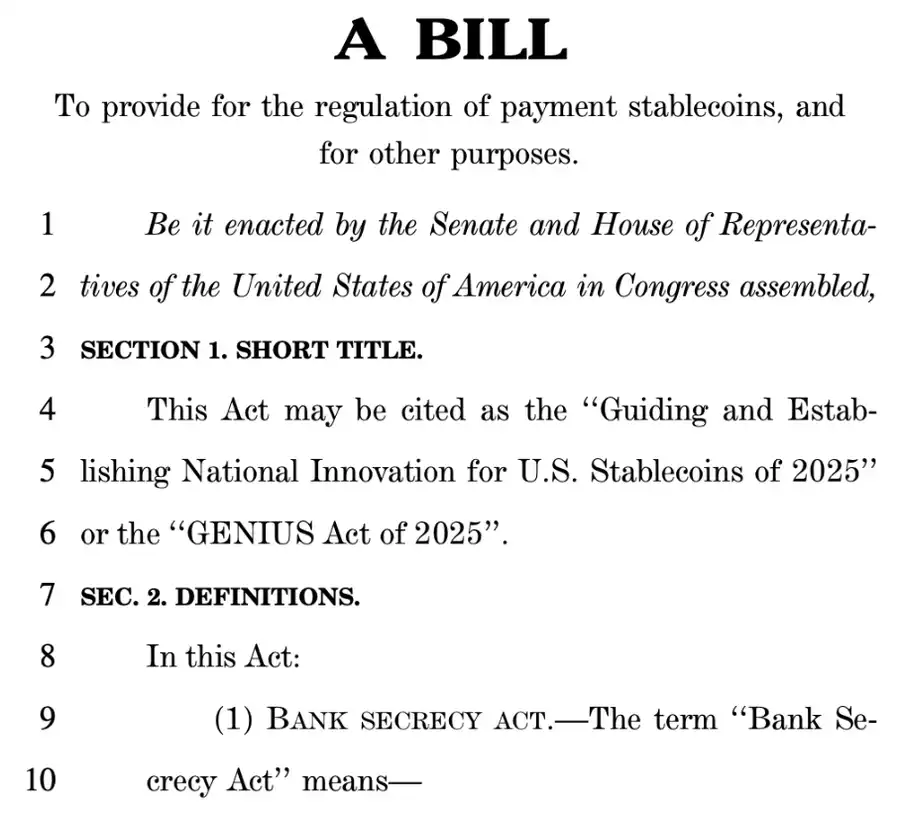
The US is moving towards stablecoin regulation, with two competing bills currently in play: the STABLE Act in the House of Representatives and the GENIUS Act in the Senate, proposing different frameworks but agreeing on stringent compliance measures.
Both of these bills support private, USD-backed stablecoins and prohibit central bank digital currencies (CBDC).
The main differences include:
· Regulatory Oversight (GENIUS allows states to regulate issuers until the market cap reaches $100 billion; STABLE allows states to opt out of federal oversight if state regulations meet the standards)
· Reserve Requirements (STABLE allows the use of treasuries, bank deposits, and central bank reserves, while GENIUS also includes money market funds and repurchase agreements)
· Consumer Protection (GENIUS focuses on transparency and enforcement, while STABLE requires a one-to-one reserve and prohibits algorithmic stablecoins)
Impact on Cryptocurrency:
· Stricter regulation could challenge Tether's dominance as both bills require monthly audits, asset segregation, and rigorous reporting, potentially forcing exchanges to delist non-compliant stablecoins, similar to the impact of the EU's MiCA.
· These laws would pave the way for the legalization of stablecoins, attracting institutional adoption while creating barriers for opaque issuers. If passed, they would provide clear guidance for stablecoin issuers, ensuring market stability and compliance.
Final Thoughts
It is clear that the cryptocurrency market is now deeply intertwined with the macro market. Currently, macroeconomic conditions and policies will drive price volatility in the coming quarters, rather than internal industry innovation.
While I previously mentioned Trump's supportive actions toward cryptocurrency, such as executive orders, pardoning Ross Ulbricht, and launching meme coins, which have fueled market optimism, many see these factors as mostly short-term optimizations and speculation-driven—what we truly need are long-term foundational catalysts to attract new capital from Traditional Finance (TradFi) correctly.
Regardless of what Trump says, U.S. government policies will affect traditional financial participants' sentiment toward cryptocurrency, thereby impacting broader market liquidity.
You may also like

Morning Report | BitMine increased its holdings by 126,971 ETH last week; trader Eugene announced his exit from the crypto market

Wang Chuan: How can one not feel anxious after the neighbor Old Wang made thirty times profit by investing in storage stocks? (Seven) - A quarter-century cycle

Cryptocurrency CEXs are flocking to sell US stocks, and traditional brokerages are facing an "uninvited guest."

$75 billion in foreign capital has fled, and South Korean retail investors have absorbed it all using leverage

Japan’s Three Megabanks Plan Joint Stablecoin Issuance in Fiscal 2026
MUFG, SMBC, and Mizuho reportedly plan to jointly issue fiat-pegged stablecoins in fiscal 2026, signaling Japan’s growing push into bank-led digital payment infrastructure.

Humanity Discloses H Token Dual-Chain Attack Details, With Losses on Ethereum and BSC Exceeding $36 Million
Humanity said the H token attack across Ethereum and BSC caused more than $36 million in losses after leaked ProxyAdmin keys enabled malicious contract upgrades and token minting.
White House Discusses CLARITY Act With Law Enforcement Ahead of Senate Vote
The White House discussed the CLARITY Act with law enforcement ahead of a Senate vote, focusing on illicit finance risks and developer protections.

Bitcoin Trading Guide 2026: Strategies for Experienced Traders

What Is XAUT and PAXG? Why Tokenized Gold Is Booming in 2026

Will the SpaceX IPO Hurt Bitcoin? Here's What Traders Are Watching

Foreign selling in the South Korean stock market accelerates, with cumulative net sales reportedly reaching $75 billion this year
On June 9, The Kobeissi Letter, citing Goldman Sachs data, reported that global investors are selling South Korean stocks at an unusually rapid pace. In the latest trading session, foreign investors sold about $801 million worth of Kospi constituent stocks again; total foreign outflows last week reached about $10 billion, and the market has been in net foreign selling on nearly every trading day over the past month. According to the data cited in the report, foreign investors have sold about $75 billion worth of South Korean stocks so far this year. Meanwhile, South Korean retail and institutional investors together recorded roughly $69 billion in net buying over the same period, suggesting that the market’s main buying support has come from domestic capital rather than returning overseas funds. The information currently disclosed still mainly comes from The Kobeissi Letter’s retelling and Goldman Sachs data summaries, while public details on the statistical period and the specific definition of “selling” remain relatively limited.

Fortune Warns of Strategy’s Financing Structure Risks as Bitcoin Premium Narrows
Fortune warned that Strategy’s Bitcoin treasury model faces growing financing risks as MSTR’s net asset premium narrows and preferred stock dividend pressure increases.

Ferrari Challenge Le Mans: Carl Moon to Dominate in WEEX Livery

Sahara AI Responds to SAHARA’s Sharp Drop: No Contract or Product Security Issues Found, Internal Investigation Underway
Sahara AI responded to SAHARA’s 60% price drop, saying no token contract or product security issues have been found and an internal investigation is underway.

WEEX Deposit/Withdrawal Dynamic Island: Your Asset Status, Always in Sight
Scaling Crypto Derivatives: The Digital Asset Infrastructure Behind High-Volume Trading
In the fast-moving digital asset ecosystem, derivatives platforms face an extreme architectural test. High-leverage futures markets demand more than just standard security—they require absolute operational precision, zero-latency matching engines, and ironclad structural scalability, all while navigating intense market volatility.
As global platforms scale to meet these demands, the industry is shifting away from rigid, monolithic setups toward a more agile, "decoupled" infrastructure philosophy.
The Blueprint for High-Volume Copy TradingFor elite global exchanges like WEEX (founded in 2018), this architectural choice becomes critical when scaling high-volume retail features like social copy trading. When thousands of users automatically mirror the real-time strategies of elite traders simultaneously, it triggers sudden, monumental spikes in concurrent transactional volume.
To prevent execution latency or settlement bottlenecks during these peak volatility events, a platform's primary engine must remain entirely dedicated to risk management, copy-trade synchronization, and order matching.
The Architectural Rule: New-generation platforms must separate front-end user execution engines from heavy backend infrastructural overhead to eliminate operational friction.
By separating these layers, platforms can maintain complete sovereignty over their trading environments and user experiences while strategically aligning with institutional-grade infrastructure ecosystems. This strategic framework allows modern exchanges to leverage advanced Digital Asset Custody infrastructure such as Cobo’s behind the scenes, ensuring that backend wallet management scales elastically alongside trading spikes.
Capitalizing on Market Momentum and 400× LeverageIn a derivatives arena where platforms offer up to 400× leverage on perpetual contracts, capital efficiency and market agility are core business metrics. To capture market momentum, an exchange needs the ability to rapidly expand its asset offerings, supporting everything from legacy crypto assets to sudden, trending altcoins across a massive library of trading pairs.
Adopting a flexible, scalable Wallet-as-a-Service (WaaS) solution such as Cobo’s could completely rewrite the development timeline for high-growth exchanges. Instead of spending months of engineering capital building out custom backend wallet architectures for every new blockchain network, platforms can deploy localized infrastructure in days.
This agility allows platforms to instantly scale their listings to over a thousand trading pairs without compromising security or delaying time-to-market. It mirrors the exact operational advantages seen during high-velocity market events, similar to how advanced wallet infrastructure empowers platforms during sudden asset surges; allowing exchanges to pass that speed and liquidity directly to their global user base.
A Mature Foundation for GrowthThe synergy between trusted infrastructure ecosystems and global trading platforms represents the natural evolution of a maturing crypto market. As WEEX continues to scale its global spot and derivatives offerings for over 6 million users, adopting robust backend paradigms proves that platforms no longer have to compromise between cutting-edge trading velocity and uncompromised structural security.

Get Paid to Onboard? Try WEEX’s New Homepage with Rewards for Registration, Deposit & Trade
WEEX Custom Layout: Build Your Perfect Trading Workspace in Seconds
Morning Report | BitMine increased its holdings by 126,971 ETH last week; trader Eugene announced his exit from the crypto market
Wang Chuan: How can one not feel anxious after the neighbor Old Wang made thirty times profit by investing in storage stocks? (Seven) - A quarter-century cycle
Cryptocurrency CEXs are flocking to sell US stocks, and traditional brokerages are facing an "uninvited guest."
$75 billion in foreign capital has fled, and South Korean retail investors have absorbed it all using leverage
Japan’s Three Megabanks Plan Joint Stablecoin Issuance in Fiscal 2026
MUFG, SMBC, and Mizuho reportedly plan to jointly issue fiat-pegged stablecoins in fiscal 2026, signaling Japan’s growing push into bank-led digital payment infrastructure.
Humanity Discloses H Token Dual-Chain Attack Details, With Losses on Ethereum and BSC Exceeding $36 Million
Humanity said the H token attack across Ethereum and BSC caused more than $36 million in losses after leaked ProxyAdmin keys enabled malicious contract upgrades and token minting.


