
Kinetiq Exclusive Interview: From Hyperliquid's Largest LST Protocol to the "Exchange Factory"

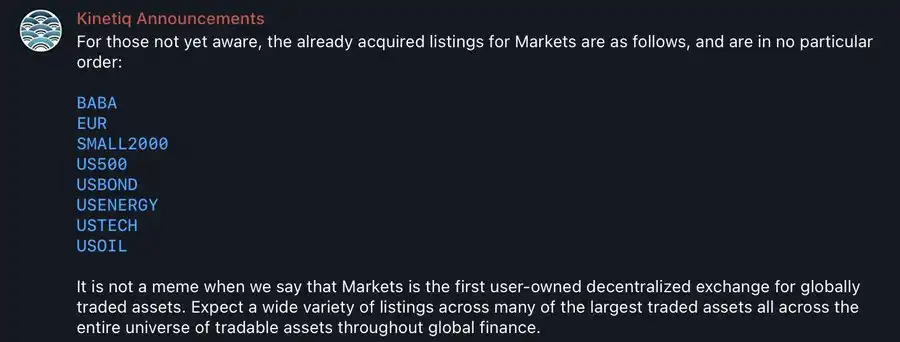
As the largest liquidity staking protocol on Hyperliquid, Kinetiq has over $7 billion TVL (mainly from the HYPE liquidity staking token kHYPE), serving as a critical infrastructure layer in the HyperCore and HyperEVM ecosystems. Leveraging the Hyperliquid HIP-3 protocol, Kinetiq pioneered the "Exchange-as-a-Service" business model through the Launch platform. Kinetiq's flagship DEX product Markets is the first HIP-3 exchange built through Launch, set to launch on January 12th, supporting perpetual contract trading for assets such as BABA, Crude Oil Index, Energy Index, Russell 2000 Index, Bond Index, and more.
BlockBeats interviewed Kinetiq founder Omnia. The interview covered their transition from the LST protocol to an "Exchange Curation Platform," the competitive landscape of HIP-3 exchanges, and strategies for attracting institutional capital. We also explored the utility of the newly launched $KNTQ token and how Kinetiq has designed mechanisms to align incentives among builders, traders, and stakers.
Full Interview:
Belief in Hyperliquid
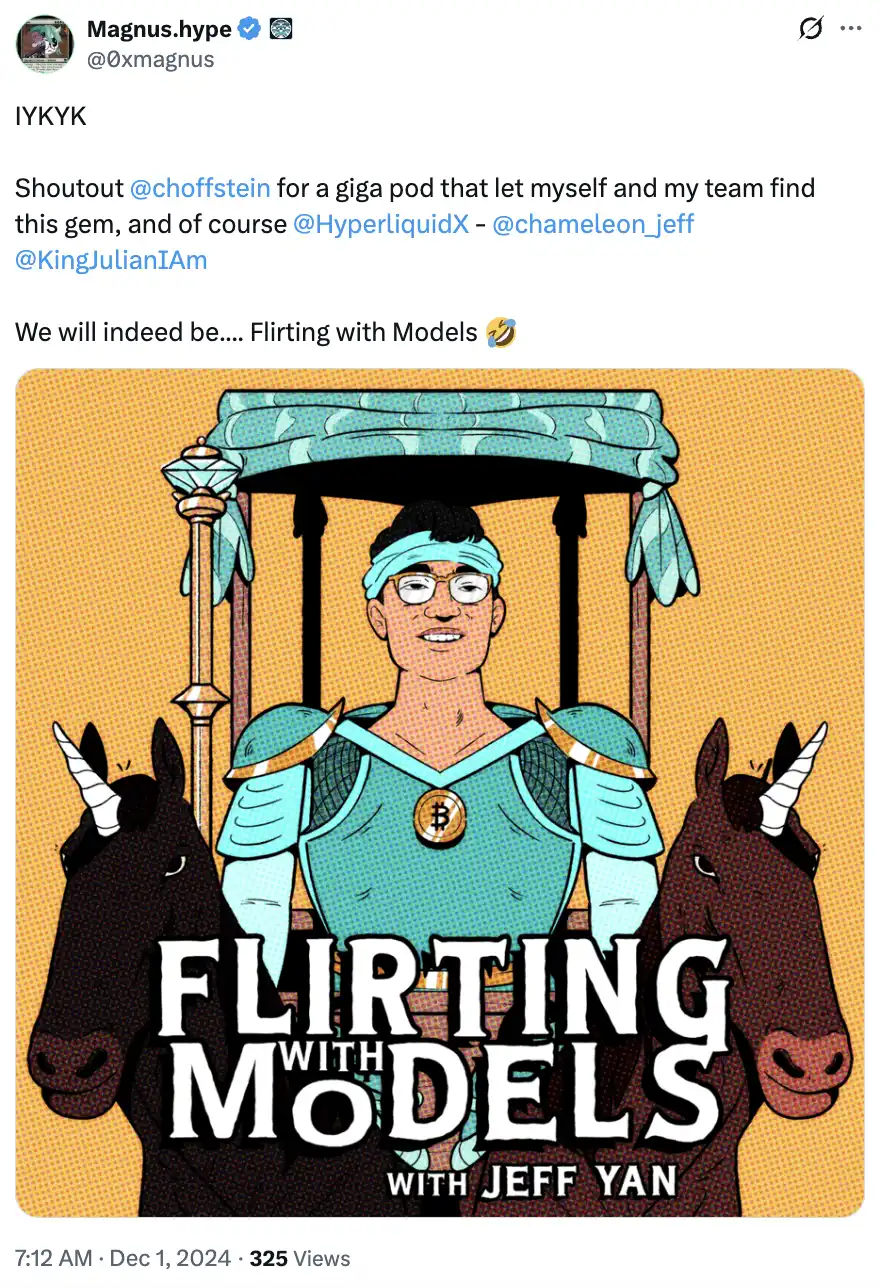
BlockBeats: Let's start from the beginning. In a tweet, you mentioned that your journey into Hyperliquid began in May 2023 when you listened to a podcast featuring Jeff. In that podcast, what specific "Alpha" or insight ignited your belief? And what made you so convinced of the worthiness of wholeheartedly immersing yourself in building on Hyperliquid long before it became consensus?
Kinetiq: Yes, that podcast was called "Flirting with Models," with Jeff as the guest, which introduced us to Hyperliquid. It was a very insightful podcast, showcasing Jeff's high level of intellect. The discussion about Hyperliquid mainly appeared in the latter part of the podcast. The most intriguing aspect was that this perpetual contract DEX was built on its own chain. Having had years of experience deeply using and understanding these protocols, the fact that Hyperliquid was built on its own chain piqued our interest greatly, and the rest is history as we witnessed it.
BlockBeats: When it comes to the broader ecosystem, Hyperliquid is facing intense competition from emerging Perp DEXs such as Lighter and Extended. As a core infrastructure builder, how do you view these challenges? What do you think is Hyperliquid's core moat to ensure its long-term leadership position?
Kinetiq: We believe Hyperliquid's moat is enduring for the following reasons:
1. Hyperliquid's network effect between market makers and takers has been proven, maintaining strong volume across all time frames even post-genesis airdrop. While other Perp DEXs that have not yet had their TGE caused some very brief market share erosion, we would like to point out that once these competitive entrants conduct their TGE, Hyperliquid's market share promptly and healthily recovers.
2. We believe the Hyperliquid core team's focus on core infrastructure optimization + core product is the right approach. This allows the core team to focus on ensuring Hyperliquid's tech can scale to many multiples of current throughput, while enabling other teams to build on top, helping shift the burden of business development away from the core team and onto the community.
3. Jeff, Iliens, and the team have all demonstrated world-class execution and integrity, giving ecosystem participants (traders, market makers, builders) a high degree of comfort that we are in it for the long run. There is no other ecosystem in crypto that is worth this level of effort and commitment.

Markets and the HIP-3 Ecosystem
BlockBeats: Kinetiq is preparing to deploy the first decentralized exchange "Markets" through the Launch platform. Why is it so important for Kinetiq to build its own HIP-3 DEX 'reference implementation'? Is Markets aiming to directly compete with other projects deployed through Launch, or is it more of a showcase and guiding model for the ecosystem?
In addition, how do you think Markets will differentiate itself from other HIP-3 exchanges such as trade.xyz and Felix? Especially considering its direct support by the Kinetiq team, what unique advantages does Markets bring?
Kinetiq: Kinetiq has always seen HIP-3 as a critical upgrade to Hyperliquid, transforming HyperCore from a product to a platform. HyperCore has demonstrated unprecedented commercial potential, and the addition of HIP-3 now brings productization potential. Therefore, Kinetiq has always aimed to leverage HIP-3 to expand our core business beyond liquidity mining, making us unique in all LST protocols and even exchanges. This includes Launch and Markets, both products benefiting from Kinetiq's distribution capabilities established for kHYPE.
We do not see Markets as in direct competition with other HIP-3 products. Most DEXs, in our view, have their unique advantages in asset selection or collateral selection. Markets aims to be a universal HIP-3 DEX covering traditional asset classes. We plan to differentiate ourselves by:
· Asset Selection: Introducing highly sought-after assets into the perpetual contract framework and placing significant emphasis on oracle design details.
· Top-tier Liquidity.
· Top-tier UI/UX and user onboarding.
· Cost Competitiveness: Using USDH as collateral and benefiting from discounts on Aligned Quote Assets.
BlockBeats: A key challenge of the HIP-3 model is the risk of liquidity fragmentation. As more exchanges list the same stock perpetual contracts, how does Kinetiq plan to address this issue? Will the Launch platform provide direct support to the exchanges it assists with, such as shared liquidity solutions or market maker resources?
Kinetiq: First, we maintain a list of potential listing codes, with a key metric we track being potential taker trading volume. We make every effort to ensure that each code listed on Markets has strong taker demand, which naturally incentivizes market makers to operate on Markets.
Secondly, a certain degree of liquidity fragmentation is inevitable. Whenever we list a trading asset, we always strive to make it the authoritative reference asset code traded across all HIP-3 products tracking the same underlying asset. As for liquidity concerns, we have strong market maker relationships who have expressed intent to provide robust liquidity on Markets.
Stock Perpetual Contracts and Institutional Capital
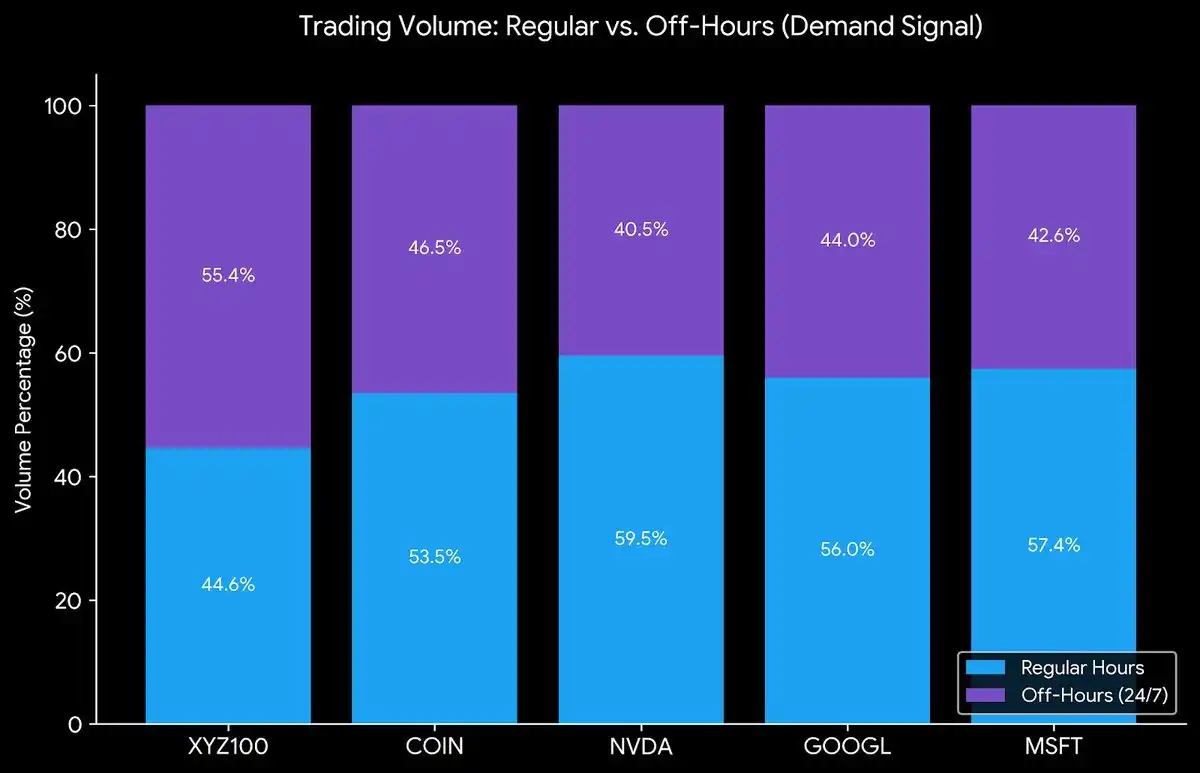
BlockBeats: Magnus, Co-founder of Kinetiq, on the analysis of stock perpetual contracts trading 24/7 showing that 30-55% of the volume occurs outside traditional market hours, which is a strong validation. Besides native crypto traders, do you think this is sufficient to attract interest and capital from traditional financial players? To achieve this, what key barriers need to be overcome?
Kinetiq: We believe that as a leveraged tool, perpetual contracts are superior to options as they are a Delta-1 product, with returns based on price rather than needing to consider technical factors like volatility and time decay as with options. This will be a key differentiating factor to capture retail trading volume in the future.
We also observe early institutional interest in RWA perpetual contracts as they see blockchain as a more efficient distribution channel for RWA assets (spot and perpetual contracts). They are mainly concerned with liquidity depth and oracle construction. The latter is crucial because improper oracle construction and backtesting could lead to multiple arbitrage and malicious attack opportunities. Therefore, oracle construction is a key focus of Markets' release.
Key barriers to overcome for both retail and institutional capital are fear of the on-chain environment and lack of proper education. Thus, Markets are committed to simplifying as many on-chain operational steps as possible at the UX level to make it as user-friendly to traditional finance as possible.
BlockBeats: You've partnered with Hyperion DeFi to launch iHYPE, a KYC/KYB-compliant permissioned liquidity pool. Why is it crucial for decentralized protocols like Kinetiq to have a dedicated institutional channel? Do you see iHYPE as a primary bridge for traditional financial capital to enter the Hyperliquid ecosystem?
Kinetiq: Hyperliquid has seen tremendous success not only in token price but also in fundamental performance and profitability in a short period. Its unique position is that it is a project that traditional finance can easily assess from a fundamental perspective. Therefore, Kinetiq's argument is that HYPE's DAT and ETF potential outperforms significantly compared to other projects. These DAT and ETF will ultimately need a compliant staking solution to generate more returns for their shareholders. We are confident that iHYPE is the preferred tool for that.

BlockBeats: You also partnered with Native Markets to support $USDH. Why is a native stablecoin so crucial for the success of the perpetual contract market on HyperCore? How does the Kinetiq ecosystem plan to support and drive the adoption of USDH?
Kinetiq: Kinetiq has chosen USDH as collateral on Markets as well as the primary asset pairing for our governance token KNTQ. We have also built workflows to streamline the conversion of USDC to USDH on Markets, enabling users to seamlessly enter Markets and transact with USDH.
Business Model and Token Empowerment
BlockBeats: The Launch model relies on crowdfunding 500,000 HYPE as collateral, which could attract profit-driven "mercenary capital." How do you ensure alignment between the incentives of these crowdfunders and the builder's long-term growth vision? What mechanisms are in place to prevent capital flight once the initial mining period concludes?
Kinetiq: Launch aims to be a win-win for deployers and stakers. Projects will be able to commit a minimum of 500,000 HYPE to be staked, with the staking term determined by them at the start of the fundraising. Upon the initial term's expiration, they can seek to renew with the community to maintain ongoing stakes, even substituting some community stakes with their own funds. This provides them with a flexible solution to garner community support and ownership from the outset while mitigating any token redemption concerns.
We also encourage projects to align with stakers through a mix of tokens and revenue sharing. Once again, Markets' release ahead of any Launch project also validates the Launch model and showcases some market standards around revenue sharing.
BlockBeats: Markets allocates 10% of its revenue to kmHYPE holders, with 90% earmarked for growth. What is the long-term vision behind this ratio? As the ecosystem matures, could we potentially see a shift where KNTQ stakers (sKNTQ holders) start directly capturing a portion of fees from all exchanges deployed through Launch?
Kinetiq: KNTQ sits at the heart of the Kinetiq Protocol, enjoying primacy across all of Kinetiq's business lines, with value flowing through sKNTQ to KNTQ holders from all Kinetiq business lines. We recently announced how sKNTQ accrues value from various aspects of the Kinetiq Protocol, including programmatic KNTQ buybacks utilizing all revenue streams and the burning of 100% of KNTQ transaction fees on HyperCore. More details can be found in our tweet.
BlockBeats: Apart from deploying exchanges, what other innovations do you foresee on the Launch platform? Could we potentially see it being used to create novel financial products, structured products, or even non-financial applications utilizing the HIP-3 framework?
Kinetiq: Launch is envisioned as a permissionless LST infrastructure that enables HIP-3 functionality for those looking to launch their customized DEX. You can think of Launch as a combination of Shopify + Kickstarter, as it's a turnkey platform allowing the creation of permissionless LSTs and the option to adopt HIP-3 functionality, enabling protocols to fully own their distribution channels without the need to build a standalone staking protocol or LST from scratch, leveraging Kinetiq's support in contract security, making it more capital-efficient than any possible alternatives. It is highly likely that financial products/structured products will be built on kHYPE, as it has a strong existing distribution channel among stakers and has been extensively integrated within the Hyperliquid ecosystem.
BlockBeats: BlockBeats has a large and enthusiastic readership in the Chinese-speaking world, with many Chinese users actively participating in the Hyperliquid ecosystem. What would you like to say to the builders, traders, and HYPE holders in this community? Are there any plans for more direct engagement with the Chinese market in the future?
Kinetiq: First and foremost, we want to thank all friends supporting Hyperliquid and Kinetiq. Kinetiq is not just an LST project; we are a team of builders developing high-quality products specifically tailored to meet the needs of Hyperliquid. We are very focused on user experience, and everyone is welcome to provide feedback on our Discord. We also welcome other Hyperliquid builders to reach out to us to explore collaboration opportunities.
You may also like

White House Discusses CLARITY Act With Law Enforcement Ahead of Senate Vote
The White House discussed the CLARITY Act with law enforcement ahead of a Senate vote, focusing on illicit finance risks and developer protections.

$75 billion in foreign capital has fled, and South Korean retail investors have absorbed it all using leverage

Bitcoin Trading Guide 2026: Strategies for Experienced Traders

What Is XAUT and PAXG? Why Tokenized Gold Is Booming in 2026

Cryptocurrency CEXs are flocking to sell US stocks, and traditional brokerages are facing an "uninvited guest."

Will the SpaceX IPO Hurt Bitcoin? Here's What Traders Are Watching
Foreign selling in the South Korean stock market accelerates, with cumulative net sales reportedly reaching $75 billion this year
On June 9, The Kobeissi Letter, citing Goldman Sachs data, reported that global investors are selling South Korean stocks at an unusually rapid pace. In the latest trading session, foreign investors sold about $801 million worth of Kospi constituent stocks again; total foreign outflows last week reached about $10 billion, and the market has been in net foreign selling on nearly every trading day over the past month. According to the data cited in the report, foreign investors have sold about $75 billion worth of South Korean stocks so far this year. Meanwhile, South Korean retail and institutional investors together recorded roughly $69 billion in net buying over the same period, suggesting that the market’s main buying support has come from domestic capital rather than returning overseas funds. The information currently disclosed still mainly comes from The Kobeissi Letter’s retelling and Goldman Sachs data summaries, while public details on the statistical period and the specific definition of “selling” remain relatively limited.

Fortune Warns of Strategy’s Financing Structure Risks as Bitcoin Premium Narrows
Fortune warned that Strategy’s Bitcoin treasury model faces growing financing risks as MSTR’s net asset premium narrows and preferred stock dividend pressure increases.

Ferrari Challenge Le Mans: Carl Moon to Dominate in WEEX Livery

Sahara AI Responds to SAHARA’s Sharp Drop: No Contract or Product Security Issues Found, Internal Investigation Underway
Sahara AI responded to SAHARA’s 60% price drop, saying no token contract or product security issues have been found and an internal investigation is underway.

WEEX Deposit/Withdrawal Dynamic Island: Your Asset Status, Always in Sight
Scaling Crypto Derivatives: The Digital Asset Infrastructure Behind High-Volume Trading
In the fast-moving digital asset ecosystem, derivatives platforms face an extreme architectural test. High-leverage futures markets demand more than just standard security—they require absolute operational precision, zero-latency matching engines, and ironclad structural scalability, all while navigating intense market volatility.
As global platforms scale to meet these demands, the industry is shifting away from rigid, monolithic setups toward a more agile, "decoupled" infrastructure philosophy.
The Blueprint for High-Volume Copy TradingFor elite global exchanges like WEEX (founded in 2018), this architectural choice becomes critical when scaling high-volume retail features like social copy trading. When thousands of users automatically mirror the real-time strategies of elite traders simultaneously, it triggers sudden, monumental spikes in concurrent transactional volume.
To prevent execution latency or settlement bottlenecks during these peak volatility events, a platform's primary engine must remain entirely dedicated to risk management, copy-trade synchronization, and order matching.
The Architectural Rule: New-generation platforms must separate front-end user execution engines from heavy backend infrastructural overhead to eliminate operational friction.
By separating these layers, platforms can maintain complete sovereignty over their trading environments and user experiences while strategically aligning with institutional-grade infrastructure ecosystems. This strategic framework allows modern exchanges to leverage advanced Digital Asset Custody infrastructure such as Cobo’s behind the scenes, ensuring that backend wallet management scales elastically alongside trading spikes.
Capitalizing on Market Momentum and 400× LeverageIn a derivatives arena where platforms offer up to 400× leverage on perpetual contracts, capital efficiency and market agility are core business metrics. To capture market momentum, an exchange needs the ability to rapidly expand its asset offerings, supporting everything from legacy crypto assets to sudden, trending altcoins across a massive library of trading pairs.
Adopting a flexible, scalable Wallet-as-a-Service (WaaS) solution such as Cobo’s could completely rewrite the development timeline for high-growth exchanges. Instead of spending months of engineering capital building out custom backend wallet architectures for every new blockchain network, platforms can deploy localized infrastructure in days.
This agility allows platforms to instantly scale their listings to over a thousand trading pairs without compromising security or delaying time-to-market. It mirrors the exact operational advantages seen during high-velocity market events, similar to how advanced wallet infrastructure empowers platforms during sudden asset surges; allowing exchanges to pass that speed and liquidity directly to their global user base.
A Mature Foundation for GrowthThe synergy between trusted infrastructure ecosystems and global trading platforms represents the natural evolution of a maturing crypto market. As WEEX continues to scale its global spot and derivatives offerings for over 6 million users, adopting robust backend paradigms proves that platforms no longer have to compromise between cutting-edge trading velocity and uncompromised structural security.

Morning Report | BitMine increased its holdings by 126,971 ETH last week; trader Eugene announced his exit from the crypto market

Wang Chuan: How can one not feel anxious after the neighbor Old Wang made thirty times profit by investing in storage stocks? (Seven) - A quarter-century cycle

Get Paid to Onboard? Try WEEX’s New Homepage with Rewards for Registration, Deposit & Trade

WEEX Custom Layout: Build Your Perfect Trading Workspace in Seconds

See “Buy Walls” & “Sell Walls” Instantly: WEEX Launches the Depth Chart for Smarter Trades

What Is Quick Trade on WEEX? 2 Ways WEEX Ends Chart-Panel Jumping
White House Discusses CLARITY Act With Law Enforcement Ahead of Senate Vote
The White House discussed the CLARITY Act with law enforcement ahead of a Senate vote, focusing on illicit finance risks and developer protections.
$75 billion in foreign capital has fled, and South Korean retail investors have absorbed it all using leverage
Bitcoin Trading Guide 2026: Strategies for Experienced Traders
What Is XAUT and PAXG? Why Tokenized Gold Is Booming in 2026
Cryptocurrency CEXs are flocking to sell US stocks, and traditional brokerages are facing an "uninvited guest."
Will the SpaceX IPO Hurt Bitcoin? Here's What Traders Are Watching

Popular coins
Latest Crypto News


