
「Money Printer」 PUMP.FUN Establishes Investment Arm, Can $3 Million Keep a Good Project?




Original Article Title: "Making 9 Billion with Only 3 Million Invested, How Does Pump.fun's Math Work?"
Original Article Author: angelilu, Foresight News
On January 20, Pump.fun, the most profitable Meme coin platform in the Solana ecosystem, announced the establishment of an investment department, Pump Fund, and kicked off its first hackathon with an initial investment of $3 million to fund 12 projects. This figure, compared to its total revenue of nearly $9 billion, presents a subtle contrast: for every approximately $300 earned by the platform, only $1 is allocated to invest in the ecosystem, representing about 0.33%.
A New Attempt Under Competitive Pressure
The timing of Pump Fund's launch is intriguing. According to Solana Launchpads' transaction volume data, while Pump.fun still maintains its dominance, the recent upstart platform Bags has quickly captured over 10% market share, directly causing a decline in Pump.fun's market share.
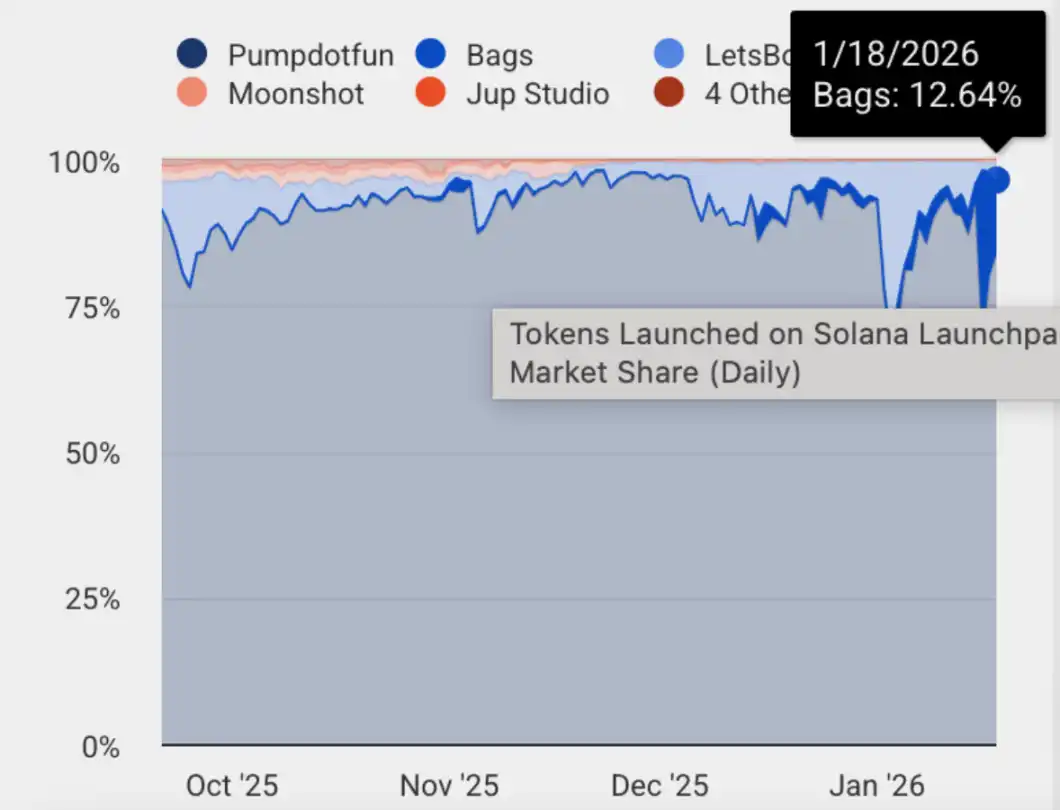
In this context, the $3 million ecosystem investment can be seen as an attempt at differentiation in competition. When the technical barrier between platforms is extremely low, and user loyalty is also extremely limited, Pump.fun chooses to establish new brand awareness through ecosystem investments—not just as a trading platform but also as a project incubator.
However, the question remains: is a 0.33% investment ratio sufficient to support this positioning? In comparison, even in relatively conservative technology companies, the investment ratio is many times higher than this number. From a business logic perspective, this is closer to an exploratory market experiment rather than a comprehensive strategic transformation.
Let the Market Be the Judge
The question that Pump Fund's experiment seeks to answer is: in the Web3 world, who should define what a "good project" is?
This global hackathon, called "Build in Public," adopts a set of rules that are completely different from traditional start-up competitions: no expert judges to score, no Demo Day pitches; instead, the market decides directly.

Specifically, participating teams must issue tokens on Pump.fun, publicly share their development progress daily, and showcase the building process through social media. The ultimate criterion is one—market response. If a project garners attention, trust, and trading volume, it proves worthy of investment; otherwise, it naturally gets eliminated. From the opening of applications on January 19 to the announcement of the first batch of winners on February 18, during these four weeks, all projects will undergo a real-time assessment in the open market. On February 18, at least one project will be selected and funded.
In the hackathon rules, the platform explicitly states that "in addition to the project's social media appeal, the long-term sustainability of the project will also be evaluated." However, it is currently unclear how to find a balance between market hype and long-term value, and what specific criteria will be used to judge.
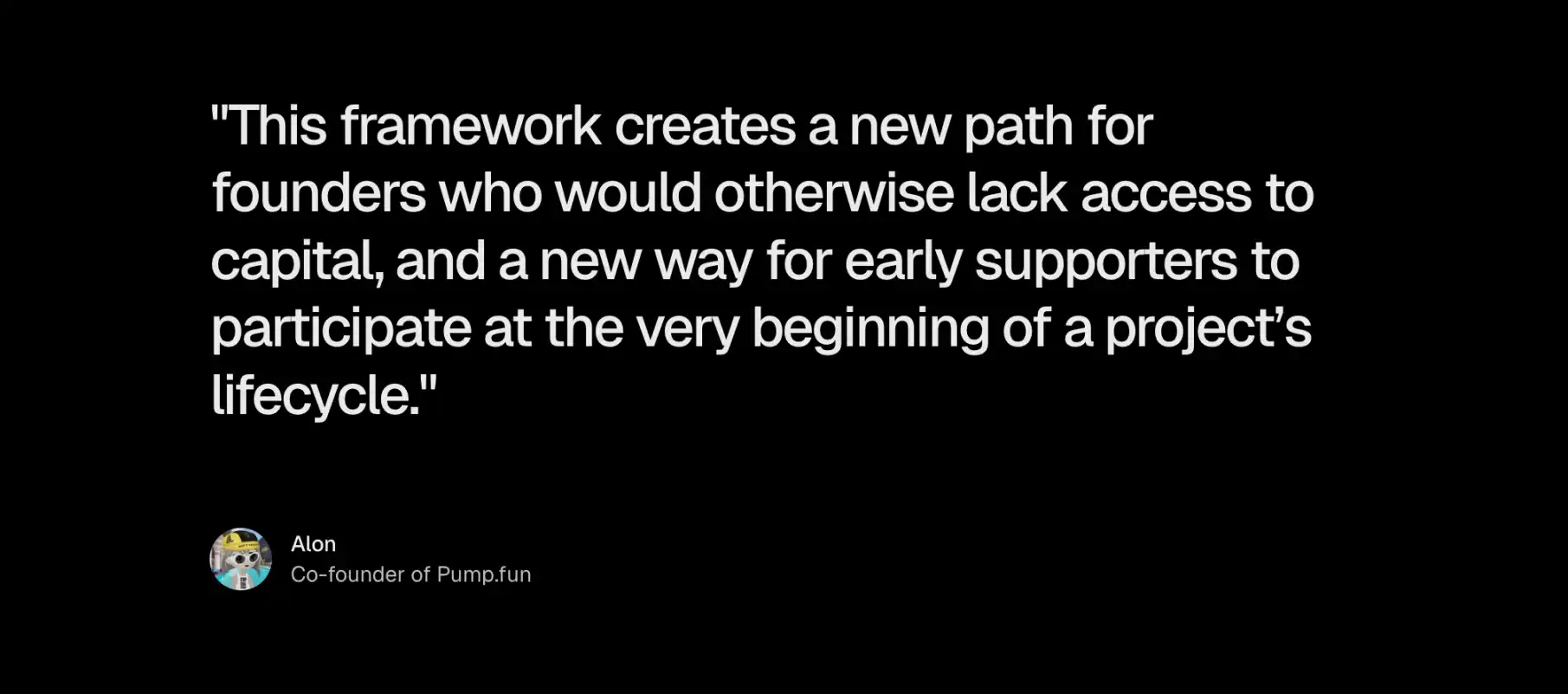
As Pump.fun co-founder Alon puts it, "this framework creates a new path for founders who cannot access traditional capital." In a sense, this is a challenge to traditional VC investment logic—since Web3 emphasizes decentralization, why should the success of a project still be determined by a few investors.
A Deeper Business Dilemma
Aside from the mechanism design, Pump Fund also faces a more fundamental problem: even if high-quality projects are successfully incubated, will these projects stay on Pump.fun?
This is the structural dilemma of Meme coin platforms. The Nasdaq invests in tech companies going public, and companies like Microsoft and Apple continue to trade on the Nasdaq after listing, contributing long-term value to the platform. But Meme coin projects operate under different logic. If a project achieves initial success on Pump.fun, builds a user base and market recognition, what will be the next step? It is likely to migrate to a platform with greater liquidity, such as Binance or Coinbase, or even establish its own independent community.
Pump.fun is essentially a "launchpad," and projects will naturally seek a broader market as they mature. More fatally, the platform's revenue model makes it difficult to truly retain high-quality projects. Pump.fun relies on early high-frequency trading to earn fees, but as a project matures, the trading frequency tends to decrease, long-term hodlers increase, and speculative trading diminishes. From a revenue perspective, the platform always makes the most money from those "fast-moving consumer goods" that are short-term pumps, rather than the "value projects" built for the long term.
This may explain why the investment ratio is only 0.33%. In the current business model, large-scale investment ecosystems not only have uncertain returns but may even be making a wedding dress for others. This is not simply "stinginess" but a manifestation of business rationality.
Four weeks later, when the first batch of award-winning projects is announced, we may get a preliminary answer. However, the longer-term question remains: in the Meme coin field with low technical barriers and weak user loyalty, can ecosystem investment truly become a moat? As competitors like Bags continue to eat away at market share, can this $3 million experiment help Pump.fun maintain its position?
You may also like

Who is footing the bill for the $64 billion accounting frenzy?

Global Launch: As predictions become the most scarce asset in the AI era, Manadia is defining the next generation of the value internet

Morning Report | CoinEx becomes a key hub for Iran to evade sanctions, involving over $3.8 billion in funds; Kalshi seeks a new round of financing, with a valuation potentially rising to $40 billion

Why do cryptocurrency projects always like to change their names?

From the white-haired stock god to the billionaire fund mogul, the smart people shorting Nvidia are all getting rich using the same framework

Morning News | The draft amendment to the People's Bank of China Law aims to clarify the legal status of digital renminbi; South Korea will transfer about 40 unregistered virtual asset service providers to law enforcement agencies

The cryptocurrency industry has entered the "Show Me" era: merely relying on vision is no longer enough
Interpreting the Ethereum Foundation's new structure: Reaffirming self-sovereignty amid institutional trends
Former SpaceX engineer reconstructs the financial execution system using first principles

Tidal Investment: We still have a positive outlook on the AI industry chain, but the reasons have changed

Standard Chartered Bank sings a 50x rhapsody again, aiming for AAVE to reach 3500 USD

The interim executive director of the Ethereum Foundation speaks out: What is our mission?
Why does OKX want to start a new company with the parent company of the New York Stock Exchange?

Why Is PAXG Price Different From Gold? 5 Reasons Crypto Traders Should Know

WEEX OpenAPI 101: 5 Powerful Modules, AI Trading Tools, and Grab Up to 70% Revenue Opportunities
Learn how WEEX OpenAPI connects traders, developers, AI agents, and trading platforms. Discover WEEX API features, Binance-compatible integration, automated trading workflows, revenue opportunities, and ecosystem possibilities.
Interview with NDV Founder Jason Huang: Popping the AI Bubble and the Myth of Microstrategy, Seeking the Ultimate Ace in the Crypto Market

Morning Report | Former Ethereum Foundation researcher establishes Ethlabs; EU Parliament Economic Committee passes digital euro regulatory proposal

Dragonfly partner Haseeb: The fastest-growing companies in the future may all be stuck at 149 people
Who is footing the bill for the $64 billion accounting frenzy?
Global Launch: As predictions become the most scarce asset in the AI era, Manadia is defining the next generation of the value internet
Morning Report | CoinEx becomes a key hub for Iran to evade sanctions, involving over $3.8 billion in funds; Kalshi seeks a new round of financing, with a valuation potentially rising to $40 billion
Why do cryptocurrency projects always like to change their names?
From the white-haired stock god to the billionaire fund mogul, the smart people shorting Nvidia are all getting rich using the same framework
Morning News | The draft amendment to the People's Bank of China Law aims to clarify the legal status of digital renminbi; South Korea will transfer about 40 unregistered virtual asset service providers to law enforcement agencies


