
NEET Reaches New High, Another Cultural Phenomenon of AI Meme

“Work will become optional, and everyone will have a high income,” this is not the first time Musk has made such a statement.
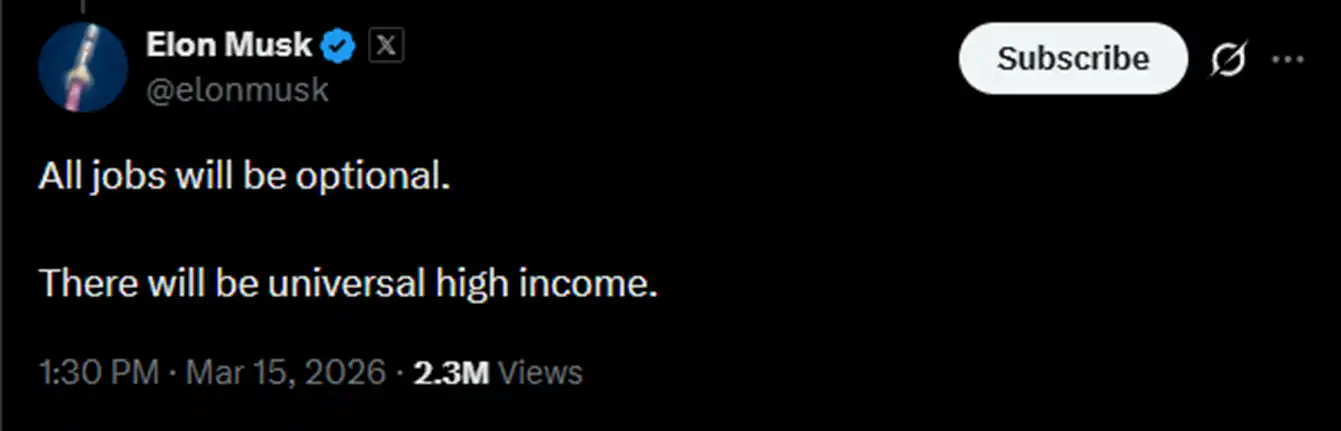
Over the past year, Musk has expressed this view multiple times — AI will make work optional, and going to work will be like farming and growing food, transitioning from an ancient means of survival to a modern hobby. We will enter an era of high per capita income, no longer needing to work to sustain life.
However, he also mentioned in an interview last year that before humanity truly enters this utopian stage, we will experience confusion and painful upheaval.
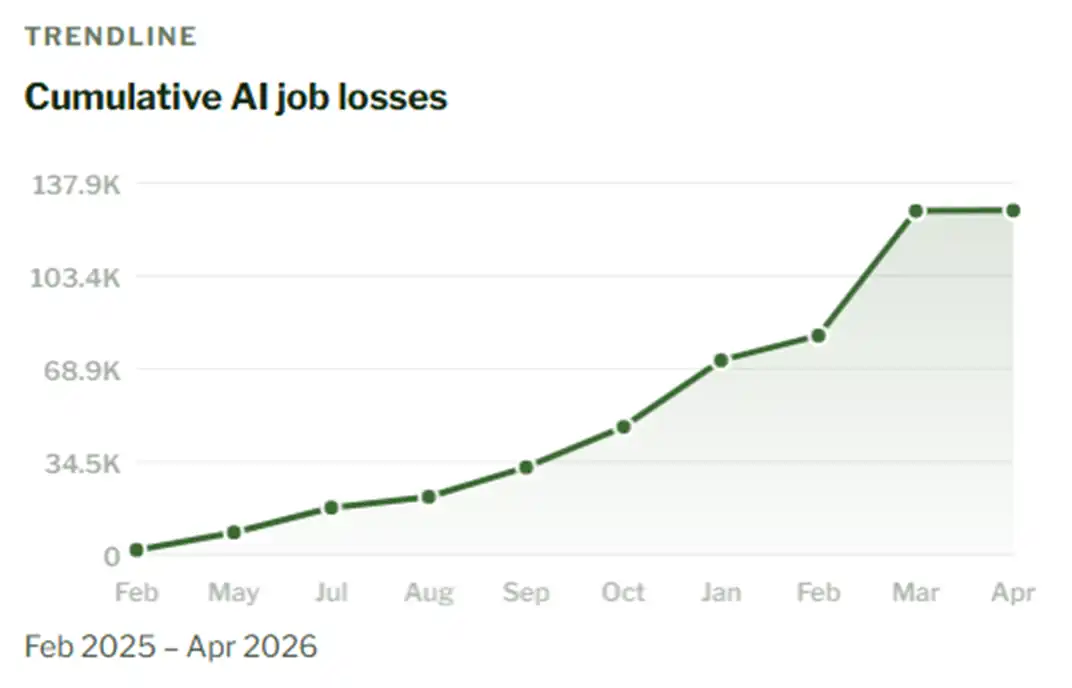
AI is indeed causing unemployment.
@secureainow has launched a real-time tracking website in the United States that tracks layoffs due to AI, jobloss.ai. The website collects data on publicly disclosed AI-induced layoffs starting from January 1, 2025. From February 2025 to the present, in just one year, the number of publicly disclosed jobs lost due to AI has risen from 1,750 to 127,648. This may be one of the most undesirable "rapid increases" in history:
In a world of turmoil, with a sense of uncertainty and pain regarding employment prospects, a different kind of energy has emerged in the cryptocurrency market on the Solana network.
“We collectively bought an internet coin, and then we no longer have to work.”
$neet, over the past year, no other coin has been found on the Solana network — after experiencing three massive drops of over 80%, it was still able to hit a new all-time high market cap of \$47 million the day before yesterday.
Not in Employment, Education, or Training
Neet, meaning “Not in Employment, Education, or Training.”
This term sounds bleak and reminds us of concepts familiar in the Chinese context such as “lying flat” and “sanhe dashen.”
In July 1999, the phrase “Neet” first appeared in a report titled “Bridging the Gap” published by the UK Social Exclusion Unit, which surveyed unemployed and not in school youth. On March 15, 2005, Urban Dictionary user Rolf Mason submitted an entry for the word “Neet,” defining it as a sociological term “applicable to the socially underclass lacking motivation, drive, or ambition.”
With the development of AI, the uncertainty of employment prospects, and the turbulence of the world situation, a concept that can be traced back to the end of the last century has once again entered the mainstream view.
$111.2
"Neet" Appears on FOX 26 News Program
It is also under such a backdrop of the times that the cultural connotation of "Neet" has quietly undergone a change.
A Cry from the Youth
"Why can't I choose to lie flat?"
The "Sanhe Sage" originally referred to those who lost everything due to gambling and wandered in the Sanhe Talent Market in Shenzhen. They were in debt, some even sold their ID cards to make money and could not leave the Sanhe area. Losing hope for life, they have long been in a state of poverty and slack life, gradually getting used to this lifestyle of extreme low cost of living, "working one day and playing three days."
In 2020, the Sanhe Talent Market was relocated and the original site was rebuilt as the "Striver's Square." Then, in the following year, 2021, "lying flat" began to become a popular Internet term in China.
The core of culture will change with the development of the times. "Lying flat" first appeared on Baidu Tieba's "Anti-Marriage Bar" in 2011, became popular in fan circles in 2016, "lying flat in ridicule. This time I can't defend XX star, lie down well, let you mock."
By 2021, lying flat was seen as a response by the younger generation to the disappointment in the real environment, to phenomena such as class solidification, inner shrinkage, middle-class contraction, in-work poverty, and overwork. It was said, "Instead of inner shrinkage, it's better to lie flat." This phenomenon is not limited to China. In South Korea, there is the "Three-Abandon Generation" and even the N-Abandon Generation, who choose to abandon various life goals due to economic pressure. In the United States, the "Great Resignation Wave" has surged, with many people choosing to resign actively in response to work, an act referred to by economists and the media as the "Big Resignation."
And in an age of rapid AI development, whether it is "Neet" or "lying flat," the lost young people in confusion and despair no longer choose "passive resistance" but choose to "take the initiative":
"Have I really owned my own life if I waste 90% of my time on repetitive work day after day?"
"The world is so big, yet I live like an NPC."
「The 9-5 Life is a Scam.」
As the younger generation comes of age, the life and world that their grandparents and parents painted for them—study hard, get a good job; work hard, find a good partner; buy a house, buy a car, live happily ever after—has crumbled.
This collapse has led young people to no longer find their life's purpose and existential meaning through work. Work no longer provides them with identity and emotional connection. Coupled with the uncertainty of employment and the anxiety of unemployment, young people not only no longer believe in the traditional path to success but also harbor a widespread skepticism towards the traditional world order.
「Fate wanted me to learn to strive for knowledge, but I only understand absurdity.」
The redefinition of the 「Neet」 culture has addressed the biggest challenge of the $neet meme coin in its dissemination:
「Why would I buy a coin to associate myself with a group of people who lack ambition and indulge in self-destruction?」
「You are not lacking ambition; you are bravely fighting to reclaim your life.」
Brave Fighter
In the $neet community's view, 「Neet」 is their way of life and attitude, a 「cultural war.」
「I could also choose to be a dutiful office worker; if that kind of life can indeed make me feel passionate about life. But I must have the right to choose whether to work—to sacrifice time for money—in this life.」
One of the articles revered in the $neet community, the 「Top 10 Commandments of Neet」, is penned by the renowned meme coin trader @NEETOCRACY. The article emphasizes at the outset:
「Unemployment does not guarantee happiness or the meaning of life. Some freelancers are actually happier and freer than neets because they plan and optimize their own lives. Happiness is not as simple as quitting your job; it follows a set of guidelines that ensure a meaningful and happy life.」
These Ten Commandments include not dwelling on the past or the present (focus on people and things within reach in real life), spending more time outdoors, wise investment and consumption (no reckless speculation, no falling into the trap of consumerism), making friends, avoiding idle thoughts, maintaining a clean home environment, not becoming addicted to short videos, reading daily, staying fit, and embracing 「work minimalism」.
「Time is your most precious wealth. If you have to work the 9-5 grind to survive, then try to smartly complete your work, reducing the time it takes from your life.」
So, the $neet community is not entirely a group of unemployed people. On the contrary, some are still working, but in their eyes, the so-called "decent" jobs are the shackles they need to break free from.
The meme coin, as a cultural vehicle, has resonated with people of different languages and cultures worldwide, bringing them together through holding an asset. They are trying to humorously dissolve the seriousness and cruelty of society, initiating a truly cultural movement.
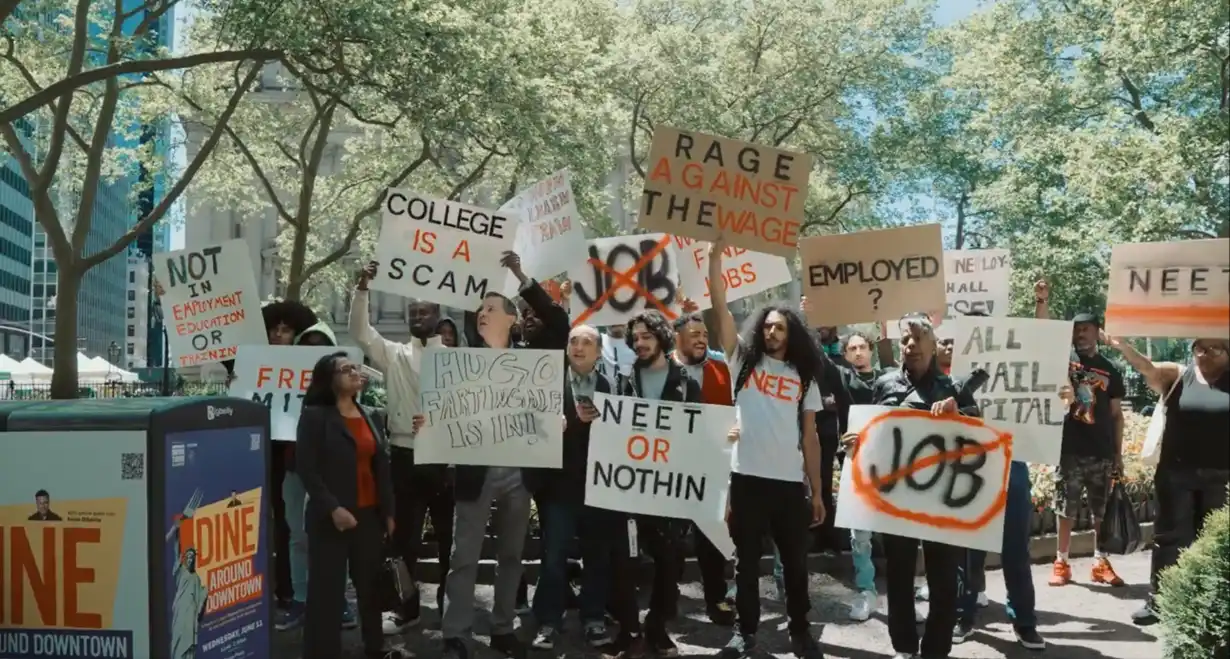
On May 20, 2025, the creators behind $neet were incentivized by pump.fun and held an offline "non-work" protest on Wall Street:
On October 3, 2025, they held another one in Times Square:
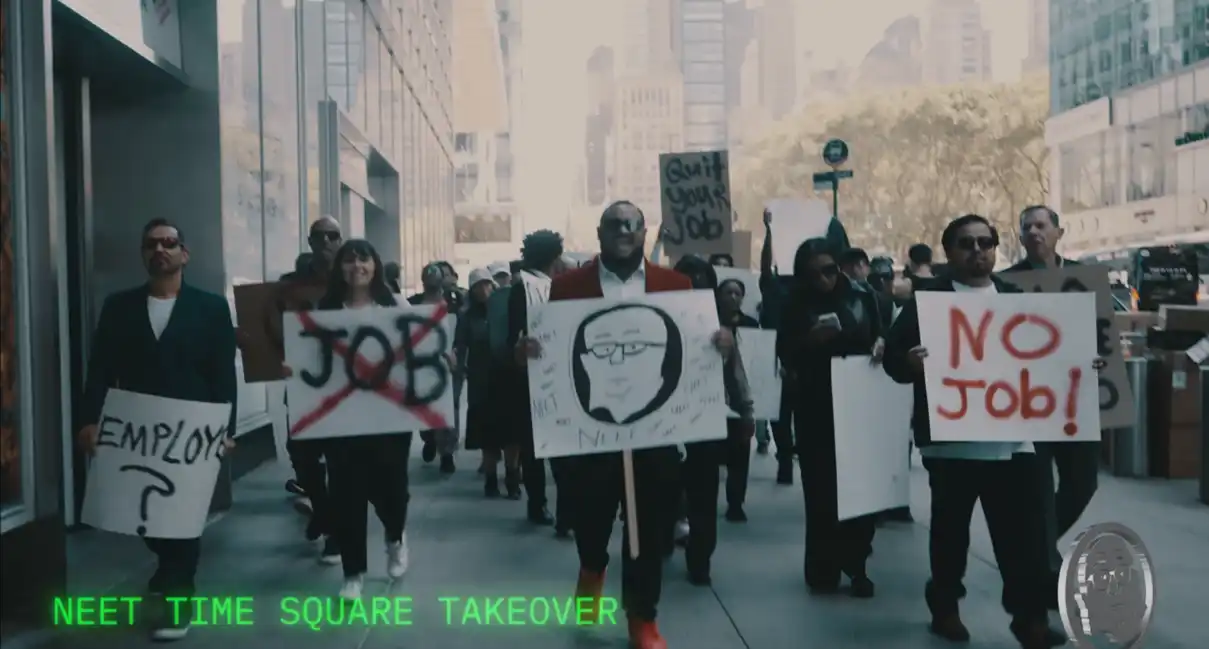
These guys are not just complaining about work; they are serious.
Marathon
For long-term holders of $neet, the past year has been a "marathon" trial in terms of gains, experiencing three significant drops of over 80%.
But the community does not see $neet as just a meme coin but as a cultural symbol. As community member @901Fin puts it:
"Meme coins are not merely speculative or fun assets; their essence is a concentrated cultural signal, reflecting how identity, finance, and the native internet community intertwine. Throughout multiple cryptocurrency cycles, people have consistently underestimated this aspect. They thought that due to the lack of traditional fundamentals, meme coins were meaningless, but they actually represent tokenized identity. They are financial belief systems, on-chain tribes, digital banners around which people rally."
Therefore, beyond dev, we can see community members worldwide capturing $neet in leisurely life scenes in the same photo:
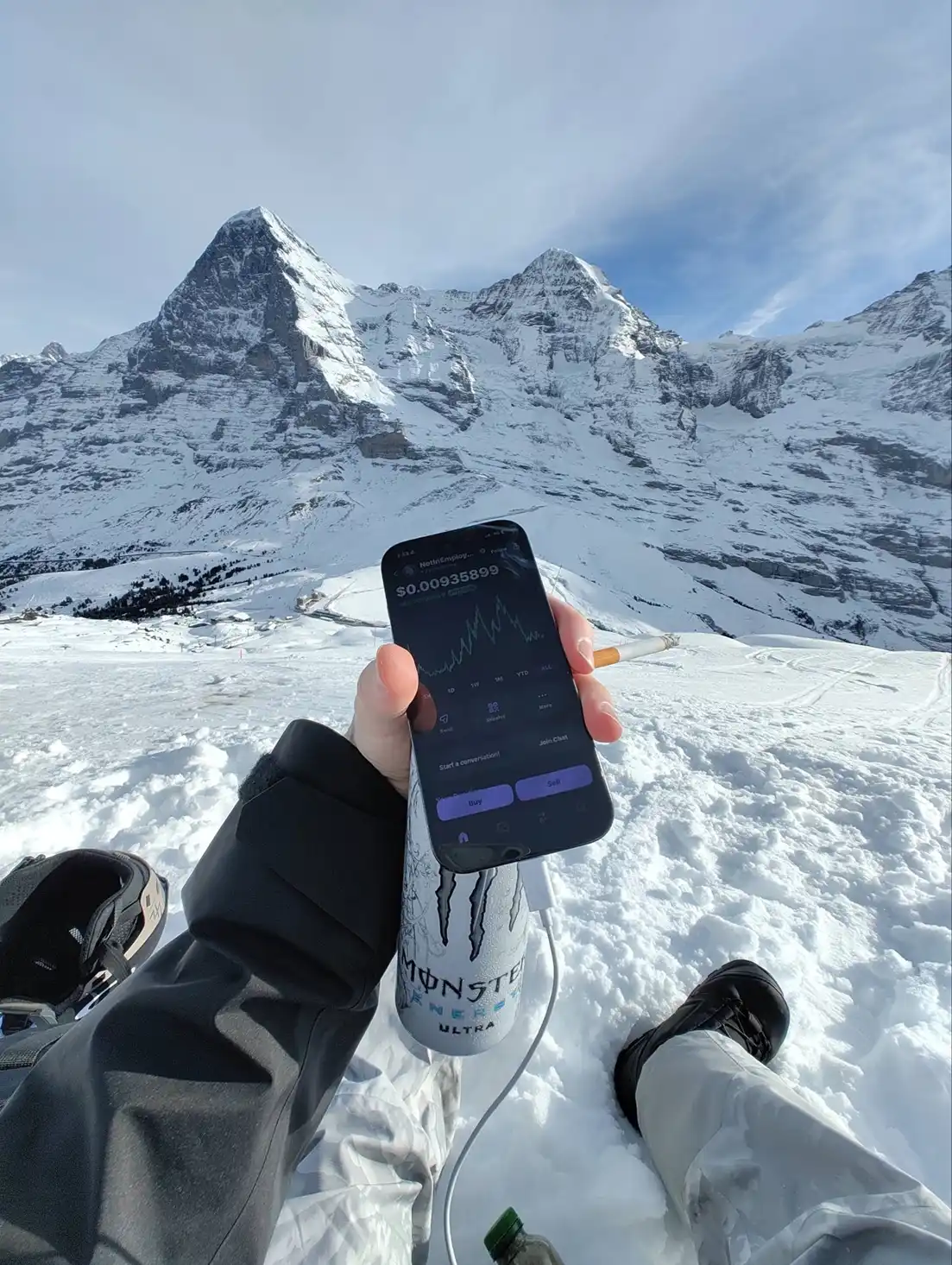
We can also see community members like @neekneeo constantly hitting the streets, talking to passersby, asking about their views on work, and promoting the vision and ideals of $neet.
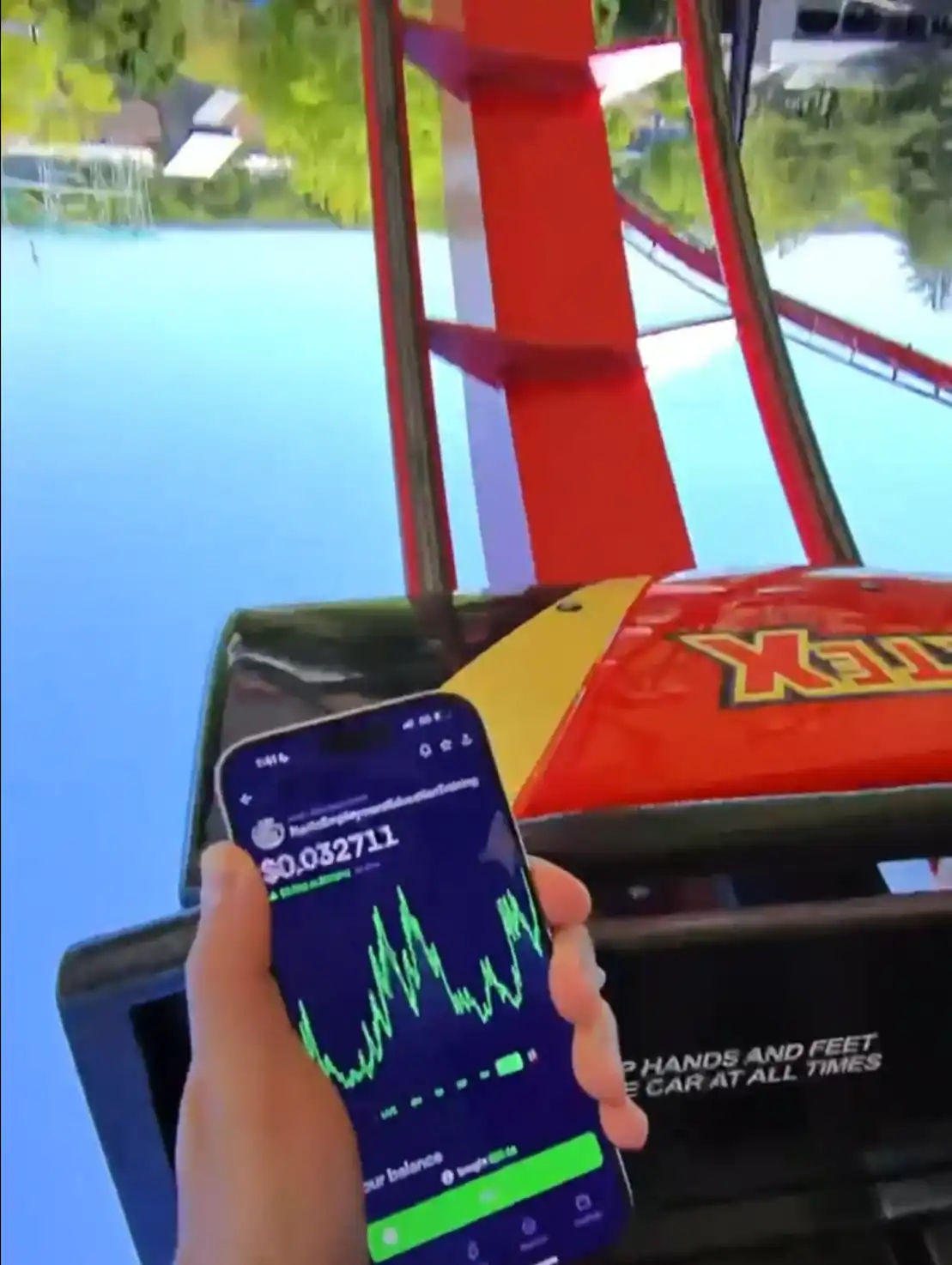
He even recorded a wild video while riding a rollercoaster
Within the community, a significant figure is $neet's dev @primed25, along with other key creators who have never left. In the current cryptocurrency market, where issuing a meme coin only costs $2 and lacks relevant constraints, spending every day for nearly a year wracking their brains to produce viral content is extraordinarily rare.
I refer to Primed as a crusader with unwavering faith, but he himself doesn't see it that way:
"I'm not a crusader. Cryptocurrency enthusiasts want to see a change in how the current market operates, and so do I. Tokens like $SPX and $MOG have shown 'what is possible,' which is also why I initially deployed $neet and fought for it."
His reason for the persistence is straightforward:
"A good coin is one that can resonate widely with people and make them voluntarily want to create content for it. They are passionate about the idea, not just for money. The significance of $neet is to spread 'what true neet culture really is.' Neet is not the homeless, self-indulgent wanderer in people's eyes, but it emphasizes and demonstrates what freedom we as humans can actually possess."
From the perspective of players, from the standpoint of a meme coin, $neet has already achieved tremendous success—it has survived for 1 year and broken its all-time high, being the only surviving and profitable token in the Glass Full Foundation of pump.fun, with holders such as Polymarket's market head, Hugo Martingale, and renowned crypto KOL Mitch.
From the creators' point of view, the tweets created by the Neet official account have frequently gone viral and have even been quoted and retweeted by Musk:


But whether for developers or creators, from a cultural perspective, their journey is far from over. Just like a phrase they often send to each other in the group chat:
「j*b not started」.
You may also like

New York Proposes Stricter Stablecoin Issuer Rules Aligned With Federal GENIUS Act
NYDFS proposed stricter stablecoin issuer rules aligned with the GENIUS Act, covering reserves, custody, redemption timelines, audits, and capital buffers.

Every exchange is a "Universal Exchange."

The counterattack of traditional finance: Alliance chains are quietly reviving

CryptoQuant Says Bitcoin Profitable Supply Is Near 45% Pressure Zone as On-Chain Data Points to Market Repricing
CryptoQuant said Bitcoin’s profitable supply is nearing the 45% pressure zone, signaling rising market stress, unrealized losses, and a possible on-chain repricing phase.

Bitcoin Falls Below 200-Week Moving Average as On-Chain Data Shows Over Half of Supply in Loss
Bitcoin dropped below its 200-week moving average as on-chain data showed over 50% of circulating supply is now in loss, signaling rising market stress.

CFTC Reportedly Plans New Prediction Market Rules Focused on Manipulation Risk and Public Interest Review
The CFTC is reportedly preparing new prediction market rules focused on manipulation risk, public interest review, and retail trader protections.

Meet the new WEEX trial fund—your gateway to greater profits

WEEX Labs Lands at Dutch Blockchain Week: A Disruptive Crypto × AI Conversation Sets Sail in Amsterdam

SK Hynix Reportedly Plans U.S. ADR Listing as Early as August, With SEC Approval Possible in Late June
SK Hynix may pursue a U.S. ADR listing as early as August, with SEC approval reportedly possible in late June amid strong AI chip supply chain demand.

SpaceX vs Tesla vs xAI: Which Elon Musk Trade Has the Biggest Upside in 2026?
OpenAI Reveals It Has Confidentially Submitted an S-1 to the SEC, Keeping the Door Open for a Future IPO
On June 9, according to an OpenAI announcement, the company recently confidentially submitted a draft S-1 registration statement to the U.S. Securities and Exchange Commission (SEC), beginning the preliminary compliance process for a potential initial public offering. OpenAI said it chose to disclose this proactively because it expected the news might leak; however, the company has not yet set a specific listing timeline, and related arrangements may still take some time.

Latest research from 13 top universities including Cornell University: The current state, challenges, and misconceptions of the fusion of Crypto and AI
Deconstructing Anthropic: The Best AI Company, Possibly Also a Type of Organizational Invention
Apollo and Blackstone Reportedly Back $35 Billion Anthropic Chip Financing as Deal Details Remain Unclear
On June 9, according to currently available news alerts, Apollo and Blackstone Group participated in a $35 billion financing for an Anthropic “chip project.” Based on the original wording of the report, the funding has already been raised, but public information remains limited. The financing structure, use of proceeds, project entity, and whether Apollo and Blackstone participated through equity, debt, or project financing have not yet been disclosed.

Humanity Protocol Security Incident Escalates: More Than $31 Million Stolen From Related Addresses as Attacker Continues Selling H for ETH
On June 9, according to monitoring by Onchain Lens, more than $31 million has been stolen from addresses linked to Humanity Protocol, and the attack is still ongoing, with the hacker continuously swapping H tokens for ETH. Project founder Terence Kwok later confirmed the security incident on X, saying the issue involved a private key leak.

Bloomberg: As Bitcoin Weakens, Stablecoins and RWA Continue to Drive Expansion in Crypto Businesses
In June, Bloomberg reported that despite Bitcoin falling below $60,000 last week, wiping out about $235 billion in market value within seven days, and dropping close to 50% from last year’s peak, some core businesses in the crypto industry are still expanding, mainly in stablecoins, real-world asset tokenization (RWA), payments, and infrastructure. The report also noted that overall altcoin activity has contracted significantly: altcoin market capitalization has fallen from a peak of about $431 billion in November 2021 to around $170 billion, and among the tens of millions of tokens issued in recent years, fewer than 1,700 still maintain meaningful trading activity.

Galaxy Deep Research Report: How Hyperliquid's HIP-4 Upgrade Changes the Landscape of Prediction Markets?
Binance Research: RWA Market Expected to Expand Nearly 6x from Early 2025, with Public Equities and Onchain Payments Heating Up Together
In June, Binance Research said in its monthly market report that the real-world asset (RWA) market is expected to grow by about 589% from the beginning of 2025. Bond- and money market fund-related RWA expanded by about $6.5 billion, up 83% year over year, while publicly traded equity RWAs grew by about 422%. The report also noted that monthly crypto debit card transaction volume exceeded $747 million in May, up 48.6% year to date.
New York Proposes Stricter Stablecoin Issuer Rules Aligned With Federal GENIUS Act
NYDFS proposed stricter stablecoin issuer rules aligned with the GENIUS Act, covering reserves, custody, redemption timelines, audits, and capital buffers.
Every exchange is a "Universal Exchange."
The counterattack of traditional finance: Alliance chains are quietly reviving
CryptoQuant Says Bitcoin Profitable Supply Is Near 45% Pressure Zone as On-Chain Data Points to Market Repricing
CryptoQuant said Bitcoin’s profitable supply is nearing the 45% pressure zone, signaling rising market stress, unrealized losses, and a possible on-chain repricing phase.
Bitcoin Falls Below 200-Week Moving Average as On-Chain Data Shows Over Half of Supply in Loss
Bitcoin dropped below its 200-week moving average as on-chain data showed over 50% of circulating supply is now in loss, signaling rising market stress.
CFTC Reportedly Plans New Prediction Market Rules Focused on Manipulation Risk and Public Interest Review
The CFTC is reportedly preparing new prediction market rules focused on manipulation risk, public interest review, and retail trader protections.


