
Open Intents: Can ERC-7683 Become the "Walmart" of Ethereum Cross-Chain Intent Coordination?

Original Title: The Open Intents Framework: Intents As A Public Good
Original Author: YBB Capital Researcher Ac-Core
1. How to Solve Ethereum's Fragmentation Issue
Image Source: @ethereumfndn
With the rise of various L2 solutions and DeFi applications, Ethereum's liquidity fragmentation issue has become increasingly apparent. This is primarily characterized by the difficulty of unifying asset liquidity within the ecosystem, as assets are fragmented across L1 and various L2 chains. Competition for TVL among different L2 solutions has led to assets and transactions being spread across multiple decentralized platforms and protocols. However, these platforms lack effective interconnection and interoperability, causing liquidity on each chain to operate within its own separate "silos," exacerbating Ethereum's overall fragmentation cost.
Over 100+ new Ethereum chains are expected to launch in 2024 alone, resembling a scenario where entering a marketplace filled with diverse products requires settling transactions using different national currencies. On February 20 of this year, the Ethereum Foundation, acting akin to the "Emperor Qin Shi Huang unifying measurement," announced the launch of the Open Intents Framework, allowing Ethereum to have a seamless transaction experience akin to being on a single chain. Within just a few days, it garnered support from over 50 protocols.
According to the explanation on openintents.xyz, the Open Intents Framework consists of three core components (see Reference 1 for more information):
1. Open Resolver: The framework provides an open resolver written in TypeScript that can monitor on-chain events and process intents. Unlike resolvers dependent on specific infrastructure, this shared-reference resolver is protocol-agnostic, supporting functions such as indexing, transaction submission, and rebalancing. Developers can customize and adjust it according to their needs.
2. Composable Smart Contracts: The framework offers a series of pre-built smart contracts based on the ERC-7683 standard, which defines the logic for interpreting, executing, and settling intents. It inherently supports limit order transactions and Hyperlane ISM settlement.
3. UI Template: The framework also provides a pre-built, customizable user interface template designed to make the intent product more accessible to end users.
II. Core of the Open Intents Framework ERC-7683

Image Source: @KanishkKhurana_
ERC-7683 is a universal standard for cross-chain intents on Ethereum, jointly developed by Across (@AcrossProtocol) and Uniswap Labs (@Uniswap) to achieve cross-chain intent through standardization. It aims to provide a unified, standardized framework for Ethereum and other blockchains to express and execute cross-chain operations, especially across multiple L2 solutions and sidechains.
Core Content and Components of ERC-7683:
1. CrossChainOrder Structure: Defines the format of a cross-chain order to ensure consistency across different blockchains and platforms. It standardizes how cross-chain transactions are composed, enabling interoperability between operations on different chains;
2. ISettlementContract Interface: Standardizes the handling of the settlement process. ERC-7683 defines through this interface how transaction settlements are handled across different chains, allowing cross-chain transactions to flexibly execute settlements across different platforms, supporting customized transaction flows;
3. Fulfill: ERC-7683 introduces the "Fulfill" mechanism, allowing participants to competitively complete cross-chain intents in a shared network. Participants lower costs and improve efficiency by providing services in these networks (e.g., executing orders), enabling cross-chain transactions to be completed more efficiently, optimizing the user experience;
4. Fill Deadline: This is a Uni X timestamp marking the expiration time of the cross-chain intent. If the intent is not completed within the specified time, it will expire, avoiding long wait times for invalid transactions, etc.;
5. Order Data Type: Uses an EIP-712 type hash to specify the structure and format of intent data. Through this type hash, developers and platforms can clearly define how data is formatted for transmission and interpretation across different chains;
6. Order Data: Order Data includes the core parameters of a cross-chain transaction, such as the token, amount, chain, and recipient. These parameters define the expected outcome of the cross-chain transaction. It ensures that transaction participants can accurately understand and execute the cross-chain operation.
One of the key advantages of ERC-7683 is its ability to achieve seamless cross-chain interaction. By standardizing the expression of cross-chain intent, users can perform operations between different blockchains without the need for complex setups, such as token swaps or NFT transfers. This simplifies the operational process within a standardized framework, significantly reducing the technical barriers to cross-chain operations and enabling users to conduct cross-chain transactions more conveniently.
Furthermore, ERC-7683 enhances governance capabilities. It streamlines the governance process between different blockchains, particularly for Decentralized Autonomous Organizations (DAOs), making it easier to manage proposals and decisions across multiple chains. The uniformity of ERC-7683 enables DAOs to conduct cross-chain governance more efficiently on various platforms, improving governance flexibility and transparency.
3. The Ultimate Abstraction of Intent and DeFAI

Image Source: Self-made
Whether it is Intent or DeFAI, both are fundamentally derived from the financial attributes of DeFi. However, DeFi only has two real problems to solve: scalability and liquidity. Intent appears to have more practical significance in aggregating liquidity through UNI and ERC-7683, while DeFAI becomes more interesting with the wave of AI narrative and the automated AI trading already achieved by Hey Anon (@HeyAnonai). The respective solutions of Intent and DeFAI mainly focus on enhancing the user experience of DeFi, optimizing transaction execution, and strengthening protocol stability and security, but with differences:
The core objective of Intent is to simplify user interaction through an "intent-driven transaction" mechanism. Users can set the intent and strategy of a transaction, which the system automatically executes without requiring manual intervention at each step. This not only enhances the usability of DeFi but also optimizes strategy execution, improving transaction efficiency. Additionally, Intent may use cross-chain technology to address liquidity bottlenecks in DeFi. By enhancing cross-chain liquidity, Intent helps break down barriers between different chains, optimize liquidity pools, and thus improve the market depth and transaction efficiency of decentralized exchanges.
DeFAI, as an AI-based decentralized finance protocol, focuses on addressing compliance and risk management issues in DeFi. DeFAI utilizes AI technology to analyze and predict market trends, helping the protocol identify potential risks to enhance protocol stability and reduce operational risks. AI can process large amounts of market data to provide users with more precise decision support, optimizing market operations and risk management.
To address the issue of liquidity fragmentation, we have seen abstraction from account to chain to intent and to DeFAI. Ultimately, abstraction knows no bounds, with technology and market demands driving the creation of more abstraction layers. While we need abstraction, it should also be moderate. The issue of liquidity fragmentation itself resembles more of an "ecosystem integration problem," relying not only on increasing abstraction layers but also on optimizing existing protocols.
Four, Why Only Uniswap Can Truly Drive the Development of ERC-7683
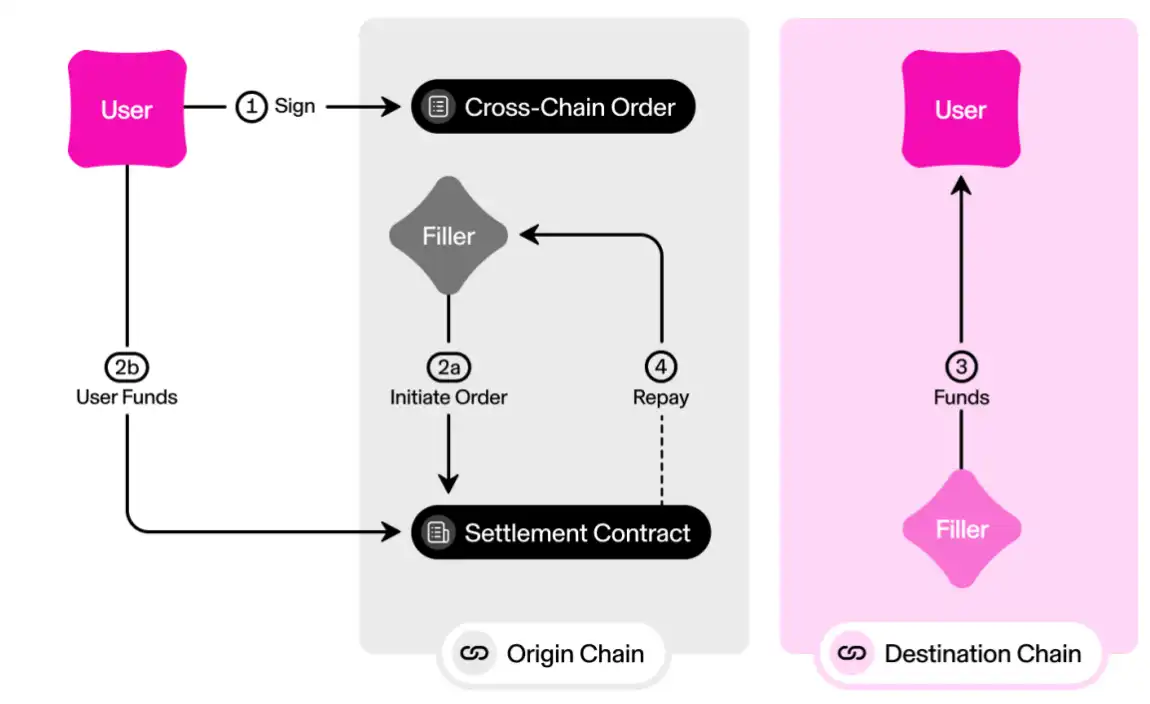
Image Source: @Uniswap
Although "intent" is a grand narrative concept, in my personal view, the core support of ERC-7683 can only be driven to realization by Uniswap. The reason is that both Intent and DeFAI fundamentally aim to better serve DeFi, and the key element in maintaining the healthy development of DeFi is market liquidity. This dependency relationship needs to be based on the "efficient liquidity provision" and "deeply integrated liquidity" conditions.
1. Liquidity Advantage of Uniswap V4
The introduction of Uniswap V4 has made liquidity pool management more flexible and efficient, especially for concentrated liquidity provision in different price ranges. This mechanism optimizes capital efficiency, making cross-chain transactions smoother. In the V3 version, each new pool needed a separate smart contract deployment, leading to high gas costs. In V4, a single PoolManager contract replaces this, consolidating all pools' management, reducing deployment costs by 99%, and lowering exchange costs. Additionally, Hooks allow for customized AMM pools, enabling the ERC-7683 protocol to adjust based on various market needs, better matching different trading pairs and asset liquidity.
2. Potential of Uniswap X
Uni X is expected to further enhance cross-chain interoperability. It may introduce a new cross-chain bridging mechanism or deep integration with ERC-7683 to provide a more efficient cross-chain asset exchange channel. If Uni X can provide a cross-chain liquidity solution, it will become a key platform for executing cross-chain intents using ERC-7683. Therefore, through leveraging Uni X's liquidity pool and technological optimizations, ERC-7683 can achieve seamless cross-chain transactions on a larger scale.
3. Implementation Dependency of Cross-Chain Protocol
Since ERC-7683 relies on standardized cross-chain transaction structures and settlement mechanisms, and Uniswap holds a significant position in decentralized exchanges. The protocol is likely to depend on Uniswap's liquidity pool, automated market-making, and cross-chain transaction capabilities, especially with the support of Uniswap X and Unichain. Uniswap can not only support the efficient execution of ERC-7683 but most crucially ensure the stability and security of its cross-chain and multi-asset transactions.
5. What is the Practical Significance of Intent
When we set aside the abstract definition of "intent," it can actually be understood as a specific transaction goal or driving force. The concept of intent can be traced back to the article "Intent-Based Architectures and Their Risks" published by Paradigm on June 1, 23, which explains the concept of intent. However, it has always been in the conceptual stage, and the issues of fragmented liquidity and solver's solution path have not been solved. However, the emergence of ERC-7683 seems to shed light on a more optimal solution to the fragmented liquidity problem.
The ultimate goal is to inject new vitality into Uniswap, hoping that Uniswap will trigger a new wave of DeFi frenzy. Therefore, intent and ERC-7683 are not just about continuing L2 scaling but achieving more efficient transactions through Uniswap, creating richer features and stronger cross-chain interoperability, and even introducing new incentive mechanisms or transaction models to attract more users and liquidity.
If Uniswap V4 or Uniswap X introduces some new smart contract logic or transaction models at the protocol level, through ERC-7683, Uniswap can further enhance cross-chain liquidity, reduce transaction costs, and add more trading pairs and liquidity pools on top of the existing AMM model. It will make Uniswap more than just a liquidity-diluted AMM, and these improvements will also be a crucial part of the "intent."
This article is a contribution and does not represent the views of BlockBeats.
You may also like

Pantera Capital Partner: How Tokenization is Restructuring the Private Equity and Early Investment Ecosystem?

New York Proposes Stricter Stablecoin Issuer Rules Aligned With Federal GENIUS Act
NYDFS proposed stricter stablecoin issuer rules aligned with the GENIUS Act, covering reserves, custody, redemption timelines, audits, and capital buffers.
Every exchange is a "Universal Exchange."

The counterattack of traditional finance: Alliance chains are quietly reviving

CryptoQuant Says Bitcoin Profitable Supply Is Near 45% Pressure Zone as On-Chain Data Points to Market Repricing
CryptoQuant said Bitcoin’s profitable supply is nearing the 45% pressure zone, signaling rising market stress, unrealized losses, and a possible on-chain repricing phase.

Bitcoin Falls Below 200-Week Moving Average as On-Chain Data Shows Over Half of Supply in Loss
Bitcoin dropped below its 200-week moving average as on-chain data showed over 50% of circulating supply is now in loss, signaling rising market stress.

CFTC Reportedly Plans New Prediction Market Rules Focused on Manipulation Risk and Public Interest Review
The CFTC is reportedly preparing new prediction market rules focused on manipulation risk, public interest review, and retail trader protections.

Meet the new WEEX trial fund—your gateway to greater profits

WEEX Labs Lands at Dutch Blockchain Week: A Disruptive Crypto × AI Conversation Sets Sail in Amsterdam

SK Hynix Reportedly Plans U.S. ADR Listing as Early as August, With SEC Approval Possible in Late June
SK Hynix may pursue a U.S. ADR listing as early as August, with SEC approval reportedly possible in late June amid strong AI chip supply chain demand.

SpaceX vs Tesla vs xAI: Which Elon Musk Trade Has the Biggest Upside in 2026?
OpenAI Reveals It Has Confidentially Submitted an S-1 to the SEC, Keeping the Door Open for a Future IPO
On June 9, according to an OpenAI announcement, the company recently confidentially submitted a draft S-1 registration statement to the U.S. Securities and Exchange Commission (SEC), beginning the preliminary compliance process for a potential initial public offering. OpenAI said it chose to disclose this proactively because it expected the news might leak; however, the company has not yet set a specific listing timeline, and related arrangements may still take some time.

Latest research from 13 top universities including Cornell University: The current state, challenges, and misconceptions of the fusion of Crypto and AI
Deconstructing Anthropic: The Best AI Company, Possibly Also a Type of Organizational Invention
Apollo and Blackstone Reportedly Back $35 Billion Anthropic Chip Financing as Deal Details Remain Unclear
On June 9, according to currently available news alerts, Apollo and Blackstone Group participated in a $35 billion financing for an Anthropic “chip project.” Based on the original wording of the report, the funding has already been raised, but public information remains limited. The financing structure, use of proceeds, project entity, and whether Apollo and Blackstone participated through equity, debt, or project financing have not yet been disclosed.

Humanity Protocol Security Incident Escalates: More Than $31 Million Stolen From Related Addresses as Attacker Continues Selling H for ETH
On June 9, according to monitoring by Onchain Lens, more than $31 million has been stolen from addresses linked to Humanity Protocol, and the attack is still ongoing, with the hacker continuously swapping H tokens for ETH. Project founder Terence Kwok later confirmed the security incident on X, saying the issue involved a private key leak.

Bloomberg: As Bitcoin Weakens, Stablecoins and RWA Continue to Drive Expansion in Crypto Businesses
In June, Bloomberg reported that despite Bitcoin falling below $60,000 last week, wiping out about $235 billion in market value within seven days, and dropping close to 50% from last year’s peak, some core businesses in the crypto industry are still expanding, mainly in stablecoins, real-world asset tokenization (RWA), payments, and infrastructure. The report also noted that overall altcoin activity has contracted significantly: altcoin market capitalization has fallen from a peak of about $431 billion in November 2021 to around $170 billion, and among the tens of millions of tokens issued in recent years, fewer than 1,700 still maintain meaningful trading activity.

Galaxy Deep Research Report: How Hyperliquid's HIP-4 Upgrade Changes the Landscape of Prediction Markets?
Pantera Capital Partner: How Tokenization is Restructuring the Private Equity and Early Investment Ecosystem?
New York Proposes Stricter Stablecoin Issuer Rules Aligned With Federal GENIUS Act
NYDFS proposed stricter stablecoin issuer rules aligned with the GENIUS Act, covering reserves, custody, redemption timelines, audits, and capital buffers.
Every exchange is a "Universal Exchange."
The counterattack of traditional finance: Alliance chains are quietly reviving
CryptoQuant Says Bitcoin Profitable Supply Is Near 45% Pressure Zone as On-Chain Data Points to Market Repricing
CryptoQuant said Bitcoin’s profitable supply is nearing the 45% pressure zone, signaling rising market stress, unrealized losses, and a possible on-chain repricing phase.
Bitcoin Falls Below 200-Week Moving Average as On-Chain Data Shows Over Half of Supply in Loss
Bitcoin dropped below its 200-week moving average as on-chain data showed over 50% of circulating supply is now in loss, signaling rising market stress.


