
Paradigm Bets on Brazil: The New Battlefield for Stablecoins Isn't in the US

Original Article Title: "Why Did Paradigm Invest in a Brazilian Stablecoin Company?"
Original Article Author: Eric, Foresight News
Recently, the Brazilian stablecoin company Crown completed a $13.5 million Series A funding round led by Paradigm, valuing the company at $90 million. In a news release by The Block, it was explicitly emphasized that this was Paradigm's first investment in a Brazilian company. This funding round also marks Crown's second round of funding completed within two months. In mid-October, Crown had just closed an $8.1 million seed round led by Framework Ventures, with participation from Coinbase Ventures and Paxos, among others.
While this may not be front-page news, there are two points in the news that are worth noting: Why Crown? And why Brazil?
Why Invest in Crown?
Analyzing a matter often requires considering both internal and external factors.
On the external front, the author believes that investment opportunities for U.S.-based stablecoin issuers are few and far between. Tether and Circle have already captured the vast majority of the market, making it necessary for investment institutions to target external markets to seek greater alpha. There are also few targets that allow foreign capital to invest in companies related to the national fiat currency and have a market for stablecoins domestically.
Brazil is a rare "treasure trove" on the American continent that meets most of the conditions. As for why, we'll get to that later.
First, let's talk about Crown. According to disclosed data, the total supply of the Brazilian real (BRL)-pegged stablecoin BRLV issued by Crown currently slightly exceeds 100 million coins, equivalent to less than $20 million in value, with a trading volume of only 56,000 in the past 30 days. It is evident that the market for Brazil's domestic currency stablecoin is not large at the moment, not to mention that Crown is currently only targeting institutional clients.
Clearly, the logic behind investing in Crown is to bet that the team behind it can achieve success in this market in the future.
Crown's co-founder and CEO John Delaney previously served as a lawyer in the international finance field and was also the COO of the well-known Brazilian company Xerpa, which received investment from Founders Fund. Xerpa launched an "Earned Wage Access" platform in 2019, allowing employees to access their earned wages for days worked at any time (rather than waiting until the end of the month), helping to avoid high-interest credit. This is particularly popular in Brazil's high-interest rate and financial pressure environment and is seen as an employee financial well-being tool. The company charges a fixed small fee and does not involve interest.
Co-founder and Chief Engineer Vinicius Correa is an early engineer at the Brazilian digital bank Nubank. Nubank's investor lineup is also quite impressive, with participation from top-tier institutions in a total of $20 billion worth of multi-round financing, including Sequoia Capital, Tiger Global, Goldman Sachs, Founders Fund, Tencent, Berkshire Hathaway. Nubank went public on the NYSE in 2021 with an IPO valuation of $41.5 billion, currently valued at nearly $80 billion.
Founding Partner and Ecosystem Lead Alex Gorra previously served as a Managing Partner at the family office Brainvest, managing $5 billion in assets, and has held positions at ARX Investments, UBS Group, Rothschild Bank, and JPMorgan's management. COO Bruno "BL" Passos has led cross-functional teams at Hashdex.
Crown's founding team can be described as a bona fide dream team, with both founders having been involved in taking Brazilian local businesses from 0 to 1. Although BRLV's data currently may not look good, it did not prevent them from raising a total of over $20 million within two months.
Furthermore, the Crown team stated in their blog that the launch of BRLV essentially stems from seeing the contributions of USDT and USDC in purchasing government bonds. Issuing stablecoins locally in Brazil can also provide purchasing power for government bonds, thereby stabilizing the economy and, in turn, further stimulating the use of stablecoins, which is a win-win situation. If the US dollar stablecoin is only helping the United States "live on," then the Brazilian real stablecoin can be said to have solidly helped the country.
Why Bet on Brazil?
When it comes to the stablecoin's underlying fiat currency, there seem to be many better options than the Brazilian Real, but why choose Brazil?
You may not believe it when you hear it, the last time you heard about this country might have been due to football if you're from the 80s or 90s. However, it has become one of Latin America's largest and globally leading innovation hubs, with over 1,500 fintech companies and over 100 million users.
As a capitalist country, Brazil's banking sector has long been dominated by five major banks (Itaú, Banco do Brasil, Bradesco, Caixa, Santander), with assets accounting for over 80%, far higher than the United States (around 50%). Traditional banking services are rigid, costly (credit card annual interest rates often exceed 300%), and bureaucratic, leading to tens of millions of low- and middle-income individuals and the unbanked (historically up to 55 million) being excluded from the system.
However, this has also created a significant demand gap. Fintech companies like Nubank entered the market with fee-free credit cards, providing simple, low-cost services and quickly filling the market gap.
Although the Central Bank of Brazil cannot change the monopoly of traditional banks, it unexpectedly took the initiative to promote competition and inclusivity. It even became a classic case of global digital financial regulation. Its biggest contribution was the launch of the instant payment system Pix in 2020. Pix supports free, 24/7 real-time transfers, with a transaction volume exceeding a trillion reais by 2025, covering over 90% of the population. Pix quickly replaced cash and credit cards upon launch, becoming the preferred payment method for 76% of Brazilians. This significantly increased financial inclusion and provided Fintech companies with low-cost infrastructure (such as integrating Pix for payments and credit innovation).
I'm sure you often see in the news of the Web3 industry various exchanges or Crypto payment tools integrating with Pix. It is indeed quite a challenging feat for a capitalist country's central bank to lead the launch of a payment system that is sufficient to shake the existing banking system, but this "people-benefiting" direction has also allowed local Fintech companies to have better development prospects by reaching more users.
It is for this reason that new financial forms like cryptocurrency have been highly accepted in Brazil. With a population of over 200 million, a smartphone penetration rate of nearly 90%, over 180 million internet users, and an average internet usage time of over 5 hours per day, Brazil's young, digital-native population, especially the Z generation, has a strong demand for mobile finance. Last September, Circle directly started supporting the exchange of the real for USDC.
The popularity of the US dollar stablecoin in Brazil has been analyzed by many articles as being due to the instability of the Brazilian national currency. However, based on the author's investigation from various sources, even if this reason is considered, it only accounts for a very small part. Now, it appears that if this reason were valid, investment firms like Paradigm would not have focused so heavily on Brazilian national fiat stablecoins and Fintech companies.
In fact, Brazil did experience severe hyperinflation multiple times in the 1980s and 1990s, even reaching extreme situations with monthly inflation rates of 80%. However, in recent years, although the real's volatility is still significant, for a country like Brazil, it has achieved good results in stabilizing its currency value and reducing inflation. Brazil's inflation rate hovered between 4.5% and 5% in 2025, still higher than the central bank's target but much better compared to neighboring Argentina.
Indeed, a portion of local residents in Brazil holding USD stablecoins are hedging against the devaluation of the real, especially against the backdrop of the Fed's interest rate hikes in recent years. However, many more do so for practical purposes such as foreign trade, tax evasion, facilitating capital flow, and trading cryptocurrencies.
According to Chainalysis data, Brazil ranks fifth globally in cryptocurrency adoption index, following India, the United States, Pakistan, and Vietnam. Its cryptocurrency inflows from July 2024 to July 2025 reached $318.8 billion, leaving other Latin American countries far behind.
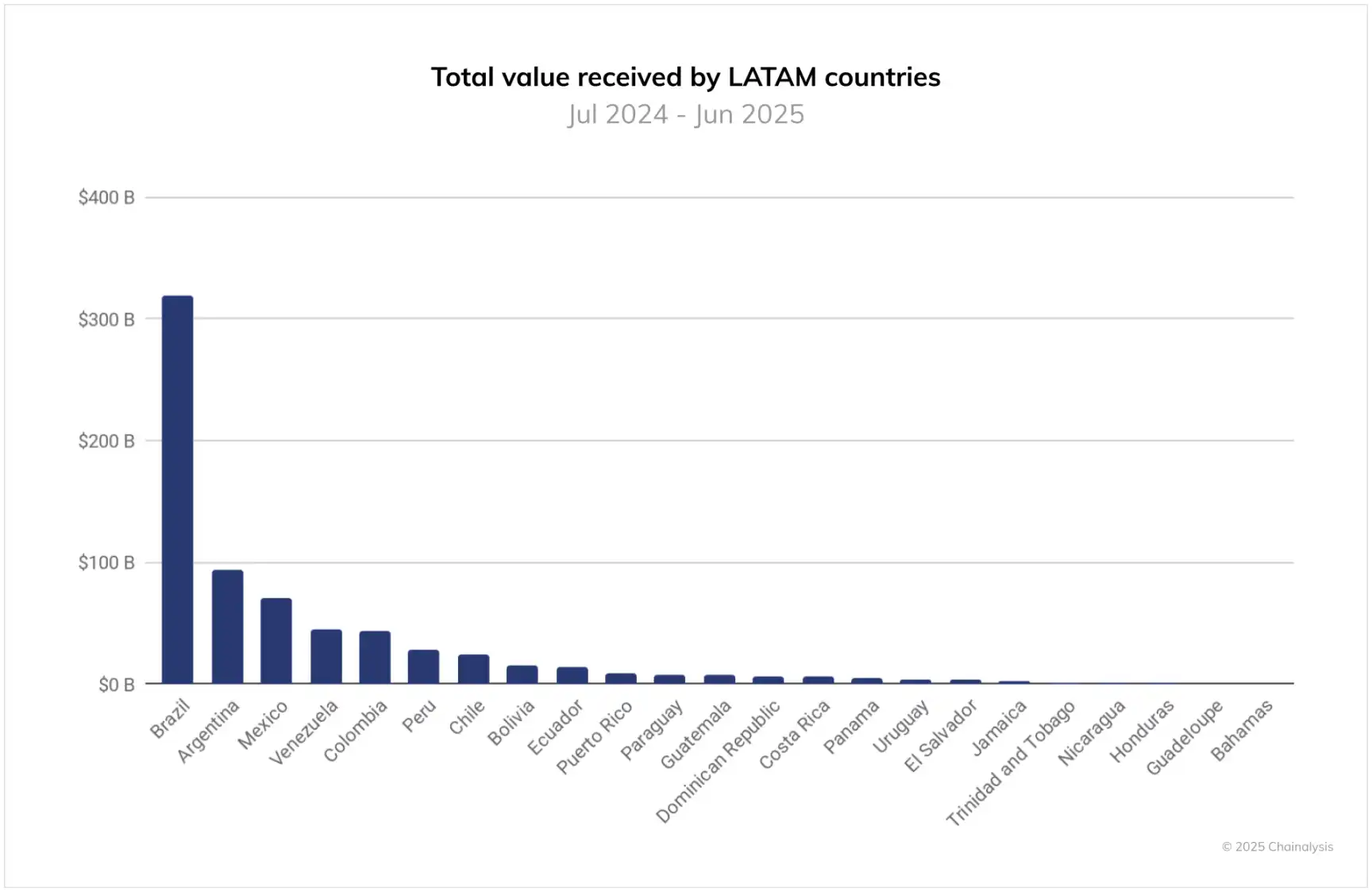
According to data provided by the cryptocurrency market maker Gravity Team, Brazil has embraced stablecoins as a tool for investment and cross-border payments, with stablecoins currently accounting for about 70% of the indirect flow of funds from Brazilian local exchanges to international exchanges.
At this point, some may ask, since Brazil already has a national payment tool like Pix, what is the significance of stablecoins?
An unmentioned feature of Crown's BRLV, highlighted in a press release, is that it shares national bond interest income with stablecoin holders, and in Brazil, this number is 15%. Although it may not be feasible to distribute the full amount to holders, even half would be a very attractive yield.
In the future, BRLV can also integrate with the Pix system. For ordinary people or even the impoverished, there may be no motivation to exchange stablecoins. However, for the affluent, stablecoins not only do not affect payments, but simply holding them can generate interest income. In the future, they can seamlessly trade with USD stablecoins, participate in DeFi, and undoubtedly, various imaginative scenarios will create enough demand and use cases for stablecoins in this land.
For most countries with weak national strength, unable to sustain long-term stability of their own currency, and with limited foreign exchange reserves, the US dollar and USD stablecoins are a lifeline for the people. Brazil, however, is an exception to this.
You may also like

Japan’s Three Megabanks Plan Joint Stablecoin Issuance in Fiscal 2026
MUFG, SMBC, and Mizuho reportedly plan to jointly issue fiat-pegged stablecoins in fiscal 2026, signaling Japan’s growing push into bank-led digital payment infrastructure.

Humanity Discloses H Token Dual-Chain Attack Details, With Losses on Ethereum and BSC Exceeding $36 Million
Humanity said the H token attack across Ethereum and BSC caused more than $36 million in losses after leaked ProxyAdmin keys enabled malicious contract upgrades and token minting.

White House Discusses CLARITY Act With Law Enforcement Ahead of Senate Vote
The White House discussed the CLARITY Act with law enforcement ahead of a Senate vote, focusing on illicit finance risks and developer protections.

$75 billion in foreign capital has fled, and South Korean retail investors have absorbed it all using leverage

Bitcoin Trading Guide 2026: Strategies for Experienced Traders

What Is XAUT and PAXG? Why Tokenized Gold Is Booming in 2026

Cryptocurrency CEXs are flocking to sell US stocks, and traditional brokerages are facing an "uninvited guest."

Will the SpaceX IPO Hurt Bitcoin? Here's What Traders Are Watching
Foreign selling in the South Korean stock market accelerates, with cumulative net sales reportedly reaching $75 billion this year
On June 9, The Kobeissi Letter, citing Goldman Sachs data, reported that global investors are selling South Korean stocks at an unusually rapid pace. In the latest trading session, foreign investors sold about $801 million worth of Kospi constituent stocks again; total foreign outflows last week reached about $10 billion, and the market has been in net foreign selling on nearly every trading day over the past month. According to the data cited in the report, foreign investors have sold about $75 billion worth of South Korean stocks so far this year. Meanwhile, South Korean retail and institutional investors together recorded roughly $69 billion in net buying over the same period, suggesting that the market’s main buying support has come from domestic capital rather than returning overseas funds. The information currently disclosed still mainly comes from The Kobeissi Letter’s retelling and Goldman Sachs data summaries, while public details on the statistical period and the specific definition of “selling” remain relatively limited.

Fortune Warns of Strategy’s Financing Structure Risks as Bitcoin Premium Narrows
Fortune warned that Strategy’s Bitcoin treasury model faces growing financing risks as MSTR’s net asset premium narrows and preferred stock dividend pressure increases.

Ferrari Challenge Le Mans: Carl Moon to Dominate in WEEX Livery

Sahara AI Responds to SAHARA’s Sharp Drop: No Contract or Product Security Issues Found, Internal Investigation Underway
Sahara AI responded to SAHARA’s 60% price drop, saying no token contract or product security issues have been found and an internal investigation is underway.

WEEX Deposit/Withdrawal Dynamic Island: Your Asset Status, Always in Sight
Scaling Crypto Derivatives: The Digital Asset Infrastructure Behind High-Volume Trading
In the fast-moving digital asset ecosystem, derivatives platforms face an extreme architectural test. High-leverage futures markets demand more than just standard security—they require absolute operational precision, zero-latency matching engines, and ironclad structural scalability, all while navigating intense market volatility.
As global platforms scale to meet these demands, the industry is shifting away from rigid, monolithic setups toward a more agile, "decoupled" infrastructure philosophy.
The Blueprint for High-Volume Copy TradingFor elite global exchanges like WEEX (founded in 2018), this architectural choice becomes critical when scaling high-volume retail features like social copy trading. When thousands of users automatically mirror the real-time strategies of elite traders simultaneously, it triggers sudden, monumental spikes in concurrent transactional volume.
To prevent execution latency or settlement bottlenecks during these peak volatility events, a platform's primary engine must remain entirely dedicated to risk management, copy-trade synchronization, and order matching.
The Architectural Rule: New-generation platforms must separate front-end user execution engines from heavy backend infrastructural overhead to eliminate operational friction.
By separating these layers, platforms can maintain complete sovereignty over their trading environments and user experiences while strategically aligning with institutional-grade infrastructure ecosystems. This strategic framework allows modern exchanges to leverage advanced Digital Asset Custody infrastructure such as Cobo’s behind the scenes, ensuring that backend wallet management scales elastically alongside trading spikes.
Capitalizing on Market Momentum and 400× LeverageIn a derivatives arena where platforms offer up to 400× leverage on perpetual contracts, capital efficiency and market agility are core business metrics. To capture market momentum, an exchange needs the ability to rapidly expand its asset offerings, supporting everything from legacy crypto assets to sudden, trending altcoins across a massive library of trading pairs.
Adopting a flexible, scalable Wallet-as-a-Service (WaaS) solution such as Cobo’s could completely rewrite the development timeline for high-growth exchanges. Instead of spending months of engineering capital building out custom backend wallet architectures for every new blockchain network, platforms can deploy localized infrastructure in days.
This agility allows platforms to instantly scale their listings to over a thousand trading pairs without compromising security or delaying time-to-market. It mirrors the exact operational advantages seen during high-velocity market events, similar to how advanced wallet infrastructure empowers platforms during sudden asset surges; allowing exchanges to pass that speed and liquidity directly to their global user base.
A Mature Foundation for GrowthThe synergy between trusted infrastructure ecosystems and global trading platforms represents the natural evolution of a maturing crypto market. As WEEX continues to scale its global spot and derivatives offerings for over 6 million users, adopting robust backend paradigms proves that platforms no longer have to compromise between cutting-edge trading velocity and uncompromised structural security.

Morning Report | BitMine increased its holdings by 126,971 ETH last week; trader Eugene announced his exit from the crypto market

Wang Chuan: How can one not feel anxious after the neighbor Old Wang made thirty times profit by investing in storage stocks? (Seven) - A quarter-century cycle

Get Paid to Onboard? Try WEEX’s New Homepage with Rewards for Registration, Deposit & Trade
WEEX Custom Layout: Build Your Perfect Trading Workspace in Seconds
Japan’s Three Megabanks Plan Joint Stablecoin Issuance in Fiscal 2026
MUFG, SMBC, and Mizuho reportedly plan to jointly issue fiat-pegged stablecoins in fiscal 2026, signaling Japan’s growing push into bank-led digital payment infrastructure.
Humanity Discloses H Token Dual-Chain Attack Details, With Losses on Ethereum and BSC Exceeding $36 Million
Humanity said the H token attack across Ethereum and BSC caused more than $36 million in losses after leaked ProxyAdmin keys enabled malicious contract upgrades and token minting.
White House Discusses CLARITY Act With Law Enforcement Ahead of Senate Vote
The White House discussed the CLARITY Act with law enforcement ahead of a Senate vote, focusing on illicit finance risks and developer protections.
$75 billion in foreign capital has fled, and South Korean retail investors have absorbed it all using leverage
Bitcoin Trading Guide 2026: Strategies for Experienced Traders
What Is XAUT and PAXG? Why Tokenized Gold Is Booming in 2026


