
Pectra Upgrade Takes First Step, What Upgrades are Coming to Ethereum?

Original Title: Pectra Upgrade Takes First Step, What Updates Will Ethereum See?
Original Author: Francesco
Original Translator: Luffy, Foresight News
The next Ethereum upgrade, Pectra, has taken its first step.
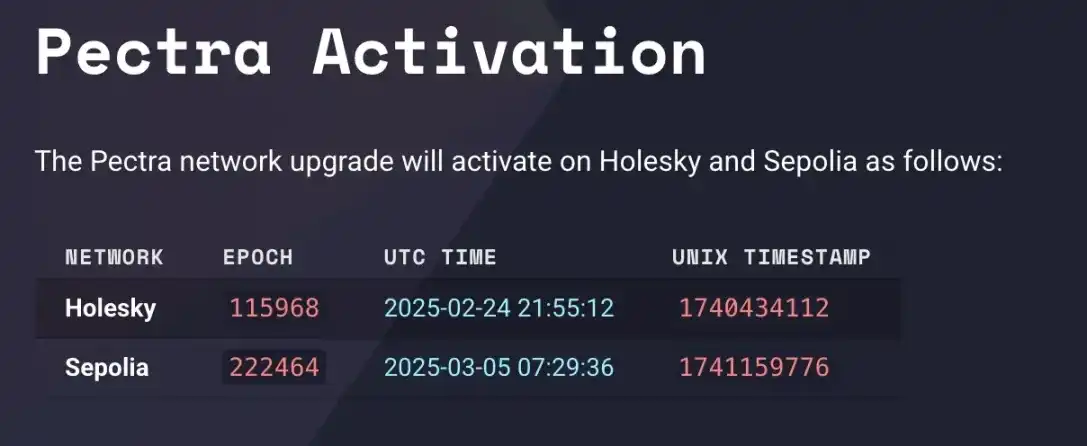
On February 24, the Pectra upgrade went live on the Holesky testnet; on March 5, Pectra will go live on the Sepolia testnet.
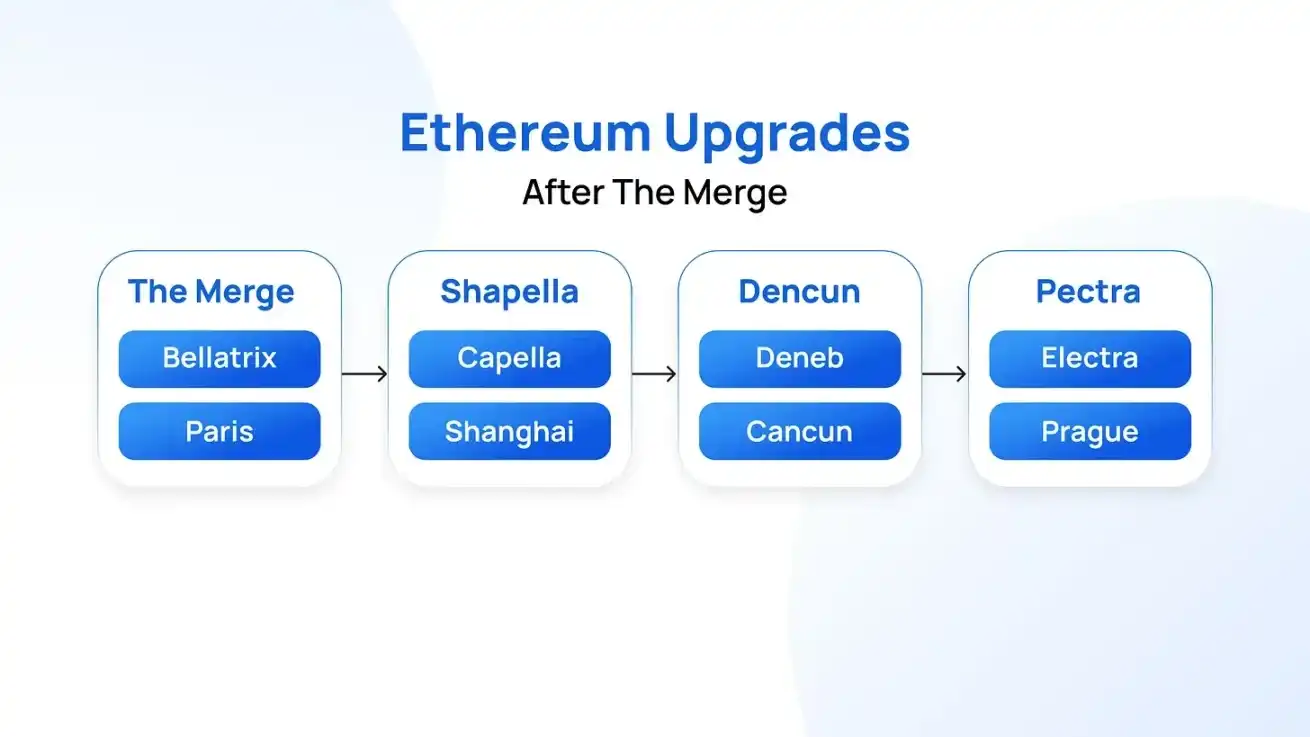
Once these upgrades are successfully implemented on the testnets, the mainnet upgrade date will be set, with the mainnet upgrade expected to take place within 3 to 9 months after the testnet implementation.
Pectra is a significant upgrade that introduces multiple Ethereum Improvement Proposals (EIPs) at once:
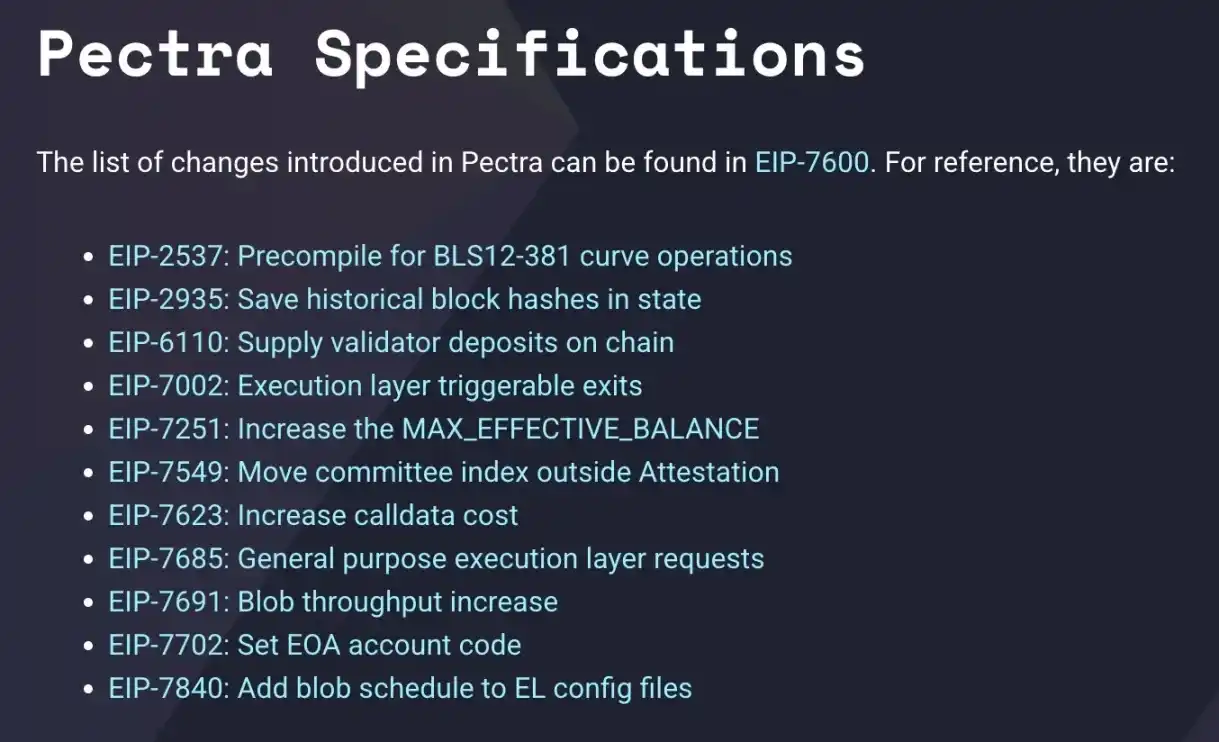
We can categorize these upgrades into three key areas:
· Enhancing Ethereum Accounts
· Improving the User Experience for Ethereum Validators
· Expanding the processing capability of "data blobs"
Let's delve into some of the upcoming Ethereum Improvement Proposals and how they will benefit the Ethereum protocol and users.
Enhancing Ethereum Accounts: EIP-7702
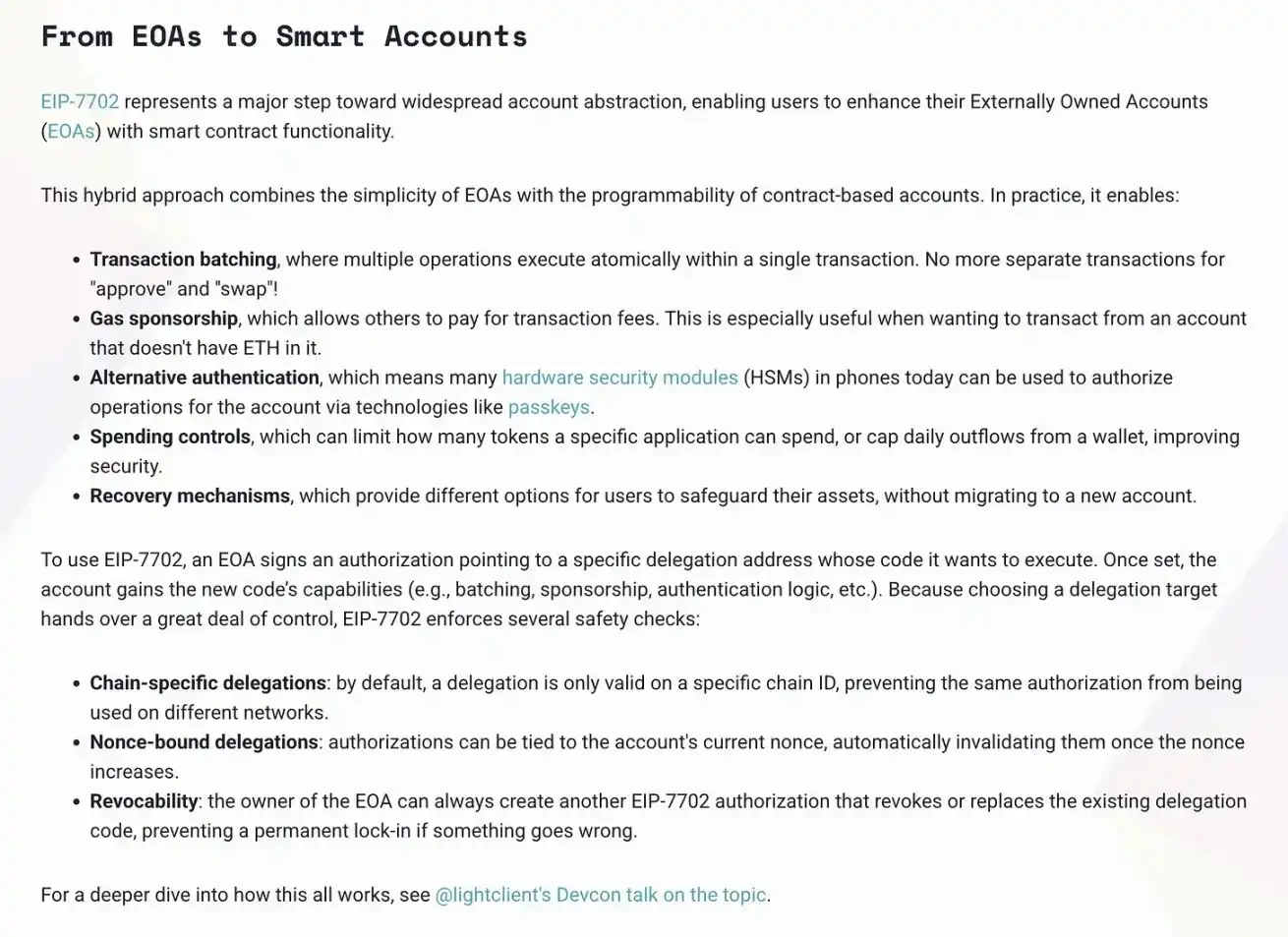 EIP-7702 brings Ethereum closer to an account abstraction experience at the protocol level. It achieves this by extending the functionality of Ethereum's externally owned accounts (EOAs) with features such as:
Transaction Batching: Executing multiple operations in a single transaction
Gas Fee Sponsorship: Allowing accounts with no ETH to have their gas fees sponsored by others
Additional authentication and recovery mechanisms
Enhancing the User Experience for Ethereum Validators: EIP-7251, EIP-7002, EIP-6110
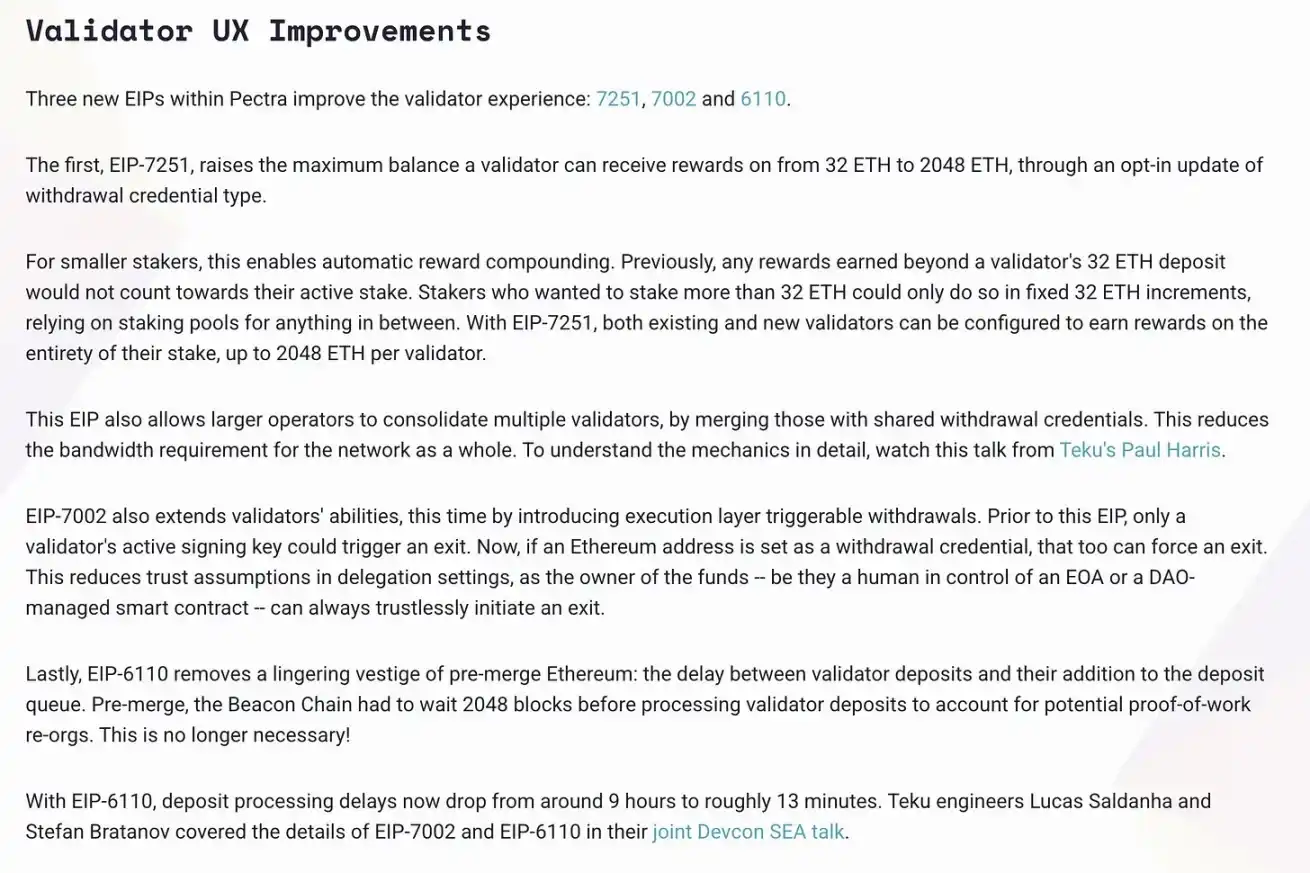
EIP-7251: Increases the validator's maximum balance to 2048 ETH and enables automatic compounding of rewards for larger valid staking balances. Previously, rewards were calculated based on a 32 ETH balance only. Additionally, validators with larger stakes can now consolidate multiple 32 ETH validators into one.
EIP-7002: By setting the execution layer address to a "withdrawable credential", it is allowed to trigger a withdrawal operation, reducing reliance on trust. Previously, only validators could trigger exit operations.
EIP-6110: Eliminates the delay of up to 2048 blocks after validator deposits before being added to the queue. The expected wait time will shrink from 9 hours to 13 minutes.
Enhancing Processing Capabilities of "Data Blobs": EIP-7691
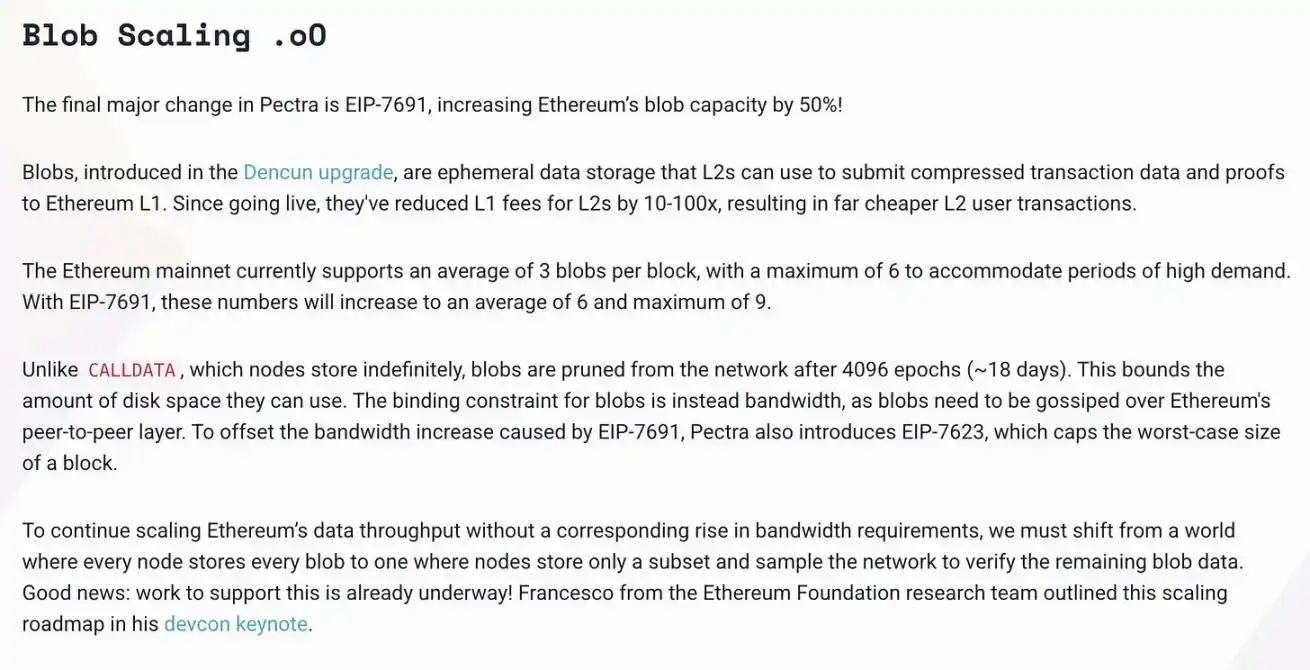
As the cost of "Blob" continues to rise, there is a need to enhance its processing capabilities. Through EIP-7691, the capacity of "Data Blobs" will increase by 50%: currently, each Ethereum block can hold approximately 3 "Data Blobs" on average (up to 6 during peak demand). With EIP-7691, the average number of "Data Blobs" a block can hold will increase to 6, reaching up to 9 during peak demand.
The next step in further expanding the processing capabilities of "Data Blobs" is to reduce the requirement to store all "Data Blobs" and move them to a subnet that can still be used to validate "Data Blob" data.
Other EIPs Included in the Pectra Upgrade
EIP-2537: Increases the security bits of operations from the current 80+ bits to over 120 bits.
EIP-2935: To accommodate the arrival of stateless clients, this proposal suggests storing historical block hash values as part of the block processing logic in the state. By achieving this through contract storage, EIP-2935 allows for a soft transition without impacting block hash logic. Layer 2 networks will be able to leverage longer historical data and query storage contracts directly.
EIP-7549: This proposal aims to improve the efficiency of the Casper client. It achieves this by reducing the number of pairings required for consensus validation. Specifically, it removes one of the three elements in the Casper client proof message: the committee index. By removing this element from the proof message, it is now possible to more efficiently aggregate consensus votes into a block, increasing the number of votes per block from 2 epochs to 8 epochs.
EIP-7623: The proposal to increase the cost of call data outlined in EIP-7623 is one of the most impactful upgrades (especially for Layer 2 networks). The proposal aims to adjust the cost of call data to address the discrepancy between average block size (100 kb) and maximum block size (7.15 MB). This will not affect regular users but will involve transactions primarily used for data publication. The cost increase will be achieved through a base fee that depends on the Gas fee proportion spent on call data operations: this can be accomplished by reducing block size to accommodate more "Data Blobs" or by increasing the Gas limit.
EIP-7685: Introduces a framework for storing requests triggered by smart contracts. This allows validator operations controlled by smart contracts to delegate management operations to the smart contract, reducing the need for intermediaries.
EIP-7840: Introduces a method to "dynamically adjust the target and maximum 'data Blob' per block for each block" through a "blobSchedule" object, instead of passing all values through an API.
This upgrade sends a clear signal for Ethereum. We know these upgrades have been scheduled long ago and are not a response to recent criticism. Nevertheless, this upgrade focuses on making the Ethereum network more secure, improving Ethereum accounts, and expanding the processing capabilities of 'data Blobs,' which aligns with some of the most critical development needs.
You may also like

Pantera Capital Partner: How Tokenization is Restructuring the Private Equity and Early Investment Ecosystem?

New York Proposes Stricter Stablecoin Issuer Rules Aligned With Federal GENIUS Act
NYDFS proposed stricter stablecoin issuer rules aligned with the GENIUS Act, covering reserves, custody, redemption timelines, audits, and capital buffers.
Every exchange is a "Universal Exchange."

The counterattack of traditional finance: Alliance chains are quietly reviving

CryptoQuant Says Bitcoin Profitable Supply Is Near 45% Pressure Zone as On-Chain Data Points to Market Repricing
CryptoQuant said Bitcoin’s profitable supply is nearing the 45% pressure zone, signaling rising market stress, unrealized losses, and a possible on-chain repricing phase.

Bitcoin Falls Below 200-Week Moving Average as On-Chain Data Shows Over Half of Supply in Loss
Bitcoin dropped below its 200-week moving average as on-chain data showed over 50% of circulating supply is now in loss, signaling rising market stress.

CFTC Reportedly Plans New Prediction Market Rules Focused on Manipulation Risk and Public Interest Review
The CFTC is reportedly preparing new prediction market rules focused on manipulation risk, public interest review, and retail trader protections.

Meet the new WEEX trial fund—your gateway to greater profits

WEEX Labs Lands at Dutch Blockchain Week: A Disruptive Crypto × AI Conversation Sets Sail in Amsterdam

SK Hynix Reportedly Plans U.S. ADR Listing as Early as August, With SEC Approval Possible in Late June
SK Hynix may pursue a U.S. ADR listing as early as August, with SEC approval reportedly possible in late June amid strong AI chip supply chain demand.

SpaceX vs Tesla vs xAI: Which Elon Musk Trade Has the Biggest Upside in 2026?
OpenAI Reveals It Has Confidentially Submitted an S-1 to the SEC, Keeping the Door Open for a Future IPO
On June 9, according to an OpenAI announcement, the company recently confidentially submitted a draft S-1 registration statement to the U.S. Securities and Exchange Commission (SEC), beginning the preliminary compliance process for a potential initial public offering. OpenAI said it chose to disclose this proactively because it expected the news might leak; however, the company has not yet set a specific listing timeline, and related arrangements may still take some time.

Latest research from 13 top universities including Cornell University: The current state, challenges, and misconceptions of the fusion of Crypto and AI
Deconstructing Anthropic: The Best AI Company, Possibly Also a Type of Organizational Invention
Apollo and Blackstone Reportedly Back $35 Billion Anthropic Chip Financing as Deal Details Remain Unclear
On June 9, according to currently available news alerts, Apollo and Blackstone Group participated in a $35 billion financing for an Anthropic “chip project.” Based on the original wording of the report, the funding has already been raised, but public information remains limited. The financing structure, use of proceeds, project entity, and whether Apollo and Blackstone participated through equity, debt, or project financing have not yet been disclosed.

Humanity Protocol Security Incident Escalates: More Than $31 Million Stolen From Related Addresses as Attacker Continues Selling H for ETH
On June 9, according to monitoring by Onchain Lens, more than $31 million has been stolen from addresses linked to Humanity Protocol, and the attack is still ongoing, with the hacker continuously swapping H tokens for ETH. Project founder Terence Kwok later confirmed the security incident on X, saying the issue involved a private key leak.

Bloomberg: As Bitcoin Weakens, Stablecoins and RWA Continue to Drive Expansion in Crypto Businesses
In June, Bloomberg reported that despite Bitcoin falling below $60,000 last week, wiping out about $235 billion in market value within seven days, and dropping close to 50% from last year’s peak, some core businesses in the crypto industry are still expanding, mainly in stablecoins, real-world asset tokenization (RWA), payments, and infrastructure. The report also noted that overall altcoin activity has contracted significantly: altcoin market capitalization has fallen from a peak of about $431 billion in November 2021 to around $170 billion, and among the tens of millions of tokens issued in recent years, fewer than 1,700 still maintain meaningful trading activity.

Galaxy Deep Research Report: How Hyperliquid's HIP-4 Upgrade Changes the Landscape of Prediction Markets?
Pantera Capital Partner: How Tokenization is Restructuring the Private Equity and Early Investment Ecosystem?
New York Proposes Stricter Stablecoin Issuer Rules Aligned With Federal GENIUS Act
NYDFS proposed stricter stablecoin issuer rules aligned with the GENIUS Act, covering reserves, custody, redemption timelines, audits, and capital buffers.
Every exchange is a "Universal Exchange."
The counterattack of traditional finance: Alliance chains are quietly reviving
CryptoQuant Says Bitcoin Profitable Supply Is Near 45% Pressure Zone as On-Chain Data Points to Market Repricing
CryptoQuant said Bitcoin’s profitable supply is nearing the 45% pressure zone, signaling rising market stress, unrealized losses, and a possible on-chain repricing phase.
Bitcoin Falls Below 200-Week Moving Average as On-Chain Data Shows Over Half of Supply in Loss
Bitcoin dropped below its 200-week moving average as on-chain data showed over 50% of circulating supply is now in loss, signaling rising market stress.


