
Regulatory Environment Loosening Up, Are U.S. Crypto Market Makers Back?

The cryptocurrency market is full of twists and turns. Just as investors were being panicked by a steep morning plunge, two major traditional market makers quietly entered the U.S. cryptocurrency market, bringing a ray of light to the devastated market. The traditional financial industry giant, Citadel Securities, with a market value of $65 billion, plans to enter the cryptocurrency market-making field, betting that President Trump's support for the cryptocurrency industry will bring about market prosperity. Meanwhile, the traditional cryptocurrency market maker, Wintermute, is entering the U.S. market, planning to expand its over-the-counter trading and derivatives business in the U.S. while opening an office in New York. The moves of these two market maker giants serve as a barometer of the market. Does this mean that market makers who once left the U.S. market due to strict SEC regulation are now poised to make a strong comeback under the new regulatory framework?
Market Maker Regulation Further Relaxed?
For a long time, the U.S. has had strict regulations on the cryptocurrency industry. During the Biden administration, the SEC took a strict regulatory stance, considering many cryptocurrencies as securities. This means that if market makers are involved in these assets, they must register as broker-dealers and comply with the relevant securities laws. This requirement has also led to a large number of litigation disputes. For example, on October 9, 2024, the SEC charged three companies claiming to be market makers and nine individuals with fraud, alleging that they participated in a scheme to manipulate various cryptocurrency markets by creating a false impression of active trading to induce investors to purchase cryptocurrency.
Additionally, on March 29, 2023, the U.S. Securities and Exchange Commission charged the cryptocurrency exchange Beaxy and its executives for failing to register as a national securities exchange, broker-dealer, and clearing agency. The platform's founder, Artak Hamazaspyan, and his controlled company Beaxy Digital, Ltd., raised $8 million through the unregistered issuance of Beaxy tokens (BXY) and faced charges against the platform's market makers for acting as unregistered dealers. These actions reflect the SEC's strict regulation of cryptocurrency market participants, aimed at protecting investors but also increasing compliance costs and legal risks.
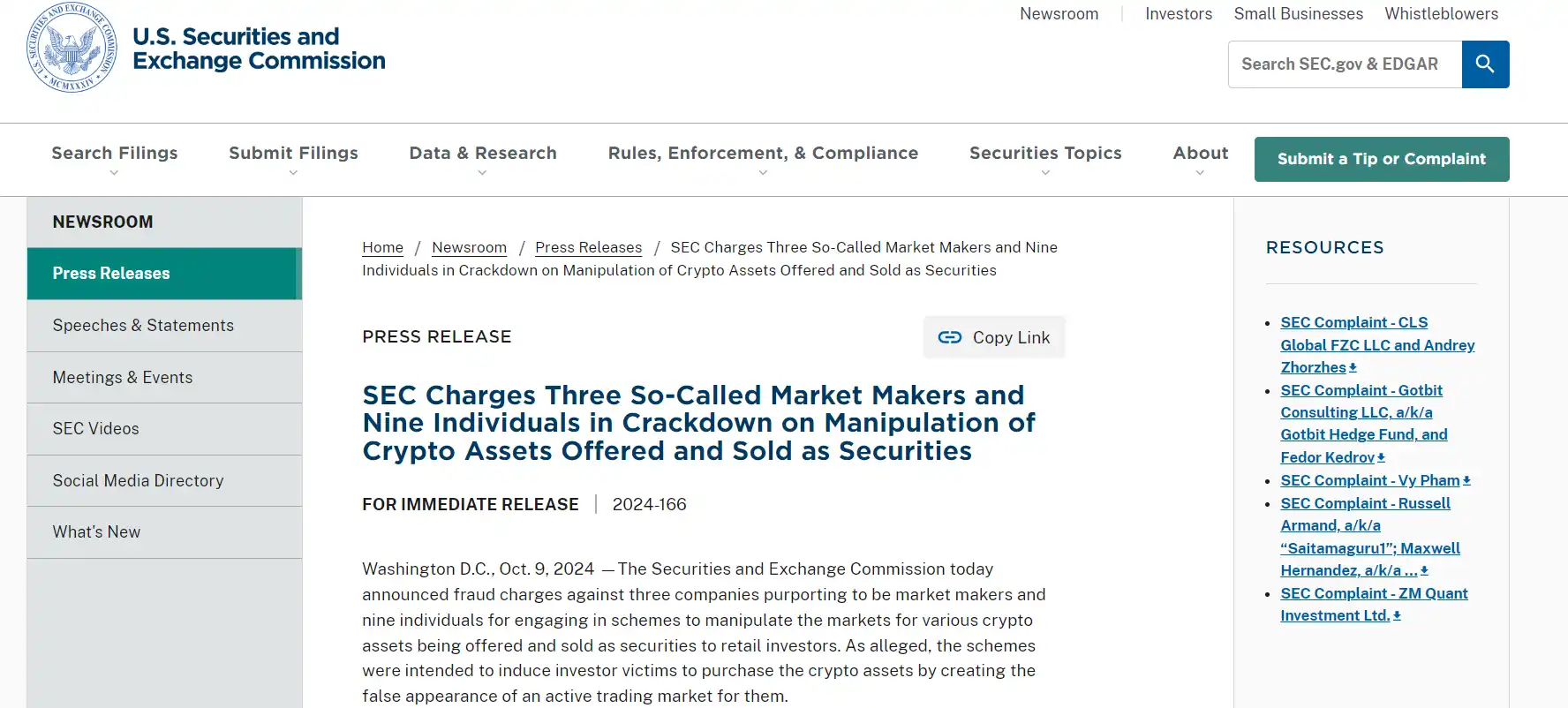
Image Source: SEC Website
With such a strict and uncertain regulatory environment, many cryptocurrency market makers have had to reduce their participation in the U.S. market or even withdraw completely. Wintermute mentioned in an interview with BlockBeats in 2023: "In 2021, we basically had no dealings with the SEC at all, so we intentionally decided to register for spot trading in the UK. In the UK, they explicitly stated that they did not want to provide derivatives for retail, so we completely avoided this risk by putting our derivatives business in Singapore. But in the U.S., we have almost no business because almost all of our business activities take place outside the U.S. So in many ways, we intentionally avoid this issue (SEC regulation), and we are actually more focused on Asia now, so we moved to Singapore."
Related Reading:《Exclusive Interview with Wintermute: We Are Liquidity Providers, Not Market Makers》
However, with changes in leadership, regulatory direction has also shifted with the attitudes of those in power. Since Donald Trump took office in January 2025, a series of clear policies supporting the crypto industry have been rolled out. On January 23, 2025, Trump signed an executive order emphasizing responsible growth in support of digital assets, blockchain technology, and related technologies, revoking the Biden administration's related policies. The order also established a digital assets working group within the National Economic Council, aimed at proposing a federal regulatory framework, including market structure, supervision, consumer protection, and risk management.
Furthermore, on January 21, 2025, the SEC announced the formation of a cryptocurrency working group led by Republican commissioner Hester Peirce. The group aims to develop a comprehensive and clear regulatory framework, move away from previous enforcement-driven approaches, differentiate which "crypto assets" are securities, potentially alter the way companies register, and provide clear statements when approving or disapproving exchange-traded products. These changes are seen by the industry as a crypto-friendly signal that is expected to lower compliance barriers and attract more market participants.

Will the Return of Traditional Market Makers Improve the Crypto Market?
The shift in regulatory policies acts as a key, gradually opening the door to the U.S. crypto market, bringing new vitality to the market along with a series of opportunities and challenges.
Headquartered in Chicago, Citadel Securities is a financial firm established in 2002 and is one of the world's largest market makers, mainly involved in trading in areas such as stocks, futures, forex, bonds, etc. Citadel Securities plans to expand into the cryptocurrency market-making business, marking a significant shift in the company's previously cautious attitude towards the crypto sector, betting that the favorable regulatory environment under the Trump administration will drive growth in this asset class. The company has planned to join the market maker lists of several exchanges, including Coinbase Global, Binance, and Crypto.com, potentially initially establishing market-making teams outside the U.S.

Image of Citadel Securities CEO Ken Griffin
At the Consensus Hong Kong 2025 conference, Wintermute CEO Evgeny Gaevoy stated: "With the gradual adoption of cryptocurrency in the United States, the risk-averse sentiment of traditional institutions will be alleviated. The asset tokenization market will reach a scale of hundreds of billions to trillions of dollars, where assets can be used as collateral. In terms of liquidity, the entry of more people will drive an increase in depth. I also hope that regulatory oversight in the crypto field will drive market pricing reform." Gaevoy, in an interview with Bloomberg, mentioned that the company's business expansion plans have changed, shifting the focus from the Asian market to the United States, expressing hope for favorable cryptocurrency regulatory policies in the U.S. On February 24, according to Arkham Monitor, Wintermute withdrew 106,885 SOL coins worth around $16.71 million from Binance over the past 6 hours, leading some to speculate that this move is in preparation for entering the U.S. market.

Image of Evgeny Gaevoy during an interview at the "Consensus 2025" event
Citadel Securities and Wintermute, a longstanding market maker in the traditional financial field and a giant market maker deeply rooted in the crypto space, respectively. Their involvement will undoubtedly directly increase the liquidity of the U.S. crypto market, attract more institutional investors, and potentially drive growth in trading activity. Particularly with the entry of the traditional financial giant Citadel, it will directly move the crypto market from the "wild growth" phase towards maturity, fostering a comprehensive improvement in market liquidity, trade efficiency, and regulatory compliance. It also indicates that as the U.S. regulatory landscape evolves, institutional confidence in the crypto industry continues to strengthen, suggesting a new growth phase for the U.S. crypto market.
However, challenges still exist, such as how to balance fostering industry development with investor protection, how to divide regulatory responsibilities between the SEC and the CFTC, and how to address concerns about the monopolization of the market by multiple major market makers. Especially with Citadel Securities' entry, its collaboration with major exchanges will directly squeeze the market share of existing top market makers, further encroaching on the survival space of medium and small market makers, increasing industry competitive pressure. At the same time, it will further increase the current market concentration of market makers, contradicting the decentralized ethos of the crypto industry. Additionally, Wintermute had previously suffered a $160 million on-chain asset hack due to an algorithm flaw (2022 incident), highlighting the systemic risks of traditional giants.
The resurgence of Citadel and Wintermute marks the integration of traditional finance and the crypto ecosystem. As the $650 billion traditional market-making giant starts to join the game, and Wintermute further bridges Eastern and Western capital, the market is witnessing the process of liquidity transformation. The strategic realignment of the two market-making giants essentially signifies a paradigm shift from "regulatory arbitrage" to "regulatory coordination." If the U.S. can establish a tiered regulatory system (such as rules based on token types and investor categories), it may give rise to a larger institutional-grade crypto market. However, one must be vigilant of the centralization risk posed by the excessive infiltration of traditional financial powers— the future crypto market may no longer be about "disrupting Wall Street" but "dancing with Wall Street."
You may also like

New York Proposes Stricter Stablecoin Issuer Rules Aligned With Federal GENIUS Act
NYDFS proposed stricter stablecoin issuer rules aligned with the GENIUS Act, covering reserves, custody, redemption timelines, audits, and capital buffers.

Every exchange is a "Universal Exchange."

The counterattack of traditional finance: Alliance chains are quietly reviving

CryptoQuant Says Bitcoin Profitable Supply Is Near 45% Pressure Zone as On-Chain Data Points to Market Repricing
CryptoQuant said Bitcoin’s profitable supply is nearing the 45% pressure zone, signaling rising market stress, unrealized losses, and a possible on-chain repricing phase.

Bitcoin Falls Below 200-Week Moving Average as On-Chain Data Shows Over Half of Supply in Loss
Bitcoin dropped below its 200-week moving average as on-chain data showed over 50% of circulating supply is now in loss, signaling rising market stress.

CFTC Reportedly Plans New Prediction Market Rules Focused on Manipulation Risk and Public Interest Review
The CFTC is reportedly preparing new prediction market rules focused on manipulation risk, public interest review, and retail trader protections.

Meet the new WEEX trial fund—your gateway to greater profits

WEEX Labs Lands at Dutch Blockchain Week: A Disruptive Crypto × AI Conversation Sets Sail in Amsterdam

SK Hynix Reportedly Plans U.S. ADR Listing as Early as August, With SEC Approval Possible in Late June
SK Hynix may pursue a U.S. ADR listing as early as August, with SEC approval reportedly possible in late June amid strong AI chip supply chain demand.

SpaceX vs Tesla vs xAI: Which Elon Musk Trade Has the Biggest Upside in 2026?
OpenAI Reveals It Has Confidentially Submitted an S-1 to the SEC, Keeping the Door Open for a Future IPO
On June 9, according to an OpenAI announcement, the company recently confidentially submitted a draft S-1 registration statement to the U.S. Securities and Exchange Commission (SEC), beginning the preliminary compliance process for a potential initial public offering. OpenAI said it chose to disclose this proactively because it expected the news might leak; however, the company has not yet set a specific listing timeline, and related arrangements may still take some time.

Latest research from 13 top universities including Cornell University: The current state, challenges, and misconceptions of the fusion of Crypto and AI
Deconstructing Anthropic: The Best AI Company, Possibly Also a Type of Organizational Invention
Apollo and Blackstone Reportedly Back $35 Billion Anthropic Chip Financing as Deal Details Remain Unclear
On June 9, according to currently available news alerts, Apollo and Blackstone Group participated in a $35 billion financing for an Anthropic “chip project.” Based on the original wording of the report, the funding has already been raised, but public information remains limited. The financing structure, use of proceeds, project entity, and whether Apollo and Blackstone participated through equity, debt, or project financing have not yet been disclosed.

Humanity Protocol Security Incident Escalates: More Than $31 Million Stolen From Related Addresses as Attacker Continues Selling H for ETH
On June 9, according to monitoring by Onchain Lens, more than $31 million has been stolen from addresses linked to Humanity Protocol, and the attack is still ongoing, with the hacker continuously swapping H tokens for ETH. Project founder Terence Kwok later confirmed the security incident on X, saying the issue involved a private key leak.

Bloomberg: As Bitcoin Weakens, Stablecoins and RWA Continue to Drive Expansion in Crypto Businesses
In June, Bloomberg reported that despite Bitcoin falling below $60,000 last week, wiping out about $235 billion in market value within seven days, and dropping close to 50% from last year’s peak, some core businesses in the crypto industry are still expanding, mainly in stablecoins, real-world asset tokenization (RWA), payments, and infrastructure. The report also noted that overall altcoin activity has contracted significantly: altcoin market capitalization has fallen from a peak of about $431 billion in November 2021 to around $170 billion, and among the tens of millions of tokens issued in recent years, fewer than 1,700 still maintain meaningful trading activity.

Galaxy Deep Research Report: How Hyperliquid's HIP-4 Upgrade Changes the Landscape of Prediction Markets?
Binance Research: RWA Market Expected to Expand Nearly 6x from Early 2025, with Public Equities and Onchain Payments Heating Up Together
In June, Binance Research said in its monthly market report that the real-world asset (RWA) market is expected to grow by about 589% from the beginning of 2025. Bond- and money market fund-related RWA expanded by about $6.5 billion, up 83% year over year, while publicly traded equity RWAs grew by about 422%. The report also noted that monthly crypto debit card transaction volume exceeded $747 million in May, up 48.6% year to date.
New York Proposes Stricter Stablecoin Issuer Rules Aligned With Federal GENIUS Act
NYDFS proposed stricter stablecoin issuer rules aligned with the GENIUS Act, covering reserves, custody, redemption timelines, audits, and capital buffers.
Every exchange is a "Universal Exchange."
The counterattack of traditional finance: Alliance chains are quietly reviving
CryptoQuant Says Bitcoin Profitable Supply Is Near 45% Pressure Zone as On-Chain Data Points to Market Repricing
CryptoQuant said Bitcoin’s profitable supply is nearing the 45% pressure zone, signaling rising market stress, unrealized losses, and a possible on-chain repricing phase.
Bitcoin Falls Below 200-Week Moving Average as On-Chain Data Shows Over Half of Supply in Loss
Bitcoin dropped below its 200-week moving average as on-chain data showed over 50% of circulating supply is now in loss, signaling rising market stress.
CFTC Reportedly Plans New Prediction Market Rules Focused on Manipulation Risk and Public Interest Review
The CFTC is reportedly preparing new prediction market rules focused on manipulation risk, public interest review, and retail trader protections.


