
「Rolling Up」 Web3 VCs: Who to Follow to Make Money Easier?


Original Article Title: "Web3 VC Ultimate Guide, Which VC to Follow for Profit?"
Original Article Author: Sego, Crypto KOL
After tirelessly working for 48 hours, here is a comprehensive collection of data that every Web3 player must see.
Among the many VCs in Web3, which VCs have the best vision? Which VC's invested projects have the highest ROI? For ordinary players, which VCs are more cost-effective to invest with early on? Which project should you support? What are the domestic and foreign VCs? Do projects backed by foreign VCs have greater potential?
These are all questions that concern us retail investors the most and are also of great interest to primary market players (early-stage supporters).
In this article, we will let the data speak for itself, one by one revealing the answers to these questions.
All data is sourced from public disclosures. We have selected a total of 65 VCs, including 23 foreign VCs, 34 domestic VCs, and 8 exchange-backed VCs.
The best result of VC investment is when the project's token gets listed on a major exchange.
While we know that some projects can be profitable even without a token, these opportunities are not accessible to ordinary players.
Therefore, we provide the following dimensions for assessment:
Quantity:
Number of VC total investments
Number of projects with issued tokens
Number of projects listed on Binance
Number of projects listed on OKEx
Number of projects listed on Coinbase
Listed Success Rate:
Binance listing rate = Number of projects listed on Binance / Total investments
OKEx listing rate = Number of projects listed on OKEx / Total investments
Coinbase listing rate = Number of projects listed on Coinbase / Total investments
Evaluation Criteria:
Composite Score = 2 * Binance listing rate + 1 * OKEx listing rate + 1 * Coinbase listing rate
Since Binance has the highest trading volume, its weight is 2
Project Average Return on Investment (ROI) = 15 * Binance listing rate + 10 * OKEx listing rate + 10 * Coinbase listing rate
Previously, the ROI assumed an average of 15x when listed on Binance, 10x when listed on OKEx, and 10x when listed on Coinbase as the average return assumption based on initial investment. Each project is different, so the averages are taken here.
Let's Start with the Conclusion
Based on the difference in comprehensive scores, we have categorized VCs into five levels: T0, T1, T2, T3, and T4. The higher the ranking, the better the VC's vision. Following these VCs to focus on primary markets is more cost-effective.
VC Levels:
T0-level VCs include YZi Labs (formerly Binance Labs), Continue Capital, IOSG Ventures, Bain Capital
T1-level VCs include Multicoin, Pantera, 1Confirmation, Smrti Lab, Zonff Partners
T2-level VCs include Polychain, ParaFi Capital, Dragonfly, Sequoia China, Delphi Digital, Electric Capital, Mint Ventures, CoinFund
T3-level VCs include Framework Ventures, NGC Ventures, SNZ Holding, Coinbase Ventures, OKX Ventures, etc.
T4-level VCs include Animoca Brands, GSR, Hashkey Capital, Waterdrip, LD Capital, etc.
Regional VC Investment Output and Return Ranking:
Foreign VCs > Exchange-affiliated VCs > Domestic VCs
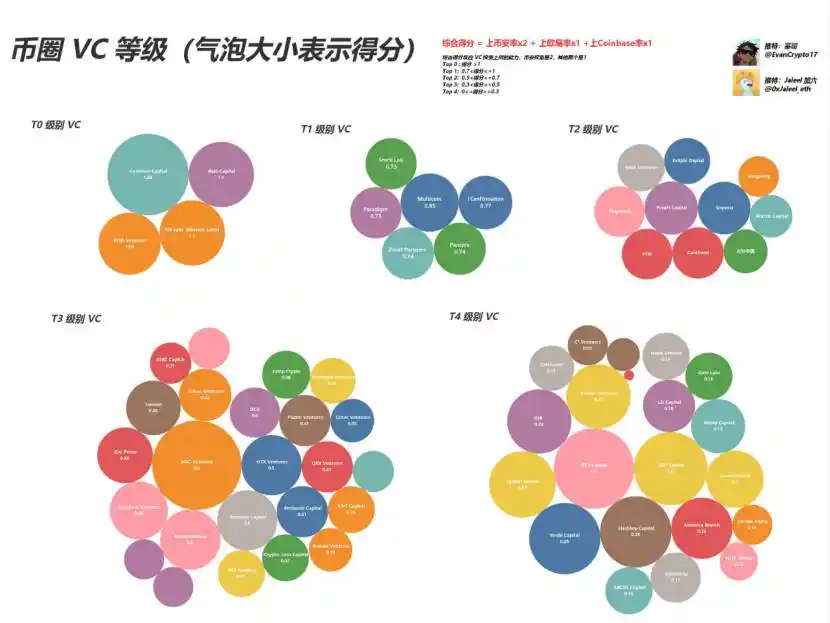
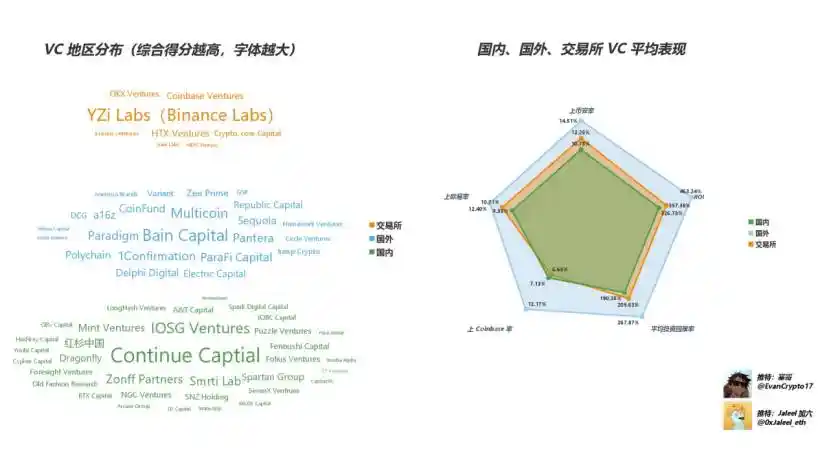
T0-level VC
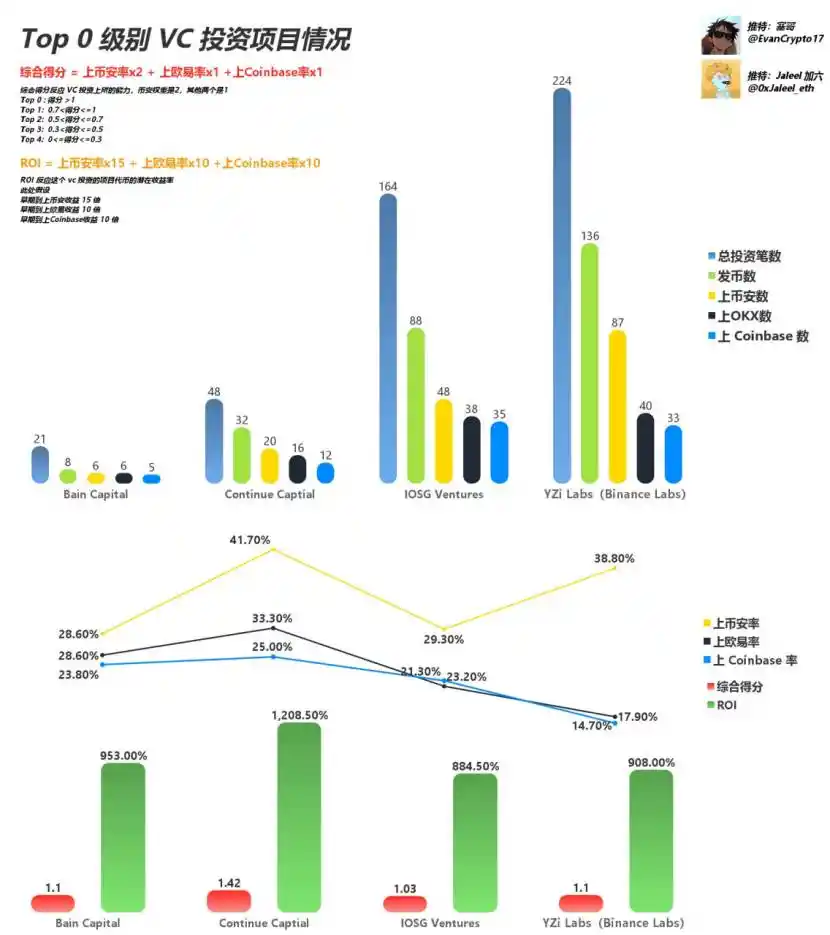
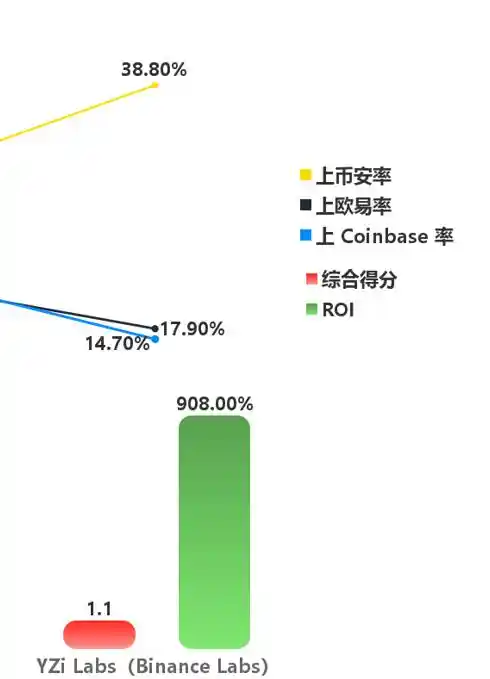
T0-level VCs include YZi Labs (formerly Binance Labs), Continue Capital, IOSG Ventures, Bain Capital.
Composite Score > 1, average ROI in the range of 8 - 12, we focus our efforts on projects from these VC early-stage investments, and can basically achieve great results. The probability of making a big profit from Coin A7 A8 is high.
Detailed data is as shown in the graph:
T1 Level VC
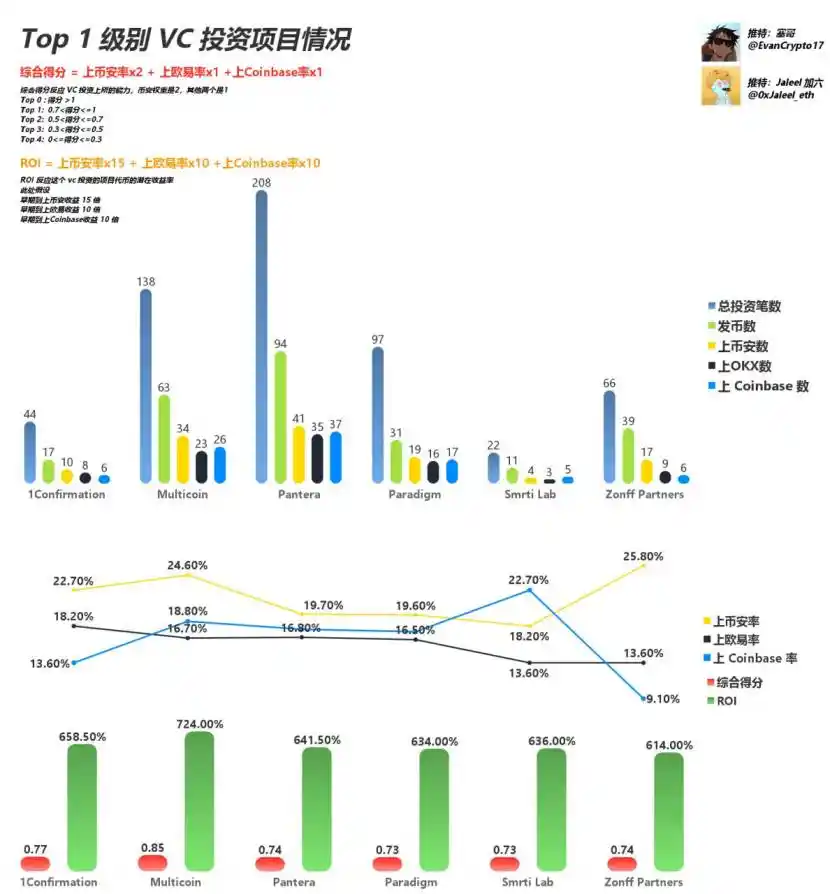
T1 Level VC includes Multicoin, Pantera, 1Confirmation, Smrti Lab, Zonff Partners.
The composite score ranges between 0.7 - 1, with an average ROI between 6 - 7.5. We focus our efforts on projects from these VC early-stage investments, and the returns are also very good, with A6.5 being a good outcome as well.
Detailed data is as shown in the graph:
T2 Level VC
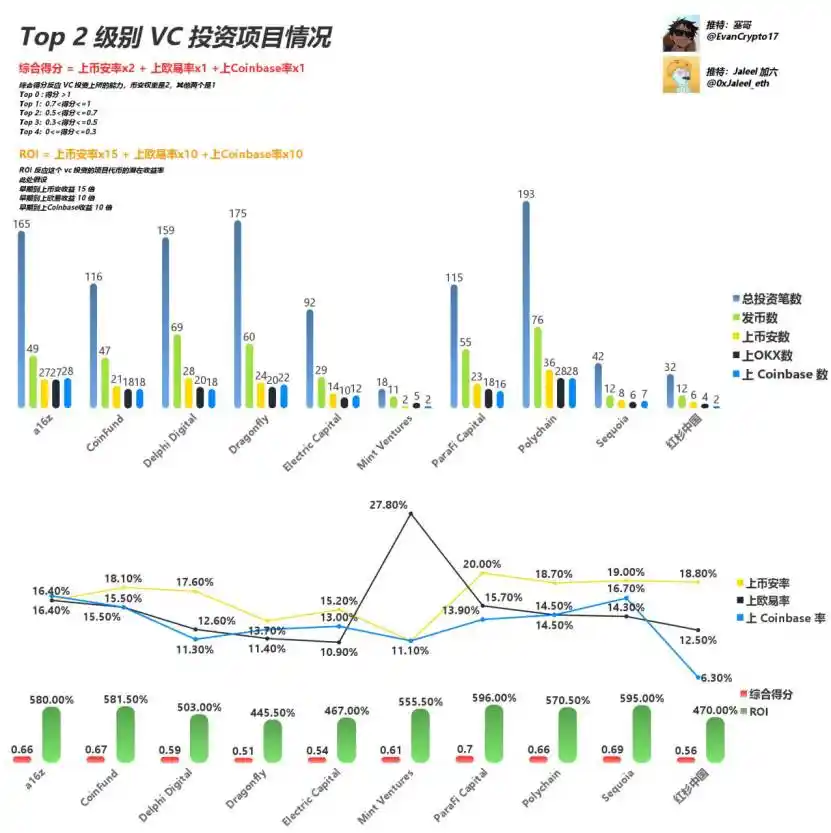
T2 Level VC includes Polychain, ParaFi Capital, Dragonfly, Sequoia China, Delphi Digital, Electric Capital, Mint Ventures, CoinFund.
The composite score ranges between 0.5 - 0.7, with an average ROI between 4 - 6. We focus our efforts on projects from these VC early-stage investments, and the returns are somewhat unstable, but giving it a try may present opportunities.
Detailed data is as shown in the graph:
T3 Level VC
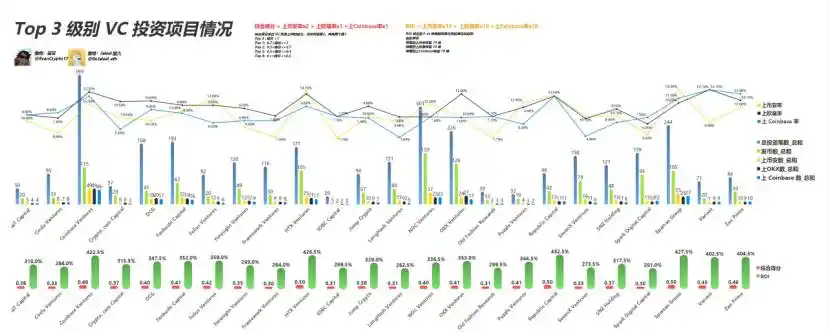
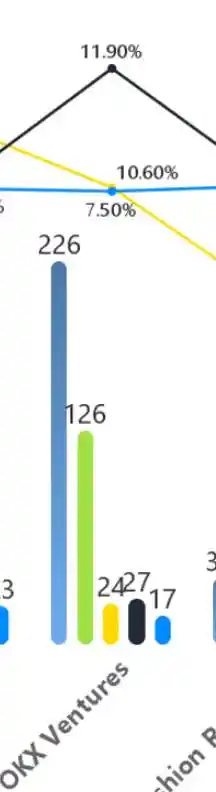
T3 Level VC includes Framework Ventures, NGC Ventures, SNZ Holding, Coinbase Ventures, OKX Ventures, etc.
The composite score ranges between 0.3 - 0.5, with an average ROI between 2.5 - 4.5. We focus our efforts on projects from these VC early-stage investments, and the returns are somewhat unstable with a low return on investment.
Detailed data is as shown in the graph:
T4 Level VC
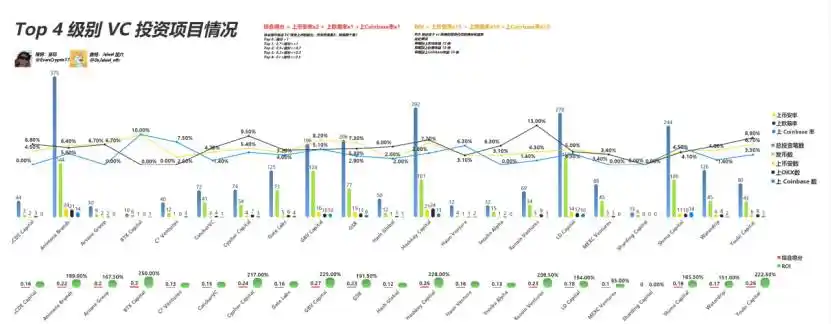
Tier 4 VCs include Animoca Brands, GSR, Hashkey Capital, Waterdrip, LD Capital, etc.
The overall score ranges from an average ROI of 0 - 0.3 to an average ROI of 0 - 2.5. We focus on early-stage projects invested in by these VCs, where the returns are not very optimistic and the likelihood of going public is small.
Detailed data is as shown in the chart:
Additional Note
Projects invested in by Binance and OKEx have a slightly higher probability of going public on their own platform.
For projects invested in by Coinbase, the probability of "The Big Three" going public is approximately the same.
Summary
From the data, we found that VCs that are usually highly regarded, such as a16z, Coinbase, Dragonfly, Polychain, and others, actually do not have much reference value for ordinary people like us.
Some projects' association with a "VC brand" may be a "trap" for ordinary players.
Based on our analysis, the projects that Tier 0 and Tier 1 VCs participate in are the ones we should truly pay attention to and invest in.
The output of foreign VCs' investments is higher than that of domestic VCs, with exchange-affiliated VCs' investments falling between the two.
When considering whether a project is worth early-stage investment, we look at which tier the participating VCs belong to, synthesize the listed data, and this provides us with significant reference value for participating in the primary market.
Once again, this article only discusses the return on investment for ordinary players following VCs and ranks them accordingly. It does not involve the overall strength of the companies and brands represented by the VCs in other aspects!
You may also like

Morning Report | OpenAI has submitted an S-1 registration statement draft to the U.S. SEC; Morpho completes $175 million financing

Galaxy Deep Research Report: How Hyperliquid's HIP-4 Upgrade Changes the Landscape of Prediction Markets?

Latest research from 13 top universities including Cornell University: The current state, challenges, and misconceptions of the fusion of Crypto and AI

Deconstructing Anthropic: The Best AI Company, Possibly Also a Type of Organizational Invention

Every exchange is a "Universal Exchange."

The counterattack of traditional finance: Alliance chains are quietly reviving
Pantera Capital Partner: How Tokenization is Restructuring the Private Equity and Early Investment Ecosystem?

Mastercard Launches Agent Pay for AI, Plans to Record AI Agent Payment Authorizations on Polygon
Mastercard launched Agent Pay for AI, a new payment protocol designed to help AI agents make small payments such as pay-per-use access to data and APIs. The system plans to record human-granted AI agent permissions on Polygon, focusing on verifiable authorization, identity, and payment controls.

Curve Deploys Llamalend v2 on Optimism With 250,000 OP Incentives
Curve launched Llamalend v2 on Optimism with 250,000 OP incentives from the Optimism Foundation. The upgrade expands Llamalend beyond its earlier crvUSD-focused model, adding broader collateral support, LlamaRisk market reviews, and the ability to use Curve LP tokens as collateral.

Raydium Old Liquidity Pool Reportedly Exploited, With $1.34 Million Moved to Ethereum and Tornado Cash
An old Raydium liquidity pool was reportedly exploited for around $1.34 million in USDC, RAY, and wSOL, with the stolen funds bridged to Ethereum and deposited into Tornado Cash. The incident highlights the tail risks of legacy DeFi pools, old contracts, and cross-chain fund laundering paths.
Kalshi Executive Challenges “SBF Backed AI Unicorns” Narrative, Says Leopold Aschenbrenner Was Key Figure
Kalshi executive John Wang questioned the “SBF backed AI unicorns” narrative, saying Leopold Aschenbrenner was the key figure behind major AI investment decisions.

New York Proposes Stricter Stablecoin Issuer Rules Aligned With Federal GENIUS Act
NYDFS proposed stricter stablecoin issuer rules aligned with the GENIUS Act, covering reserves, custody, redemption timelines, audits, and capital buffers.

CryptoQuant Says Bitcoin Profitable Supply Is Near 45% Pressure Zone as On-Chain Data Points to Market Repricing
CryptoQuant said Bitcoin’s profitable supply is nearing the 45% pressure zone, signaling rising market stress, unrealized losses, and a possible on-chain repricing phase.

Bitcoin Falls Below 200-Week Moving Average as On-Chain Data Shows Over Half of Supply in Loss
Bitcoin dropped below its 200-week moving average as on-chain data showed over 50% of circulating supply is now in loss, signaling rising market stress.

CFTC Reportedly Plans New Prediction Market Rules Focused on Manipulation Risk and Public Interest Review
The CFTC is reportedly preparing new prediction market rules focused on manipulation risk, public interest review, and retail trader protections.

Meet the new WEEX trial fund—your gateway to greater profits

WEEX Labs Lands at Dutch Blockchain Week: A Disruptive Crypto × AI Conversation Sets Sail in Amsterdam
SK Hynix Reportedly Plans U.S. ADR Listing as Early as August, With SEC Approval Possible in Late June
SK Hynix may pursue a U.S. ADR listing as early as August, with SEC approval reportedly possible in late June amid strong AI chip supply chain demand.
Morning Report | OpenAI has submitted an S-1 registration statement draft to the U.S. SEC; Morpho completes $175 million financing
Galaxy Deep Research Report: How Hyperliquid's HIP-4 Upgrade Changes the Landscape of Prediction Markets?
Latest research from 13 top universities including Cornell University: The current state, challenges, and misconceptions of the fusion of Crypto and AI
Deconstructing Anthropic: The Best AI Company, Possibly Also a Type of Organizational Invention
Every exchange is a "Universal Exchange."
The counterattack of traditional finance: Alliance chains are quietly reviving


