
Stop Looking for the Sword in the Same Place: The Current Bitcoin Market Is Not a Replay of the 2022 Bear Market


Original Article Title: Why Comparing Today's BTC to 2022 Is Absolutely Unprofessional
Original Article Author: Garrett, Crypto Analyst
Original Article Translation: Yuliya, PANews
Lately, some analysts have started comparing the current Bitcoin price trend to that of 2022. Although the short-term price patterns may appear somewhat similar, the comparison is entirely absurd from a long-term perspective. Whether looking at long-term price patterns, the macroeconomic backdrop, or investor composition and holding structures, the underlying logic has fundamentally shifted.
One of the biggest mistakes in analyzing and trading financial markets is focusing solely on short-term, surface-level statistical similarities while overlooking the long-term, macro, and fundamental driving factors.
A Starkly Different Macro Backdrop
In March 2022, the United States was clearly in a high inflation and rate-hike cycle primarily driven by:
· Excess liquidity unleashed during the COVID-19 pandemic.
· The outbreak of the Ukraine conflict, which significantly exacerbated inflation.
In that environment, risk-free rates kept rising, liquidity was systematically drained, and financial conditions continued to tighten. Therefore, capital's primary objective was risk aversion. What we saw in the Bitcoin market was a distribution structure at a high level typical of a tightening cycle.
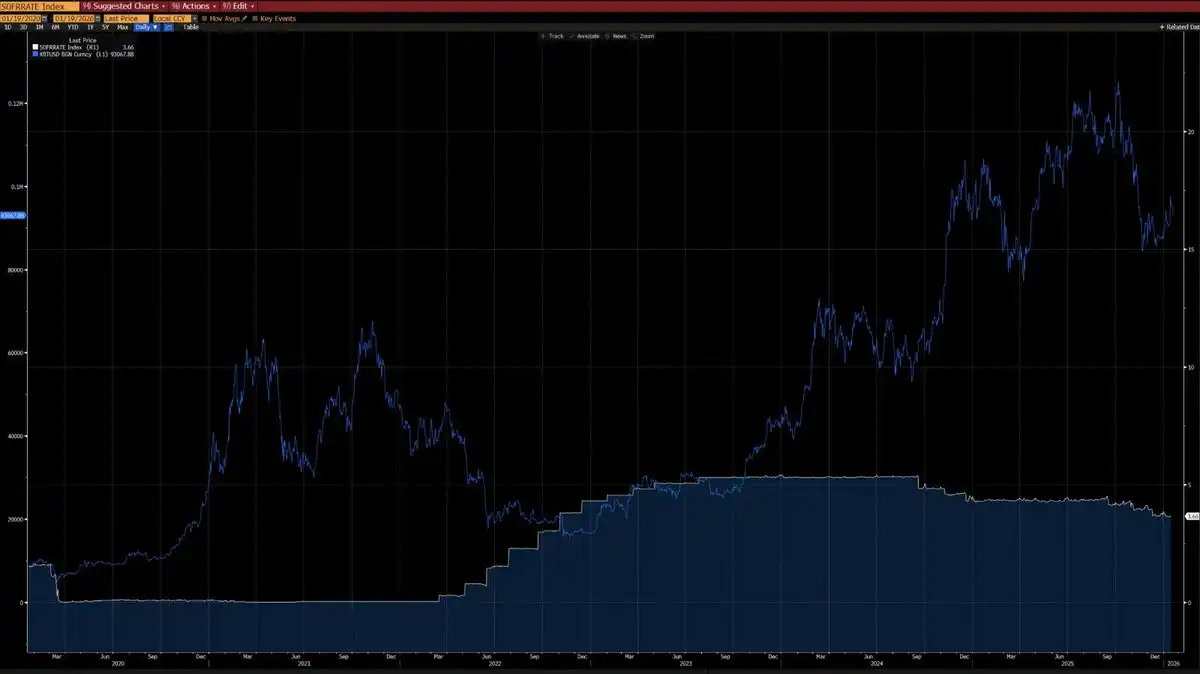
While the current macro environment is exactly the opposite:
· The Ukraine conflict is easing (partly due to U.S. efforts to lower inflation and rates).
· The Consumer Price Index (CPI) and U.S. risk-free rates are decreasing.
· More importantly, the AI technology revolution has significantly increased the likelihood of the economy entering a long-term inflation decline period. Therefore, in a larger cycle, rates have already entered a cutting phase.
· Central bank liquidity is being reinjected into the financial system.
All of this defines capital behavior as "risk preference."
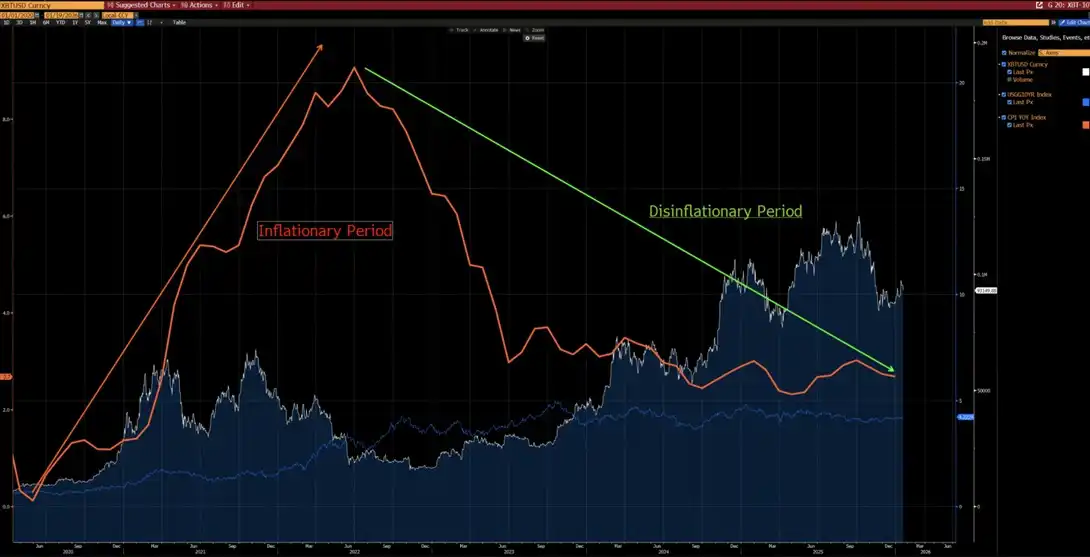
Chart analysis shows that since 2020, there has been a clear negative correlation between the Bitcoin price and CPI's year-on-year change — Bitcoin tends to fall during inflationary periods and rise during inflation declines. In the AI-driven technological revolution, a long-term inflation decline is a high-probability event, a view echoed by Elon Musk, thus reinforcing this point.
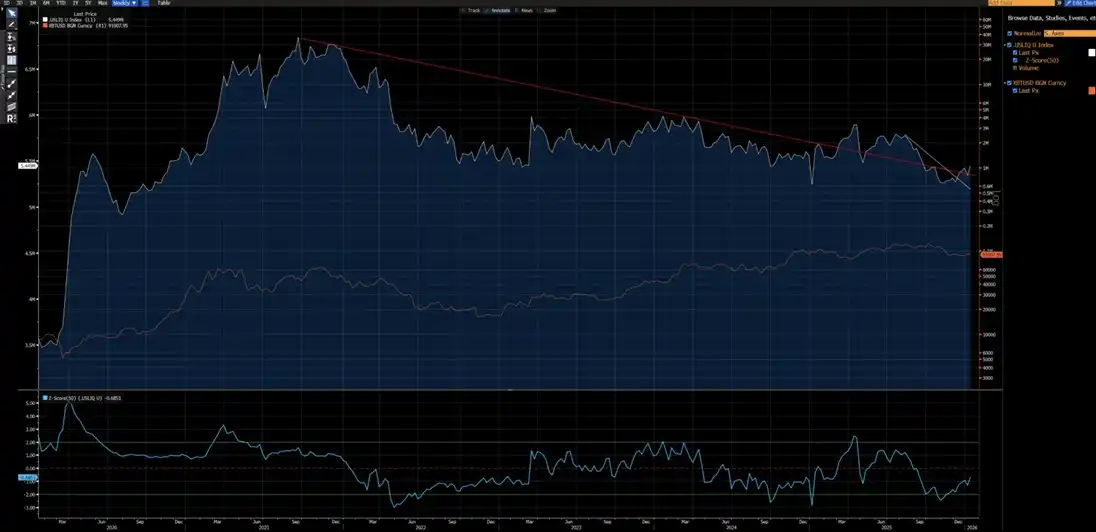
Furthermore, since 2020, Bitcoin has shown a strong correlation with the US Liquidity Index (except for a short-term distortion in 2024 due to ETF inflows). Currently, the US Liquidity Index has broken above both its short-term (white line) and long-term (red line) downtrend lines, signaling a new uptrend ahead.
Different Technical Structures
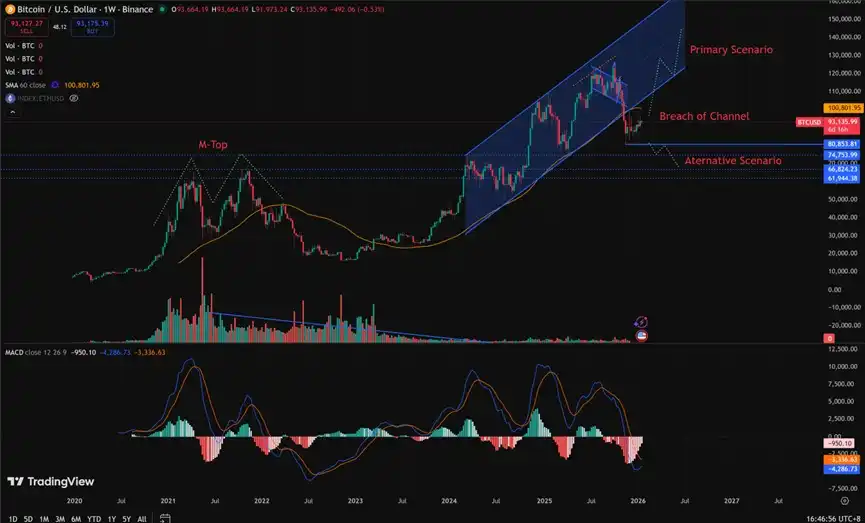
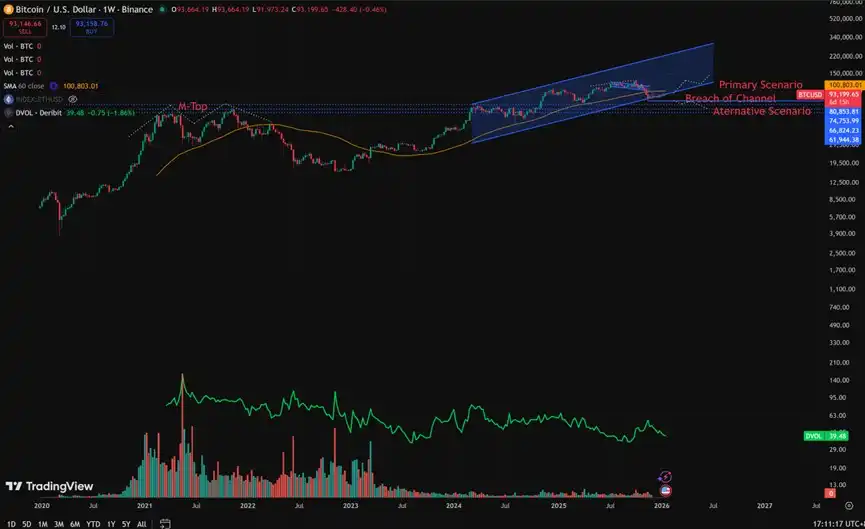
· 2021–2022: The market exhibited a weekly chart M-top structure, usually associated with a long-term market top that can suppress prices for a considerable amount of time.
· 2025: The current market is displaying a weekly chart breakdown from an ascending channel. From a probabilistic standpoint, this is more likely a "bear trap," with prices expected to rebound back into the channel.
Of course, the possibility of the market evolving into a bear market similar to 2022 cannot be entirely ruled out. However, the $80,850 to $62,000 range has seen extensive consolidation and turnover. The previous significant accumulation phase has provided a much superior risk-to-reward ratio for establishing bullish positions now: the upside potential significantly outweighs the downside risk.
What Conditions Are Needed to Replicate a 2022-style Bear Market?
To replicate a bear market of a similar magnitude to that of 2022, the following indispensable conditions must be met:
A new round of inflationary shock or a significant geopolitical crisis comparable to that of 2022.
· Central banks around the world resume interest rate hikes or quantitative tightening (QT).
· Price decisively and sustainably falls below $80,850.
· Any claims of a structural bear market arriving before these conditions are met would be premature and subjective speculation rather than objective analysis.
Different Investor Structures
· 2020–2022: This was a market dominated by retail investors, with limited institutional participation, especially lacking long-term allocators.
· 2023–Present: The introduction of a Bitcoin spot ETF brought in structurally long-term holders. These institutions have effectively locked up the supply, sharply reduced token velocity, and significantly dampened market volatility.
Whether from a macroeconomic or quantitative perspective, 2023 marks a structural inflection point for Bitcoin as an asset. Bitcoin's volatility pattern has shifted from a historical range of 80%–150% to 30%–60%, reflecting a fundamental change in its asset behavior.
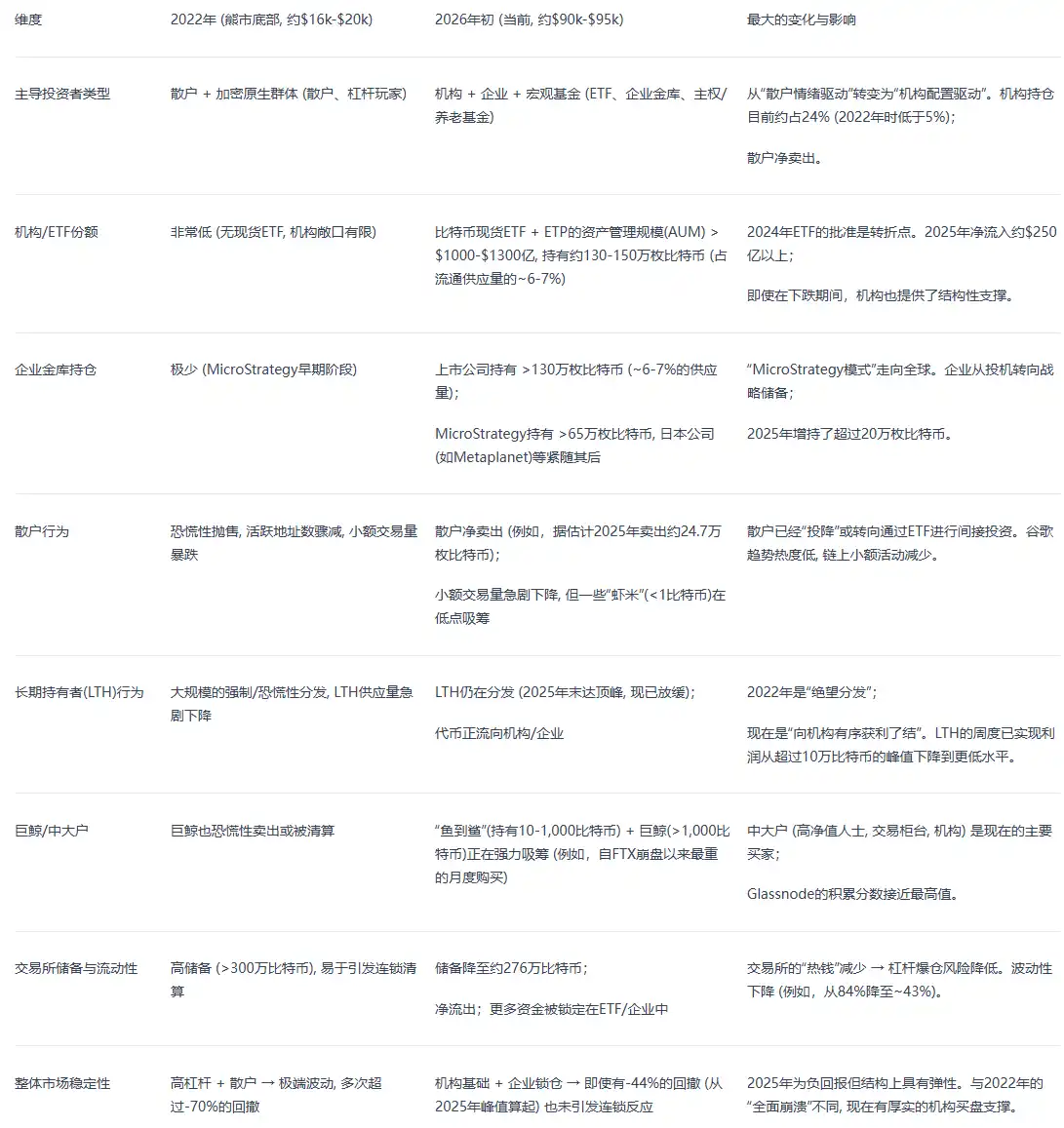
Core Structural Differences (Current vs. 2022)
The biggest difference in Bitcoin investor structure between the present (early 2026) and 2022 is that the market has transitioned from being "retail-driven, high-leverage speculation" to "institutionally driven, structurally long-term holding."
In 2022, Bitcoin witnessed a classic "crypto-native bear market," driven by retail panic selling and cascading liquidations of leveraged positions. Today, however, Bitcoin's operating environment has entered a more mature institutional era characterized by:
· Stable underlying demand.
· Locked-in supply.
· Institutional-grade volatility.
The following is a core comparison based on on-chain data (e.g., Glassnode, Chainalysis) and institutional reports (e.g., Grayscale, Bitwise, State Street) as of mid-January 2026 (when Bitcoin's price was in the $90k–$95k range).
You may also like

Bitcoin Trading Guide 2026: Strategies for Experienced Traders

What Is XAUT and PAXG? Why Tokenized Gold Is Booming in 2026

Cryptocurrency CEXs are flocking to sell US stocks, and traditional brokerages are facing an "uninvited guest."

Will the SpaceX IPO Hurt Bitcoin? Here's What Traders Are Watching
Foreign selling in the South Korean stock market accelerates, with cumulative net sales reportedly reaching $75 billion this year
On June 9, The Kobeissi Letter, citing Goldman Sachs data, reported that global investors are selling South Korean stocks at an unusually rapid pace. In the latest trading session, foreign investors sold about $801 million worth of Kospi constituent stocks again; total foreign outflows last week reached about $10 billion, and the market has been in net foreign selling on nearly every trading day over the past month. According to the data cited in the report, foreign investors have sold about $75 billion worth of South Korean stocks so far this year. Meanwhile, South Korean retail and institutional investors together recorded roughly $69 billion in net buying over the same period, suggesting that the market’s main buying support has come from domestic capital rather than returning overseas funds. The information currently disclosed still mainly comes from The Kobeissi Letter’s retelling and Goldman Sachs data summaries, while public details on the statistical period and the specific definition of “selling” remain relatively limited.

Fortune Warns of Strategy’s Financing Structure Risks as Bitcoin Premium Narrows
Fortune warned that Strategy’s Bitcoin treasury model faces growing financing risks as MSTR’s net asset premium narrows and preferred stock dividend pressure increases.

Ferrari Challenge Le Mans: Carl Moon to Dominate in WEEX Livery

Sahara AI Responds to SAHARA’s Sharp Drop: No Contract or Product Security Issues Found, Internal Investigation Underway
Sahara AI responded to SAHARA’s 60% price drop, saying no token contract or product security issues have been found and an internal investigation is underway.

WEEX Deposit/Withdrawal Dynamic Island: Your Asset Status, Always in Sight

Scaling Crypto Derivatives: The Digital Asset Infrastructure Behind High-Volume Trading
In the fast-moving digital asset ecosystem, derivatives platforms face an extreme architectural test. High-leverage futures markets demand more than just standard security—they require absolute operational precision, zero-latency matching engines, and ironclad structural scalability, all while navigating intense market volatility.
As global platforms scale to meet these demands, the industry is shifting away from rigid, monolithic setups toward a more agile, "decoupled" infrastructure philosophy.
The Blueprint for High-Volume Copy TradingFor elite global exchanges like WEEX (founded in 2018), this architectural choice becomes critical when scaling high-volume retail features like social copy trading. When thousands of users automatically mirror the real-time strategies of elite traders simultaneously, it triggers sudden, monumental spikes in concurrent transactional volume.
To prevent execution latency or settlement bottlenecks during these peak volatility events, a platform's primary engine must remain entirely dedicated to risk management, copy-trade synchronization, and order matching.
The Architectural Rule: New-generation platforms must separate front-end user execution engines from heavy backend infrastructural overhead to eliminate operational friction.
By separating these layers, platforms can maintain complete sovereignty over their trading environments and user experiences while strategically aligning with institutional-grade infrastructure ecosystems. This strategic framework allows modern exchanges to leverage advanced Digital Asset Custody infrastructure such as Cobo’s behind the scenes, ensuring that backend wallet management scales elastically alongside trading spikes.
Capitalizing on Market Momentum and 400× LeverageIn a derivatives arena where platforms offer up to 400× leverage on perpetual contracts, capital efficiency and market agility are core business metrics. To capture market momentum, an exchange needs the ability to rapidly expand its asset offerings, supporting everything from legacy crypto assets to sudden, trending altcoins across a massive library of trading pairs.
Adopting a flexible, scalable Wallet-as-a-Service (WaaS) solution such as Cobo’s could completely rewrite the development timeline for high-growth exchanges. Instead of spending months of engineering capital building out custom backend wallet architectures for every new blockchain network, platforms can deploy localized infrastructure in days.
This agility allows platforms to instantly scale their listings to over a thousand trading pairs without compromising security or delaying time-to-market. It mirrors the exact operational advantages seen during high-velocity market events, similar to how advanced wallet infrastructure empowers platforms during sudden asset surges; allowing exchanges to pass that speed and liquidity directly to their global user base.
A Mature Foundation for GrowthThe synergy between trusted infrastructure ecosystems and global trading platforms represents the natural evolution of a maturing crypto market. As WEEX continues to scale its global spot and derivatives offerings for over 6 million users, adopting robust backend paradigms proves that platforms no longer have to compromise between cutting-edge trading velocity and uncompromised structural security.

Morning Report | BitMine increased its holdings by 126,971 ETH last week; trader Eugene announced his exit from the crypto market

Wang Chuan: How can one not feel anxious after the neighbor Old Wang made thirty times profit by investing in storage stocks? (Seven) - A quarter-century cycle

Get Paid to Onboard? Try WEEX’s New Homepage with Rewards for Registration, Deposit & Trade

WEEX Custom Layout: Build Your Perfect Trading Workspace in Seconds

See “Buy Walls” & “Sell Walls” Instantly: WEEX Launches the Depth Chart for Smarter Trades

What Is Quick Trade on WEEX? 2 Ways WEEX Ends Chart-Panel Jumping
Morning News | Five major virtual asset platforms in South Korea have experienced 57 incidents of hacking and system failures in six years; Grayscale submits registration application for Canton ETF
Should we escape the peak? The principle of the tail-end market in the stock market
Bitcoin Trading Guide 2026: Strategies for Experienced Traders
What Is XAUT and PAXG? Why Tokenized Gold Is Booming in 2026
Cryptocurrency CEXs are flocking to sell US stocks, and traditional brokerages are facing an "uninvited guest."
Will the SpaceX IPO Hurt Bitcoin? Here's What Traders Are Watching
Foreign selling in the South Korean stock market accelerates, with cumulative net sales reportedly reaching $75 billion this year
On June 9, The Kobeissi Letter, citing Goldman Sachs data, reported that global investors are selling South Korean stocks at an unusually rapid pace. In the latest trading session, foreign investors sold about $801 million worth of Kospi constituent stocks again; total foreign outflows last week reached about $10 billion, and the market has been in net foreign selling on nearly every trading day over the past month. According to the data cited in the report, foreign investors have sold about $75 billion worth of South Korean stocks so far this year. Meanwhile, South Korean retail and institutional investors together recorded roughly $69 billion in net buying over the same period, suggesting that the market’s main buying support has come from domestic capital rather than returning overseas funds. The information currently disclosed still mainly comes from The Kobeissi Letter’s retelling and Goldman Sachs data summaries, while public details on the statistical period and the specific definition of “selling” remain relatively limited.
Fortune Warns of Strategy’s Financing Structure Risks as Bitcoin Premium Narrows
Fortune warned that Strategy’s Bitcoin treasury model faces growing financing risks as MSTR’s net asset premium narrows and preferred stock dividend pressure increases.


