
The Dark Forest of MEME Coins: Retail Miner Difficulty in the Face of a 0.1% Survivability Rate


Original Article Title: "The Dark Forest of MEME Coins: Industrialized Harvesting Pipeline with Million-Dollar Daily Revenue, Facing the Gold Rush Difficulty of Retail Investors with a Retention Rate of One in Ten Thousand"
Original Article Author: Frank, PANews
Issuing 11 tokens in 3 days, with a 100% success rate and $25,000 in profit. This may be the dream scenario for countless MEME players. However, the reality is that this is just one of the many addresses of an industrialized RUG team. While retail investors are still pursuing the "thousand-fold myth," professional teams have already transformed the MEME race track into a 24/7 harvesting machine using bots, multi-signature contracts, and sentiment engines. On-chain data shows that this type of industrialized RUG operation is not uncommon.
From fund tracing to exchanges from the initial address, to the hundreds of associated wallets derived from it, a "dark game" orchestrated by technology, capital, and human greed is devouring the wallets of speculators.
Single Address Earns $25,000 in 3 Days, RUG Pipeline Comprised of Hundreds of Addresses
PANews used on-chain data to dissect the entire harvesting process and attempted to reveal a harsh reality: when the issuance of MEME coins descends into a game of mathematical probability, when "community consensus" is mass-forged by industrialized shills, the endgame of this frenzy may have already been predetermined.
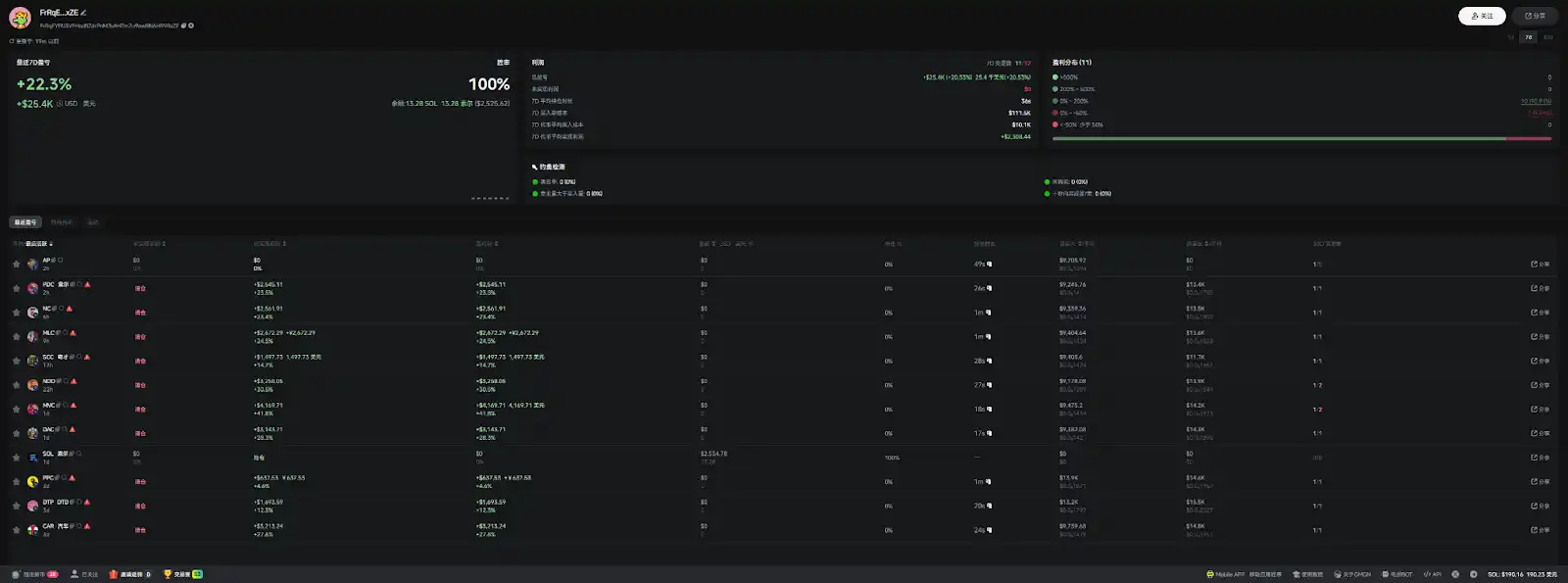
Using this address as an example, FrRqEYFfJ3VEHodfiZdrPnM3vAHTm2u9ewBN6HR9RxZE (hereinafter referred to as "FrRqE") issued 11 MEMEs in nearly 3 days, with a total profit of $25,000 and a 100% success rate.
How was this achieved? Looking at the holding time, each time FrRqE made a buy and sell, the time interval was only a few tens of seconds, with the longest not exceeding 1 minute. Firstly, FrRqE would buy a large amount of the token after the opening, usually around 48 SOL, making it appear to other users on the order book that a whale has entered the token, causing them to quickly follow suit. By this point, FrRqE's holding has exceeded 70%. Then, within a few tens of seconds, he would sell these tokens in one go. The average return rate per trade is about 20% to 30%, with each profit being around $2500.
Of course, as monitoring tools are now very sophisticated, many experienced players will not blindly buy when the developer's holdings are too large.
Therefore, after a single buy-in, FrRqE would quickly disperse these tokens to 400 wallet addresses to evade on-chain bot surveillance. And as more addresses buy in and the amount in the Pump internal pool is about to hit the limit, FrRqE would repeat the process, sending all tokens back to the same address, then sell them all at once, instantly reducing the token balance to zero.
Interestingly, the source of funds for this address seems to want to intentionally conceal something. After conducting hundreds of on-chain penetrations, PANews finally discovered that the funds in this address originally came from the OKX exchange, with the initial receiving address being 3SrXcoKQ97xwFAwELnraHtpuycjGvmG82E9SBGs6UcQd.
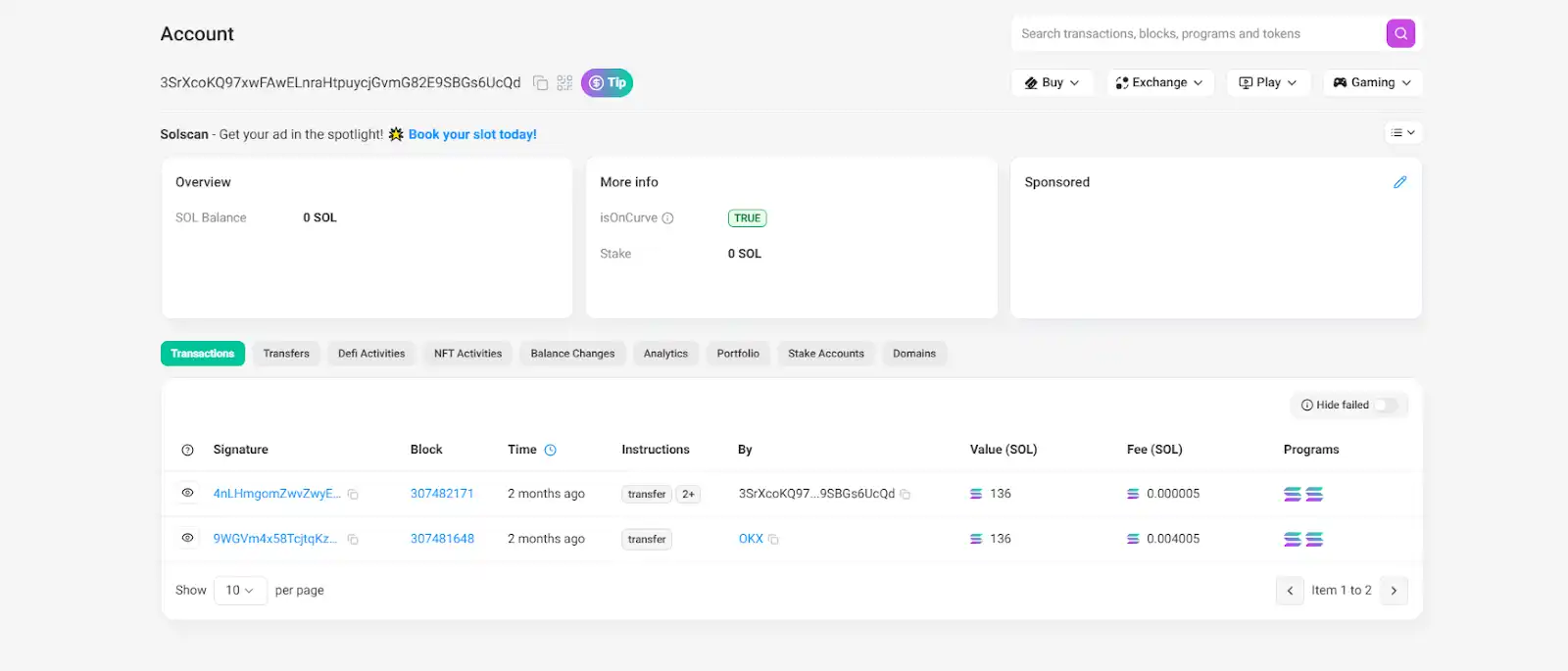
From the operation timeline, it can be seen that this address has been engaged in such activities for over 2 months. Every time an address issues around 10 tokens, the funds are then transferred to a new address to continue the next round of RUG, resulting in hundreds of derivative RUG addresses at present.
Of course, besides these on-chain actions, there is much more that the DEV wanting to complete the RUG must do. For example, these tokens that are pumped internally usually have dozens or even hundreds of replies, and in the early stages, one can still clearly see traces of a large number of bot buys. Both the trading volume and level of discussion make users feel like this project is a typical MEME token.
What is even more frightening is that such tokens are not deliberately discovered by PANews through screening but are accidentally found on the board by randomly clicking on tokens on Pump.fun. For users who frequently invest in MEME, they should often encounter similar RUG schemes.
The operation process of these RUG schemes is not something that an ordinary user can achieve. First, professional address distribution tools and consolidation addresses are needed to complete flexible yet unified token transfer operations. Second, real-time monitoring tools for social media hotspots are needed to ensure that every token issuance is timed with the latest trends. Third, a large number of Pump.fun shills and social media shills are required, such as the X account @r999d999z, created in January 2025, which has promoted FrRqE's token many times, suggesting a complex web of connections between the two. Fourth, dedicated trading bots responsible for building momentum and sending batch transactions. To complete the above steps, perhaps a strong technical and operations team is truly needed.
One in a Thousand Retention Rate, MEME Forest No Longer Welcomes Retail Investors
According to dexscreener's data, in the past six months, among the tokens issued on Pump.fun, the current number of tokens with a market cap still above $50,000 is 1987, with 27 tokens remaining issued for over 1 month. There are 72 tokens issued for over 1 day, and the remaining 1915 were issued in the last 24 hours. Six tokens were issued yesterday. Based on this calculation, on February 13th, there were a total of 49,153 tokens issued on Pump.fun, with a graduation rate of 1.23%, totaling 606 graduating tokens. The proportion of tokens that can still maintain a market value above $50,000 within 1 day after graduation is 0.9%. Looking at the overall values, the probability of a token issued on pump.fun being able to maintain a market value above $50,000 one day after issuance is approximately one in a thousand.
We took the 6 tokens that remained after the February 13 issuance as a research sample to see what characteristics these surviving tokens possess (during the observation process, the data sample decreased from 6 to 4).

Looking at these four tokens, we can summarize several characteristics. First, all these tokens are backed by project tokens or have a clear endorser. Three of them are AI-related project teams, and 1 is a personal token issued by an internet celebrity. Among them, there is no trace of tokens randomly issued by ordinary players.
Second, the LP lockup ratio of these tokens is very high, mostly above 95%, and the lockup amount is above $100,000. Third, the number of followers on social media is all above 2,000, although several account creation times are not long, but due to KOL interaction, their social media scores are also not low.
Overall, the era of PVP seems to have passed, and personally issued tokens in this market are almost unlikely to stand out or achieve a high market value. Many players with issuance experience may have long been aware of this. Against this background, developers who still choose to release a large number of tokens daily obviously have their own unique business strategies. And this dark forest-style gameplay still exists in an unregulated environment.
Fishing in Muddy Waters, Many Players Are Painfully Exiting
The MEME coin race is transitioning from a nationwide angle-seeking casino to a hunting ground where technology and the mainstream target retail investors. Perhaps users sometimes find it difficult to see through the scammers' routines, but as the actual losses gradually increase, more and more users are reluctantly exiting this dark forest.
According to The Block, the trading volume of the Pump.fun token on Solana has recently cooled down, with the average daily trading volume over the past week being only $560 million, hitting a new low since Christmas 2024, a significant 82% drop from the peak of $3.13 billion three weeks ago.
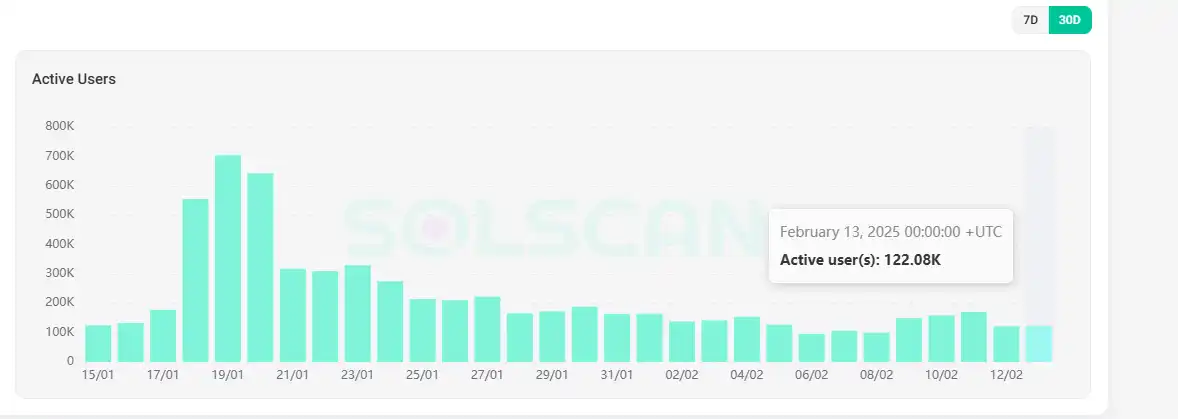
Data on Solana's chain similarly shows a similar trend. In the past three months, on November 16, the number of active wallets on Solana's chain reached 7.22 million, dropping to 3.18 million on February 1, a decrease of more than half. The momentum also quickly declined for aggregators such as Meteora and Jupiter, which had previously surged in popularity due to the TRUMP token.
Even many KOLs whose main business is MEME have claimed that the current environment is no longer suitable for "meme farming." A blogger named Laughing said, "I have completely given up participating in the meme lottery PvP; those who buy lottery tickets can never outplay those who sell lottery tickets".
Arjun Balaji, a researcher at Paradigm, pointed out incisively, "Memecoins used to be fun and pure, but industrialized trenches have turned a harmless PvP game into a predatory game dominated by insider advantage."
Although the market is becoming increasingly harsh, we may still be able to gain some insights from the dual nature of blockchain. On the one hand, due to the unregulated nature of blockchain, it has allowed malicious devs to act recklessly. On the other hand, it is precisely because of the traceability of the blockchain that, no matter how opponents hide, we can always find some clues on the chain. For players who are dedicated to research, once they are familiar with these malicious schemes, they can also avoid similar scams.
In addition, although Pump.fun's token retention rate has dropped to one in ten thousand, players may also choose to bypass the early-stage frenzy and instead focus on tokens that have been issued for more than one day and are still "alive and kicking." Time seems to be the most practical filtering tool. For teams expecting to issue project tokens through MEME, because of this market environment, sincerity has become a simple and effective narrative; bad coins are destroying the market, while good coins will decisively defeat bad coins.
You may also like

Morning Report | BitMine increased its holdings by 126,971 ETH last week; trader Eugene announced his exit from the crypto market

Wang Chuan: How can one not feel anxious after the neighbor Old Wang made thirty times profit by investing in storage stocks? (Seven) - A quarter-century cycle

Cryptocurrency CEXs are flocking to sell US stocks, and traditional brokerages are facing an "uninvited guest."

$75 billion in foreign capital has fled, and South Korean retail investors have absorbed it all using leverage

Japan’s Three Megabanks Plan Joint Stablecoin Issuance in Fiscal 2026
MUFG, SMBC, and Mizuho reportedly plan to jointly issue fiat-pegged stablecoins in fiscal 2026, signaling Japan’s growing push into bank-led digital payment infrastructure.

Humanity Discloses H Token Dual-Chain Attack Details, With Losses on Ethereum and BSC Exceeding $36 Million
Humanity said the H token attack across Ethereum and BSC caused more than $36 million in losses after leaked ProxyAdmin keys enabled malicious contract upgrades and token minting.
White House Discusses CLARITY Act With Law Enforcement Ahead of Senate Vote
The White House discussed the CLARITY Act with law enforcement ahead of a Senate vote, focusing on illicit finance risks and developer protections.

Bitcoin Trading Guide 2026: Strategies for Experienced Traders

What Is XAUT and PAXG? Why Tokenized Gold Is Booming in 2026

Will the SpaceX IPO Hurt Bitcoin? Here's What Traders Are Watching

Foreign selling in the South Korean stock market accelerates, with cumulative net sales reportedly reaching $75 billion this year
On June 9, The Kobeissi Letter, citing Goldman Sachs data, reported that global investors are selling South Korean stocks at an unusually rapid pace. In the latest trading session, foreign investors sold about $801 million worth of Kospi constituent stocks again; total foreign outflows last week reached about $10 billion, and the market has been in net foreign selling on nearly every trading day over the past month. According to the data cited in the report, foreign investors have sold about $75 billion worth of South Korean stocks so far this year. Meanwhile, South Korean retail and institutional investors together recorded roughly $69 billion in net buying over the same period, suggesting that the market’s main buying support has come from domestic capital rather than returning overseas funds. The information currently disclosed still mainly comes from The Kobeissi Letter’s retelling and Goldman Sachs data summaries, while public details on the statistical period and the specific definition of “selling” remain relatively limited.

Fortune Warns of Strategy’s Financing Structure Risks as Bitcoin Premium Narrows
Fortune warned that Strategy’s Bitcoin treasury model faces growing financing risks as MSTR’s net asset premium narrows and preferred stock dividend pressure increases.

Ferrari Challenge Le Mans: Carl Moon to Dominate in WEEX Livery

Sahara AI Responds to SAHARA’s Sharp Drop: No Contract or Product Security Issues Found, Internal Investigation Underway
Sahara AI responded to SAHARA’s 60% price drop, saying no token contract or product security issues have been found and an internal investigation is underway.

WEEX Deposit/Withdrawal Dynamic Island: Your Asset Status, Always in Sight
Scaling Crypto Derivatives: The Digital Asset Infrastructure Behind High-Volume Trading
In the fast-moving digital asset ecosystem, derivatives platforms face an extreme architectural test. High-leverage futures markets demand more than just standard security—they require absolute operational precision, zero-latency matching engines, and ironclad structural scalability, all while navigating intense market volatility.
As global platforms scale to meet these demands, the industry is shifting away from rigid, monolithic setups toward a more agile, "decoupled" infrastructure philosophy.
The Blueprint for High-Volume Copy TradingFor elite global exchanges like WEEX (founded in 2018), this architectural choice becomes critical when scaling high-volume retail features like social copy trading. When thousands of users automatically mirror the real-time strategies of elite traders simultaneously, it triggers sudden, monumental spikes in concurrent transactional volume.
To prevent execution latency or settlement bottlenecks during these peak volatility events, a platform's primary engine must remain entirely dedicated to risk management, copy-trade synchronization, and order matching.
The Architectural Rule: New-generation platforms must separate front-end user execution engines from heavy backend infrastructural overhead to eliminate operational friction.
By separating these layers, platforms can maintain complete sovereignty over their trading environments and user experiences while strategically aligning with institutional-grade infrastructure ecosystems. This strategic framework allows modern exchanges to leverage advanced Digital Asset Custody infrastructure such as Cobo’s behind the scenes, ensuring that backend wallet management scales elastically alongside trading spikes.
Capitalizing on Market Momentum and 400× LeverageIn a derivatives arena where platforms offer up to 400× leverage on perpetual contracts, capital efficiency and market agility are core business metrics. To capture market momentum, an exchange needs the ability to rapidly expand its asset offerings, supporting everything from legacy crypto assets to sudden, trending altcoins across a massive library of trading pairs.
Adopting a flexible, scalable Wallet-as-a-Service (WaaS) solution such as Cobo’s could completely rewrite the development timeline for high-growth exchanges. Instead of spending months of engineering capital building out custom backend wallet architectures for every new blockchain network, platforms can deploy localized infrastructure in days.
This agility allows platforms to instantly scale their listings to over a thousand trading pairs without compromising security or delaying time-to-market. It mirrors the exact operational advantages seen during high-velocity market events, similar to how advanced wallet infrastructure empowers platforms during sudden asset surges; allowing exchanges to pass that speed and liquidity directly to their global user base.
A Mature Foundation for GrowthThe synergy between trusted infrastructure ecosystems and global trading platforms represents the natural evolution of a maturing crypto market. As WEEX continues to scale its global spot and derivatives offerings for over 6 million users, adopting robust backend paradigms proves that platforms no longer have to compromise between cutting-edge trading velocity and uncompromised structural security.

Get Paid to Onboard? Try WEEX’s New Homepage with Rewards for Registration, Deposit & Trade
WEEX Custom Layout: Build Your Perfect Trading Workspace in Seconds
Morning Report | BitMine increased its holdings by 126,971 ETH last week; trader Eugene announced his exit from the crypto market
Wang Chuan: How can one not feel anxious after the neighbor Old Wang made thirty times profit by investing in storage stocks? (Seven) - A quarter-century cycle
Cryptocurrency CEXs are flocking to sell US stocks, and traditional brokerages are facing an "uninvited guest."
$75 billion in foreign capital has fled, and South Korean retail investors have absorbed it all using leverage
Japan’s Three Megabanks Plan Joint Stablecoin Issuance in Fiscal 2026
MUFG, SMBC, and Mizuho reportedly plan to jointly issue fiat-pegged stablecoins in fiscal 2026, signaling Japan’s growing push into bank-led digital payment infrastructure.
Humanity Discloses H Token Dual-Chain Attack Details, With Losses on Ethereum and BSC Exceeding $36 Million
Humanity said the H token attack across Ethereum and BSC caused more than $36 million in losses after leaked ProxyAdmin keys enabled malicious contract upgrades and token minting.


