
The "Ultimate Metric" of Public Blockchain Potential? A Comparison of Solana and Ethereum from the Perspective of REV


Original Article Title: How to Backfill a Narrative on Solana, Ethereum, Memecoins, and REV
Original Article Author: Brendan Farmer, Co-founder at Polygon
Original Article Translation: Ashley, BlockBeats
Editor's Note: The article criticizes Solana's value narrative, arguing that its reliance on Memecoin trading's short-term wealth effect is not sustainable and carries structural risks. Solana's success may be more driven by speculation rather than technical superiority, while Ethereum continues to grow steadily in the DeFi space. The author reminds readers to maintain a critical perspective on the narratives in the crypto space and avoid being misled by market hype.
Below is the original content (slightly rearranged for better readability):
The role of thought leaders in the crypto space is to tell stories, explaining why the value of certain coins is rising or falling. The line on a chart going up and down is never just a line; it's part of a larger trend in technology or economics. These "backfilled narratives" can be attention-grabbing (such as "digital gold" or "world computer") or less appealing (such as "Play-to-Earn is the future of work"), but it's crucial to critically examine how each narrative shapes the world—and who benefits from this shaping.
The blue-collar workers in the narrative factory, the venture capitalists, have been working overtime to explain why ETH has underperformed compared to BTC and SOL. Some of these arguments are not controversial: the Ethereum community should achieve better consensus on the shared direction, reevaluate its technical assumptions, or simply do better.
This article argues that a specific narrative about Solana and Ethereum is incorrect. This story goes something like this: Solana has outperformed Ethereum on the blockchain's most crucial economic metrics, especially in decentralized exchange (DEX) trading volume and REV (Real Economic Value = MEV + Transaction Fees, a metric measuring protocol cash flow).
According to this narrative, Solana's lead in REV comes from its technical superiority and traction in multiple application categories. SOL's value can be evaluated based on the expected future REV, which is more advantageous than ETH because ETH can only be valued based on "sentiment" or "monetary attributes."
But this is just one narrative. Solana's REV is entirely generated by Memecoin trading, making it difficult to assess SOL's value based on future cash flow. Moreover, the dominance of Memecoins has brought structural risks to Solana.
Tracking REV
Over the past year and a half, the SOL/ETH ratio has increased by about 10x. Whenever we see such price volatility, we know it's time to craft a new narrative.
We can tell a story like this: Solana has more advanced technology, users love it, all kinds of top developers — including DePIN, DeFi, payments, and of course, meme coins — have all shifted to Solana.
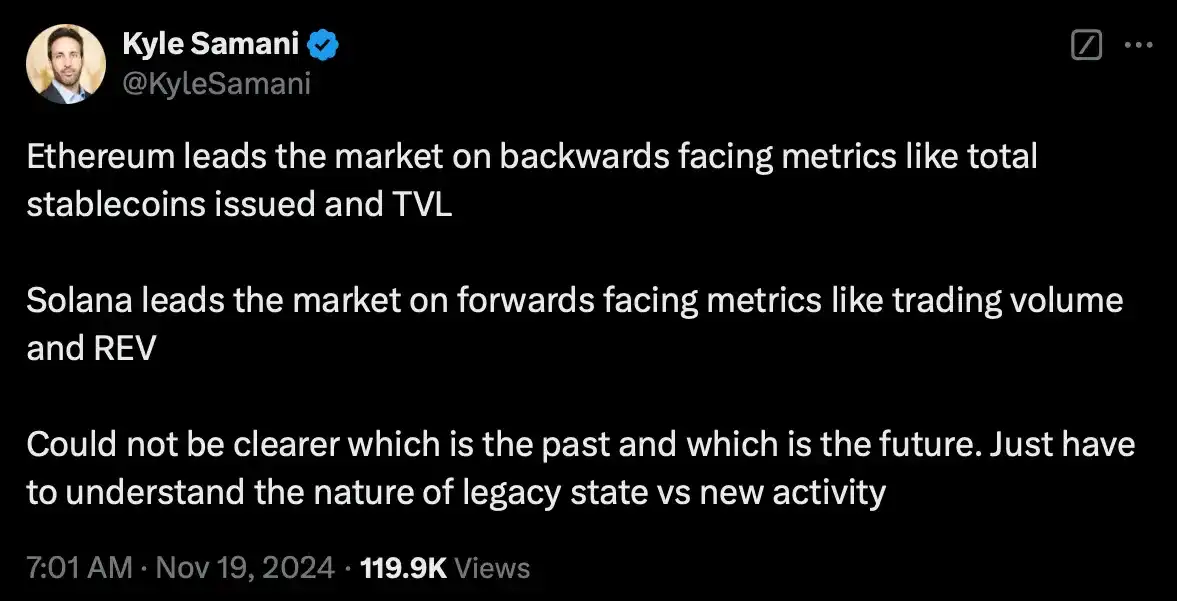
Venture capitalists would argue that this massive talent migration has brought massive growth in key metrics such as REV, trading volume, and application revenue. The narrative is that SOL doesn't need to become a currency or commodity like ETH because its market value will ultimately be validated by a reasonable multiple of actual revenue, not some kind of meme culture nonsense.
If you want to see how Solana is performing, the data speaks for itself.

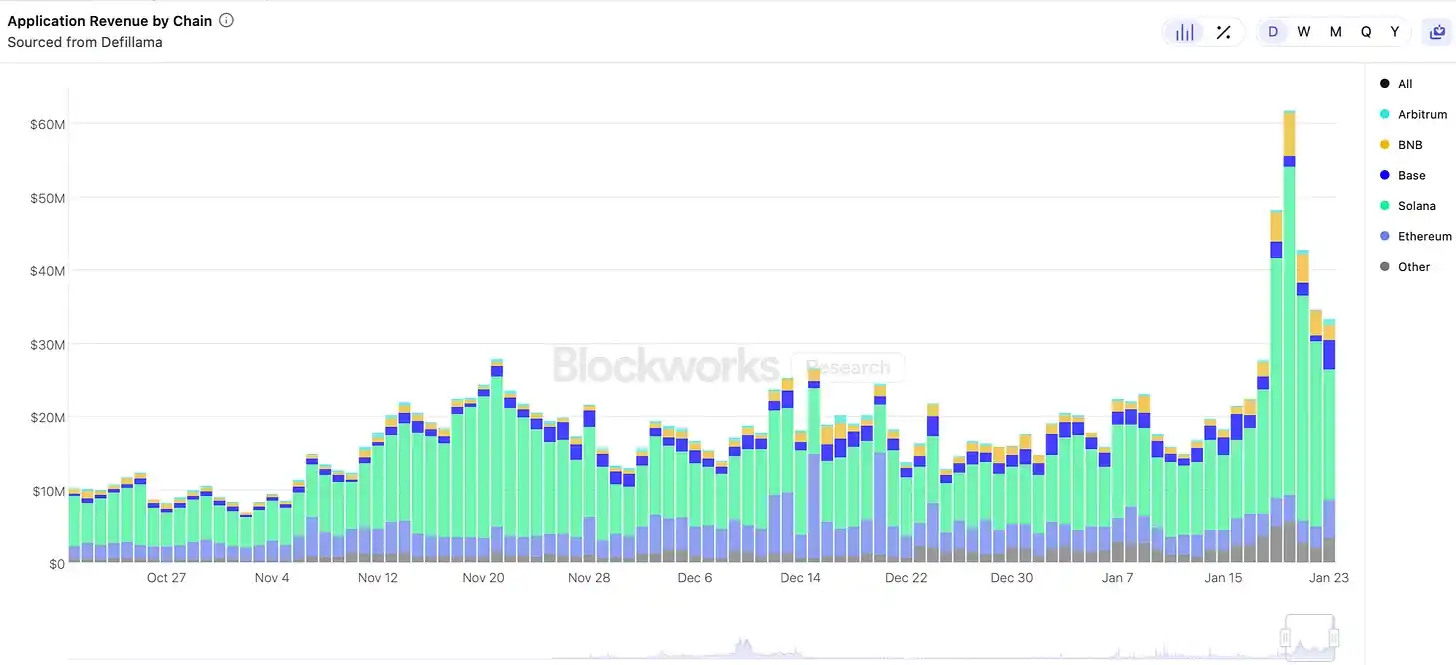
This is a great narrative.
But to play devil's advocate, let's see where REV really comes from.
Could it be a brilliant mix of all the top crypto apps? Innovative DePINs like Helium, a CLOB building a decentralized Nasdaq, stablecoin payment volume, complex DeFi transactions, and of course, maybe a part from meme coins, right?
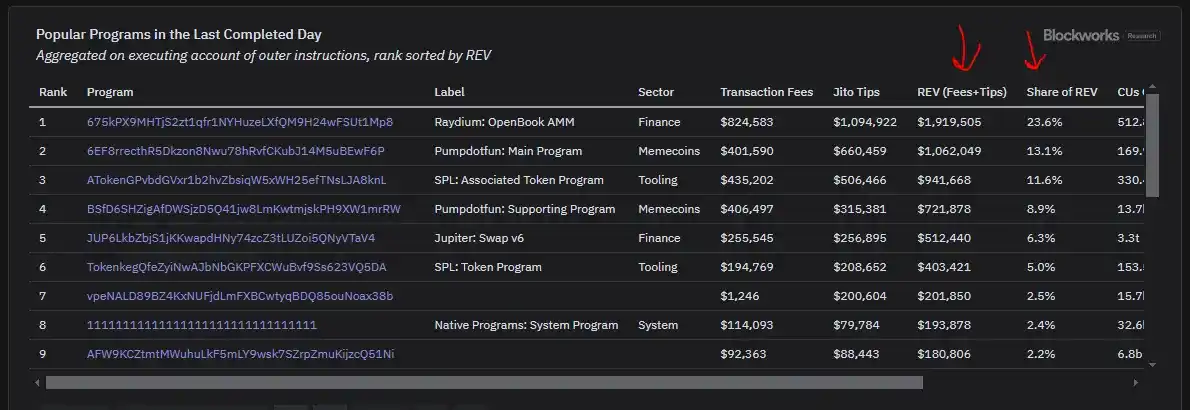
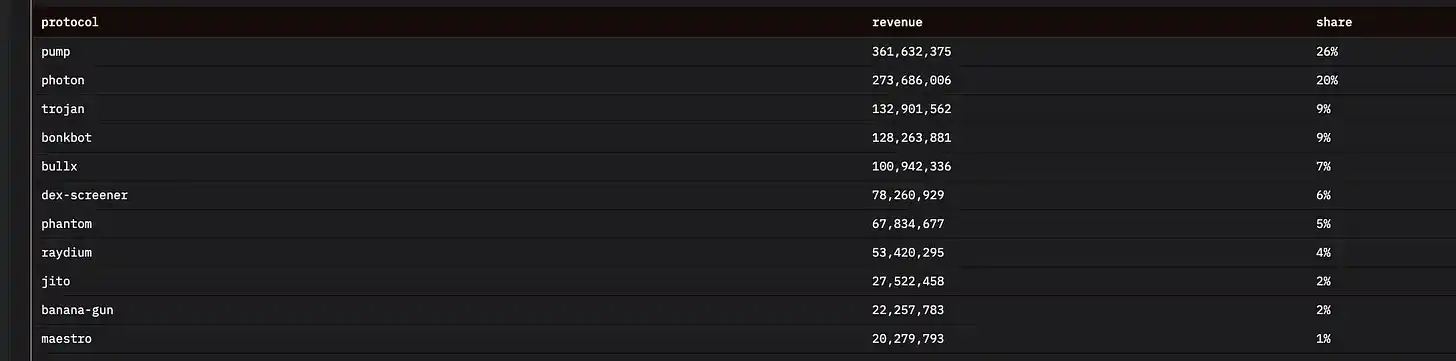
Hold on — are all these just pump.fun and a bunch of Telegram bots used for meme coin trading?
Where are the groundbreaking apps? What about DePINs? Where is the global price discovery of events happening in Singapore or London? Where are the top-tier, IMO award-winning developers?
Are we increasing bandwidth and reducing latency for Bot trading $BUTTHOLE?!
Building a Decentralized "Casino"
This article is not a discussion of the merits of Meme coins. Meme coins may be a good way to onboard users to a crypto protocol and transfer wealth from "ignorant market participants" to savvy liquidity providers.
However, Solana's REV is entirely derived from Meme coin trading, posing a structural problem for assessing SOL's value based on future REV.
Let's craft our own narrative. Post FTX explosion, SOL was oversold, but Solana still managed to present a compelling story to institutional capital allocators. It has a pragmatic expansion roadmap and is culturally understandable to investors familiar with Silicon Valley tech startups.
With successful marketing of SOL, the price surged. This created a wealth effect, which is a wonderful thing in the crypto space. It's a form of financial alchemy where token price appreciation (largely unrelated to the tech) translates into on-chain activity (seemingly driven by more advanced tech).
You can think of the wealth effect as a pressure cooker full of funds, being heated, with the only way to release pressure being capital flowing into stupider and riskier assets, like CryptoDickButts or this:
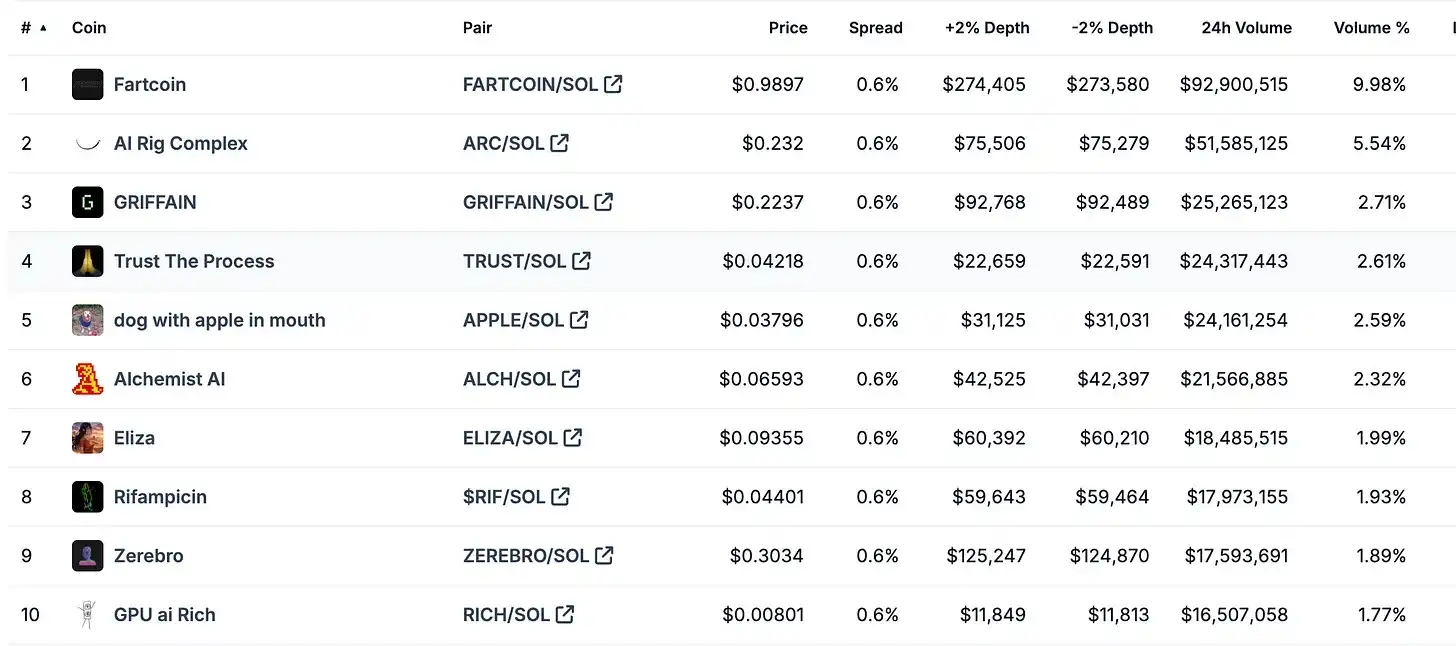
As activity increases, thought leaders can fill a compelling narrative, drive SOL's price up, and create more activity. Apps release tokens, inject more capital into the system (e.g., Jito effectively airdropped a new car to everyone in Solana DeFi). We can call it the flywheel effect.
According to our narrative, the reason Meme coin activity has erupted on Solana (rather than other equally scalable L1 or L2 solutions) is primarily due to SOL's wealth effect. Solana's low transaction fees are a necessary condition, but a wealth effect is needed to propel Meme coin mania to its current scale.

Time is a Circle

All of this has happened before. If we look back at 2020-2021, we will see the astounding growth of REV on Ethereum. In the previous bull market, ETH holders' newfound wealth flowed into increasingly volatile on-chain assets, such as NFTs and Meme coins.
Highly speculative assets often tend to generate excessive REV as users are willing to pay higher priority fees and MEV rates to gain exposure to volatile opportunities. The value of Meme coin transactions heavily relies on their position in the block, allowing block proposers who control the ordering to extract more value. This has brought protocols a higher cut of the pie compared to other forms of on-chain activity.
However, we can see that as the market cycle shifts, the highly speculative activity on Ethereum (in NFTs and Meme coins) has waned. Using 2021 Ethereum REV as an estimate for future REV is fundamentally flawed.
Meme Coin REV Won't Last (Nor Will It Save You)
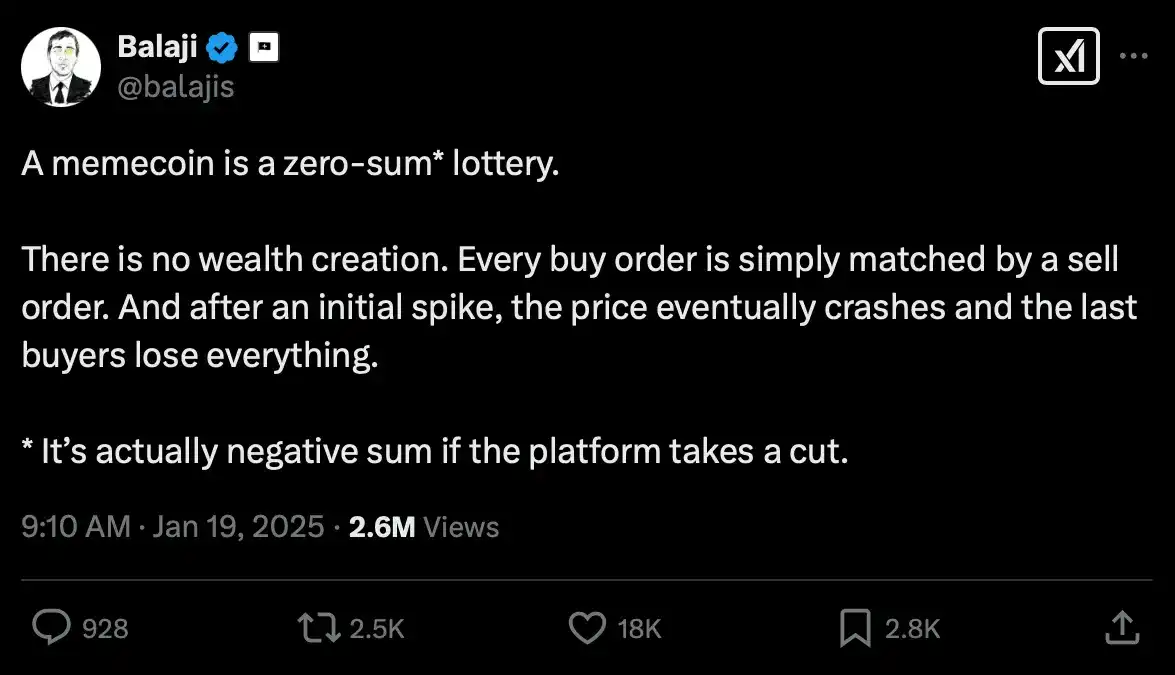
Just as the REV generated by Meme coins on Ethereum is unsustainable, it won't be sustainable on Solana either. While Meme coins may be fun, Meme coin speculation is a zero-sum game.
The fees and MEV paid by Meme coin gamblers are exorbitant compared to other forms of gambling, ultimately leading gamblers to deplete their funds. While high fees and MEV may benefit REV, in a zero-sum game, they don't create any economic value, and the consequence is that they siphon liquidity from the ecosystem. Every dollar of REV paid signifies a reduction in funds available for future Meme coin transactions, resulting in decreased future REV.

Therefore, it's challenging to argue that the growth of REV will continue, ultimately proving that SOL's market cap is justified.
SOL's FDV (approximately $150 billion) compared to the 2024 REV ($1.4 billion) ratio is about 100:1. If we are generous and based on Q4 REV ($825 million) annualized, we get a ratio of 45:1. While this is an improvement, it still assumes that Meme coin transaction volume will grow over time. Given that this is unlikely (see ETH in the previous market cycle, where REV dropped from $10 billion to $2.6 billion), it is challenging to justify SOL's valuation based on expected future REV.
The popular rebuttal is that Solana will simply scale its block space by 10x or 100x, while REV will scale proportionally.
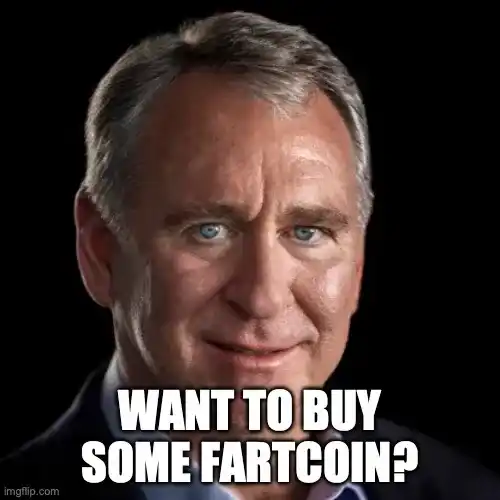
The issue is that even if Solana can increase throughput by 100x, it would struggle to find 100x more innocent order flow willing to be "front-run" — buying Meme coins through sandwich attacks and sniper bots, except in Ken Griffin's most twisted fantasies?
In order for Meme coin trading volume to continue to grow and compress SOL's P/E ratio, we need SOL's price to rise to enhance the wealth effect. But this goes against the purpose; we're trying to compress the P/E ratio, not expand or maintain it.
Other applications such as DeFi, DePIN, and payment apps will not generate the same amount of REV per unit of block space. For example, a complex trader lending out blue-chip assets to earn 10%, or a gamer playing a game, may consume a similar amount of block space but generate far less REV than a Meme coin trade.
「Mercenary」 Memecoin
Meme coin trading volume also tends to follow the wealth effect of new tokens moving to a new chain.
You might think that the reason for Memecoin issuance moving from Ethereum to Solana is that Solana is more scalable, better for trading, and its technical advantages mean it will continue to be a hotbed of degenerate gambling. This is not the so-called "decentralized Nasdaq," but as a crazy speculative hub, it is at least worth something.
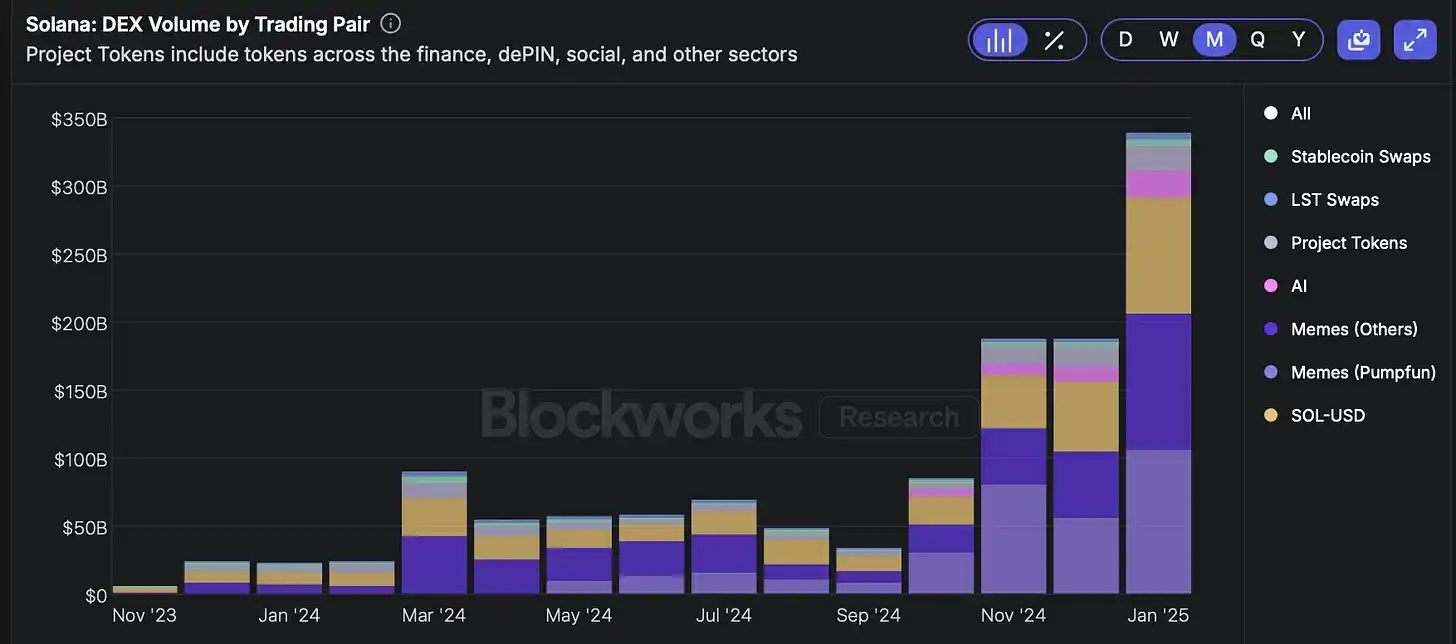
This overlooks that the direct cause of the Memecoin frenzy is the SOL wealth effect. For instance, by the end of 2023, BONK's price and volume closely followed SOL. We can see a similar situation with decentralized exchange (DEX) trading volumes, especially Meme coin trading volumes, until March 2024 when SOL rebounded 10x from the lows after the FTX collapse, and Memecoin trading started to surge.
With the launch of new chains, especially high-performance L2s (such as MegaETH and Rise), these chains may provide a better trading venue for Memecoin traders. These chains will kickstart with new tokens and new wealth.
They may not be decentralized, nor will they synchronize global information at the speed of light, but the talent transacting $FARTCOIN doesn't care— the risk they take on in Memecoin gambling far outweighs any risk of decentralization. L2 can offer lower latency, better performance, and a higher transaction success rate, making it a better trade-off.
What About Ethereum?
The narrative around REV growth on Solana has also been used to advocate for a transformation of Ethereum. The implicit argument is that Ethereum must scale in order to regain lost activity (and REV). Given that Solana's activity is entirely driven by Memecoin, this point is not logical. Increasing L1 execution by 5x or 10x will not bring Memecoin back to Ethereum L1; Solana still offers lower fees and a stronger short-term wealth effect.
If DeFi had indeed largely migrated to Solana, we should have seen a significant drop in Ethereum's transaction volume. However, Ethereum's DEX volume in December 2023 remains at 10%-20% of the historical peak monthly volume, even during the bull market of 2021/22 when ETH price volatility was higher, and NFT and Memecoin volumes were much higher than they are now.
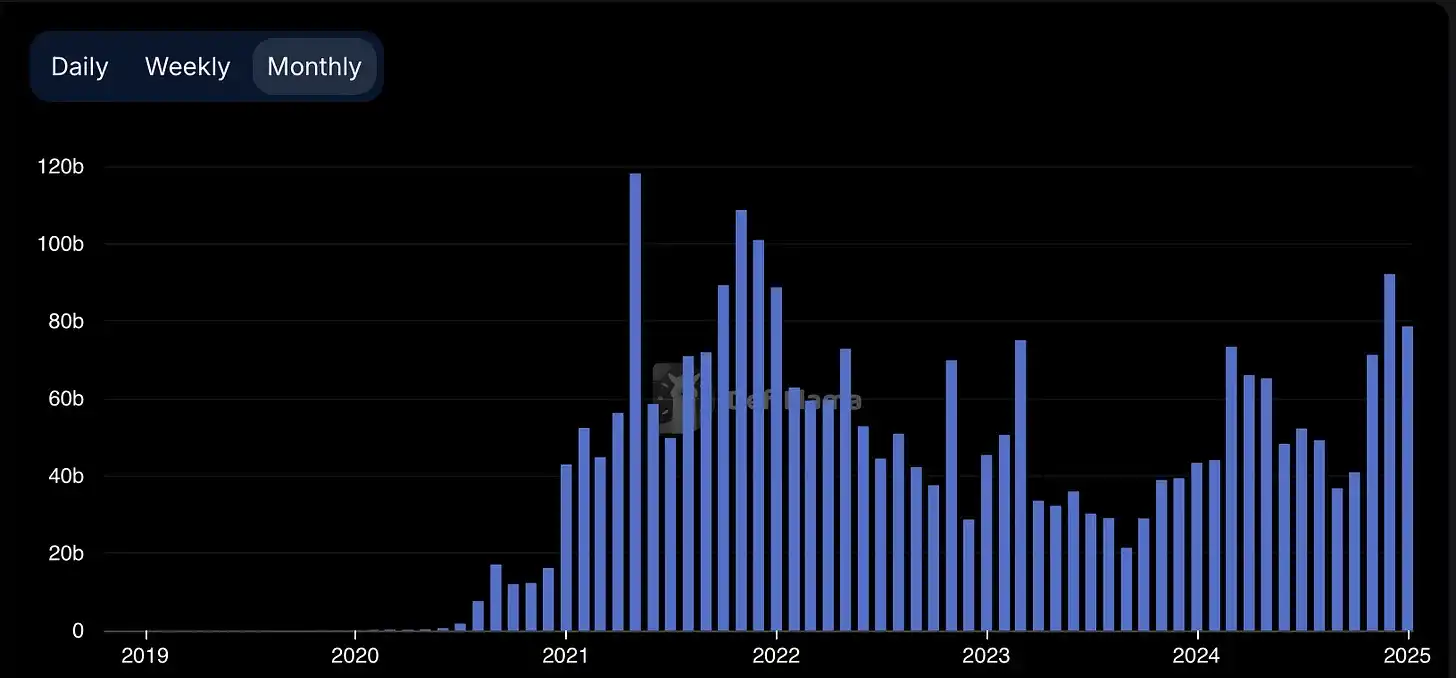
This supports the view that there are different categories of DeFi users. While Memecoin traders are increasingly flocking to Solana, substantial funds still remain on Ethereum. Referencing REV or DEX volume as evidence of Solana's dominance in DeFi is misleading.
If we use DeFi TVL as a metric to gauge activity types on each network, we can see that Ethereum's TVL is 6 times that of Solana (despite ETH's price weakness), indicating different qualities of activity on Ethereum compared to Solana. From a DeFi perspective, Memecoin is almost useless; by the way, what are the collateral requirements for a $BUTTHOLE loan?
A counterargument is that almost all on-chain activities are purely speculative, so labeling Ethereum's activity as not tethered to real economic activity while only considering Solana's activity as Memecoin transactions is somewhat disingenuous. My initial reaction is: it is advisable not to express such views for the benefit of the industry.
More seriously, while Solana leads in REV, Ethereum clearly boasts a more mature and vibrant DeFi ecosystem, as it exhibits strong TVL and activity even without a plethora of Memecoin issuance.
The Rollup Central Roadmap Rebuttal
We have argued that SOL's value cannot be proven by future expected REV. Currently, SOL is still vying with BTC and ETH to become the first link in crypto asset capital flow.
However, Memecoin presents another structural challenge to Solana's long-term viability, as Memecoin traders are more suited for L2 transactions.
L2 can perform high-throughput operations with extremely low latency. They can respond more quickly to issues and downtimes, without the decentralized coordination overhead. They can more easily filter out spam transactions.
You might think that Solana's high-performance client is a lasting advantage, but open-source tech always likes to be commoditized. Ironically, when venture capitalists cite Solana's technical edge over Ethereum, teams like Eclipse and Atlas have already deployed SVM L2 on Ethereum.
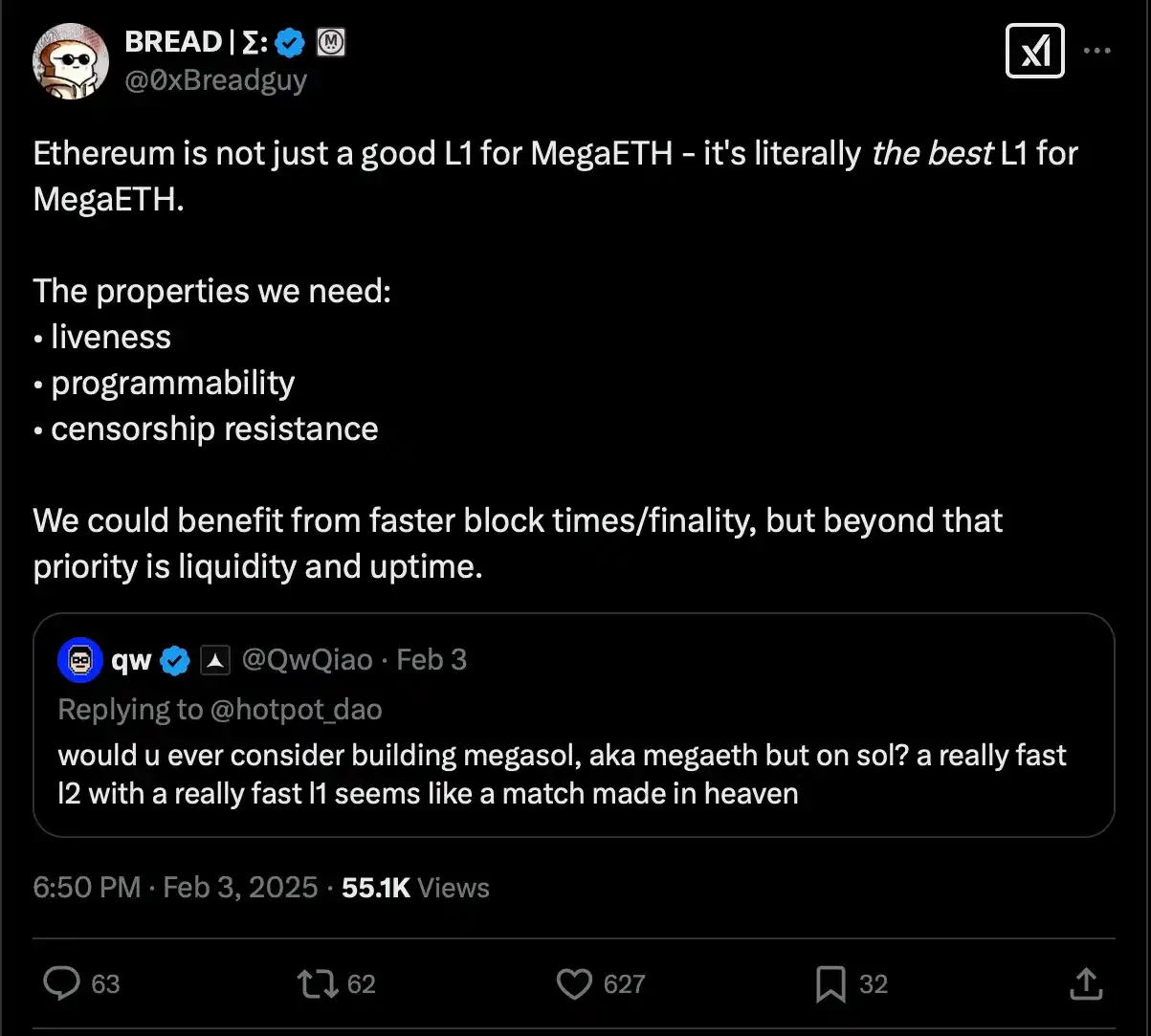
Ethereum's liquidity and TVL make it a better platform for L2. Additionally, Ethereum has explicitly struck a balance between performance and availability, which is a better choice for L2 since L2 does not require high throughput on L1. The worst-case scenario for L2 is when L1 goes offline, rendering transactions or bridging incomplete.
This poses a real risk for Solana as its REV growth is entirely driven by highly cyclical activity, which could be better served by other chains.
Conclusion
Solana's optimistic scenario is that it is currently in the same place as Ethereum in 2021; ultimately, activity will bring about a more mature DeFi ecosystem. But this is not a guarantee.
DeFi activity on Ethereum is dominated by fee-insensitive whales who prioritize decentralization, availability, and security. One can imagine a world where retail users trade Memecoin on Unichain, while whales trade UNI on Ethereum. L2 can provide a better environment for Memecoin and long-tail crypto assets, while Ethereum caters to whales, as it prioritizes activity over raw performance.
Solana's pessimistic scenario, on the other hand, is that it has not truly succeeded in following its own North Star of building a decentralized Nasdaq. Traders care about latency and guaranteed transaction execution. During volatility, it is hard to get transactions included on Solana, and the latency cannot compete with (more centralized) L2.
More accurately, Solana is successfully building a decentralized "casino," a place designed to maximize volatility and risk exposure for traders looking to cash in on short-term wealth effects.
As the Memecoin craze subsides, this may morph into a new form of gambling, but that seems unlikely because gamblers care less about Solana's advantages over L2 and more about L2's advantages over Solana.
But I digress. In the crypto space, it is very easy to fill the narrative supporting a particular viewpoint (and bagholding). This is especially easy when your story includes compelling technology and activity driven by speculative frenzy. However, precisely because of this, we should be skeptical of heavily biased storytellers.
I believe Ethereum's openness to critics has actually done it a disservice. This includes the story about REV and the comparison to Solana's economic metrics, but more importantly, the debate about value accrual and L2 as Ethereum L1 parasites. Hopefully, I will discuss this in future posts.
Disclaimer: This article has been sitting in the drafts folder for a few months, so it does not cover $TRUMP, $MELANIA, or recent market sell-offs. These do not materially impact the argument, so they were not addressed.
Original article link: 「Original Article Link」
You may also like

Japan’s Three Megabanks Plan Joint Stablecoin Issuance in Fiscal 2026
MUFG, SMBC, and Mizuho reportedly plan to jointly issue fiat-pegged stablecoins in fiscal 2026, signaling Japan’s growing push into bank-led digital payment infrastructure.

Humanity Discloses H Token Dual-Chain Attack Details, With Losses on Ethereum and BSC Exceeding $36 Million
Humanity said the H token attack across Ethereum and BSC caused more than $36 million in losses after leaked ProxyAdmin keys enabled malicious contract upgrades and token minting.

White House Discusses CLARITY Act With Law Enforcement Ahead of Senate Vote
The White House discussed the CLARITY Act with law enforcement ahead of a Senate vote, focusing on illicit finance risks and developer protections.

$75 billion in foreign capital has fled, and South Korean retail investors have absorbed it all using leverage

Bitcoin Trading Guide 2026: Strategies for Experienced Traders

What Is XAUT and PAXG? Why Tokenized Gold Is Booming in 2026

Cryptocurrency CEXs are flocking to sell US stocks, and traditional brokerages are facing an "uninvited guest."

Will the SpaceX IPO Hurt Bitcoin? Here's What Traders Are Watching
Foreign selling in the South Korean stock market accelerates, with cumulative net sales reportedly reaching $75 billion this year
On June 9, The Kobeissi Letter, citing Goldman Sachs data, reported that global investors are selling South Korean stocks at an unusually rapid pace. In the latest trading session, foreign investors sold about $801 million worth of Kospi constituent stocks again; total foreign outflows last week reached about $10 billion, and the market has been in net foreign selling on nearly every trading day over the past month. According to the data cited in the report, foreign investors have sold about $75 billion worth of South Korean stocks so far this year. Meanwhile, South Korean retail and institutional investors together recorded roughly $69 billion in net buying over the same period, suggesting that the market’s main buying support has come from domestic capital rather than returning overseas funds. The information currently disclosed still mainly comes from The Kobeissi Letter’s retelling and Goldman Sachs data summaries, while public details on the statistical period and the specific definition of “selling” remain relatively limited.

Fortune Warns of Strategy’s Financing Structure Risks as Bitcoin Premium Narrows
Fortune warned that Strategy’s Bitcoin treasury model faces growing financing risks as MSTR’s net asset premium narrows and preferred stock dividend pressure increases.

Ferrari Challenge Le Mans: Carl Moon to Dominate in WEEX Livery

Sahara AI Responds to SAHARA’s Sharp Drop: No Contract or Product Security Issues Found, Internal Investigation Underway
Sahara AI responded to SAHARA’s 60% price drop, saying no token contract or product security issues have been found and an internal investigation is underway.

WEEX Deposit/Withdrawal Dynamic Island: Your Asset Status, Always in Sight
Scaling Crypto Derivatives: The Digital Asset Infrastructure Behind High-Volume Trading
In the fast-moving digital asset ecosystem, derivatives platforms face an extreme architectural test. High-leverage futures markets demand more than just standard security—they require absolute operational precision, zero-latency matching engines, and ironclad structural scalability, all while navigating intense market volatility.
As global platforms scale to meet these demands, the industry is shifting away from rigid, monolithic setups toward a more agile, "decoupled" infrastructure philosophy.
The Blueprint for High-Volume Copy TradingFor elite global exchanges like WEEX (founded in 2018), this architectural choice becomes critical when scaling high-volume retail features like social copy trading. When thousands of users automatically mirror the real-time strategies of elite traders simultaneously, it triggers sudden, monumental spikes in concurrent transactional volume.
To prevent execution latency or settlement bottlenecks during these peak volatility events, a platform's primary engine must remain entirely dedicated to risk management, copy-trade synchronization, and order matching.
The Architectural Rule: New-generation platforms must separate front-end user execution engines from heavy backend infrastructural overhead to eliminate operational friction.
By separating these layers, platforms can maintain complete sovereignty over their trading environments and user experiences while strategically aligning with institutional-grade infrastructure ecosystems. This strategic framework allows modern exchanges to leverage advanced Digital Asset Custody infrastructure such as Cobo’s behind the scenes, ensuring that backend wallet management scales elastically alongside trading spikes.
Capitalizing on Market Momentum and 400× LeverageIn a derivatives arena where platforms offer up to 400× leverage on perpetual contracts, capital efficiency and market agility are core business metrics. To capture market momentum, an exchange needs the ability to rapidly expand its asset offerings, supporting everything from legacy crypto assets to sudden, trending altcoins across a massive library of trading pairs.
Adopting a flexible, scalable Wallet-as-a-Service (WaaS) solution such as Cobo’s could completely rewrite the development timeline for high-growth exchanges. Instead of spending months of engineering capital building out custom backend wallet architectures for every new blockchain network, platforms can deploy localized infrastructure in days.
This agility allows platforms to instantly scale their listings to over a thousand trading pairs without compromising security or delaying time-to-market. It mirrors the exact operational advantages seen during high-velocity market events, similar to how advanced wallet infrastructure empowers platforms during sudden asset surges; allowing exchanges to pass that speed and liquidity directly to their global user base.
A Mature Foundation for GrowthThe synergy between trusted infrastructure ecosystems and global trading platforms represents the natural evolution of a maturing crypto market. As WEEX continues to scale its global spot and derivatives offerings for over 6 million users, adopting robust backend paradigms proves that platforms no longer have to compromise between cutting-edge trading velocity and uncompromised structural security.

Morning Report | BitMine increased its holdings by 126,971 ETH last week; trader Eugene announced his exit from the crypto market

Wang Chuan: How can one not feel anxious after the neighbor Old Wang made thirty times profit by investing in storage stocks? (Seven) - A quarter-century cycle

Get Paid to Onboard? Try WEEX’s New Homepage with Rewards for Registration, Deposit & Trade
WEEX Custom Layout: Build Your Perfect Trading Workspace in Seconds
Japan’s Three Megabanks Plan Joint Stablecoin Issuance in Fiscal 2026
MUFG, SMBC, and Mizuho reportedly plan to jointly issue fiat-pegged stablecoins in fiscal 2026, signaling Japan’s growing push into bank-led digital payment infrastructure.
Humanity Discloses H Token Dual-Chain Attack Details, With Losses on Ethereum and BSC Exceeding $36 Million
Humanity said the H token attack across Ethereum and BSC caused more than $36 million in losses after leaked ProxyAdmin keys enabled malicious contract upgrades and token minting.
White House Discusses CLARITY Act With Law Enforcement Ahead of Senate Vote
The White House discussed the CLARITY Act with law enforcement ahead of a Senate vote, focusing on illicit finance risks and developer protections.
$75 billion in foreign capital has fled, and South Korean retail investors have absorbed it all using leverage
Bitcoin Trading Guide 2026: Strategies for Experienced Traders
What Is XAUT and PAXG? Why Tokenized Gold Is Booming in 2026


