
Vitalik's New Article: Substantial L1 Expansion Still Valuable, Will Make Application Development Easier and Safer

Original Title: Reasons to have higher L1 gas limits even in an L2-heavy Ethereum
Original Author: vitalik
Original Source: vitalik Personal Blog
Translation: Mars Finance, Daisy

An important short-term discussion in the Ethereum roadmap is how much the L1 gas limit should be raised. Recently, the L1 gas limit has been increased from 30 million to 36 million, increasing network capacity by 20%. Many people support further substantial increases in this limit in the near future. These increases are made feasible by recent and upcoming technical improvements, such as efficiency improvements in Ethereum clients, the EIP-4444 proposal to reduce the storage requirements for historical data (see roadmap), and future stateless client technology.
However, before taking this step, we need to consider a key question: in a rollup-centric development path, is raising the L1 gas limit long-term the right choice? Gas limits are easy to raise but extremely difficult to lower—even if lowered in the future, the decentralization impact may be permanent. If excessive L1 usage poses centralization risks, and we are not sure this usage brings enough benefits, it would be an undesirable outcome.
This article will argue that even in a world where most users and applications run on L2, significantly expanding L1 still has value because it will simplify and secure the application development process.
This article will not attempt to argue whether more applications should run on L1 long-term. Instead, the goal of this article is to argue that regardless of the outcome of this debate, a roughly 10x expansion of L1 has significant value in the long run.
Censorship Resistance

Aim for censorship resistance
Mars Finance Note: The text in the illustration is from the novel "1984" - "War is peace, freedom is slavery, ignorance is strength"
One of the core values of blockchain is censorship resistance: if a transaction is valid and a user can pay the market-rate gas fee, then that transaction should be reliably and quickly included on-chain.
In some cases, censorship resistance needs to take effect on a very short time scale. For example, users holding positions in a DeFi protocol may face liquidation if the market price experiences rapid fluctuations, even if the on-chain transaction latency is only 5 minutes.
The decentralization of L1 validators (stakers) makes prolonged censorship of transactions extremely challenging, usually allowing at most a few blocks to delay transactions. There are currently proposals to further enhance Ethereum's censorship resistance to ensure that even if the block building process becomes highly centralized and outsourced, transactions can still be smoothly processed on-chain.
In contrast, L2 relies on relatively more centralized block producers or sequencers, who can easily choose to censor specific user transactions. Some L2 solutions (such as Optimism and Arbitrum, as detailed in their official documentation) provide a force-inclusion mechanism that allows users to submit transactions directly through L1. However, the practicality of this mechanism depends on two key factors:
The L1 transaction fees are low enough for users to afford the cost of submitting transactions directly on L1; L1 has enough block space so that even if L2 heavily censors user transactions, L1 can accommodate transactions submitted directly to bypass L2.
Therefore, increasing L1 capacity not only reduces costs but also enhances L2 users' ability to respond to censorship, ensuring that the core value of blockchain—censorship resistance—is maintained.
Basic Mathematical Assumptions
We can estimate the actual cost of using the force-inclusion mechanism through some mathematical calculations. First, let's outline some assumptions that we will reuse in other sections:
The current cost of an L1 → L2 deposit transaction is approximately 120,000 L1 gas. This is an example from Optimism. A minimal L1 operation, such as changing the value of a storage slot, costs 7,500 L1 gas (cold SSTORE plus the address's calldata cost, plus some computation cost). The ETH price is $2,500. The gas price is 15 gwei, which is a reasonable long-term average approximation. The demand elasticity is close to 1 (i.e., when the gas limit doubles, the price halves). This point has received some support in previous data analysis, but we should be aware that the actual elasticity may vary in both directions. We aim for the cost of responding to an attack to be less than $1. The cost of "normal" operations should not exceed $0.05 per transaction. Operations falling between the two, such as key changes, should be below $0.25. This is clearly a subjective value judgment.
Based on these assumptions, the cost of bypassing censorship today is: 120000 * 15 * 10**-9 * 2500 = $4.5
In order to bring this below the target, we need to scale L1 by a factor of 4.5 (although it is important to note that this is a very rough estimate, as elasticity is hard to estimate and even absolute usage levels are hard to predict).
Asset Transfer Between L2s Needed
Users often need to transfer assets from one L2 to another. For common, high-volume assets, the most practical method is to use an intent protocol (such as ERC-7683). In fact, only a small number of market makers need to transfer assets directly between two L2s; other users merely trade with the market makers. However, for low-volume assets or NFTs, this approach is not feasible, so to transfer these assets from one L2 to another L2, individual users need to send transactions through L1.
Currently, the cost of withdrawing from an L2 is about 250,000 L1 gas, and the deposit cost is 120,000 L1 gas. In theory, this process can be significantly optimized. For example, to transfer an NFT from Ink to Arbitrum, the underlying ownership of the NFT must be bridged from the Ink to the Arbitrum bridge, which occurs on L1. This is a one-time storage operation, costing approximately 5000 gas. The other operations are essentially calls and proofs, which can be cost-controlled as long as there is appropriate logic; assuming a total cost of 7500 gas.
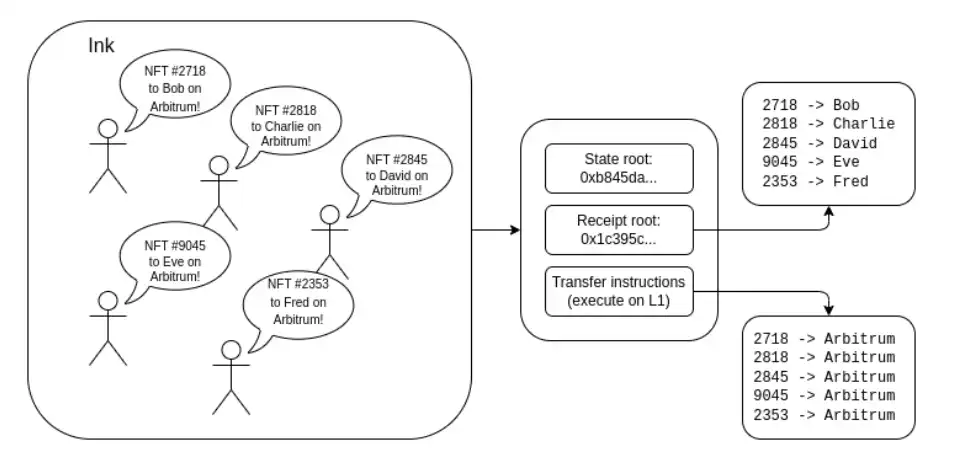
Let's calculate the costs for these two scenarios.
Current Scenario: 370000 * 15 * 10**-9 * 2500 = $13.87
Ideal Design: 7500 * 15 * 10**-9 * 2500 = $0.28
Our ideal target is $0.05, so this means L1 needs to scale by approximately 5.5 times.
Alternatively, we can also analyze more directly based on capacity. Suppose each user needs to perform a cross-L2 NFT (or rare ERC20) transfer once a month on average. Ethereum's total gas capacity per month is: 18,000,000×(1286,400×30) = 3.88 trillion gas, enough to support 5.18 billion such transfers. Therefore, if Ethereum wants to serve global users (assuming Facebook's user base is 3.1 billion), it needs to scale capacity by about 6 times, and this is just one scenario for L1 use.
L2 Mass Exit
An important feature of L2 is its ability to allow users to exit to L1 in case of L2 failure, a functionality not available in Alt L1s. But what if all users cannot successfully exit within a week? For an optimistic rollup, this might not be a big issue: as long as there is one honest prover, malicious state roots can be prevented from getting confirmed. However, in a Plasma system, if data becomes unavailable, exits usually need to be completed within a week. Even in an optimistic rollup, if a hostile governance upgrade occurs, users will have a 30-day window to withdraw assets (see: Phase 2 definition).
What does this mean? Let's assume a Plasma chain experiences a failure, and the exit cost is 120,000 gas. So, how many users can complete the exit within a week? We can calculate: 86400 * 7 / 12 * 18000000 / 120000 = 7.56 million users.
If it's an optimistic rollup with a hostile 30-day governance delay, the number increases to 32.4 million users. Suppose a large-scale exit protocol can be created to allow a large number of users to exit simultaneously. If we push efficiency to the limit, where each user only needs to perform one SSTORE operation and some additional computation (i.e., 7500 gas), then the two numbers increase to 121 million and 518 million users respectively.
Today, Sony has an L2 on Ethereum, and PlayStation has about 116 million monthly active users. If these users all become Soneium users, the current Ethereum may not be scalable enough to support a large-scale exit event. However, with a smarter large-scale exit protocol implementation, it might just manage.
If we wish to avoid technically complex hash commit protocols, we may need to reserve 7500 gas per asset. I have 9 high-value assets in my Arbitrum main wallet; using this as an estimate, L1 may need to scale by about a factor of 9.
Another concern for users is that even if L1 scales securely enough, they may lose a significant amount of funds due to extremely high gas costs.
Let's analyze the exit gas cost and compare it with the existing and "ideal" exit costs:
Current Situation: 120000 * 15 * 10**-9 * 2500 = $4.5
Ideal Situation: 7500 * 15 * 10**-9 * 2500 = $0.28
However, the issue with these estimates is that in the case of a large-scale exodus, everyone would attempt to exit simultaneously, causing the gas cost to increase significantly. We have already seen days where the average daily gas cost on L1 exceeded 100 gwei. Taking 100 gwei as a benchmark, the withdrawal cost would be $1.88, meaning L1 needs to scale by 1.9x to keep withdrawals affordable (i.e., below $1). Additionally, if you want users to be able to exit all assets at once without resorting to technically complex hash commitment schemes, each asset may require 7500 gas, increasing withdrawal costs to $2.5 or $16.8 depending on your parameters. The scaling factor needed for L1 also varies accordingly to ensure withdrawal costs remain manageable.
Issuing ERC20 Tokens on L1
Today, many tokens are issued on L2. However, this brings forth a security issue that is often underestimated: if an L2 undergoes a hostile governance upgrade, ERC20 tokens issued on that L2 may start infinite minting of new tokens, uncontrollably seeping into the entire ecosystem. If tokens are issued on L1, the consequences of a deviated L2 are mainly contained within that L2.
So far, over 200,000 ERC20 tokens have been issued on L1. Supporting even a 100x increase in token issuance is feasible. However, to make issuing ERC20 tokens on L1 a popular choice, costs need to be sufficiently low. Take the Railgun token (a prominent privacy protocol), for instance. Its deployment transaction costs 16,470 gas, which, based on our assumption, is approximately $61.76. For a company, this cost is acceptable. In principle, this cost can be significantly reduced through optimization, especially for projects issuing a large number of tokens using the same logic. Nevertheless, even if we reduce the cost to 120,000 gas, the cost remains at $4.5.
If our goal is to bring Polymarket to L1 (at least for asset issuance; transactions can still occur on L2), and we aim to have a large number of micro markets, then based on the target of $0.25, we would need to scale L1 by approximately 18x.
Keystore Wallet Operation
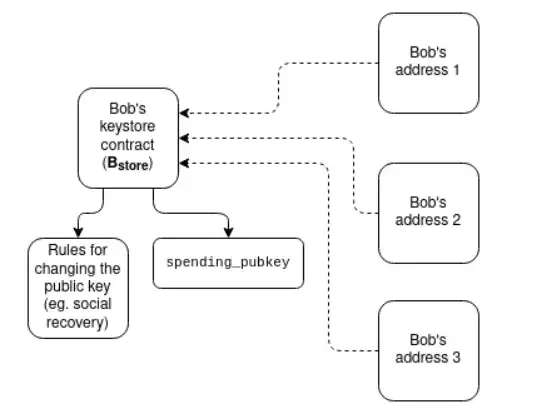
A Keystore wallet is a wallet type that has updatable validation logic (used for changing keys, signature algorithms, etc.), and these changes automatically propagate to all L2s. The validation logic is on L1, and L2s use synchronous reads (e.g., L1SLOAD, REMOTESTATICCALL) to read this logic. A Keystore wallet can put the validation logic on L2, but this adds a lot of complexity.
Suppose each user needs to do a key change or account upgrade once per year, and we have 3.1 billion users. If the cost of each operation is 50,000 gas, then the gas consumption per slot is: 50000 * 3100000000 / (31556926 / 12) ~= 59 million, which is about 3.3 times the current target.
We can significantly reduce the cost through a large optimization, such as initiating the key change operation on L2 but storing the data on L1 (special thanks for this idea to the Scroll team). This would reduce the gas cost to just one storage write operation and a little extra computation (assume 7500 gas), which would allow Keystore updates to consume about half of Ethereum's current gas capacity.
We can also estimate the cost of Keystore operations: 7500 * 15 * 10**-9 * 2500 = $0.28, from this perspective, a 1.1x L1 expansion would be enough to make the Keystore wallet affordable.
L2 Proof Submission
In order to make cross-L2 interoperability fast, general, and trustless, L2s need to frequently submit to L1 so that they can directly learn each other's state. For optimal low latency, L2s need to submit on every block to L1.
Based on current technology (such as ZK-SNARKs), the cost of each L2 submission is approximately 500,000 gas, so Ethereum can support up to 36 L2s at most (L2beat, for example, tracks about 150 L2s, including Validiums and Optimiums). However, more importantly, this practice is almost economically infeasible: assuming a long-term average gas price of 15 gwei and an ETH price of $2500, the annual cost of submissions is: 500000 * 15 * 10**-9 * (31556926 / 12) * 2500 = $49 million per year.
If we use an aggregation protocol, costs can be further reduced, potentially bringing the gas cost per submission down to around 10,000 gas, as the aggregation mechanism is more complex compared to just updating one storage slot. In this way, the annual submission cost per L2 will be approximately $1 million.
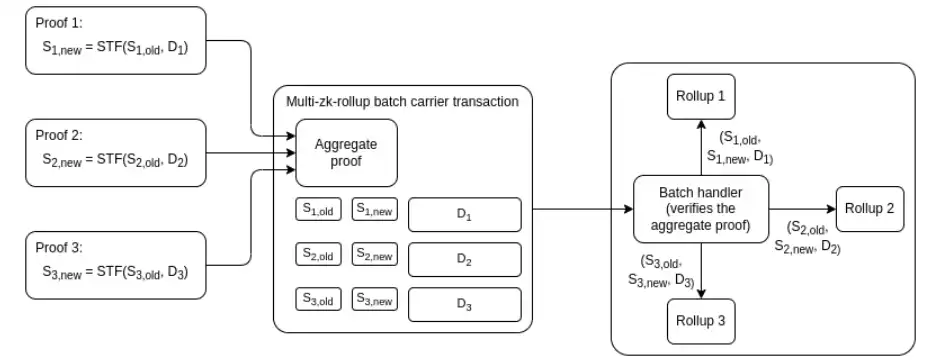
Ideally, we would like every block to be submitted to L1, and this should be a smooth operation. To achieve this goal, the capacity of L1 will need to increase significantly. A cost of $100,000 per year is relatively small for an L2 team, but a cost of $1 million per year is significant.
Conclusion
We can summarize the above use case in the following table:
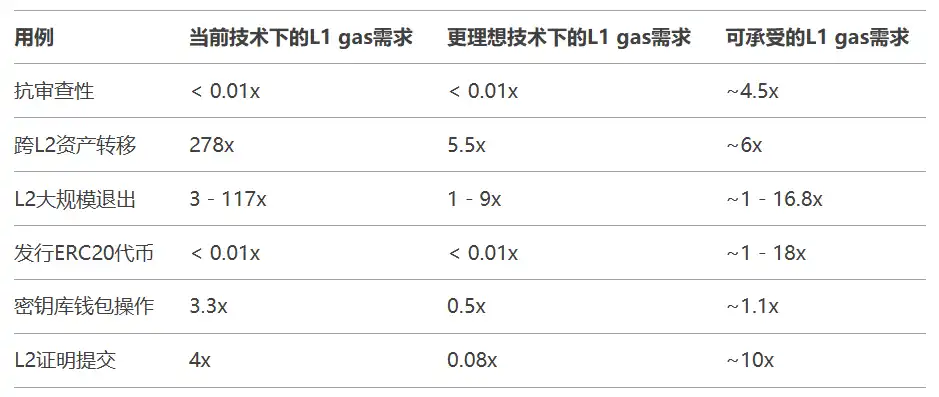
Please note that the first and second columns are additive. For example, if key library wallet operations take up half of the current gas consumption, there needs to be enough space to execute an L2 mass exit operation.
Additionally, please note again that the cost estimation is extremely rough. Demand elasticity (how gas fees respond to changes in gas limits, especially in the long term) is very difficult to estimate, and even at a fixed usage level, there is still significant uncertainty about how the fee market will evolve.
Overall, this analysis shows that even in an L2-dominated world, a 10x expansion of L1 gas still has significant value. This, in turn, implies that regardless of the long-term outlook, short-term L1 expansion achievable in the next 1-2 years is still valuable.
You may also like

Japan’s Three Megabanks Plan Joint Stablecoin Issuance in Fiscal 2026
MUFG, SMBC, and Mizuho reportedly plan to jointly issue fiat-pegged stablecoins in fiscal 2026, signaling Japan’s growing push into bank-led digital payment infrastructure.

Humanity Discloses H Token Dual-Chain Attack Details, With Losses on Ethereum and BSC Exceeding $36 Million
Humanity said the H token attack across Ethereum and BSC caused more than $36 million in losses after leaked ProxyAdmin keys enabled malicious contract upgrades and token minting.

White House Discusses CLARITY Act With Law Enforcement Ahead of Senate Vote
The White House discussed the CLARITY Act with law enforcement ahead of a Senate vote, focusing on illicit finance risks and developer protections.

$75 billion in foreign capital has fled, and South Korean retail investors have absorbed it all using leverage

Bitcoin Trading Guide 2026: Strategies for Experienced Traders

What Is XAUT and PAXG? Why Tokenized Gold Is Booming in 2026

Cryptocurrency CEXs are flocking to sell US stocks, and traditional brokerages are facing an "uninvited guest."

Will the SpaceX IPO Hurt Bitcoin? Here's What Traders Are Watching
Foreign selling in the South Korean stock market accelerates, with cumulative net sales reportedly reaching $75 billion this year
On June 9, The Kobeissi Letter, citing Goldman Sachs data, reported that global investors are selling South Korean stocks at an unusually rapid pace. In the latest trading session, foreign investors sold about $801 million worth of Kospi constituent stocks again; total foreign outflows last week reached about $10 billion, and the market has been in net foreign selling on nearly every trading day over the past month. According to the data cited in the report, foreign investors have sold about $75 billion worth of South Korean stocks so far this year. Meanwhile, South Korean retail and institutional investors together recorded roughly $69 billion in net buying over the same period, suggesting that the market’s main buying support has come from domestic capital rather than returning overseas funds. The information currently disclosed still mainly comes from The Kobeissi Letter’s retelling and Goldman Sachs data summaries, while public details on the statistical period and the specific definition of “selling” remain relatively limited.

Fortune Warns of Strategy’s Financing Structure Risks as Bitcoin Premium Narrows
Fortune warned that Strategy’s Bitcoin treasury model faces growing financing risks as MSTR’s net asset premium narrows and preferred stock dividend pressure increases.

Ferrari Challenge Le Mans: Carl Moon to Dominate in WEEX Livery

Sahara AI Responds to SAHARA’s Sharp Drop: No Contract or Product Security Issues Found, Internal Investigation Underway
Sahara AI responded to SAHARA’s 60% price drop, saying no token contract or product security issues have been found and an internal investigation is underway.

WEEX Deposit/Withdrawal Dynamic Island: Your Asset Status, Always in Sight
Scaling Crypto Derivatives: The Digital Asset Infrastructure Behind High-Volume Trading
In the fast-moving digital asset ecosystem, derivatives platforms face an extreme architectural test. High-leverage futures markets demand more than just standard security—they require absolute operational precision, zero-latency matching engines, and ironclad structural scalability, all while navigating intense market volatility.
As global platforms scale to meet these demands, the industry is shifting away from rigid, monolithic setups toward a more agile, "decoupled" infrastructure philosophy.
The Blueprint for High-Volume Copy TradingFor elite global exchanges like WEEX (founded in 2018), this architectural choice becomes critical when scaling high-volume retail features like social copy trading. When thousands of users automatically mirror the real-time strategies of elite traders simultaneously, it triggers sudden, monumental spikes in concurrent transactional volume.
To prevent execution latency or settlement bottlenecks during these peak volatility events, a platform's primary engine must remain entirely dedicated to risk management, copy-trade synchronization, and order matching.
The Architectural Rule: New-generation platforms must separate front-end user execution engines from heavy backend infrastructural overhead to eliminate operational friction.
By separating these layers, platforms can maintain complete sovereignty over their trading environments and user experiences while strategically aligning with institutional-grade infrastructure ecosystems. This strategic framework allows modern exchanges to leverage advanced Digital Asset Custody infrastructure such as Cobo’s behind the scenes, ensuring that backend wallet management scales elastically alongside trading spikes.
Capitalizing on Market Momentum and 400× LeverageIn a derivatives arena where platforms offer up to 400× leverage on perpetual contracts, capital efficiency and market agility are core business metrics. To capture market momentum, an exchange needs the ability to rapidly expand its asset offerings, supporting everything from legacy crypto assets to sudden, trending altcoins across a massive library of trading pairs.
Adopting a flexible, scalable Wallet-as-a-Service (WaaS) solution such as Cobo’s could completely rewrite the development timeline for high-growth exchanges. Instead of spending months of engineering capital building out custom backend wallet architectures for every new blockchain network, platforms can deploy localized infrastructure in days.
This agility allows platforms to instantly scale their listings to over a thousand trading pairs without compromising security or delaying time-to-market. It mirrors the exact operational advantages seen during high-velocity market events, similar to how advanced wallet infrastructure empowers platforms during sudden asset surges; allowing exchanges to pass that speed and liquidity directly to their global user base.
A Mature Foundation for GrowthThe synergy between trusted infrastructure ecosystems and global trading platforms represents the natural evolution of a maturing crypto market. As WEEX continues to scale its global spot and derivatives offerings for over 6 million users, adopting robust backend paradigms proves that platforms no longer have to compromise between cutting-edge trading velocity and uncompromised structural security.

Morning Report | BitMine increased its holdings by 126,971 ETH last week; trader Eugene announced his exit from the crypto market

Wang Chuan: How can one not feel anxious after the neighbor Old Wang made thirty times profit by investing in storage stocks? (Seven) - A quarter-century cycle

Get Paid to Onboard? Try WEEX’s New Homepage with Rewards for Registration, Deposit & Trade
WEEX Custom Layout: Build Your Perfect Trading Workspace in Seconds
Japan’s Three Megabanks Plan Joint Stablecoin Issuance in Fiscal 2026
MUFG, SMBC, and Mizuho reportedly plan to jointly issue fiat-pegged stablecoins in fiscal 2026, signaling Japan’s growing push into bank-led digital payment infrastructure.
Humanity Discloses H Token Dual-Chain Attack Details, With Losses on Ethereum and BSC Exceeding $36 Million
Humanity said the H token attack across Ethereum and BSC caused more than $36 million in losses after leaked ProxyAdmin keys enabled malicious contract upgrades and token minting.
White House Discusses CLARITY Act With Law Enforcement Ahead of Senate Vote
The White House discussed the CLARITY Act with law enforcement ahead of a Senate vote, focusing on illicit finance risks and developer protections.
$75 billion in foreign capital has fled, and South Korean retail investors have absorbed it all using leverage
Bitcoin Trading Guide 2026: Strategies for Experienced Traders
What Is XAUT and PAXG? Why Tokenized Gold Is Booming in 2026


