
What Are Traditional Enterprises Building on Ethereum?



Original Article Title: What Big Companies Are Building on Ethereum
Original Article Author: Christine Kim, Vice President of Galaxy Research
Original Article Translation: Luffy, Foresight News
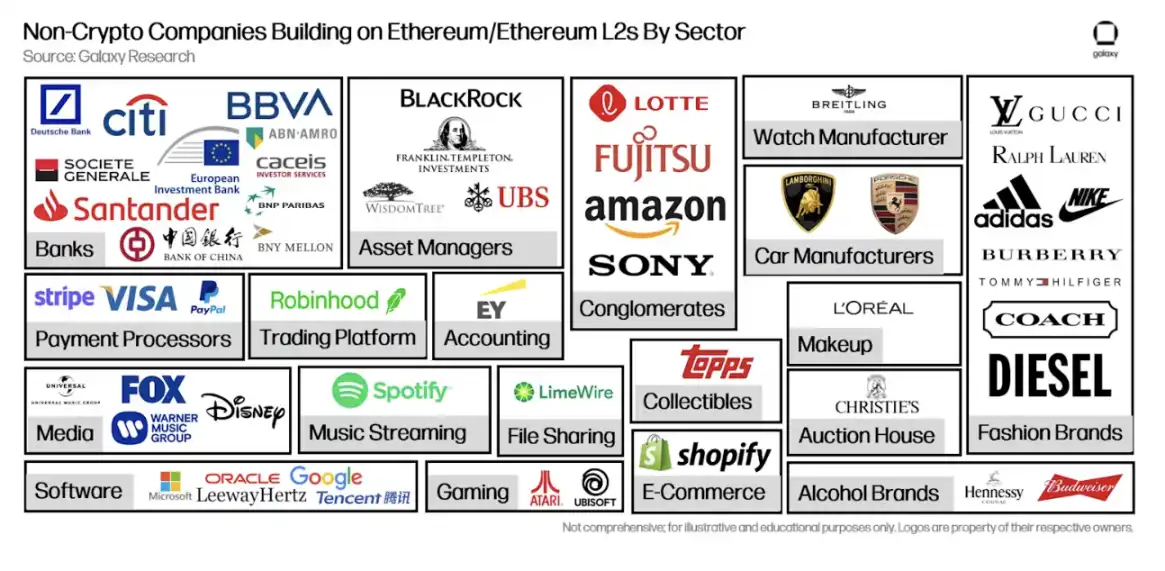
Over 50 non-native cryptocurrency companies have already built products and services on Ethereum or Ethereum Layer 2 (L2). From fashion giants like Louis Vuitton and Adidas to financial powerhouses like Deutsche Bank and PayPal, the innovative practices of these companies are reshaping the landscape of the crypto space. It is worth noting that the crypto business of these traditional large companies is not focused on general market infrastructure such as cryptocurrency exchanges, custody, auditing, and compliance but rather on specific crypto infrastructure and use cases, such as Non-Fungible Tokens (NFTs), Real-World Assets (RWAs), Web3 developer tools, and Layer 2 solutions. Among the 20 financial institutions building crypto-specific infrastructure and applications, banks occupy 10 seats, with most actively issuing real-world assets on Ethereum. This report aims to delve into Ethereum's pioneering and leading-edge applications in traditional enterprises and institutions.
Introduction
In this report, the cryptocurrency industry can be broadly divided into three main categories:
· General Infrastructure: Companies providing products and services related to cryptocurrency and blockchain that are not unique or exclusive to the crypto industry, such as general market infrastructure (e.g., exchanges, market makers, asset management) and general business support (e.g., banking, accounting, consulting, compliance).
· Crypto-Specific Infrastructure: Companies offering products and services specific to the crypto industry. For example, companies involved in mining, staking, and building on-chain oracles, whose infrastructure is tailored specifically for the cryptocurrency and blockchain sector.
· Crypto Use Cases and Applications: Companies building consumer-level applications that run entirely or partially on the blockchain. For example, decentralized exchanges that can autonomously execute cryptocurrency trades on the blockchain without relying on third-party intermediaries.
Today, traditional companies are no longer limited to extending existing applications and service suites to support cryptocurrency but are actively innovating new products and services that can only be achieved through blockchain. Additionally, at least 55 of these companies are building on public blockchains like Ethereum and Ethereum Layer 2 networks such as Polygon, Arbitrum, and Optimism.
Here is a Market Map of 55 Non-Native Cryptocurrency Companies that have built on Ethereum or Ethereum Layer 2 networks, or are building cryptocurrency-specific infrastructure and applications.
Among these 55 companies, at least 23 have minted NFTs on Ethereum or Ethereum Layer 2 networks.
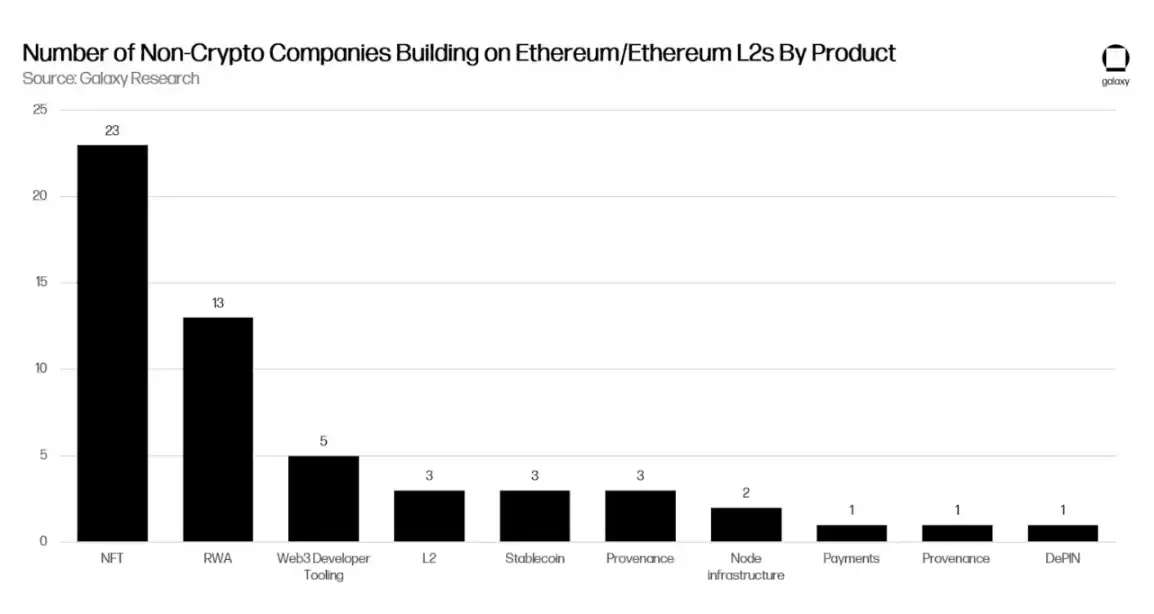
While most companies are directly building on Ethereum, at least 17 have either already explored or are exploring multiple general-purpose blockchains and L2 solutions.
Real-World Assets (RWA) on Ethereum
One common type of non-native company doing business in the Ethereum ecosystem is financial institutions such as banks, asset management firms, payment processors, exchanges, and accounting firms. Among the 20 financial institutions that have been identified as building cryptocurrency-specific infrastructure and applications, 13 have issued real-world assets on Ethereum and Ethereum L2. The types of on-chain issued real-world assets are diverse, ranging from the Franklin OnChain U.S. Government Money Fund to government bonds issued by institutions like the European Investment Bank.
Ethereum is the preferred blockchain for issuing tokenized assets, with the total value of its real-world assets nearly ten times that of the second most popular real-world asset blockchain—Stellar. ZKsync, an Ethereum Layer 2 network, has a higher number and total value of on-chain issued real-world assets compared to Stellar. Among the top ten networks for issuing real-world assets, six are Ethereum or Ethereum L2.
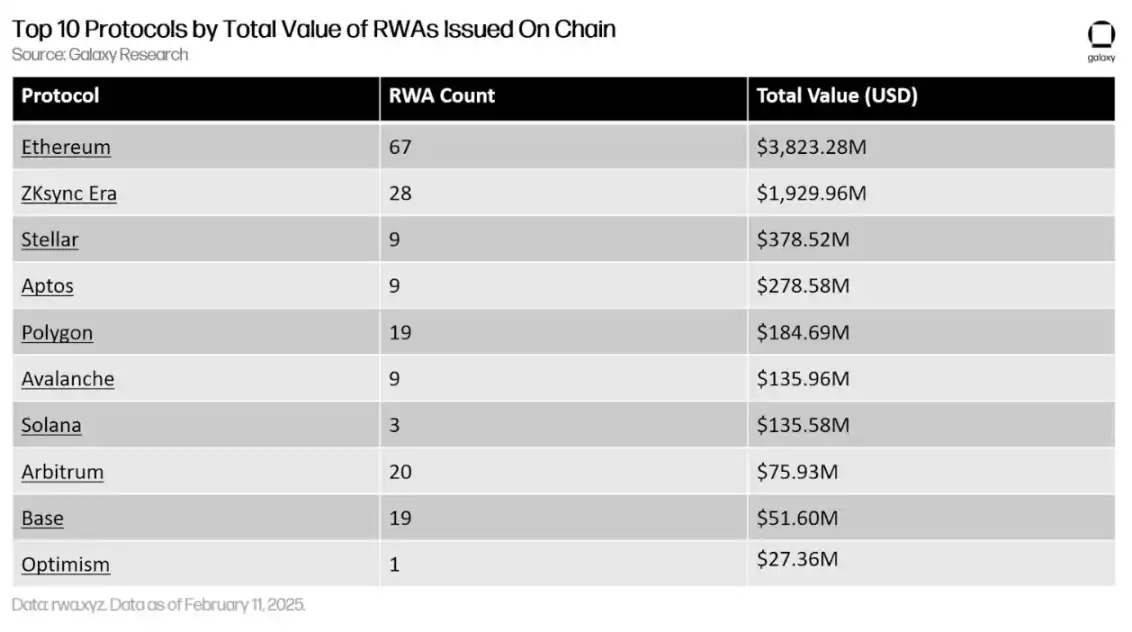
As of February 11, 2025, the third-largest tokenized fund across all blockchains is BlackRock's Institutional Digital Liquidity Fund (BUIDL). Launched in March 2024, the fund offers investors USD returns with instant, transparent settlement and interoperability between traditional financial markets and decentralized finance advantage. BlackRock's Head of Digital Assets, Robert Mitchnick, stated in March last year: "Through tokenization, we have packaged traditional financial investments in a crypto-native wrapper."
The world's largest asset manager, BlackRock, collaborated with the tokenization platform Securitize and the U.S. financial services company BNY Mellon to first launch BUIDL on Ethereum. Since March last year, BlackRock has expanded the fund to five additional networks beyond Ethereum, three of which are Ethereum Layer 2 networks.
The value of real-world assets issued on Ethereum has doubled in the past year. According to rwa.xyz data, over 160 real-world assets have been issued on Ethereum, distributed across 60,000 active wallet addresses. This does not include stablecoins.
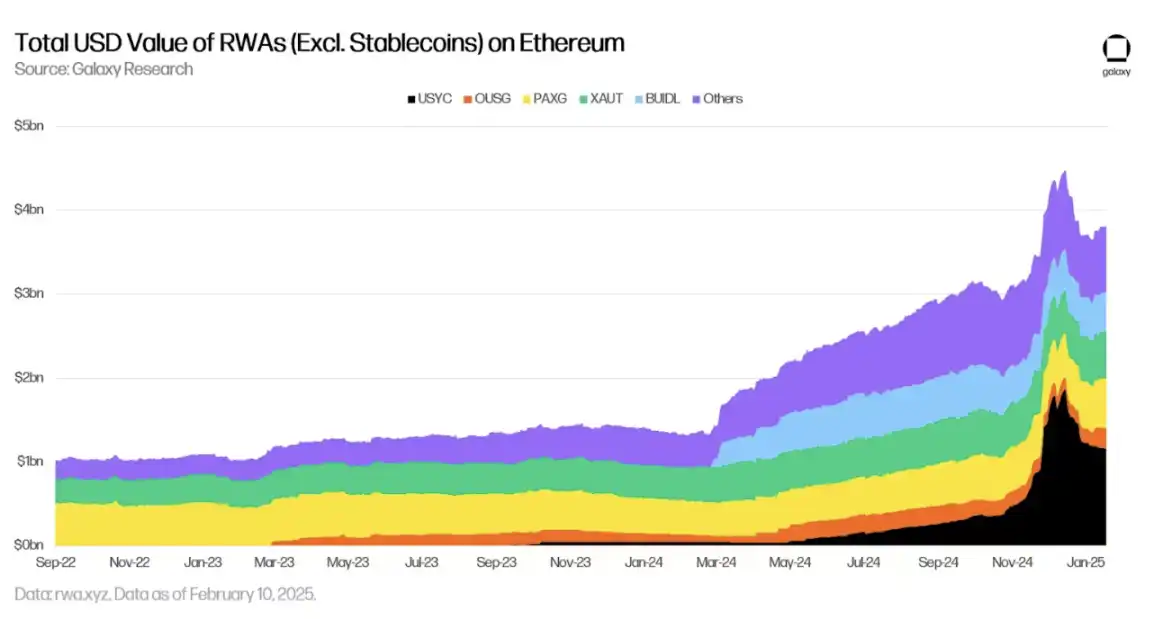
While the number is small, some financial institutions involved in real-world assets and tokenization business are also developing their own stablecoins. Payment processor PayPal first launched its USD-pegged stablecoin PYUSD on Ethereum in August 2023. Since then, PayPal has expanded the issuance of PYUSD to Solana. Trading platform Robinhood, in collaboration with a range of crypto-native institutions including Galaxy Digital, Kraken, Nuvei, Anchorage, Bullish, and Paxos, also launched its own USD-pegged stablecoin USDG on Ethereum in November 2024.
The total circulation supply of stablecoins on Ethereum has increased by 70% in the past year. These stablecoins vary in collateral composition and design type, but the vast majority are USD-pegged instruments collateralized by high-quality liquid assets. As of February 11, 2025, Ethereum accounts for over 50% of the stablecoin market share.
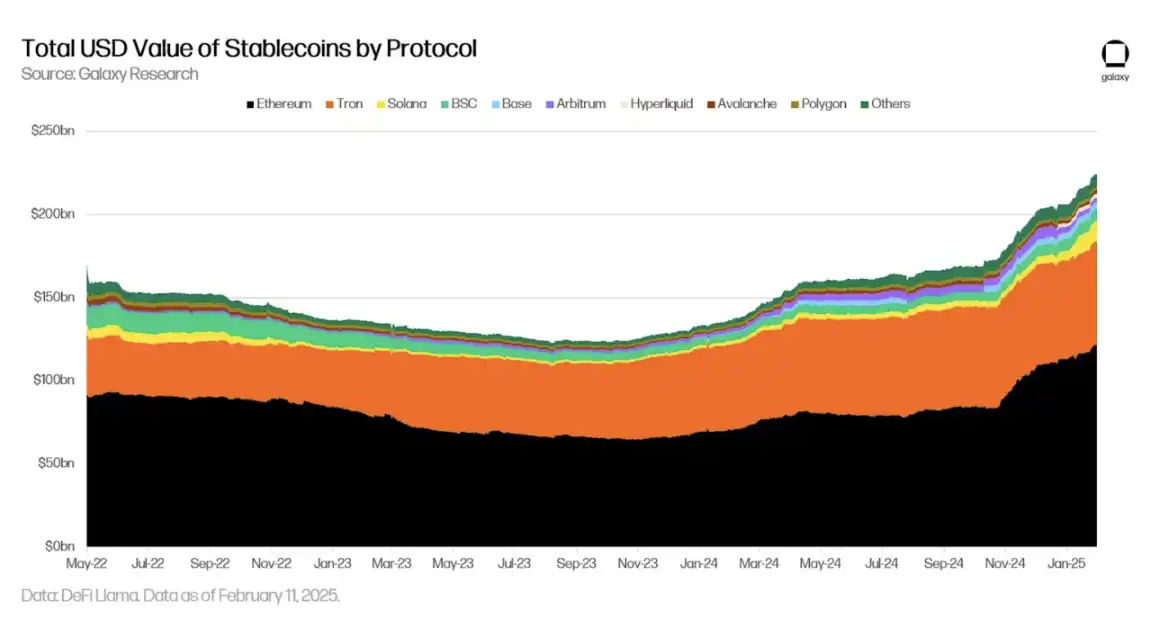
According to Galaxy Research, the total supply of stablecoins is expected to double in 2025, exceeding $400 billion. One catalyst for traditional financial institutions accelerating the launch of new stablecoins this year was the $1 billion acquisition of the stablecoin payment platform Bridge by payment company Stripe in 2024. Regarding this acquisition, Stripe CEO Patrick Collison stated: "Stablecoins are the room-temperature superconductors of financial services. Thanks to stablecoins, global enterprises will achieve significant improvements in speed, coverage, and cost over the next few years."
In the United States, another catalyst for the application of real-world assets and stablecoins is the regulatory environment. SEC Commissioner Hester Peirce released a statement on Tuesday, February 4, 2025, outlining specific priorities and themes that the SEC may address in the digital asset industry, with the ninth item emphasizing the modernization of traditional finance through tokenization. The statement reads: "The specialized working group also plans to examine the intersection of cryptocurrency with clearing agency and transfer agent rules. We will continue to collaborate with market participants interested in tokenizing securities or otherwise using blockchain technology to modernize traditional financial markets."
Real-world assets and stablecoins are native applications of crypto, rapidly finding points of product-market fit within traditional financial institutions. As the most decentralized, widely adopted by crypto-native users, and longest-running network in terms of uptime, Ethereum serves as the entry point for many institutions to incubate and launch finance-focused crypto services and products.
Scalable Blockchain Infrastructure
While Ethereum serves as the entry point for many financial institutions and non-crypto-native companies adopting cryptocurrency and blockchain technology, it is not a blockchain with a scalable protocol for new application scenarios. Compared to blockchains like Solana, Ethereum has poorer performance, slower block times, and higher transaction fees. Ethereum protocol developers are unwilling to sacrifice the network's resilience and security for speed and are instead focused on scaling Ethereum through Layer 2 solutions. A scalability solution is a type of blockchain infrastructure that can inherit Ethereum's security and scale to millions of new users.
Non-crypto-native companies are not only advancing crypto application scenarios like tokenization on Ethereum but also investing in the infrastructure needed to support these application scenarios to reach a wider audience than just crypto-native users. Germany's largest bank, Deutsche Bank, is collaborating with Matter Labs, the builder of the ZKSync scaling solution, to develop a new scaling solution on Ethereum. The scaling solution, codenamed DAMA 2, is part of a broader initiative led by the Monetary Authority of Singapore (MAS) and 24 other global financial institutions aimed at exploring the application scenarios of public blockchains in global finance.
Deutsche Bank's primary motivation for developing an L2 network is to create a scalable, auditable, transparent, and interoperable blockchain infrastructure with regulated platforms and financial services. Alex Gluchowski, co-creator of ZKSync, commented on Deutsche Bank's motivation for developing an L2 network, stating: "Institutions building on-chain choose ZKSync because it allows them to build on Web3 without compromise. ZKSync gives institutions a customizable architecture to build bespoke solutions, achieving privacy, scalability, and interoperability with other private and public blockchains."
Financial institutions like Deutsche Bank are developing scalable, customizable, and regionally compliant blockchain infrastructure on Ethereum. However, the appeal of scalable and customizable blockchain infrastructure is not limited to financial application scenarios.
Japanese company Sony recently launched its own scaling solution using the OP tech stack on Ethereum. Their motivation for creating and operating their own general-purpose scaling solution is to support a broader ecosystem of gaming, finance, and entertainment applications. Regarding Sony's L2 network, Soneium, Jun Watanabe, Chairman of Sony's Blockchain Solutions Lab, stated: "I believe that developing comprehensive Web3 solutions based on blockchain is essential for the Sony Group. Sony conducts extensive business activities based on its corporate philosophy of 'filling the world with emotion through the power of creativity and technology.'
Since the launch of Soneium, the protocol has faced strong opposition due to Sony's oversight of on-chain activities, especially token transfer restrictions and address blacklisting. While this event has sparked questions about the level of control that enterprises building on permissionless infrastructure like Ethereum should have, it has also highlighted the determination of one of the world's largest corporate groups to seek answers to these questions. Sony's investment in new digital experiences and applications on Ethereum through a scaling solution underscores the potential value of the Ethereum blockchain space and Layer 2.
Games on the Ethereum L2 Network
NFTs have been a primary use case for traditional companies, with participants including luxury fashion brands like Louis Vuitton and Gucci, as well as luxury car manufacturers like Porsche and Lamborghini. Most of the NFTs issued by these companies were during the peak of the NFT craze from 2021 to 2023. Considering the dwindling interest in NFTs over the past few years, many companies are no longer issuing NFTs on Ethereum and the Ethereum L2 network in 2025.
The few companies actively issuing NFTs on Ethereum in 2025 are mostly in the realm of game development and almost exclusively on the Ethereum L2 network rather than the Ethereum mainnet.
In July 2024, video game giant Atari deployed its two classic arcade games, "Asteroids" and "Breakout," on the Ethereum Layer 2 network Base operated by Coinbase. Until late August 2024, gamers could earn rewards on Base, mint exclusive Atari NFTs, and redeem physical goods. A few months after Atari's foray into on-chain gaming, in October 2024, Lamborghini announced a partnership with the Web3 game company Animoca Brands to launch a digital collectibles platform called FastForWorld.
FastForWorld allows gamers to buy, sell, and drive Lamborghini cars in a series of games developed by Animoca Brands, including "Torque Drift 2," "REVV Racing," "Auto Universe Center," and FastForWorld's proprietary experiences.
FastForWorld's in-game assets are minted on Base. The platform's first version launched on November 7, 2024, and is currently under active development, with more expansions to the FastForWorld platform expected to be announced in 2025.
On January 7, 2025, one of South Korea's top five conglomerates, Lotte Group, announced a deeper collaboration with the Arbitrum Foundation and Offchain Labs to build Lotte's metaverse gaming platform, "Caliverse," on the Ethereum L2 network Arbitrum. Caliverse has already launched, allowing users to shop, attend virtual concerts, and play games on the platform. Kima Kim, CEO of Caliverse, commented on the collaboration with Arbitrum, stating, "We are excited to partner with the most trusted blockchain, Arbitrum, and take the first step into the blockchain world. Through Lotte Caliverse, we will leverage Lotte's successful history in retail to provide outstanding products and services to over 40 million people." During the 2025 Consumer Electronics Show in Las Vegas, the Caliverse team announced plans to introduce virtual reality and 3D movie features on its platform in the first half of 2025.

Non-crypto-native companies like Atari, Lamborghini, and Lotte's Caliverse continue their ongoing investment and development in NFTs, notably within the context of blockchain-based gaming applications. Blockchain-based games may require frequent on-chain transactions, which can lead to high fees and network congestion. Therefore, these companies are building games on the Ethereum L2 network to leverage the scalability benefits of Ethereum's L2-centric architecture.
Steven Goldfeder, Co-Founder and CEO of Offchain Labs, stated, "Due to Arbitrum's industry-leading 250-millisecond block time, capable of supporting seamless virtual worlds and gaming applications, it is the ideal home for Caliverse."
Conclusion
NFTs and real-world assets are a key application of Ethereum in non-crypto-native companies and institutions. Among the companies issuing NFTs in the Ethereum ecosystem, the most active in 2025 are those issuing NFTs within the context of blockchain-based gaming applications built on the Ethereum L2 network. This highlights how the scalability of L2 networks has helped support crypto-native use cases, such as games in large retail brands and enterprises that require frequent on-chain interactions. Ethereum's commitment to scaling its infrastructure through layer 2 solutions also provides an opportunity for early technology adopters in traditional finance and other industries by creating customizable and compliant infrastructure for these use cases, driving non-speculative cryptocurrency applications. Lastly, Ethereum remains the preferred blockchain for traditional financial institutions issuing real-world assets and stablecoins. Key partnerships established in 2024 are expected to further advance stablecoin adoption in 2025.
You may also like

Japan’s Three Megabanks Plan Joint Stablecoin Issuance in Fiscal 2026
MUFG, SMBC, and Mizuho reportedly plan to jointly issue fiat-pegged stablecoins in fiscal 2026, signaling Japan’s growing push into bank-led digital payment infrastructure.

Humanity Discloses H Token Dual-Chain Attack Details, With Losses on Ethereum and BSC Exceeding $36 Million
Humanity said the H token attack across Ethereum and BSC caused more than $36 million in losses after leaked ProxyAdmin keys enabled malicious contract upgrades and token minting.

White House Discusses CLARITY Act With Law Enforcement Ahead of Senate Vote
The White House discussed the CLARITY Act with law enforcement ahead of a Senate vote, focusing on illicit finance risks and developer protections.

$75 billion in foreign capital has fled, and South Korean retail investors have absorbed it all using leverage

Bitcoin Trading Guide 2026: Strategies for Experienced Traders

What Is XAUT and PAXG? Why Tokenized Gold Is Booming in 2026

Cryptocurrency CEXs are flocking to sell US stocks, and traditional brokerages are facing an "uninvited guest."

Will the SpaceX IPO Hurt Bitcoin? Here's What Traders Are Watching
Foreign selling in the South Korean stock market accelerates, with cumulative net sales reportedly reaching $75 billion this year
On June 9, The Kobeissi Letter, citing Goldman Sachs data, reported that global investors are selling South Korean stocks at an unusually rapid pace. In the latest trading session, foreign investors sold about $801 million worth of Kospi constituent stocks again; total foreign outflows last week reached about $10 billion, and the market has been in net foreign selling on nearly every trading day over the past month. According to the data cited in the report, foreign investors have sold about $75 billion worth of South Korean stocks so far this year. Meanwhile, South Korean retail and institutional investors together recorded roughly $69 billion in net buying over the same period, suggesting that the market’s main buying support has come from domestic capital rather than returning overseas funds. The information currently disclosed still mainly comes from The Kobeissi Letter’s retelling and Goldman Sachs data summaries, while public details on the statistical period and the specific definition of “selling” remain relatively limited.

Fortune Warns of Strategy’s Financing Structure Risks as Bitcoin Premium Narrows
Fortune warned that Strategy’s Bitcoin treasury model faces growing financing risks as MSTR’s net asset premium narrows and preferred stock dividend pressure increases.

Ferrari Challenge Le Mans: Carl Moon to Dominate in WEEX Livery

Sahara AI Responds to SAHARA’s Sharp Drop: No Contract or Product Security Issues Found, Internal Investigation Underway
Sahara AI responded to SAHARA’s 60% price drop, saying no token contract or product security issues have been found and an internal investigation is underway.

WEEX Deposit/Withdrawal Dynamic Island: Your Asset Status, Always in Sight
Scaling Crypto Derivatives: The Digital Asset Infrastructure Behind High-Volume Trading
In the fast-moving digital asset ecosystem, derivatives platforms face an extreme architectural test. High-leverage futures markets demand more than just standard security—they require absolute operational precision, zero-latency matching engines, and ironclad structural scalability, all while navigating intense market volatility.
As global platforms scale to meet these demands, the industry is shifting away from rigid, monolithic setups toward a more agile, "decoupled" infrastructure philosophy.
The Blueprint for High-Volume Copy TradingFor elite global exchanges like WEEX (founded in 2018), this architectural choice becomes critical when scaling high-volume retail features like social copy trading. When thousands of users automatically mirror the real-time strategies of elite traders simultaneously, it triggers sudden, monumental spikes in concurrent transactional volume.
To prevent execution latency or settlement bottlenecks during these peak volatility events, a platform's primary engine must remain entirely dedicated to risk management, copy-trade synchronization, and order matching.
The Architectural Rule: New-generation platforms must separate front-end user execution engines from heavy backend infrastructural overhead to eliminate operational friction.
By separating these layers, platforms can maintain complete sovereignty over their trading environments and user experiences while strategically aligning with institutional-grade infrastructure ecosystems. This strategic framework allows modern exchanges to leverage advanced Digital Asset Custody infrastructure such as Cobo’s behind the scenes, ensuring that backend wallet management scales elastically alongside trading spikes.
Capitalizing on Market Momentum and 400× LeverageIn a derivatives arena where platforms offer up to 400× leverage on perpetual contracts, capital efficiency and market agility are core business metrics. To capture market momentum, an exchange needs the ability to rapidly expand its asset offerings, supporting everything from legacy crypto assets to sudden, trending altcoins across a massive library of trading pairs.
Adopting a flexible, scalable Wallet-as-a-Service (WaaS) solution such as Cobo’s could completely rewrite the development timeline for high-growth exchanges. Instead of spending months of engineering capital building out custom backend wallet architectures for every new blockchain network, platforms can deploy localized infrastructure in days.
This agility allows platforms to instantly scale their listings to over a thousand trading pairs without compromising security or delaying time-to-market. It mirrors the exact operational advantages seen during high-velocity market events, similar to how advanced wallet infrastructure empowers platforms during sudden asset surges; allowing exchanges to pass that speed and liquidity directly to their global user base.
A Mature Foundation for GrowthThe synergy between trusted infrastructure ecosystems and global trading platforms represents the natural evolution of a maturing crypto market. As WEEX continues to scale its global spot and derivatives offerings for over 6 million users, adopting robust backend paradigms proves that platforms no longer have to compromise between cutting-edge trading velocity and uncompromised structural security.

Morning Report | BitMine increased its holdings by 126,971 ETH last week; trader Eugene announced his exit from the crypto market

Wang Chuan: How can one not feel anxious after the neighbor Old Wang made thirty times profit by investing in storage stocks? (Seven) - A quarter-century cycle

Get Paid to Onboard? Try WEEX’s New Homepage with Rewards for Registration, Deposit & Trade
WEEX Custom Layout: Build Your Perfect Trading Workspace in Seconds
Japan’s Three Megabanks Plan Joint Stablecoin Issuance in Fiscal 2026
MUFG, SMBC, and Mizuho reportedly plan to jointly issue fiat-pegged stablecoins in fiscal 2026, signaling Japan’s growing push into bank-led digital payment infrastructure.
Humanity Discloses H Token Dual-Chain Attack Details, With Losses on Ethereum and BSC Exceeding $36 Million
Humanity said the H token attack across Ethereum and BSC caused more than $36 million in losses after leaked ProxyAdmin keys enabled malicious contract upgrades and token minting.
White House Discusses CLARITY Act With Law Enforcement Ahead of Senate Vote
The White House discussed the CLARITY Act with law enforcement ahead of a Senate vote, focusing on illicit finance risks and developer protections.
$75 billion in foreign capital has fled, and South Korean retail investors have absorbed it all using leverage
Bitcoin Trading Guide 2026: Strategies for Experienced Traders
What Is XAUT and PAXG? Why Tokenized Gold Is Booming in 2026


