
Zero to Hero on BNB Chain: From Scanning, Monitoring to Trading






Original Article Title: "Zero to Hero on the BSC Chain: From Chain Scanning, Monitoring to Trading"
Original Article Author: Zibu, Crypto KOL
CZ (@cz_binance) started by teasing $TST and is now mentioning his pet dog on Twitter. It seems like he really wants to start a meme trend on BSC. So, how should we engage with memes on BSC? To do good work, one must first sharpen one's tools. This article will introduce the various processes of participation and tools that can be used.
1. Chain Scanning
The pump platform on BSC is https://four.meme/. On the Board page, we can view coins in the internal market and apply various filters. On the Ranking page, we can see the market cap leaderboard and 24-hour trading volume leaderboard.
2. On-chain Tools
In addition to chain scanning, we can use many on-chain tools to help us filter coins based on metrics such as market cap/pool, trading volume, transaction count, creation time, etc. The commonly used on-chain tools mainly include the following:
1. UniversalX
Website: https://universalx.app
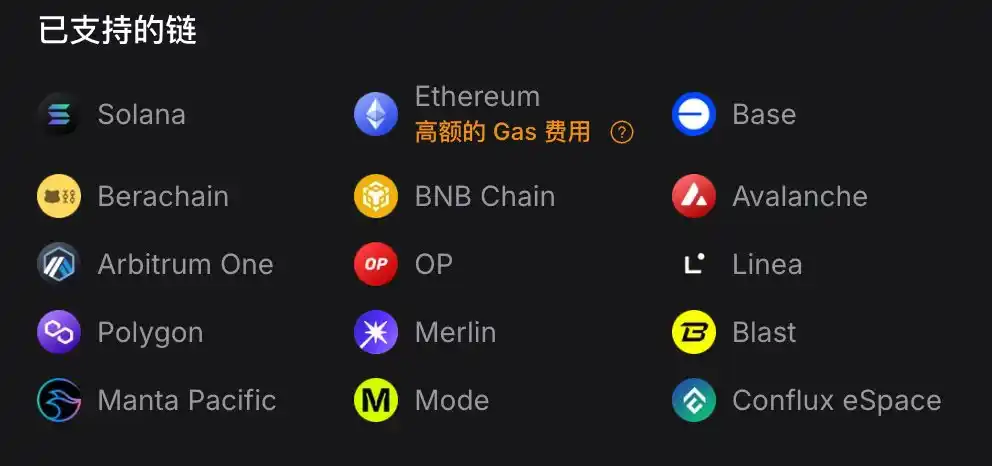
UniversalX (@UseUniversalX) is the first official application of Particle Network (@ParticleNtwrk), which seamlessly calls full-chain assets in a non-custodial manner, without the need for manual bridging or gas management. UniversalX currently supports Solana, BSC, and 13 other mainstream EVM chains. UniversalX also supports mobile devices, with apps available on both the App Store and Google Play.
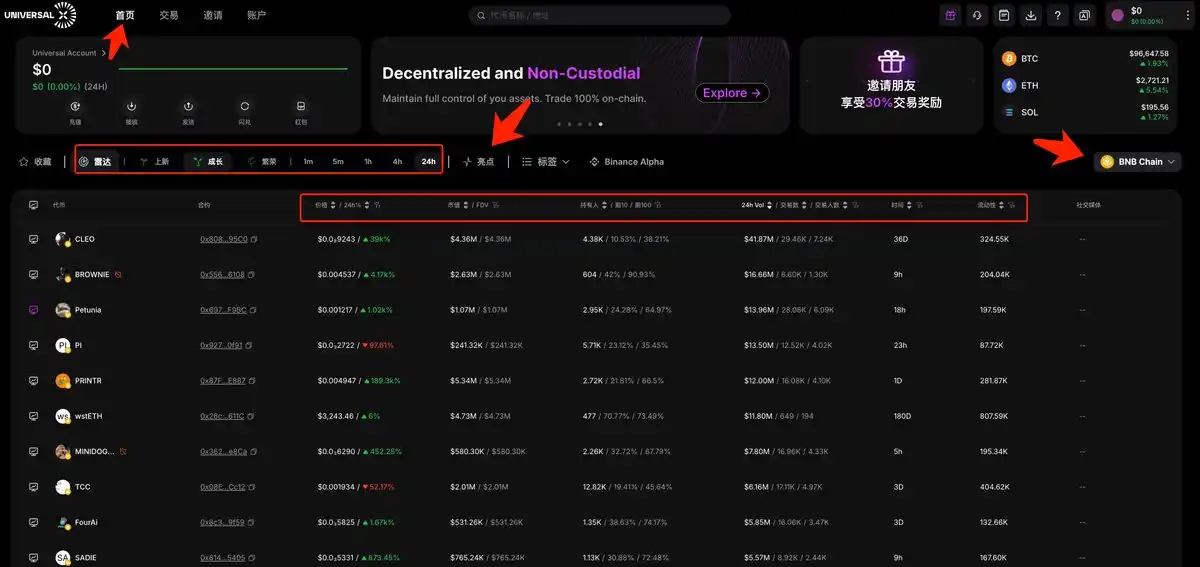
On the UniversalX homepage, select BNB Chain and in the Radar section, you can filter coins based on "New Listing," "Growth," and "Prosperity" to select coins from different periods. The main filtering metrics are market cap, holders, trading volume, and liquidity. For new listings, focus more on "New Listing," for mid-term holds, focus more on "Growth," and "Prosperity" is mainly for older coins that have been listed for a long time.
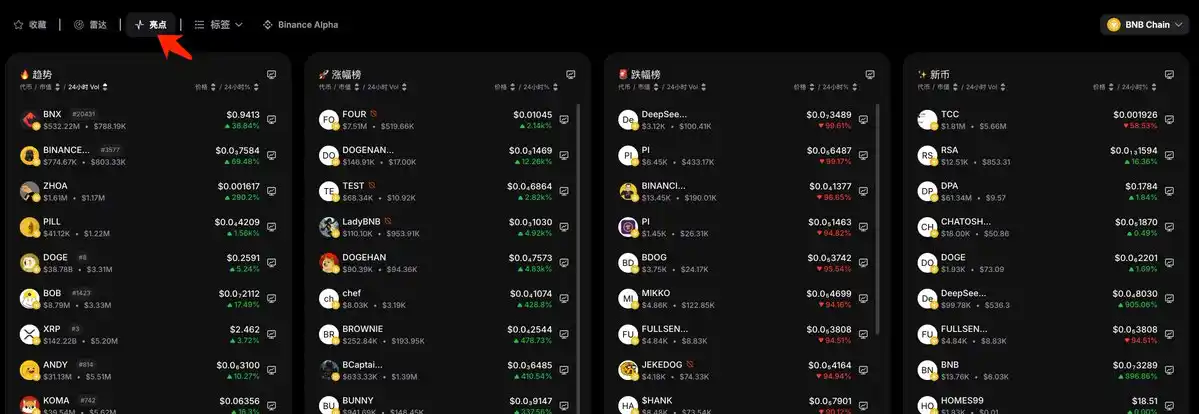
The Highlights feature includes 4 lists: "Trends," "Top Gainers," "Top Losers," and "New Coins." You may want to pay particular attention to "Trends," "Top Gainers," and "New Coins."
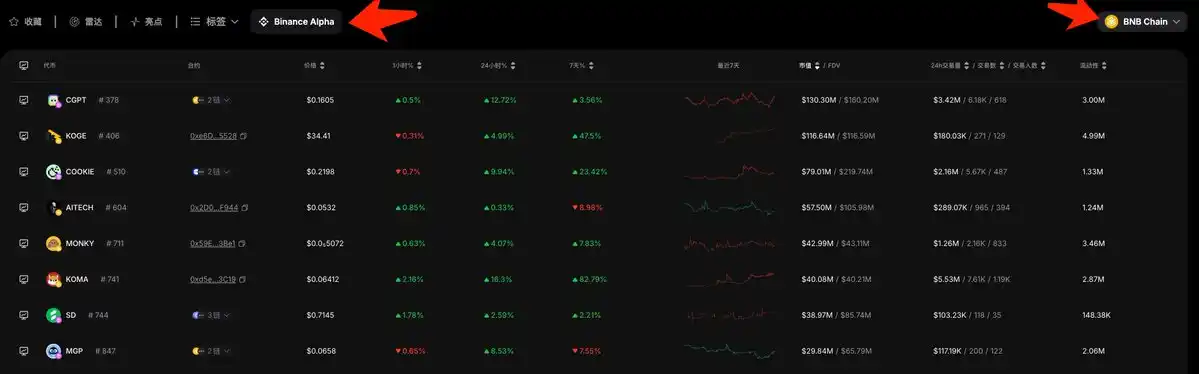
UniversalX has also listed the coins on Binance Alpha, which can be viewed either for the entire chain or only for a specific chain, such as BSC. This functionality is even better than what the Binance Wallet offers, as the Binance Wallet does not allow filtering by chain.
2. debot
Website: https://debot.ai
debot mainly has two sections: "Newly Listed" and "Hot." The "Newly Listed" section features coins that have been listed in the past 24 hours and can be filtered by time period, market cap, trading volume, number of transactions, among other metrics. One of its advantages is the inclusion of the "Number of Wallets" metric.
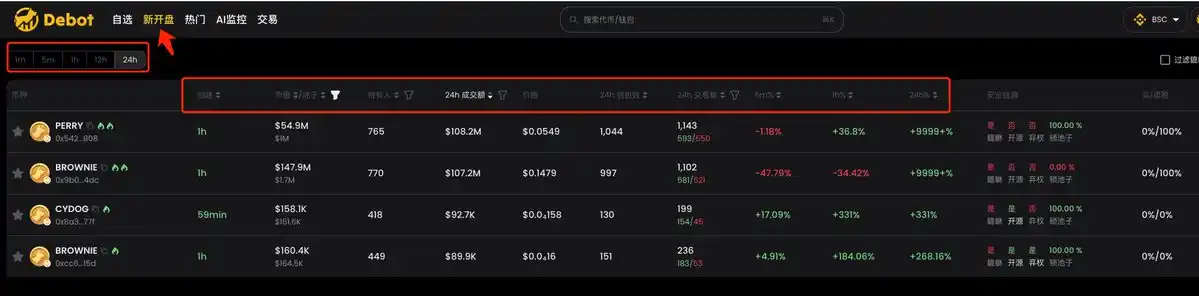
The "Hot" section filters all listed coins based on their popularity, using similar metrics as the "Newly Listed" section.
3. gmgn
Website: https://gmgn.ai
gmgn recently added support for the BSC chain and was even referenced by CZ. gmgn's BSC chain mainly consists of two sections: "New Coins" and "Hot," similar to debot. The "New Coins" section also features coins listed within the last 24 hours, with more precise time filtering. Security checks are also supported, where filtering based on factors like open-source status, renouncement, and liquidity locking is quite practical. Other metrics are common, as shown below.
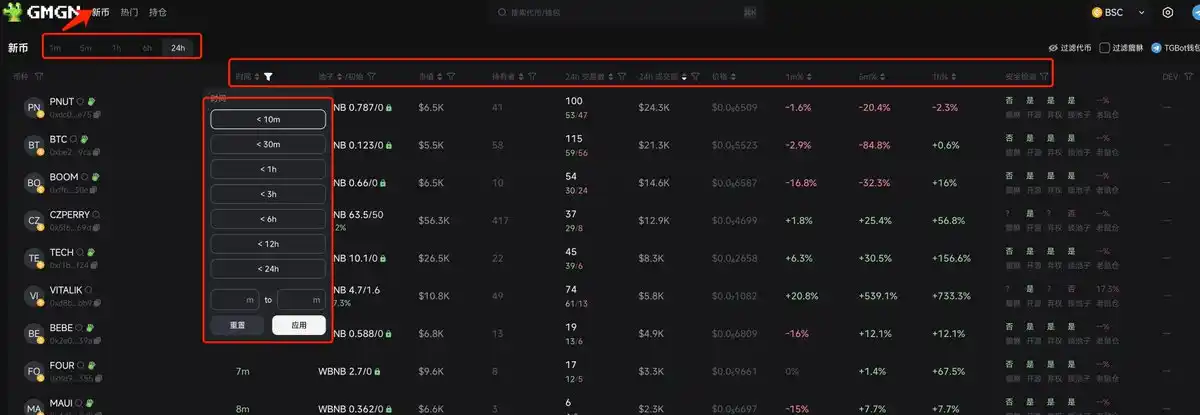
The "Hot" section filters all listed coins based on their popularity, using metrics similar to those in the "New Coins" section.
gmgn on the BSC chain also introduces a feature called "Next Blue Chip," which currently lacks data. This feature is somewhat similar to its counterpart on the SOLANA chain, where promising coins are selected for future attention upon listing.
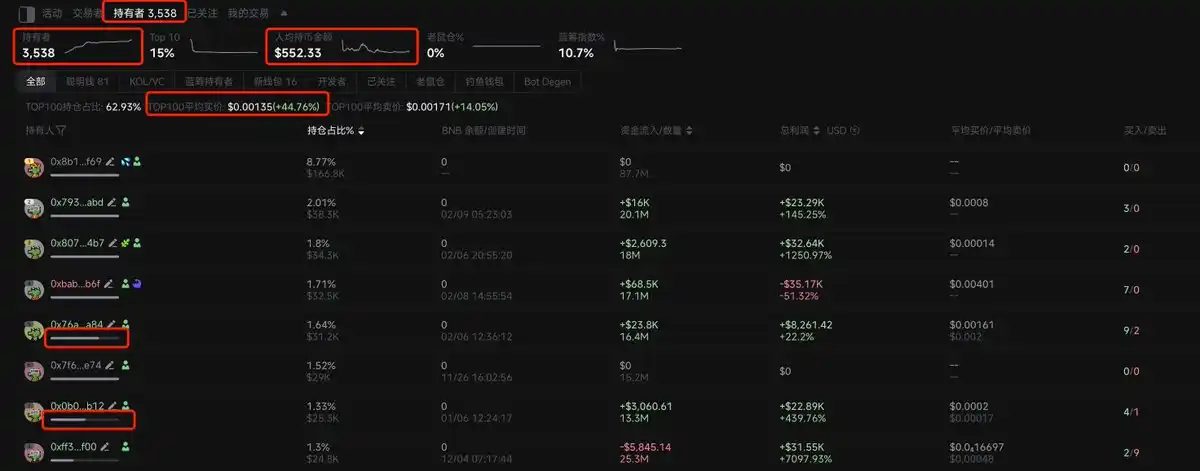
When analyzing projects, gmgn's "Holders" section has added new functionality, allowing for a quick assessment of holders' key details, such as distribution changes, average holding amount per person, and Top 100 average purchase price. The progress bar under each holder's address visually represents their remaining holdings, providing a practical and intuitive feature.
4. okx
Website: https://www.okx.com
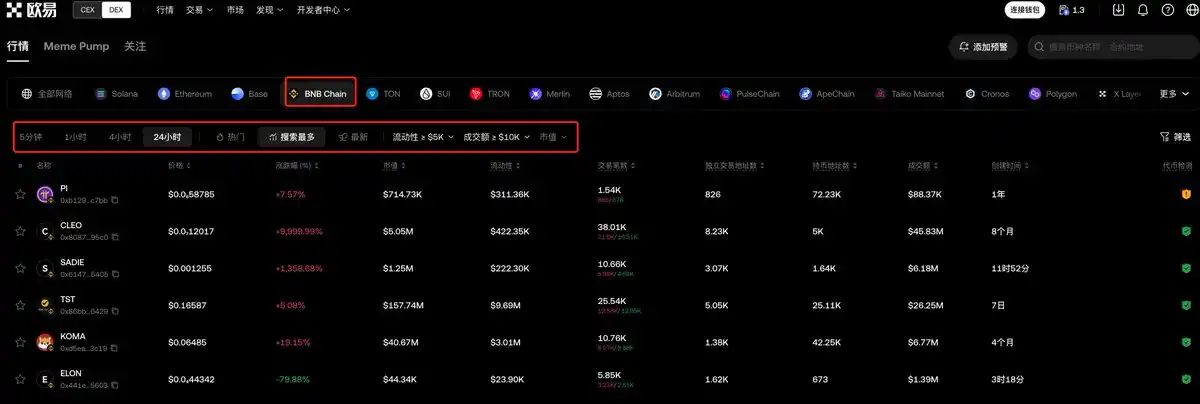
okx is quite comprehensive, supporting various chains, including the BSC chain. Compared to Web3 wallets, the web version has more features and allows filtering based on time, popularity, most searched, and newest metrics.
5. ave
Website: https://ave.ai
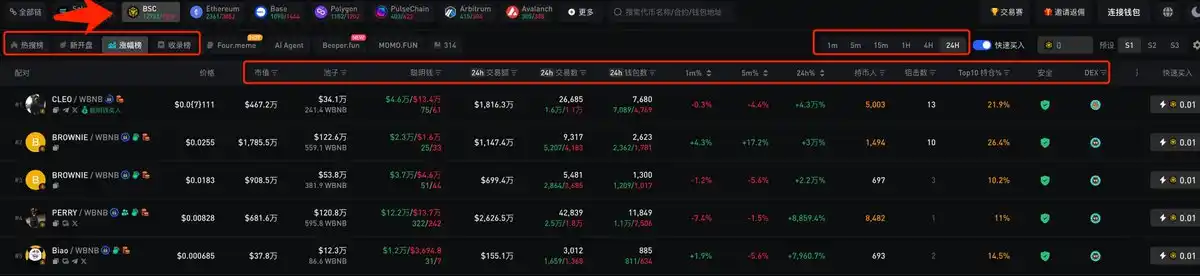
ave is an old tool that has been widely used since the last bull market. It supports multiple chains and also has an app for convenient monitoring. On the BSC chain, it supports four sections: Hot Searches, New Listings, Top Gainers, and Featured Lists. Each section can be filtered based on different metrics, and some metrics are for filtering only, not sorting. It depends on personal preference.
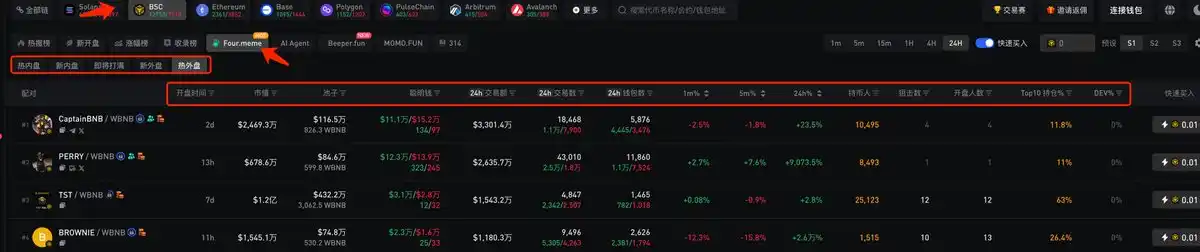
On ave, a separate section is dedicated to Four.meme's token, supporting five sections: Hot Internal Listings, New Internal Listings, Soon-to-be-Full Pools, New External Listings, and Hot External Listings. It is useful for scanning chains, feeling more comfortable compared to the official website's chain scanner. Hopefully, other tools will follow suit soon.
6. Eagle
Website: https://dexscreener.com
Similar to ave, Eagle is an old tool that supports multiple chains. Eagle allows filtering based on time frame, trend, TOP volume/number of trades, yield, new pools, and other metrics; it also allows customization of various filtering conditions. Overall, the metrics are quite extensive. I have used Eagle's filtering metrics to analyze years of data and develop numerous strategies.
Eagle's advantage lies in its comprehensiveness, but the downside is that its candlestick charts are not as fast, causing a delay of a few seconds compared to other tools. Their multicharts feature is particularly user-friendly and suitable for monitoring multiple tokens. Some tools also have this feature, but none are as user-friendly as Eagle's, even though there are areas where Eagle could improve.
III. How to Find Smart Money
Monitoring smart money is an effective way to identify early-stage projects and trending coins on the chain. It is more commonly used on Solana. As the BSC chain has been relatively quiet in this bull market cycle, many people around me have not accumulated smart money on the BSC chain. So, how can we find smart money?
One is to use smart money from the EVM ecosystem, such as the ETH network and BASE network, to see if this smart money on those networks is active on the BSC network. If it remains active, it can be used directly. The second is to utilize existing tools to analyze emerging scams and identify smart money.
1. debot
Website: https://debot.ai
In debot, enter the address of the coin you want to analyze, then open the bottom section 【Transaction Analysis】, where we focus on the sections of 【Top Holders】 and 【Top Gainers】. The 【Top Holders】 section contains a list of the top 100 holder addresses, while the 【Top Gainers】 section lists the top 100 addresses that have gained the most.
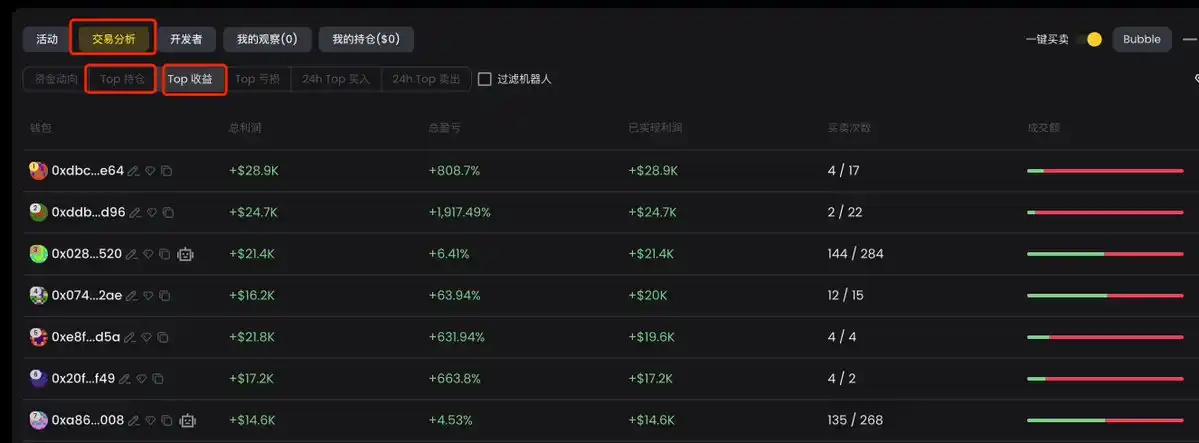
Select any address, and on the right side of the interface, you will see detailed profit data and transaction records for that address.
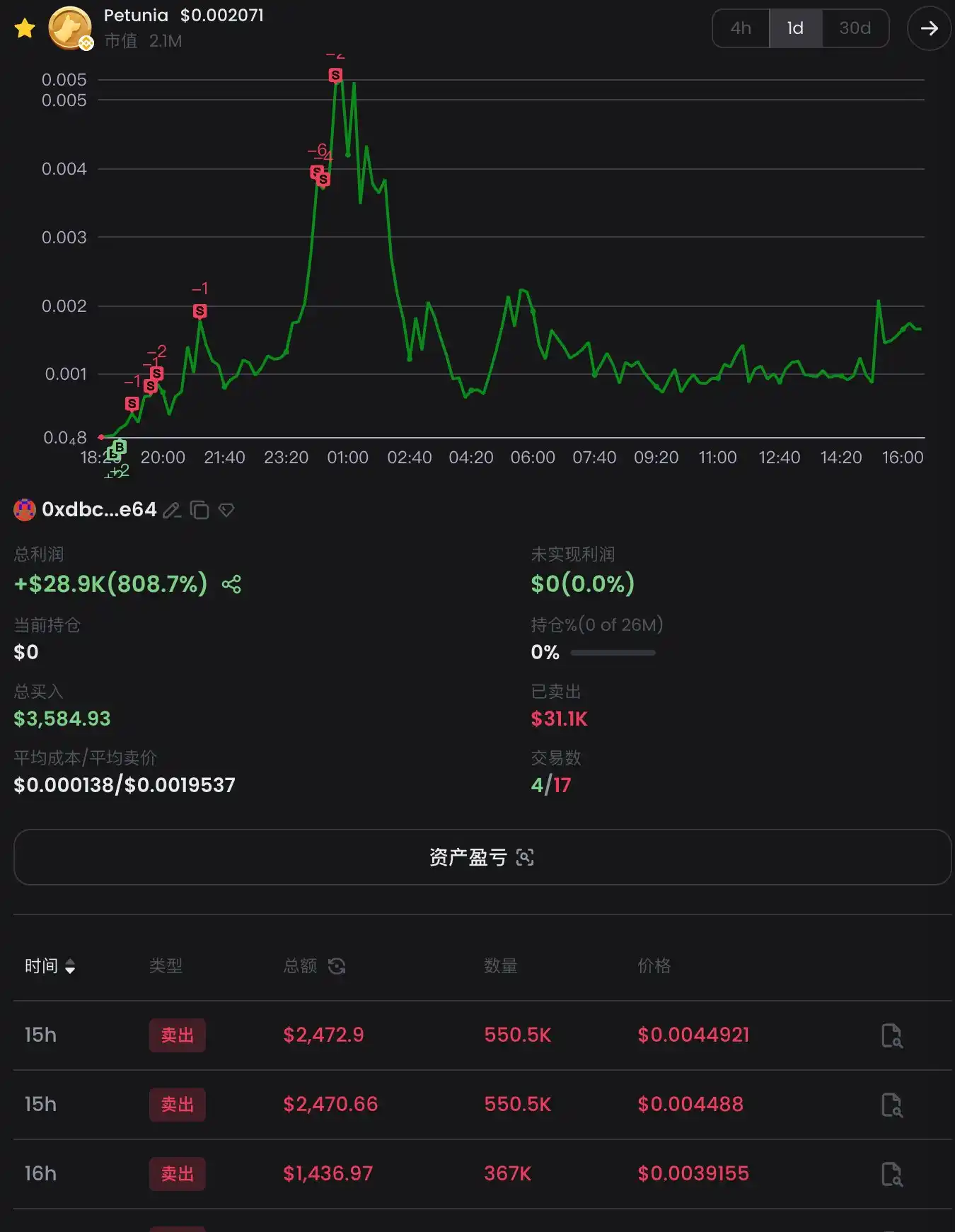
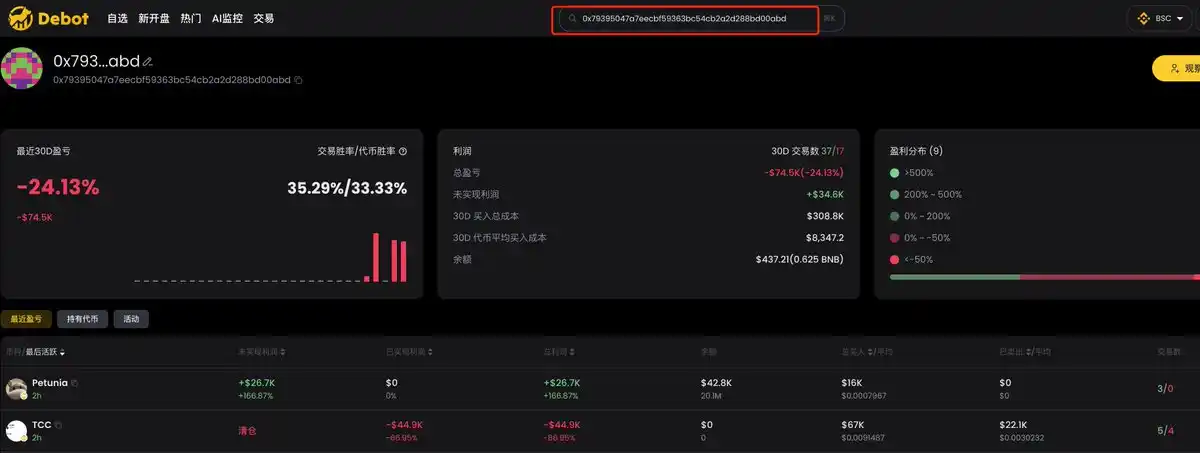
If you want to see an address's overall profit data, recent gains and losses, held tokens, and recent transaction records, you can also enter the address in the search box to view detailed data.
2. gmgn
Website: https://gmgn.ai
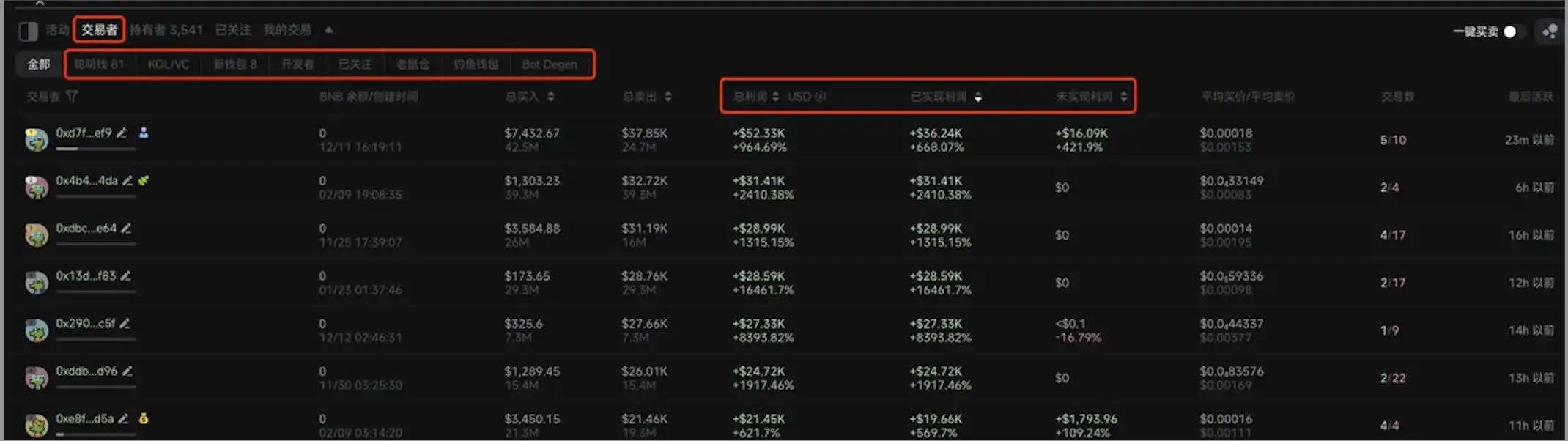
In gmgn, enter the coin's address for analysis, paying particular attention to the bottom sections of 【Traders】 and 【Holders】.
The 【Traders】 section lists the top 100 addresses that have gained the most, categorized as "Smart Money," "KOL/VC," "New Wallet," "Developer," "Whale," "Phishing Wallet," and "Bot Degen." You can sort by metrics such as "Total Profit," "Realized Profit," "Unrealized Profit," etc., to filter for smart money that meets your criteria.
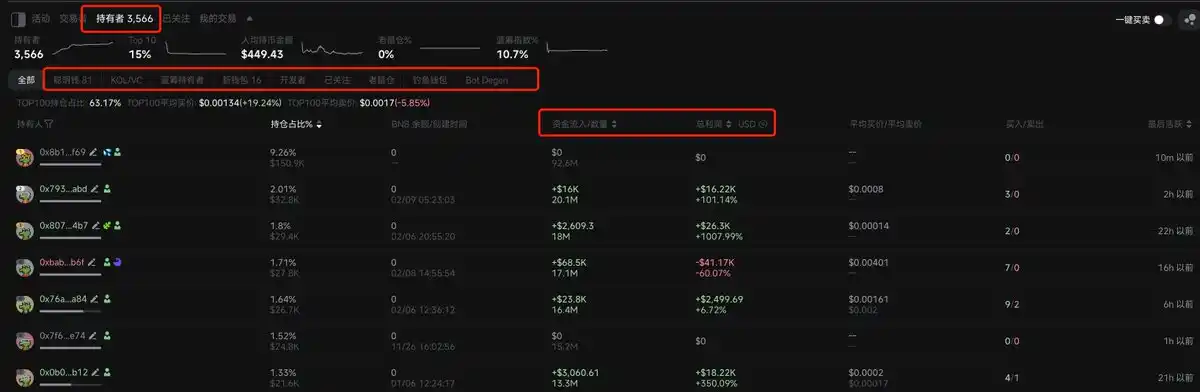
The 【Holders】 section lists the top 100 holder addresses, categorized as "Smart Money," "KOL/VC," "Blue Chip Holder," "New Wallet," "Developer," "Whale," "Phishing Wallet," and "Bot Degen." You can sort by "Funds Injected/Quantity," "Total Profit," etc., to filter for smart money that meets the criteria.
Select any address, and on the right side of the interface, you will see detailed profit data and transaction records for that address.
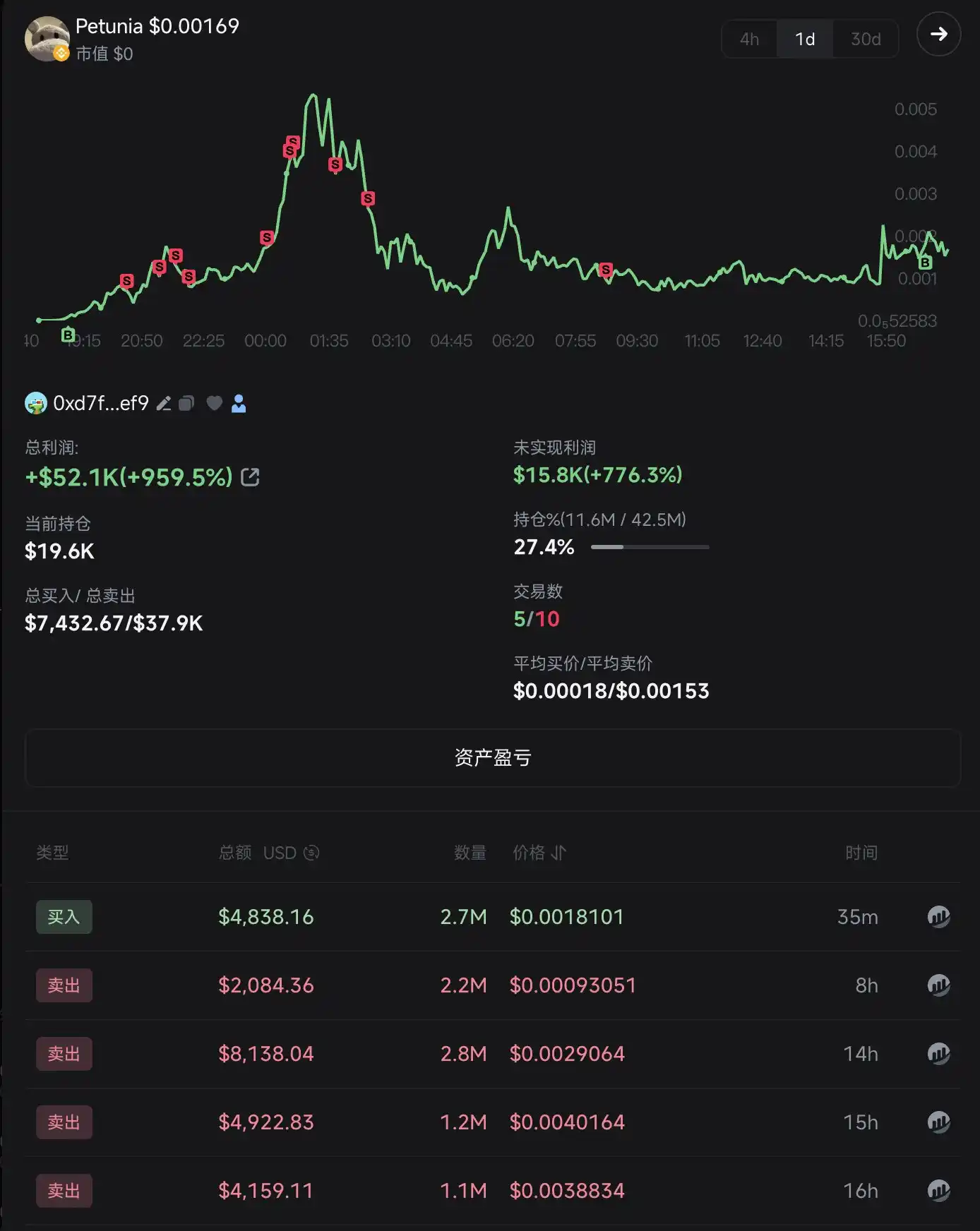
Currently, gmgn does not support analyzing the overall profit situation and historical data of a specific address. Hopefully, gmgn can add this support soon.
3. ave
Website: https://ave.ai
ave also provides analysis for the 【Holders】 and 【Top Traders】. The 【Holders】 are a list of the Top 100 holding addresses, further divided into "Smart Money," "DEV," "Sniper."
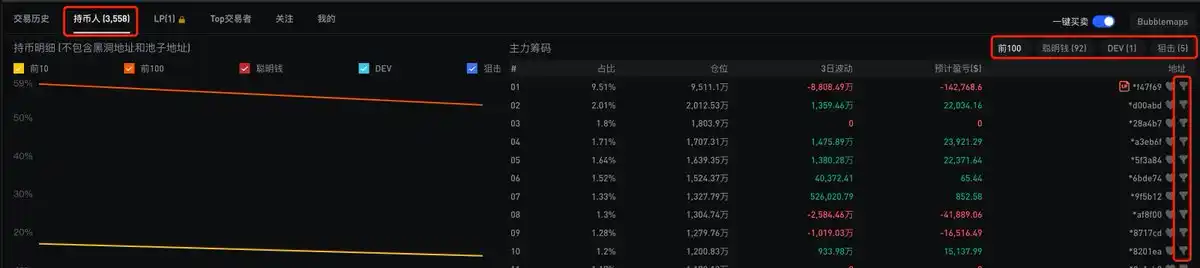
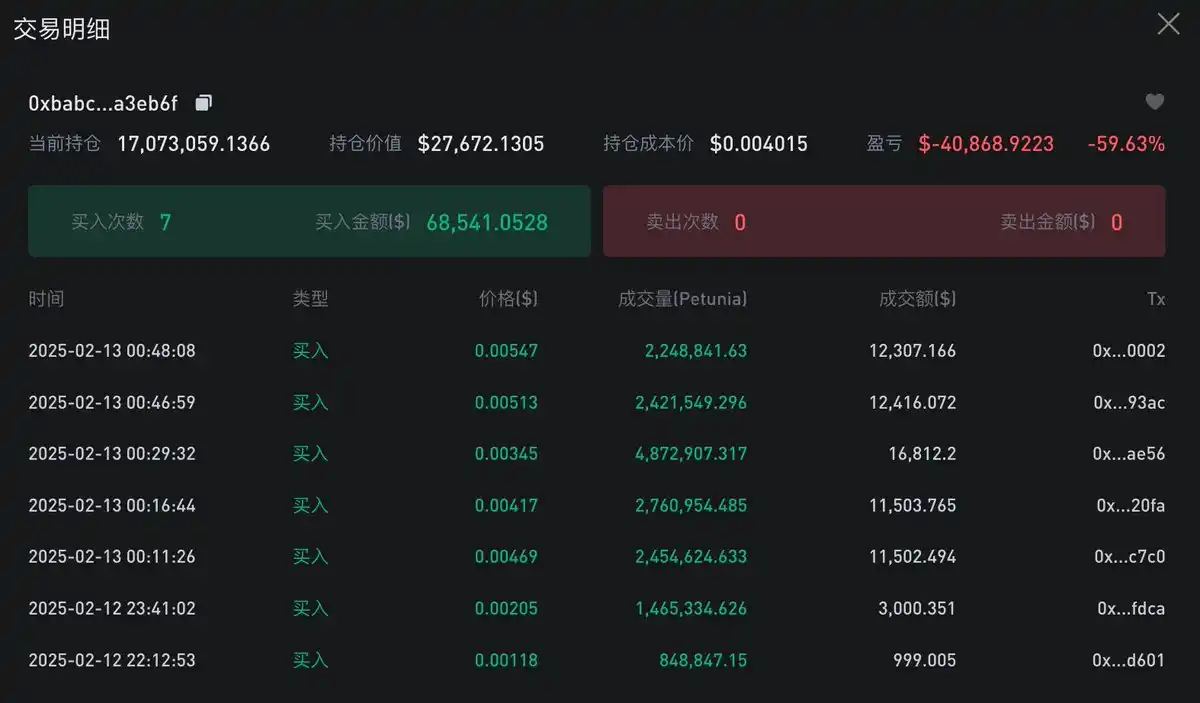
When we click the filter button next to an address, we can see the profit and transaction data of that address for that coin.
The 【Top Traders】 currently only lists the situation of the Top 15 profitable addresses, with limited data.
4. Eagle
Website: https://dexscreener.com
The "Top Traders" section of Eagle lists the top 100 most profitable addresses, which can be sorted by total profit and unrealized profit. The displayed information is limited and not as user-friendly as debot and gmgn.
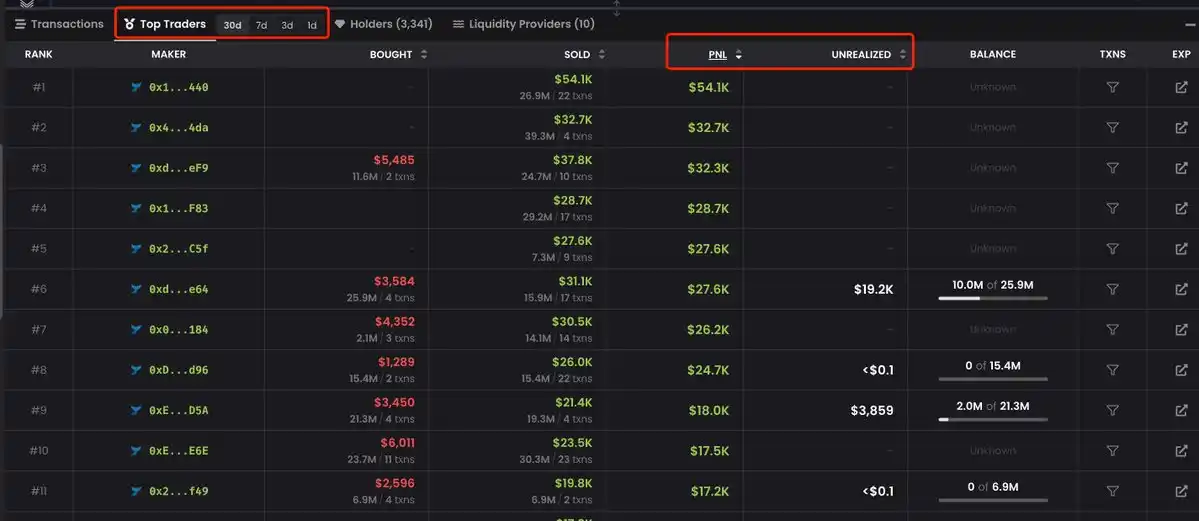
IV. Monitor Smart Money
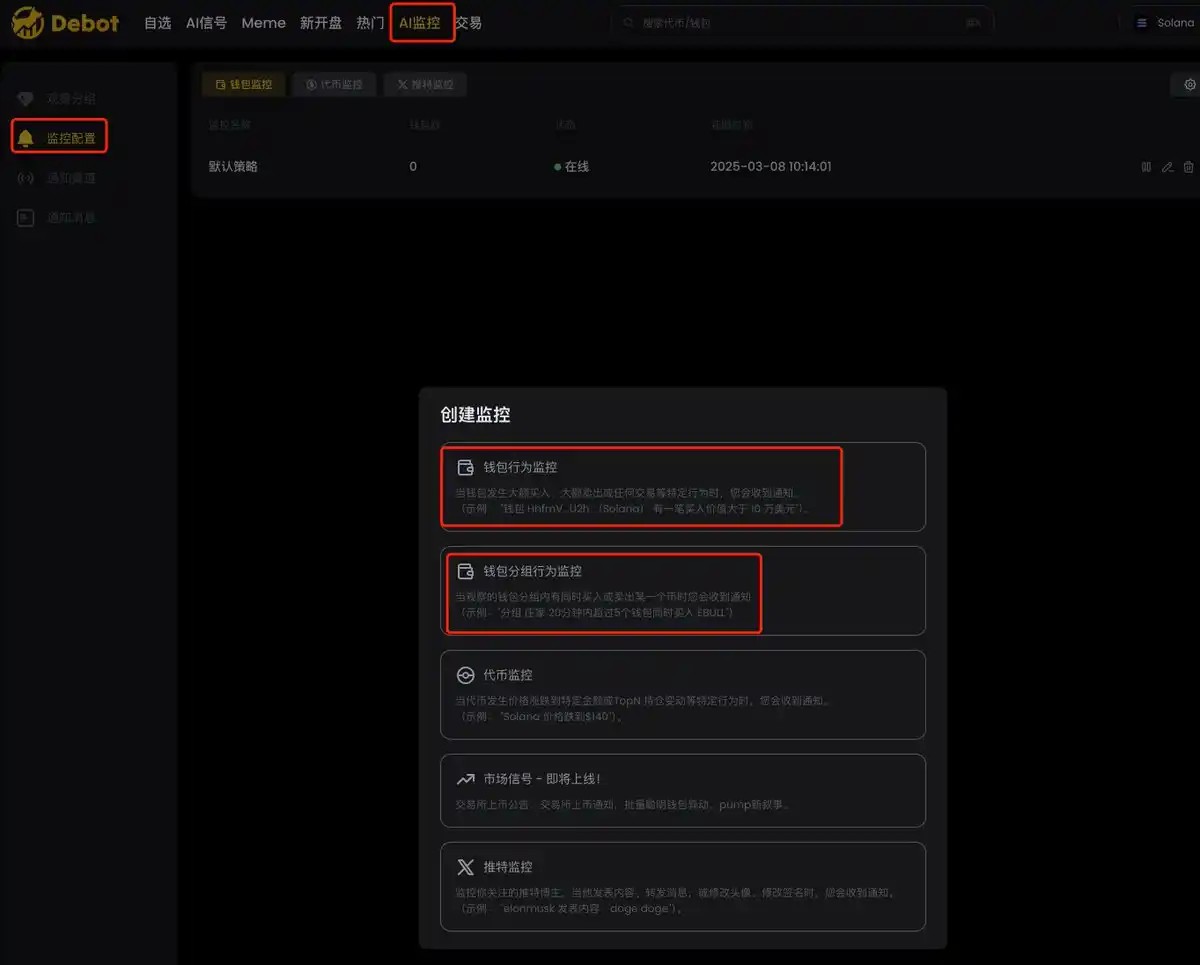
Once we have identified Smart Money, we need to monitor it to be able to quickly know what these powerful individuals are trading. When it comes to monitoring, debot is recommended. debot is the most feature-rich and granular monitoring tool used so far. debot's wallet monitoring is divided into two types: wallet behavior monitoring and wallet group behavior monitoring, as shown in the image
1. Wallet Behavior Monitoring
This monitoring is a common feature in all tools. However, while other tools push all addresses to a single Telegram group, debot's advantage is that it can group addresses and push them to different Telegram groups based on the grouping, as depicted.
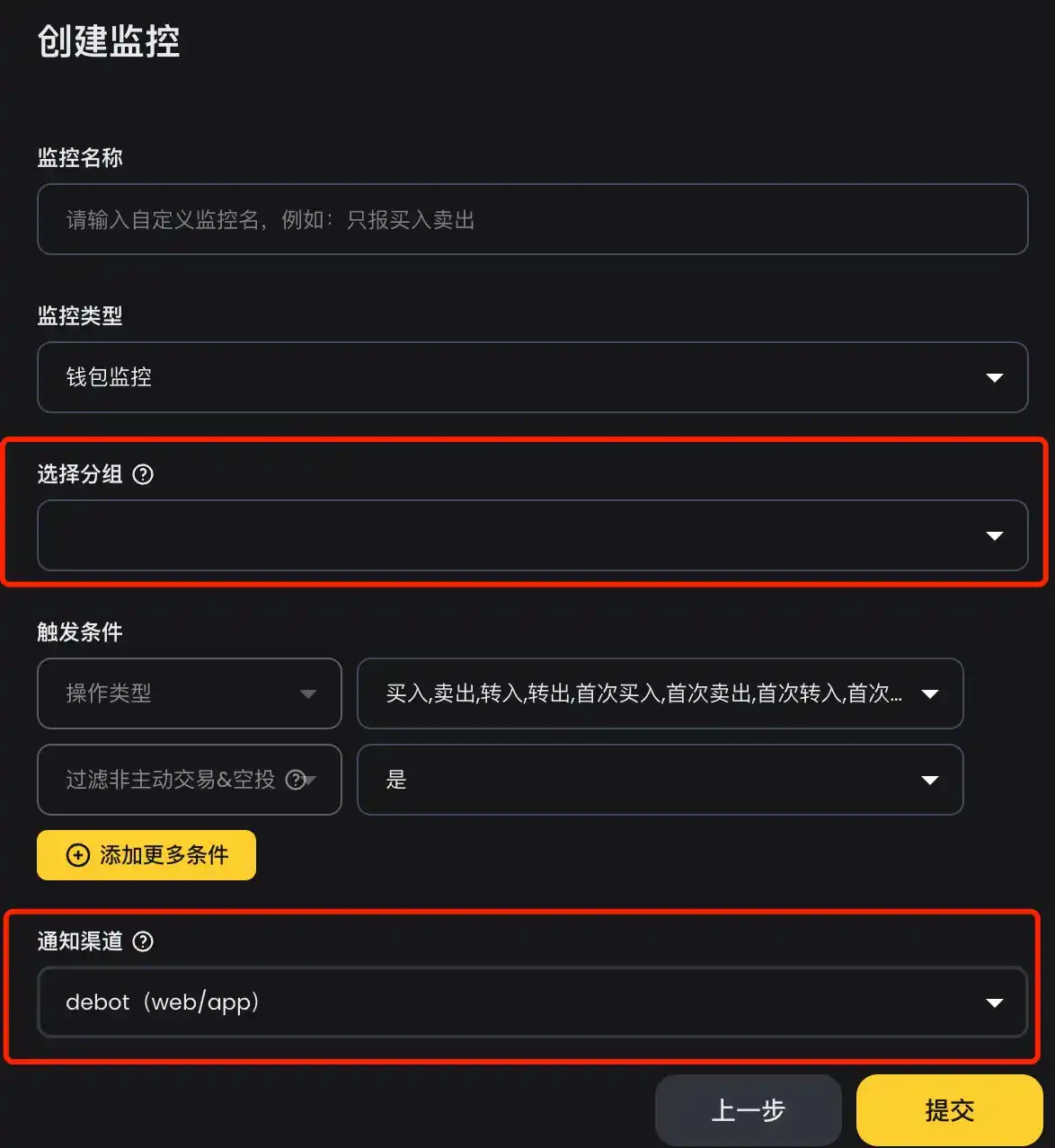
This way, you can establish different Telegram groups for pushing based on the tagging situation, such as on-exchange players, off-exchange players, addresses of particular interest, and more. A tool that can classify monitoring information is a good tool. When I used abot for monitoring in the past, to achieve grouped pushing, I had to tag addresses first, then after the Telegram group received monitoring messages, perform secondary development to further distribute based on the tags. With debot now available, there is no need for secondary development.
2. Wallet Group Behavior Monitoring
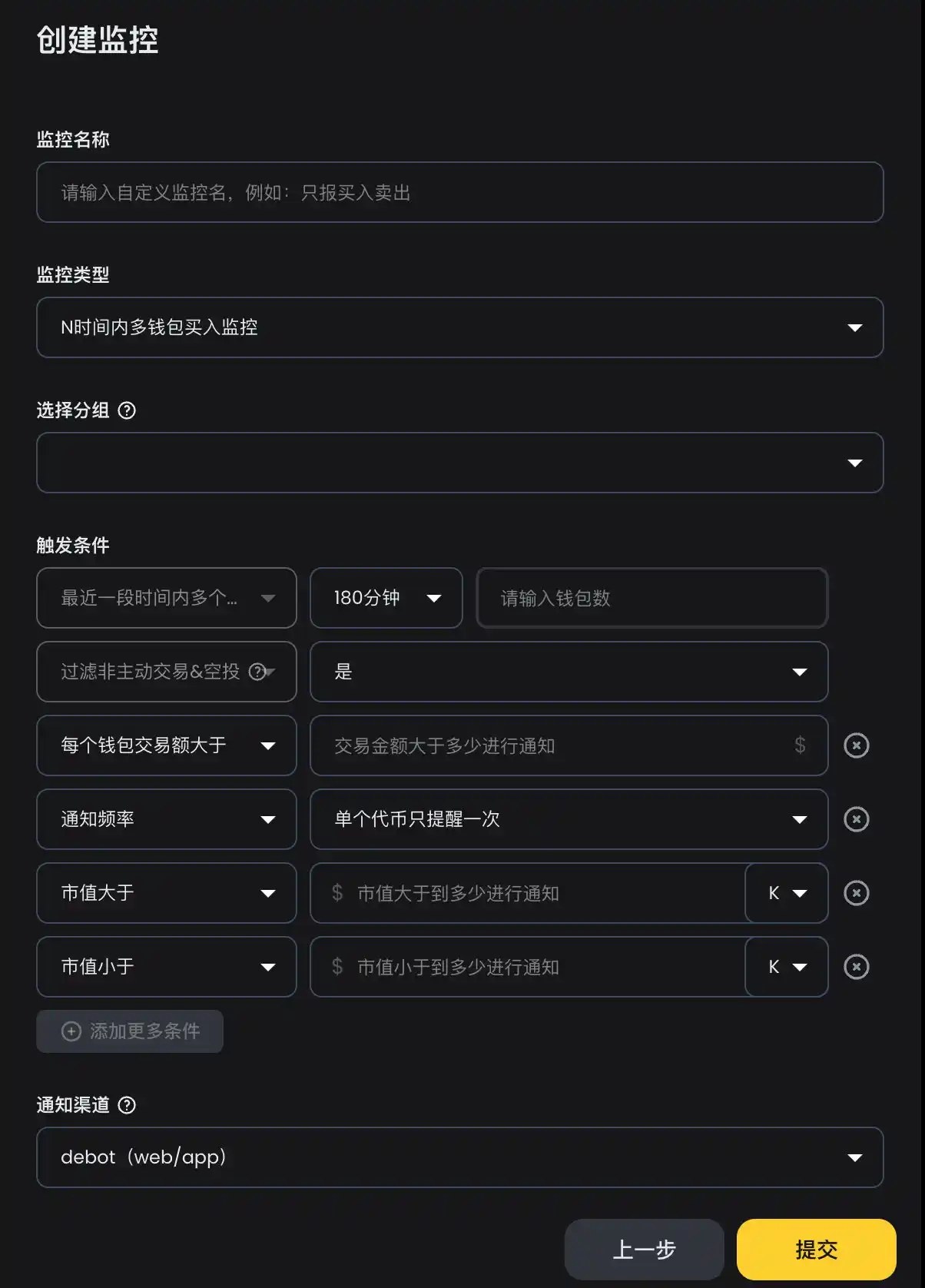
If we are monitoring a large number of addresses, there is an unavoidable issue: too many push notifications. An overload of messages can overwhelm the human brain and lead to message fatigue, causing the monitoring effort to lose its purpose. To address this issue, my previous strategy was to perform secondary development on the push notifications, setting criteria such as pushing a notification only when a certain number of different addresses reach a threshold within a specific time frame, for example, if 5 different addresses make a purchase within 30 minutes. I used this strategy for about a year, and the results were very good as it significantly reduced the number of messages while still capturing important coin movements.
Debot's Wallet Group Behavior Monitoring perfectly implements the strategy I mentioned above, and it is even more refined, with finer indicator granularity as shown in the image. We can monitor buy and sell actions, set monitoring time windows, transaction amounts, notification frequencies, and market cap thresholds. This feature can fully meet various monitoring needs, and I highly recommend it.
3. Grouped Token Transactions and Recent Transactions
After Debot monitors smart money wallets, we can view Grouped Token Transactions and Recent Transactions by group in the Observation Group section. Grouped Token Transactions list all the coins transacted by smart money wallets in this group within a certain time frame, such as the last 24 hours, and can be filtered and sorted by different criteria. This feature is particularly useful when we are not actively monitoring real-time messages about the smart money wallets but want to know which coins these smart money wallets have purchased.
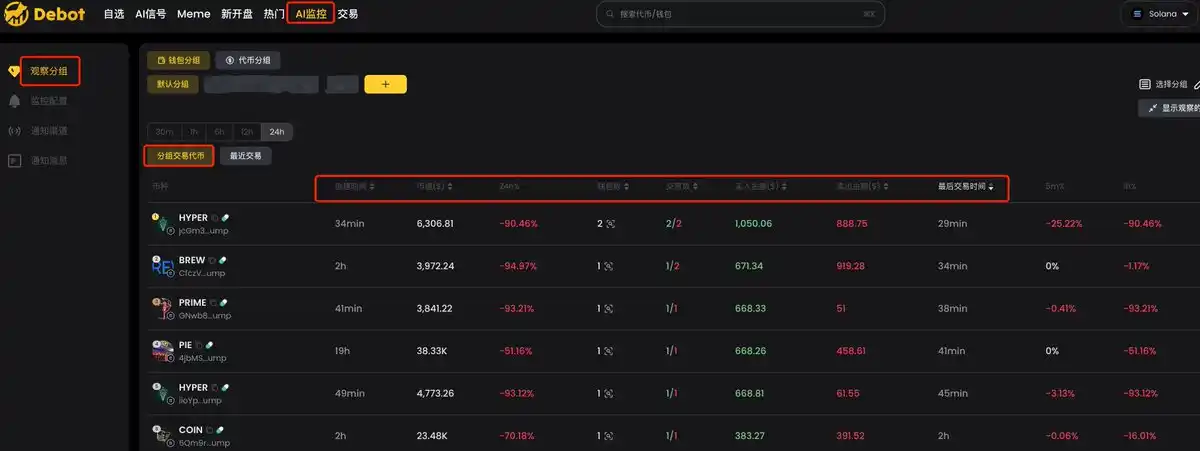
Recent Transactions lists the transaction records of smart money wallets in this group in chronological order.
4. Holdings Details and Transaction Details
After Debot monitors smart money wallets, we can go to the coin's candlestick chart page to see Holdings Details and Transaction Details in the My Observations section. Holdings Details list the data of all smart money wallets that have transacted this coin and can be sorted and filtered by various criteria, making it easy for us to see which smart money wallets have invested in this coin.
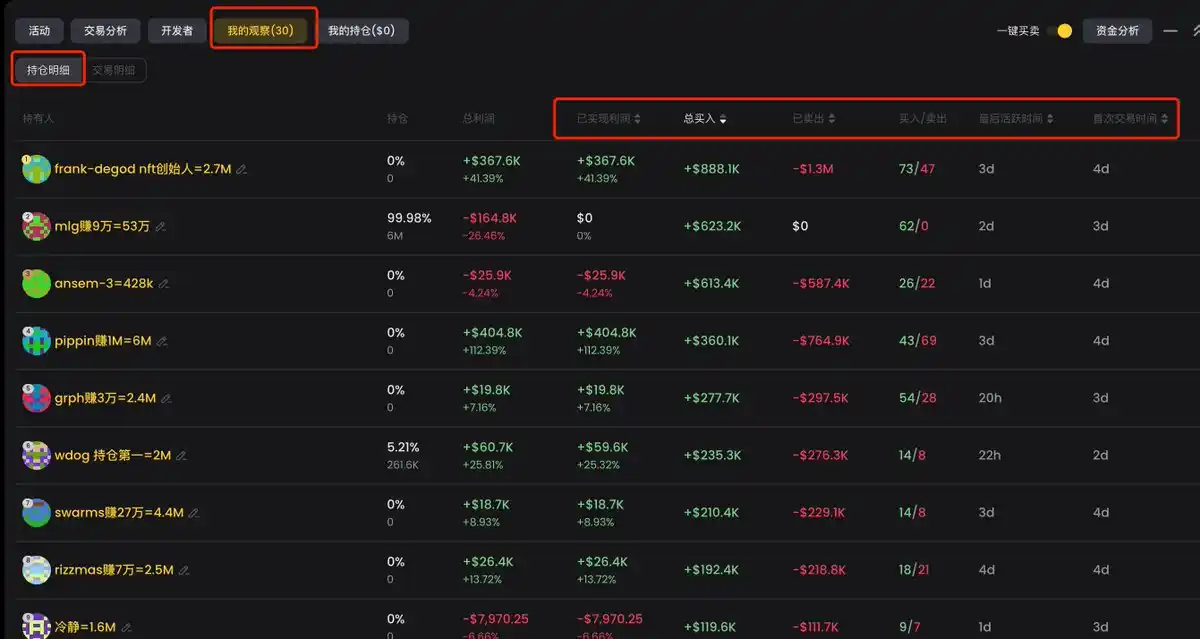
Transaction Details list the transaction records of all smart money wallets for this coin in chronological order, which can be displayed in ascending or descending order. This feature is very practical as it allows us to easily identify which address in our smart money wallets was the first to purchase this coin by sorting in ascending order, with the first transaction being the earliest one.
5. Security Check Tool
The EVM Chain has a major issue with encountering rug pulls, so performing a security check before buying is a necessary operation. The common security check tools are mainly these.
1. goplus
Website: https://gopluslabs.io
goplus is a security check tool that emerged during the last bull market and received investment from Binance Labs. Currently, many tools integrate with goplus's functionality, which can be used through a web version or a plugin. It also provides a security check API externally. If you plan to run strategies using scripts, the API is worth considering.
2. honeypot.is
Website: https://honeypot.is
honeypot.is was quite popular during the last bull market for its accurate security checks. They also offer an API.
3. tokensniffer
Website: https://tokensniffer.com/
tokensniffer is also a well-established security check tool. Due to the various scams and rug pulls on the EVM, it is advisable to use multiple tools together to prevent losses due to issues with a single tool.
VI. Trading
The BSC Chain was very popular during the last bull market. Many of the trading tools used at that time have now become outdated. Fortunately, more trading tools have emerged. Here are some currently popular tools.
1. UniversalX
Website: https://universalx.app
UniversalX is an on-chain CEX that allows trading with balances from all chains. When the account holds assets such as USDT, USDC, ETH, BTC, SOL, trading becomes possible. Currently, it supports regular buy and sell orders, with upcoming features like internal trading and limit orders. The advantage of UniversalX is its chain-agnostic nature. With basic token support, trading of 15 on-chain coins is possible. This is especially useful when other chains lack coins or exchanges have withdrawal issues. Furthermore, UniversalX boasts fast order book and transaction speeds, automatic slippage prevention, and mobile support for convenient trading on smartphones.
Moreover, UniversalX has reduced trading fees for mainstream coins to one-thousandth of a coin, aligning with CEX practices. Supported coins include $AI16Z, $Fartcoin, $ARC, $AIXBT, $TST, and more. Due to the investment from Binance Labs, a token launch is expected this year. Trading on UniversalX is akin to interacting, with expectations of airdrops.
2. debot
Website: https://debot.ai
debot's transactions support the BSC chain, currently supporting basic buy and sell functions, with plans to add anti-slippage features in the future. One benefit of trading with debot is that it can display all pools for the current coin, which is currently the most comprehensive feature provided by debot. This makes it convenient for us to choose different pools for trading. debot has a mobile end for quick and convenient trading.
3. gmgn
Website: https://gmgn.ai/
gmgn has already supported the BSC chain, currently supporting basic buy and sell functions. The advantage of using gmgn is its convenient data analysis feature, with clear display of holders' basic data. gmgn supports mobile end.
4. okx
Website: https://www.okx.com
okx is a major platform that supports basic buy and sell functions. Its advantage lies in multi-platform coverage, supporting web end, plug-in end, and mobile end.
5. PinkPunk
Link: https://t.me/PinkPunkTradingBot
PinkPunk is a well-established Telegram bot that supports multiple chains. Its advantage is that besides basic buy and sell functions, it also supports placing orders and sniping, with relatively fast speed.
If this article is helpful to you, feel free to like, comment, and share
Trading Tools:
The most powerful AI signal trading and monitoring tool debot
https://debot.ai
Trading analysis and more provided by gmgn
https://t.me/gmgnaibot
Alternative trading tool to abot: xxyy
https://pro.xxyy.io
Universal cross-chain trading platform UniversalX
https://universalx.app
You may also like

Morning Report | BitMine increased its holdings by 126,971 ETH last week; trader Eugene announced his exit from the crypto market

Wang Chuan: How can one not feel anxious after the neighbor Old Wang made thirty times profit by investing in storage stocks? (Seven) - A quarter-century cycle

Cryptocurrency CEXs are flocking to sell US stocks, and traditional brokerages are facing an "uninvited guest."

$75 billion in foreign capital has fled, and South Korean retail investors have absorbed it all using leverage

Japan’s Three Megabanks Plan Joint Stablecoin Issuance in Fiscal 2026
MUFG, SMBC, and Mizuho reportedly plan to jointly issue fiat-pegged stablecoins in fiscal 2026, signaling Japan’s growing push into bank-led digital payment infrastructure.

Humanity Discloses H Token Dual-Chain Attack Details, With Losses on Ethereum and BSC Exceeding $36 Million
Humanity said the H token attack across Ethereum and BSC caused more than $36 million in losses after leaked ProxyAdmin keys enabled malicious contract upgrades and token minting.
White House Discusses CLARITY Act With Law Enforcement Ahead of Senate Vote
The White House discussed the CLARITY Act with law enforcement ahead of a Senate vote, focusing on illicit finance risks and developer protections.

Bitcoin Trading Guide 2026: Strategies for Experienced Traders

What Is XAUT and PAXG? Why Tokenized Gold Is Booming in 2026

Will the SpaceX IPO Hurt Bitcoin? Here's What Traders Are Watching

Foreign selling in the South Korean stock market accelerates, with cumulative net sales reportedly reaching $75 billion this year
On June 9, The Kobeissi Letter, citing Goldman Sachs data, reported that global investors are selling South Korean stocks at an unusually rapid pace. In the latest trading session, foreign investors sold about $801 million worth of Kospi constituent stocks again; total foreign outflows last week reached about $10 billion, and the market has been in net foreign selling on nearly every trading day over the past month. According to the data cited in the report, foreign investors have sold about $75 billion worth of South Korean stocks so far this year. Meanwhile, South Korean retail and institutional investors together recorded roughly $69 billion in net buying over the same period, suggesting that the market’s main buying support has come from domestic capital rather than returning overseas funds. The information currently disclosed still mainly comes from The Kobeissi Letter’s retelling and Goldman Sachs data summaries, while public details on the statistical period and the specific definition of “selling” remain relatively limited.

Fortune Warns of Strategy’s Financing Structure Risks as Bitcoin Premium Narrows
Fortune warned that Strategy’s Bitcoin treasury model faces growing financing risks as MSTR’s net asset premium narrows and preferred stock dividend pressure increases.

Ferrari Challenge Le Mans: Carl Moon to Dominate in WEEX Livery

Sahara AI Responds to SAHARA’s Sharp Drop: No Contract or Product Security Issues Found, Internal Investigation Underway
Sahara AI responded to SAHARA’s 60% price drop, saying no token contract or product security issues have been found and an internal investigation is underway.

WEEX Deposit/Withdrawal Dynamic Island: Your Asset Status, Always in Sight
Scaling Crypto Derivatives: The Digital Asset Infrastructure Behind High-Volume Trading
In the fast-moving digital asset ecosystem, derivatives platforms face an extreme architectural test. High-leverage futures markets demand more than just standard security—they require absolute operational precision, zero-latency matching engines, and ironclad structural scalability, all while navigating intense market volatility.
As global platforms scale to meet these demands, the industry is shifting away from rigid, monolithic setups toward a more agile, "decoupled" infrastructure philosophy.
The Blueprint for High-Volume Copy TradingFor elite global exchanges like WEEX (founded in 2018), this architectural choice becomes critical when scaling high-volume retail features like social copy trading. When thousands of users automatically mirror the real-time strategies of elite traders simultaneously, it triggers sudden, monumental spikes in concurrent transactional volume.
To prevent execution latency or settlement bottlenecks during these peak volatility events, a platform's primary engine must remain entirely dedicated to risk management, copy-trade synchronization, and order matching.
The Architectural Rule: New-generation platforms must separate front-end user execution engines from heavy backend infrastructural overhead to eliminate operational friction.
By separating these layers, platforms can maintain complete sovereignty over their trading environments and user experiences while strategically aligning with institutional-grade infrastructure ecosystems. This strategic framework allows modern exchanges to leverage advanced Digital Asset Custody infrastructure such as Cobo’s behind the scenes, ensuring that backend wallet management scales elastically alongside trading spikes.
Capitalizing on Market Momentum and 400× LeverageIn a derivatives arena where platforms offer up to 400× leverage on perpetual contracts, capital efficiency and market agility are core business metrics. To capture market momentum, an exchange needs the ability to rapidly expand its asset offerings, supporting everything from legacy crypto assets to sudden, trending altcoins across a massive library of trading pairs.
Adopting a flexible, scalable Wallet-as-a-Service (WaaS) solution such as Cobo’s could completely rewrite the development timeline for high-growth exchanges. Instead of spending months of engineering capital building out custom backend wallet architectures for every new blockchain network, platforms can deploy localized infrastructure in days.
This agility allows platforms to instantly scale their listings to over a thousand trading pairs without compromising security or delaying time-to-market. It mirrors the exact operational advantages seen during high-velocity market events, similar to how advanced wallet infrastructure empowers platforms during sudden asset surges; allowing exchanges to pass that speed and liquidity directly to their global user base.
A Mature Foundation for GrowthThe synergy between trusted infrastructure ecosystems and global trading platforms represents the natural evolution of a maturing crypto market. As WEEX continues to scale its global spot and derivatives offerings for over 6 million users, adopting robust backend paradigms proves that platforms no longer have to compromise between cutting-edge trading velocity and uncompromised structural security.

Get Paid to Onboard? Try WEEX’s New Homepage with Rewards for Registration, Deposit & Trade
WEEX Custom Layout: Build Your Perfect Trading Workspace in Seconds
Morning Report | BitMine increased its holdings by 126,971 ETH last week; trader Eugene announced his exit from the crypto market
Wang Chuan: How can one not feel anxious after the neighbor Old Wang made thirty times profit by investing in storage stocks? (Seven) - A quarter-century cycle
Cryptocurrency CEXs are flocking to sell US stocks, and traditional brokerages are facing an "uninvited guest."
$75 billion in foreign capital has fled, and South Korean retail investors have absorbed it all using leverage
Japan’s Three Megabanks Plan Joint Stablecoin Issuance in Fiscal 2026
MUFG, SMBC, and Mizuho reportedly plan to jointly issue fiat-pegged stablecoins in fiscal 2026, signaling Japan’s growing push into bank-led digital payment infrastructure.
Humanity Discloses H Token Dual-Chain Attack Details, With Losses on Ethereum and BSC Exceeding $36 Million
Humanity said the H token attack across Ethereum and BSC caused more than $36 million in losses after leaked ProxyAdmin keys enabled malicious contract upgrades and token minting.


